滥用市场支配地位

Search documents
亚马逊就英零售商和消费者诉讼的上诉申请遭拒
Xin Lang Cai Jing· 2026-02-26 11:31
Core Viewpoint - Amazon has lost its attempt to dismiss two large-scale lawsuits totaling £4 billion ($5.41 billion) due to allegations of abusing its dominant market position [1][4]. Group 1: Lawsuit Details - The lawsuits include one filed by competition law scholar Andreas Stephan on behalf of over 200,000 third-party retailers, valued at £2.7 billion [1][4]. - The allegations claim that Amazon manipulates the "Buy Box" feature on its website to benefit itself and favors products using its own logistics and delivery network [1][4]. - A second lawsuit, valued at £1.3 billion, was filed by consumer rights advocate Robert Hammond on behalf of millions of Amazon customers, also accusing Amazon of similar abuses of market power [1][4]. Group 2: Legal Proceedings - Amazon previously stated that these allegations are baseless and argued that the cases should not be certified as part of the litigation process due to flaws in the economic methods used to prove the claims [1][4]. - The Competition Appeal Tribunal certified the two cases last year, meaning that members of the claim group will be part of the case unless they opt out [1][4]. - Amazon's request to appeal this decision was rejected by the appeals court [2][5].

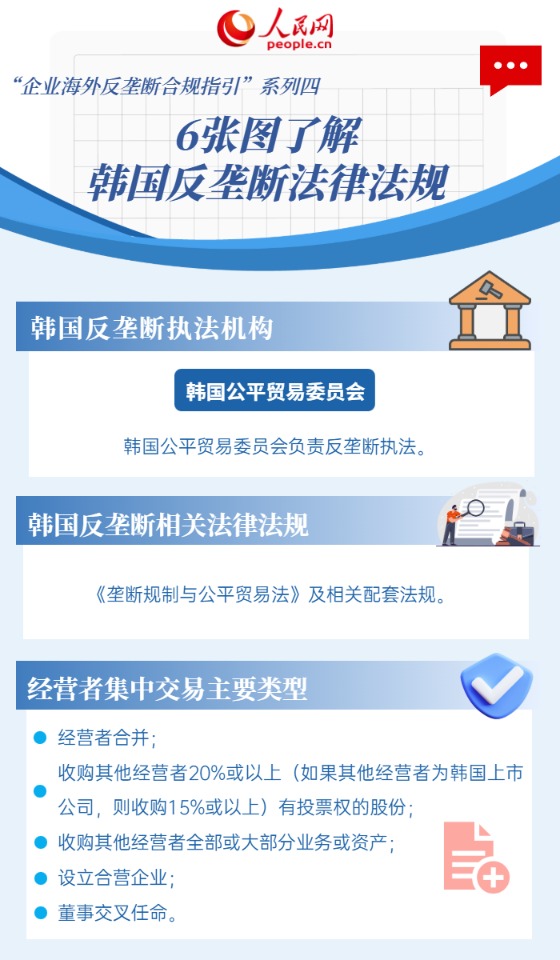
“企业海外反垄断合规指引”系列四 6张图了解韩国反垄断法律法规
Ren Min Wang· 2026-02-12 02:53
Core Viewpoint - The article discusses the accelerated internationalization of Chinese enterprises and the importance of understanding overseas antitrust compliance, highlighting the launch of a series of guidelines by People's Daily in collaboration with the State Administration for Market Regulation [1] Group 1: Antitrust Compliance Guidelines - The guidelines provide insights into foreign antitrust legal systems categorized by country, aimed at assisting business operators in navigating international competition [1] Group 2: Merger Notification Thresholds - A merger must be reported if any participating party has a global asset total or global revenue of 3 trillion Korean Won (approximately 2.3 billion USD) in the previous fiscal year, or if another party has 300 billion Korean Won (approximately 230 million USD) [3] - For transactions involving parties outside Korea, each must have a revenue of at least 300 billion Korean Won in Korea during the previous fiscal year [3] - The transaction amount must reach or exceed 6 trillion Korean Won (approximately 4.6 billion USD) and the target company must conduct substantial business activities in the Korean market [3] Group 3: Merger Review Standards - The Korea Fair Trade Commission evaluates mergers based on multiple factors, including market share, market concentration, and market entry [3] Group 4: Review Timeline - The review period is 30 calendar days from the receipt of the notification by the Korea Fair Trade Commission, extendable by up to 90 days depending on case complexity [3] Group 5: Review Outcomes - Possible outcomes of the merger review include unconditional approval, conditional approval, or prohibition of the merger [4] Group 6: Legal Responsibilities for Non-Compliance - Companies failing to report or implement a merger without approval may face fines up to 100 million Korean Won (approximately 76,000 USD) [4] - Violating conditional approval or prohibition can result in daily fines up to 0.03% of the transaction amount, with a maximum of 200 million Korean Won (approximately 152,000 USD) [4] Group 7: Types of Anticompetitive Agreements - Major types of anticompetitive agreements include price fixing, setting terms of trade, limiting production or supply, and restricting market access [5] Group 8: Legal Penalties for Anticompetitive Behavior - Companies may face administrative fines of up to 20% of the relevant product's revenue during the violation period, with a maximum fine of 4 billion Korean Won (approximately 3 million USD) [6] - Individuals may face up to three years of imprisonment and fines up to 200 million Korean Won (approximately 152,000 USD) [7] Group 9: Abuse of Market Dominance - A company is presumed to have market dominance if it holds a market share of 50% or more, or if the top three companies collectively hold 75% of the market share [9] Group 10: Types of Abusive Conduct - Abusive conduct includes unfair pricing practices, exclusion of competitors, and interference with new market entrants [10][13]

最高法:严格依法规制头部企业掠夺性定价和排他性滥用市场支配地位行为
Zhong Guo Jing Ying Bao· 2026-01-29 04:56
Core Viewpoint - The Supreme People's Court is taking steps to address "involution" competition through judicial measures, focusing on regulating monopolistic behaviors and preventing large enterprises from squeezing the profit margins of small and medium-sized enterprises [1][3]. Group 1: Judicial Measures Against Involution Competition - The Supreme People's Court's Intellectual Property Court aims to explore judicial paths to comprehensively address "involution" competition, emphasizing the need to regulate predatory pricing and other exclusionary practices by dominant firms [1][3]. - The court has identified three main factors contributing to "involution" competition: monopolistic behaviors, insufficient innovation, and unfair competition practices [1]. Group 2: Actions Taken by the Intellectual Property Court - The court has increased the supply of competition rules and case studies, clarifying the boundaries of market behavior, and has published 34 typical cases related to monopolistic and unfair competition since 2021 [2]. - Judicial anti-monopoly efforts have intensified, with 66 cases recognized as monopolistic since the court's establishment, including 15 cases in 2025 [2][4]. - The court is focusing on protecting innovation and promoting high-quality competition by applying measures such as evidence preservation and punitive damages to combat patent infringements [2]. Group 3: Addressing Malicious Competition - The court is targeting malicious competition cycles by strictly regulating unfair competition behaviors, such as stealing trade secrets and organized poaching, to prevent downward competition spirals [2][3]. - In 2025, the court handled several high-profile cases in sectors like platforms, new energy, and pharmaceuticals, encouraging cooperation and innovation among leading enterprises [3]. Group 4: Strengthening Judicial and Administrative Coordination - The court is enhancing the integration of administrative enforcement and judicial adjudication, ensuring that antitrust violations identified in civil lawsuits are reported to enforcement agencies [4]. - Since its establishment, the court has effectively adjudicated 203 antitrust cases, with 66 cases confirmed as monopolistic, covering various sectors including pharmaceuticals, telecommunications, and e-commerce [4].
反垄断调查敲门 携程“舒适圈”到头
BambooWorks· 2026-01-16 09:50
Core Viewpoint - The recent antitrust investigation into Ctrip may force the company to terminate exclusive cooperation agreements and potentially divest its holdings in competitors, marking a significant regulatory action against market dominance in the online travel sector [1][4]. Group 1: Background and Market Position - Ctrip has been a leading player in the online travel industry since its NASDAQ listing in 2003, expanding aggressively through investments and acquisitions over the past decade, controlling over half of the market [2][4]. - The company has maintained a dominant position in the Chinese online travel market, with its hotel booking segment accounting for approximately 44% of its revenue in Q3 [4][8]. - Ctrip's market influence is further amplified by its stakes in major competitors, including a 48% stake in Qunar and a significant investment in Tuniu, which enhances its control over the market [7][8]. Group 2: Regulatory Investigation Details - The State Administration for Market Regulation (SAMR) has initiated an investigation into Ctrip for potential abuse of market dominance, focusing on its hotel booking business [4][5]. - Ctrip has been accused of requiring hotels to sign exclusive or restrictive agreements, leveraging its market power to secure favorable terms and limit competition [4][9]. - The investigation comes after previous antitrust actions against other major players like Alibaba and Meituan, raising questions about why Ctrip has only recently come under scrutiny despite being an early participant in such practices [5][6]. Group 3: Financial Impact and Future Outlook - Following the announcement of the investigation, Ctrip's stock price fell by 22% over four trading days, resulting in a market capitalization loss of approximately $9 billion [7]. - Despite the recent decline, Ctrip's stock has appreciated significantly since its IPO, with a current price of $61.30 reflecting a 54-fold increase from its adjusted IPO price [7]. - The online travel agency market in China was valued at approximately $105 billion last year, with a projected compound annual growth rate of about 15% over the next five years, in which Ctrip controls roughly one-third of the market [7][8]. - Anticipated regulatory outcomes may include substantial fines, potentially exceeding $1 billion, and mandated changes to Ctrip's business practices, which could disrupt its market position and lead to a more competitive landscape in the online travel sector [9].


携程因涉嫌垄断被立案调查 查什么?
Sou Hu Cai Jing· 2026-01-16 02:06
Core Viewpoint - Ctrip is under investigation for suspected monopolistic behavior due to alleged abuse of market dominance, as announced by the State Administration for Market Regulation [3][4] Group 1: Investigation Details - The investigation is based on the Anti-Monopoly Law of the People's Republic of China, focusing on Ctrip's potential misuse of its market position [3][5] - Ctrip's market share is reported to be 56% in the domestic OTA market, significantly higher than its competitors [5] - The investigation does not specify the exact behaviors that led to the inquiry, but it is noted that Ctrip has faced complaints regarding unfair trading conditions and price manipulation [6][7] Group 2: Allegations Against Ctrip - Allegations include imposing unreasonable trading conditions on merchants and engaging in practices like "forced exclusivity" and differential treatment among partners [9] - Ctrip has previously been subject to administrative talks regarding its practices, including forced tool activation for price adjustments without merchant consent [8][10] Group 3: Potential Consequences - If found guilty of monopolistic practices, Ctrip could face fines ranging from 1% to 10% of its previous year's sales, potentially amounting to billions [10][11] - The estimated fine could range from 650 million to 6.5 billion RMB, depending on the severity of the violations [11] - Ctrip may also face civil liability claims from affected hotels and consumers, similar to cases faced by other international OTA platforms [12]

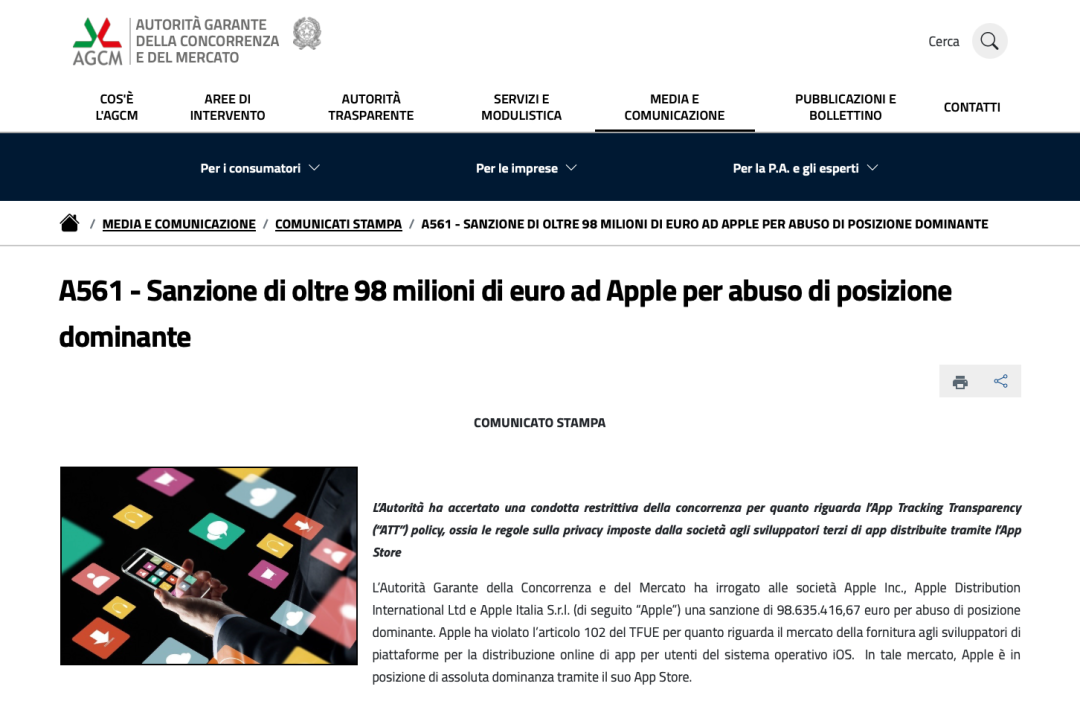
意大利宣布对苹果公司罚款超9800万欧元
Qi Lu Wan Bao· 2025-12-24 10:47
Core Viewpoint - The Italian Competition and Market Authority has imposed a fine of €98.635 million on Apple for abusing its dominant market position, citing violations of EU regulations related to its "App Tracking Transparency" policy [1] Group 1 - The fine was announced on the 22nd and is a result of an investigation that found Apple's policy, implemented since April 2021, restricts competition [1] - Apple strongly opposes the penalty and plans to appeal the decision [1]

苹果被指滥用市场支配地位
Jing Ji Guan Cha Wang· 2025-12-23 09:07
Core Viewpoint - The Italian Competition and Market Authority has fined Apple Inc. €98.635 million (approximately ¥820 million) for abusing its market dominance, specifically related to its "App Tracking Transparency" policy that restricts competition [1] Group 1: Regulatory Actions - The fine was imposed due to Apple's implementation of the "App Tracking Transparency" policy starting from April 2021, which was found to violate EU regulations [1] - The policy requires third-party app developers to obtain explicit user consent through a pop-up before collecting and linking user advertising data, which is deemed non-compliant with privacy regulations [1] Group 2: Impact on Stakeholders - The enforcement of this policy has reportedly harmed the interests of developers, advertisers, and advertising intermediary platforms by forcing developers to repeatedly seek user consent for the same purpose [1] Group 3: Company Response - Apple has strongly opposed the penalty and announced plans to appeal the decision [1]
意大利监管重拳出击:苹果因滥用市场支配地位遭近亿欧元罚款
Sou Hu Cai Jing· 2025-12-23 06:37
Core Viewpoint - The Italian Competition and Market Authority (AGCM) has imposed a significant fine of up to €98.635 million on Apple Inc., Apple Distribution International, and Apple Italy for abusing their dominant market position [1][3] Group 1: Penalty Details - The fine imposed by AGCM amounts to €98.635 million, highlighting the severity of the regulatory action against Apple [1] - The investigation concluded that Apple's App Tracking Transparency (ATT) policy restricts competition within the market [3] Group 2: Policy Impact - Apple's ATT policy, implemented in April 2021, requires third-party app developers to obtain explicit user consent before tracking user data [3] - While the ATT policy emphasizes user privacy protection, it creates barriers for many small developers who rely on data tracking for service optimization and targeted marketing, thus affecting fair competition in the app market [3]
意大利以滥用市场支配地位对苹果罚款超9800万欧元
Xin Hua She· 2025-12-23 03:49
Group 1 - The Italian Competition and Market Authority imposed a fine of €98.635 million on Apple for abusing its market dominance [1] - The investigation revealed that Apple's "App Tracking Transparency" policy, implemented since April 2021, restricts competition and violates EU regulations [1] - The policy requires third-party app developers to obtain explicit user consent through a pop-up, which does not comply with privacy regulations, forcing developers to repeatedly seek consent and undermining their advertising models [1] Group 2 - Apple strongly opposes the penalty and plans to appeal the decision [1]
苹果 被罚超8亿!
Zhong Guo Ji Jin Bao· 2025-12-22 11:49
Core Viewpoint - Apple Inc. has been fined over €98 million by the Italian Competition and Market Authority for allegedly abusing its market dominance through its App Tracking Transparency (ATT) policy, which is seen as limiting competition [1][3][4]. Group 1: Fine Details - The fine imposed on Apple amounts to €98,635,416.67, approximately 814 million yuan [4]. - Apple has expressed strong opposition to the decision and plans to appeal [1]. Group 2: Competition Concerns - The Italian Competition and Market Authority found that Apple's ATT policy, implemented since April 2021, restricts competition by requiring third-party app developers to obtain user consent through a pop-up that does not comply with privacy regulations [3][4]. - The requirement for double consent for data collection is deemed disproportionate and detrimental to developers, advertisers, and intermediary platforms [4]. Group 3: Global Regulatory Actions - Apple has faced multiple fines this year related to its iOS ecosystem and App Store rules, including a €150 million fine from France and a €500 million fine from the European Commission [5]. - Investigations into Apple's ATT policy are ongoing in Germany and Romania, with potential penalties in Poland reaching up to 10% of Apple's annual revenue if violations are confirmed [5][6]. Group 4: Apple's Position - Apple claims that the ATT policy is designed to empower consumers by allowing them to choose whether to permit tracking, thereby enhancing personal privacy [7]. - The company argues that the backlash from the data tracking industry against its efforts to give users control over their data is expected and warns that pressure could lead to the removal of this feature, harming consumer rights [8].