不正当竞争

Search documents
永辉,炮轰山姆
阿尔法工场研究院· 2026-03-18 04:28
Core Viewpoint - The article discusses a supply chain battle in the Chinese retail industry, highlighting a public letter from Yonghui Supermarket to Sam's Club, criticizing the latter's alleged "choose one of two" practices with suppliers, which Yonghui claims undermines fair competition [4][6][30]. Group 1: Yonghui's Position - Yonghui Supermarket's public letter to Sam's Club is a bold move, marking a shift from its usual humble approach to a more aggressive stance, emphasizing the need for fair supplier practices [4][6]. - Yonghui is undergoing a transformation, shifting its focus from "traffic" to "quality," aiming to establish a strong supply chain to support its new brand identity, "Quality Yonghui" [13][28]. - The company is facing significant financial challenges, with projected losses of 2.14 billion yuan in 2025, marking its fifth consecutive year of losses [12][28]. Group 2: Sam's Club's Strengths - Sam's Club is thriving in the Chinese retail market, with projected sales exceeding 140 billion yuan by 2025, reflecting a growth rate of approximately 40% [8]. - The core competitive advantage of Sam's Club lies in its robust supply chain, which has enabled the successful development of its private label, Member's Mark, accounting for over 20% of total sales [8][9]. - Sam's Club's business model focuses on global sourcing and stringent quality control, fostering strong partnerships with suppliers to create in-demand products [9]. Group 3: Industry Dynamics - The article highlights the competitive landscape in the Chinese retail sector, where companies with superior supply chains dominate the market, while quality supply chains remain scarce [25][26]. - The ongoing struggle for suppliers between major players like Yonghui and Sam's Club illustrates the intense competition and the challenges faced by retailers in securing quality products [30][32]. - The concept of "choose one of two" is debated, with some suppliers denying any restrictions imposed by Sam's Club, indicating a complex relationship between retailers and suppliers [15][19].


永辉超市喊话山姆:不要让供应商“二选一”
21世纪经济报道· 2026-03-16 12:55
Core Viewpoint - The letter from Yonghui Supermarket's private brand "Quality Yonghui" emphasizes the importance of fair competition and calls on Sam's Club to refrain from forcing suppliers into a "choose one" scenario, advocating for a focus on quality and ethical business practices [1][4]. Group 1: Quality Improvement - The company aims to enhance product quality by selecting superior raw materials, employing scientific formulas, utilizing advanced processes, and improving design and packaging aesthetics [5]. - Transparency in ingredient usage is a priority, with the company committing to publish ingredient lists and additive usage annually, urging Sam's Club to adopt similar standards for safer and healthier products [6]. Group 2: Pricing Strategy - The fundamental principle of private brands is to win customers through exceptional quality-to-price ratios, emphasizing that for the same quality, price should be the determining factor, and for the same price, quality should prevail [7]. Group 3: Employee Development - Employees are viewed as essential partners in the private brand's success, with a focus on providing reasonable salaries, ample vacation, professional training, and a supportive work environment, while maintaining strict ethical standards [8].
市场监管总局公布4起直播电商领域典型案例 成都快购被罚超2600万
证券时报· 2026-01-30 13:07
Core Viewpoint - The article discusses the recent enforcement actions taken by the State Administration for Market Regulation (SAMR) against various companies in the live e-commerce sector for violations of laws and regulations related to e-commerce, advertising, and consumer protection [2][5][6][8]. Group 1: Enforcement Actions - SAMR investigated Chengdu Kuai Gou Technology Co., Ltd. for multiple violations, including failure to fulfill information disclosure obligations, charging unreasonable fees to platform operators, and not ensuring consumer safety [2][3][4]. - The company was fined 26,692,904.62 yuan and ordered to rectify its illegal practices [4]. - Fourhui City Market Supervision Bureau penalized Fourhui City Wande Li Jewelry Store for false advertising during live broadcasts, resulting in a fine of 500,000 yuan [5]. - Shanghai Yangpu District Market Supervision Bureau fined Shanghai Laotangyou Health Technology Development Co., Ltd. 350,000 yuan for false claims about a health product's efficacy [6][7]. - Tongliao City Market Supervision Bureau fined Tongliao Hongrenhui Media Co., Ltd. 400,000 yuan for fabricating transaction data and misleading advertising practices [8]. Group 2: Violations Identified - Chengdu Kuai Gou Technology Co., Ltd. was found to have not displayed necessary business licenses and agreements prominently, charged excessive penalties, and failed to act against intellectual property infringements [2][3][4]. - The company also published misleading advertisements and assisted other operators in deceptive marketing practices [3][4]. - Fourhui City Wande Li Jewelry Store's live broadcasts included false claims about the health benefits of their products, misleading consumers about their efficacy [5]. - Shanghai Laotangyou Health Technology Development Co., Ltd. promoted a health product without scientific backing for its claimed benefits, constituting false advertising [6][7]. - Tongliao Hongrenhui Media Co., Ltd. engaged in practices such as fake transactions to inflate sales figures, misleading consumers about product availability [8].

最高法:严格依法规制头部企业掠夺性定价和排他性滥用市场支配地位行为
Zhong Guo Jing Ying Bao· 2026-01-29 04:56
Core Viewpoint - The Supreme People's Court is taking steps to address "involution" competition through judicial measures, focusing on regulating monopolistic behaviors and preventing large enterprises from squeezing the profit margins of small and medium-sized enterprises [1][3]. Group 1: Judicial Measures Against Involution Competition - The Supreme People's Court's Intellectual Property Court aims to explore judicial paths to comprehensively address "involution" competition, emphasizing the need to regulate predatory pricing and other exclusionary practices by dominant firms [1][3]. - The court has identified three main factors contributing to "involution" competition: monopolistic behaviors, insufficient innovation, and unfair competition practices [1]. Group 2: Actions Taken by the Intellectual Property Court - The court has increased the supply of competition rules and case studies, clarifying the boundaries of market behavior, and has published 34 typical cases related to monopolistic and unfair competition since 2021 [2]. - Judicial anti-monopoly efforts have intensified, with 66 cases recognized as monopolistic since the court's establishment, including 15 cases in 2025 [2][4]. - The court is focusing on protecting innovation and promoting high-quality competition by applying measures such as evidence preservation and punitive damages to combat patent infringements [2]. Group 3: Addressing Malicious Competition - The court is targeting malicious competition cycles by strictly regulating unfair competition behaviors, such as stealing trade secrets and organized poaching, to prevent downward competition spirals [2][3]. - In 2025, the court handled several high-profile cases in sectors like platforms, new energy, and pharmaceuticals, encouraging cooperation and innovation among leading enterprises [3]. Group 4: Strengthening Judicial and Administrative Coordination - The court is enhancing the integration of administrative enforcement and judicial adjudication, ensuring that antitrust violations identified in civil lawsuits are reported to enforcement agencies [4]. - Since its establishment, the court has effectively adjudicated 203 antitrust cases, with 66 cases confirmed as monopolistic, covering various sectors including pharmaceuticals, telecommunications, and e-commerce [4].
最高法:重点打击有计划有组织“挖人”等不正当竞争行为
2 1 Shi Ji Jing Ji Bao Dao· 2026-01-28 15:25
Core Viewpoint - The Supreme People's Court emphasizes the need to address "involution" competition in the national unified market, highlighting the importance of strict regulation against monopolistic behaviors and unfair competition practices [1] Group 1: Judicial Actions and Regulations - The People's Court has intensified judicial anti-monopoly efforts, focusing on regulating monopolistic behaviors [1] - There is a strict crackdown on unfair competition practices, particularly those involving the theft, inducement, coercion, and organized "poaching" of trade secrets [1] - The aim is to disrupt the vicious cycle of "downward competition" caused by unfair competition, establishing a baseline for fair competition [1] Group 2: Industry Focus and Impact - In 2025, the court successfully handled several high-profile lawsuits involving leading companies in sectors such as platforms, new energy, and pharmaceuticals [1] - The court's actions are intended to guide companies towards collaboration for development and innovation to escape the pitfalls of vicious competition, thereby fostering a healthier market ecosystem [1]
思看科技(杭州)股份有限公司 关于公司涉及诉讼的公告
Zhong Guo Zheng Quan Bao - Zhong Zheng Wang· 2026-01-27 23:45
Core Viewpoint - The company, Sikan Technology (Hangzhou) Co., Ltd., is currently involved in a lawsuit initiated by Hangzhou Qiyuan Visual Technology Co., Ltd. over allegations of unfair competition, with the claimed amount being 10.04 million RMB [2][3][5]. Group 1: Lawsuit Details - The lawsuit has been filed in the Hangzhou Intermediate People's Court, and the case has been officially registered but has not yet gone to trial [2][5]. - The plaintiff, Hangzhou Qiyuan, claims that Sikan Technology has engaged in unfair competition by attempting to gain an improper competitive advantage and obstructing Qiyuan's business opportunities [7]. - The plaintiff's demands include an immediate cessation of alleged unfair competition, removal of unauthorized video materials, a public statement to mitigate negative impacts, and compensation totaling 10.04 million RMB [7]. Group 2: Company Response and Legal Actions - The company has stated that it does not recognize the plaintiff's claims and will actively defend its legal rights [9][10]. - Prior to receiving the lawsuit notification, the company had already taken legal actions against Qiyuan, including patent litigation, trademark infringement, and protection of trade secrets [3][8]. - The company is also pursuing arbitration against former employees for violating non-compete agreements, with some cases already resulting in favorable rulings for the company [8].
思看科技:被诉1004万元不正当竞争
Xin Lang Cai Jing· 2026-01-27 09:55
Core Viewpoint - The company, Sikan Technology, is facing a lawsuit from Hangzhou Qiyuan Vision Technology Co., Ltd. for unfair competition, with the claimed amount of 10.04 million yuan [1] Group 1 - The plaintiff alleges that Sikan Technology engaged in unfair competition practices to gain an improper advantage [1] - The lawsuit requests the defendant to immediately cease the unfair competition activities and delete illegally recorded video materials [1] - The economic damages claimed by the plaintiff amount to 10 million yuan, along with reasonable legal expenses of 40,000 yuan [1]
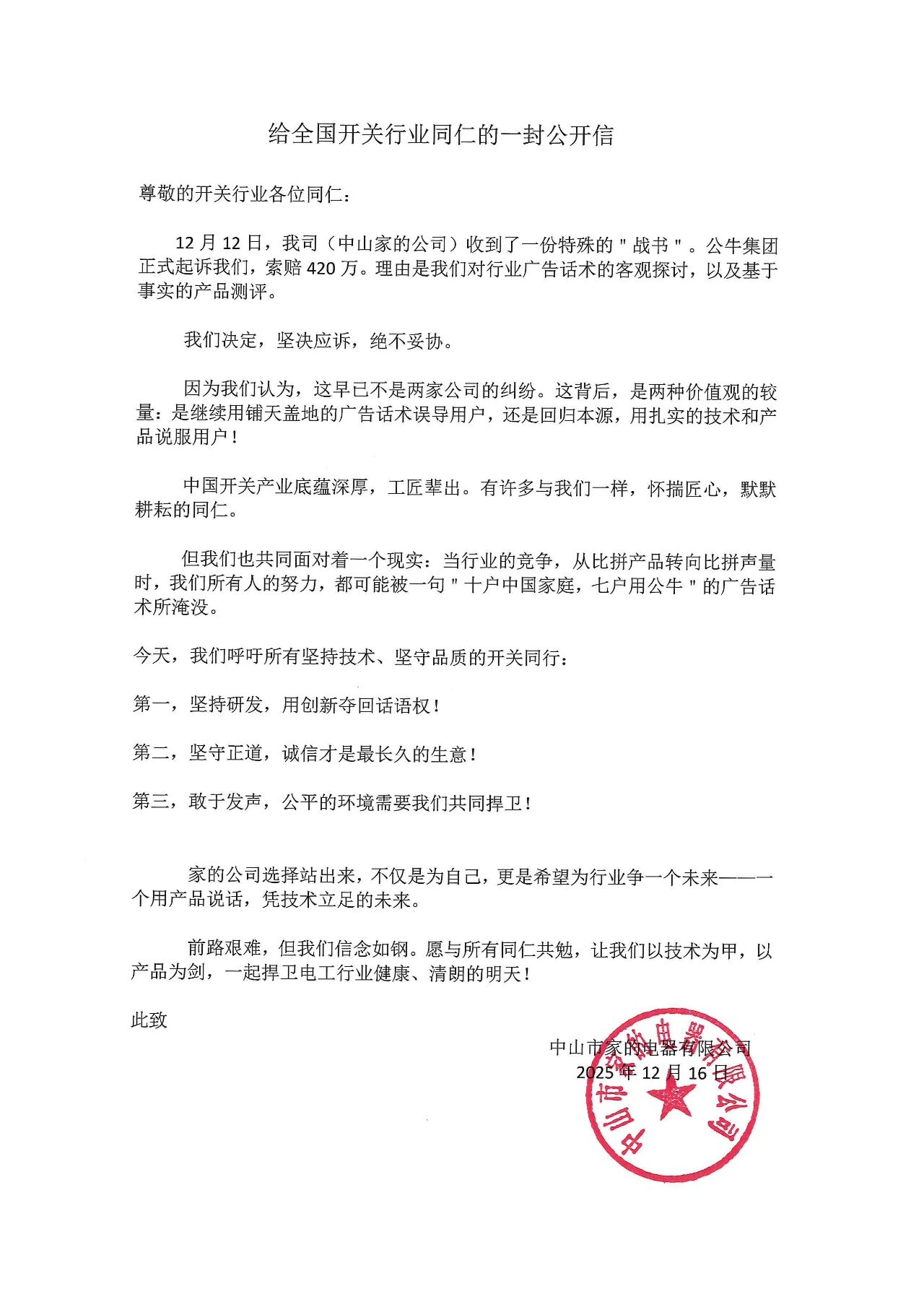
公牛集团起诉家的电器索赔420万遭反诉 年投7.55亿营销曾因垄断被罚2.95亿
Chang Jiang Shang Bao· 2026-01-26 00:50
Core Viewpoint - The ongoing legal dispute between Bull Group and Jia's Electric revolves around the advertising slogan "7 out of 10 Chinese families use Bull," which is claimed to be misleading and has led to accusations of false advertising and unfair competition [1][5][6]. Group 1: Legal Dispute - Jia's Electric has raised jurisdictional objections to Bull Group's lawsuit and has countered with claims of false advertising and unfair competition [1][5]. - Bull Group has accused Jia's Electric of damaging its reputation through misleading comparisons and has demanded the removal of the videos and an apology [5][6]. - The legal battle is seen as a clash of values between misleading advertising and a commitment to fair competition and consumer rights [6]. Group 2: Financial Performance - Bull Group's financial performance has been under pressure, with a notable decline in revenue and net profit in the second and third quarters of 2025, marking a rare double decline [3][11]. - For the first three quarters of 2025, Bull Group reported revenues of 12.198 billion and a net profit of 2.979 billion, representing year-on-year declines of 3.22% and 8.72% respectively [11]. - The company's marketing expenses for 2024 totaled 755 million, contributing to a total sales expense of 1.369 billion [2][11]. Group 3: Market Position and Stock Performance - Since January 13, 2021, Bull Group's stock price has dropped by over 50%, reflecting a significant decline in market valuation [4][11]. - The company's market capitalization has decreased from a peak of 153.594 billion to 76.55 billion by January 23, 2026, less than half of its highest value [11]. - Bull Group has faced previous legal challenges, including a 2.95 billion fine for monopolistic practices in 2021, highlighting ongoing regulatory scrutiny [9][10].

几块钱“租”视频VIP账号“租号”卖家被判赔31万
Xin Lang Cai Jing· 2026-01-25 23:27
Core Viewpoint - The case highlights the legal implications of renting video platform VIP accounts, which constitutes unfair competition and violates the Anti-Unfair Competition Law of the People's Republic of China [1][2]. Group 1: Case Summary - A Beijing court ruled that a seller, Hu, must compensate an electronic product company 310,000 yuan for renting out video VIP accounts without permission, which undermined the company's pricing structure and business model [1]. - The plaintiff, an operator of a video terminal device, relies on VIP membership fees as a primary revenue source, which was directly threatened by Hu's rental activities [1]. Group 2: Legal Implications - The court determined that Hu's actions created substantial competition with the plaintiff, despite not being a direct competitor, by targeting the same core consumer group [1]. - The judge emphasized that any new business model must comply with legal standards to avoid harming others' legitimate rights and disrupting fair market order, indicating clear legal risks associated with account rental practices [2].
吐槽公牛集团广告语被起诉索赔420万,家的电器已提起反诉
Xin Lang Cai Jing· 2026-01-23 01:15
Group 1 - The core issue revolves around a legal dispute between Bull Group and Jia's Electric, with Bull Group suing for 4.2 million yuan over alleged misleading advertising claims [1][4] - Jia's Electric held a media conference to address accusations of "hitching a ride on traffic," asserting that their intentions were to maintain fair competition and consumer rights, rather than to create hype [1] - Jia's Electric's legal counsel indicated that they have raised jurisdictional objections to Bull Group's lawsuit, which is currently under review, and have filed a separate lawsuit alleging compliance issues with Bull Group's advertising [1] Group 2 - Jia's Electric's public letter to industry peers described the lawsuit as a clash of values, emphasizing the choice between misleading advertising and relying on solid technology and products to win over consumers [4] - Bull Group defended its advertising slogan, stating it is backed by rigorous third-party research and complies with Chinese advertising laws, while expressing a commitment to consumer feedback and ongoing optimization of their messaging [4] - Jia's Electric was founded in March 2007 with a registered capital of 30 million yuan, focusing on the production and sale of lighting fixtures, electrical switches, sockets, and home appliances [4]