
焦虑营销

Search documents
私护营销不该踩着女性焦虑牟利
Xin Jing Bao· 2026-02-06 10:05
Core Viewpoint - The article highlights the exploitation of women's insecurities by some companies in the female intimate care market, which has turned a sector meant for women's health and empowerment into a space of anxiety and misinformation [1][2]. Group 1: Industry Issues - Some female intimate care products exaggerate concerns about women's private areas, using terms that belittle women and create unnecessary anxiety [1]. - The marketing strategies employed by certain businesses involve misleading claims about product efficacy, such as falsely advertising the ability to treat gynecological conditions [2]. - The private care economy, initially a response to women's health awareness, is being undermined by unethical marketing practices that objectify women [1][2]. Group 2: Consumer Impact - Many doctors have clarified that excessive use of intimate care products can disrupt the natural balance of the vaginal environment, leading to health issues [2]. - The rise of "intimate aesthetic" procedures has created a new form of anxiety among women, who feel pressured to conform to unrealistic beauty standards [2]. - Marketing tactics link intimate procedures to emotional well-being and relationship stability, further intensifying women's insecurities and driving them towards unnecessary consumption [2]. Group 3: Regulatory and Ethical Considerations - There is a call for stricter regulations and oversight in the industry to eliminate unethical practices and ensure consumer safety [3]. - Companies, especially leading ones, are urged to abandon anxiety-driven marketing and focus on product development and service improvement to genuinely support women's health [2][3]. - The article emphasizes the need for a cultural shift where women can reject imposed beauty standards and embrace their natural selves, which would undermine the exploitative practices of certain companies [4].
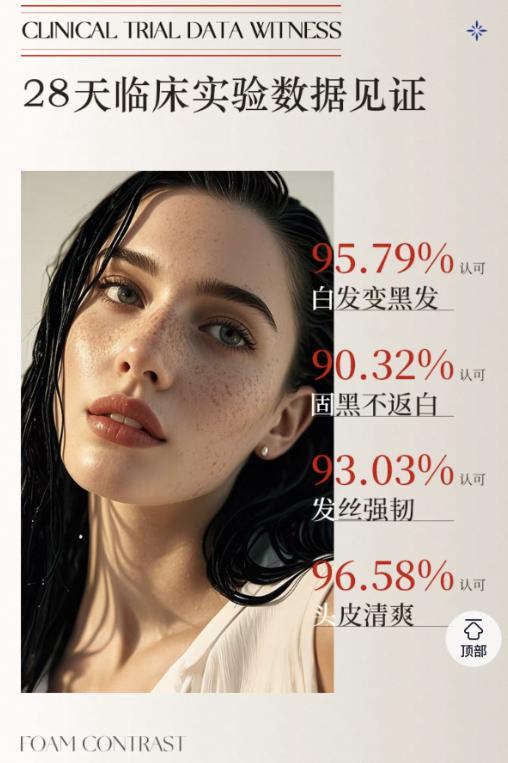
洗发水“白发洗黑”是假,收“智商税”是真
Xin Jing Bao· 2026-01-27 11:41
Core Viewpoint - The rise of products claiming to turn white hair black is exploiting consumer anxiety, particularly among younger individuals experiencing premature graying, through misleading marketing tactics [2][3]. Group 1: Product Claims and Marketing Tactics - Numerous non-dye shampoos are marketed as capable of turning white hair black, often accompanied by dubious claims of effectiveness based on "real person" test data [2]. - The marketing language targets the emotional concerns of consumers regarding aging, creating a sense of urgency and desire to purchase these products [2]. - Despite the bold claims, experts assert that once hair emerges from the follicle, its color is fixed and cannot be altered by external treatments, with the only true method being dyeing [3]. Group 2: Regulatory and Ethical Concerns - Companies are aware of the misleading nature of their claims, as evidenced by the actual product registrations that only list basic functions like "cleansing" and "moisturizing," without any mention of hair color change [3]. - There is a clear conflict between product labeling and marketing claims, which raises issues of false advertising and potential violations of consumer rights [3]. - Regulatory frameworks, such as the Cosmetics Supervision and Administration Regulations, require truthful advertising and accurate labeling, yet these products appear to violate these standards [3][4]. Group 3: Impact on Market and Consumer Trust - The proliferation of such deceptive marketing practices undermines market order and harms consumer interests, necessitating stronger regulatory enforcement to protect consumers [4]. - The reliance on contract manufacturing for these products allows companies to distance themselves from the misleading marketing, further complicating accountability [3].

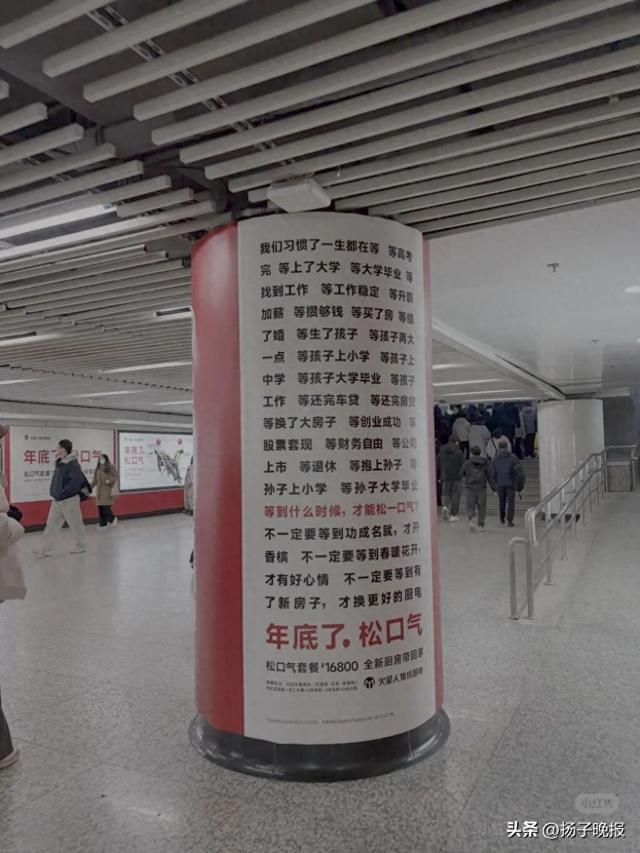
“等到什么时候,才能松一口气?”地铁站内“松口气套餐”厨电广告被质疑贩卖焦虑,相关内容已撤下
Xin Lang Cai Jing· 2026-01-10 15:25
Core Viewpoint - A recent kitchen appliance advertisement in Shanghai's subway has sparked online debate, with some viewers criticizing it as a "anxiety vending machine" for promoting bundled consumption through the concept of waiting for life milestones [1][4]. Group 1: Advertisement Details - The advertisement featured a white background with black text, prominently displaying phrases about waiting for various life events, concluding with "At the end of the year, take a breath" and promoting a "Breath Easy Package" priced at ¥16,800 for a new kitchen [4][5]. - The ad was strategically placed in a high-traffic area of the subway, which contributed to its visibility and subsequent discussions on social media [4]. Group 2: Public Reaction - The advertisement received mixed reactions from the public; some users felt it was exploiting anxiety, while others viewed it as a motivational reminder to take action in life [4][3]. - Following the backlash and discussions online, the advertising company decided to withdraw the ad on January 9 [1].
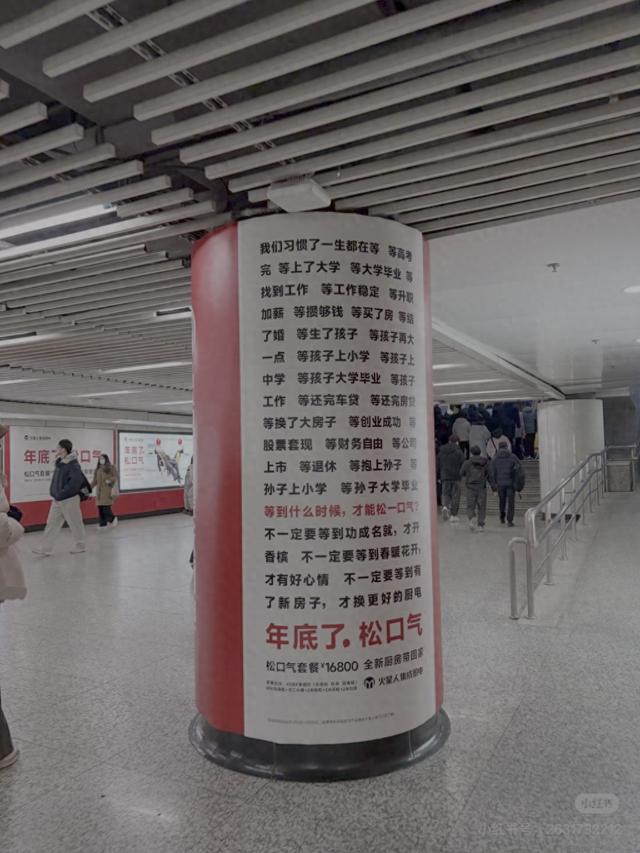
地铁站内“松口气套餐”厨电广告引争议,相关内容已撤下
Xin Lang Cai Jing· 2026-01-10 14:20
Core Viewpoint - A recent kitchen appliance advertisement in Shanghai's Xujiahui subway station sparked significant online discussion, with some netizens criticizing it as a "anxiety-selling machine" due to its focus on life milestones and waiting periods [1][4] Group 1: Advertisement Details - The advertisement featured a striking white background with black text, highlighting various life events such as "waiting for a job," "waiting to have children," and "waiting to pay off a mortgage," ultimately promoting a kitchen package priced at ¥16,800 [3][6] - The ad was launched on January 8 and was quickly removed on January 9 after the company received feedback from passengers and noticed online discussions [6][8] Group 2: Public Reaction - The advertisement generated mixed reactions online, with some users feeling it was a form of anxiety exploitation, while others viewed it as a motivational reminder to take action in life [4][8] - The advertising company, Dega Advertising (Shanghai) Co., acknowledged the emotional intensity of the ad's content and the potential for varied interpretations, leading to its prompt removal and plans for a revised version [8]
千元童鞋背后的中产焦虑:泰兰尼斯的高价博弈
Xin Lang Zheng Quan· 2025-10-24 09:57
Core Insights - The article discusses the high-priced children's shoes from the brand 泰兰尼斯, which are marketed using technology narratives and anxiety marketing to appeal to a new generation of parents [1] - 泰兰尼斯 has sold over 6 million pairs of children's shoes in 2024, achieving an annual revenue exceeding 3 billion yuan, with a year-on-year growth of over 50% [1] Pricing Strategy - 泰兰尼斯's main product line, the "稳稳鞋" series, is priced between 500-1500 yuan, with popular models concentrated in the 600-800 yuan range, while the newly launched "稳跑鞋" is priced at 1499 yuan, double that of similar Nike children's shoes [2] - The pricing strategy is notably higher than mainstream brands like 基诺浦 and 江博士, which typically range from 150-300 yuan [2] - Founder 丁飞 revealed that over 80% of transactions occur within the 300-600 yuan range, still significantly above the market average [2] Marketing Strategy - 泰兰尼斯 has invested heavily in marketing since 2022, partnering with 分众传媒 for extensive advertising across over 100 cities, resulting in over 9.33 billion exposures through elevator media [3][4] - The brand's marketing strategy has effectively increased brand recognition, even among those without children [4] Technology Narrative - To justify its high prices, 泰兰尼斯 has developed a comprehensive technology narrative, featuring imported materials and specialized designs for its shoes [5] - The "稳稳鞋" incorporates an Italian Vibram anti-slip sole and a multi-density support sole tailored for toddlers, while the "稳跑鞋" includes advanced protective technologies [5] Quality Concerns - The application of carbon plate technology in children's shoes has raised concerns among medical experts regarding potential impacts on children's foot development [6] - Consumer feedback on social media indicates dissatisfaction with the anti-slip performance of 泰兰尼斯 shoes, leading to over 500 complaints regarding product quality and after-sales service [7] Business Model - 泰兰尼斯 employs a "six-stage system" to categorize children aged 0-16, offering products tailored to each developmental stage, achieving a high repurchase rate of 80-90% [8] - The company maintains a consistent pricing strategy across online and offline channels, with over 1000 stores globally, 80% of which are self-operated [9] Market Dynamics - 泰兰尼斯's high pricing strategy is being tested in a declining birth rate environment, with newborn numbers in China dropping from 18.83 million in 2016 to 9.54 million in 2024 [10] - Market trends indicate a shift towards more affordable children's shoe brands, with a noticeable increase in market share for brands priced between 100-200 yuan [10] - Sales data from platforms like 天猫 and 淘宝 show a decline in 泰兰尼斯's sales, while competitors with better cost-performance ratios are experiencing growth [10]
以骂游戏之名卖课,套路满满的生意帮不了孩子
Xin Jing Bao· 2025-07-22 09:35
Core Viewpoint - The rise of the "anti-gaming industry" is driven by influencers who criticize video games while promoting expensive educational courses, exploiting parental anxiety about children's gaming habits [1][2][4]. Group 1: Anti-Gaming Industry - The "anti-gaming industry" is characterized by influencers linking gaming to negative behaviors, capturing parental attention, and directing children to addiction treatment programs, forming a significant part of the current ecosystem [2][3]. - The industry has grown into a substantial market, with estimates suggesting that by 2025, the total scale of the anti-gaming industry, including addiction schools and training camps, could exceed 70 billion yuan [2]. Group 2: Parental Responsibility and Systemic Issues - Addressing youth gaming addiction requires a comprehensive approach, including parental supervision and educational responsibilities, rather than relying solely on regulations or measures from gaming platforms [3][5]. - Parents often face challenges in monitoring their children's gaming due to work commitments and other responsibilities, leading to a collective anxiety that the anti-gaming content exploits [3][4]. Group 3: Marketing Tactics and Consumer Awareness - The marketing strategies employed by influencers involve creating emotional distress among parents, leading them to invest in high-priced educational courses that often yield little to no results [4]. - Parents are encouraged to critically evaluate these marketing tactics and recognize the underlying psychological issues related to gaming addiction, promoting a more balanced approach to managing their children's gaming interests [5].