
科技叙事

Search documents
——十四届全国人大四次会议经济主题记者会学习心得:信心铿锵,专注落实,坚定看好证券行业中长期经营发展空间
Shenwan Hongyuan Securities· 2026-03-08 12:55
Investment Rating - The report maintains a positive outlook on the securities industry, suggesting a long-term growth potential and recommending investors to consider undervalued brokerage stocks as a buying opportunity [4]. Core Insights - The report highlights the ongoing transformation in the domestic financing structure, with direct financing's share increasing to 31.97%, indicating a robust capital market environment that supports the growth of leading investment banks [2]. - Technological advancements are expected to enhance operational efficiency in the securities industry, particularly for leading firms, as they leverage synergies across investment research, investment banking, and investment activities [2]. - Regulatory reforms are being introduced to optimize the policy environment for the securities industry, including measures to enhance the quality of listed companies and streamline the refinancing process [3]. - The report emphasizes the resilience of the market and the importance of maintaining a stable investment environment, which is crucial for the sustainable operations of brokerages [3]. - Opportunities arising from the internationalization of the RMB and the increasing demand for diversified asset allocation by international investors are expected to benefit the securities industry [3]. Summary by Sections Section 1: Market Trends - The report notes that the capital market is experiencing significant growth in scale, structure, and quality, with the total market capitalization of A-shares exceeding 110 trillion yuan and over 5,400 listed companies generating revenues surpassing half of the GDP [2]. - The report also mentions the government's commitment to maintaining a moderately loose monetary policy and a more proactive fiscal stance, creating a favorable environment for brokerage operations [2]. Section 2: Technological Development - The clarity and specificity of the technology narrative in the A-share market are expected to facilitate a smooth cycle of equity investment, enhancing the collaborative efforts of leading brokerages in their business segments [2]. Section 3: Regulatory Reforms - The report outlines upcoming reforms aimed at enhancing the entrepreneurial board and optimizing the refinancing mechanism, which will support high-quality development in emerging and future industries [3][5]. - Specific measures include improving the inclusivity and adaptability of regulatory frameworks, expediting the review process for quality companies, and enhancing the overall governance of listed firms [5]. Section 4: Market Resilience - The report stresses the importance of enhancing the internal stability of the market and improving the quality of listed companies, which will lay a solid foundation for the sustainable and healthy operation of brokerages [3]. Section 5: International Opportunities - The report identifies the trends of RMB appreciation and internationalization as key factors that will create new opportunities for the securities industry, particularly for leading brokerages that can effectively mobilize global resources [3].
十四届全国人大四次会议经济主题记者会学习心得:信心铿锵,专注落实,坚定看好证券行业中长期经营发展空间
Shenwan Hongyuan Securities· 2026-03-08 12:11
Investment Rating - The report maintains an "Overweight" rating for the securities industry, indicating a positive outlook for the sector's performance relative to the overall market [11]. Core Insights - The report emphasizes the long-term growth potential of the securities industry, driven by factors such as increased direct financing, capital market expansion, and structural upgrades [3][4]. - It highlights the importance of technological advancements in enhancing operational capabilities within the industry, particularly for leading securities firms [3]. - Regulatory reforms are expected to create a more favorable policy environment for the securities industry, facilitating business expansion and improving market quality [4]. - The report notes the resilience of the market and its capacity for sustainable operations, which will support the long-term stability of securities firms [4]. - Opportunities arising from the internationalization of the RMB and the increasing demand for "China investment" are identified as significant growth drivers for the industry [5]. Summary by Sections Section 1: Industry Trends - The report discusses the ongoing shift towards direct financing, with the proportion of direct financing reaching 31.97%, an increase of 3.2 percentage points from the end of the previous five-year plan [3]. - The total market capitalization of A-shares exceeds 110 trillion yuan, with over 5,400 listed companies generating annual revenues that surpass half of the GDP [3]. Section 2: Technological Development - The report indicates that the clarity and specificity of the technology narrative in the A-share market will enhance the operational synergy among investment research, investment banking, and investment businesses [3]. Section 3: Regulatory Environment - The report outlines upcoming reforms aimed at optimizing the listing and refinancing mechanisms, which will support high-quality development in emerging and future industries [4]. Section 4: Market Resilience - The report emphasizes the need for enhanced market stability and quality of listed companies, which will provide a solid foundation for the sustainable operations of securities firms [4]. Section 5: International Opportunities - The report identifies the ongoing internationalization of the RMB and the increasing attractiveness of "China assets" as key opportunities for the securities industry, particularly for leading firms [5].
粤开证券董事长郭川舟:奋楫扬帆,骏驰新程,以产业金融之力共赴2026
Sou Hu Cai Jing· 2026-02-17 09:14
Group 1: Market Overview - In 2025, the total market capitalization of A-shares surpassed 100 trillion yuan, reaching approximately 123 trillion yuan, with the Shanghai Composite Index rising nearly 20% to break the 4000-point mark, marking its best performance in six years [1] - The market's trading volume exceeded 400 trillion yuan for the first time, with daily average trading volume increasing over 60% compared to 2024, indicating strong liquidity and high participation enthusiasm [1][4] Group 2: Structural Changes and Investment Trends - The year 2025 was pivotal for the Chinese capital market, characterized by a structural transformation rather than a broad market rally, with "technology narrative" becoming the core logic, and strategic emerging industries accounting for over 40% of the market capitalization [4] - The total scale of domestic ETFs increased from 3.73 trillion yuan to 6.03 trillion yuan, a growth of 62%, highlighting the influx of long-term capital, which serves as a stabilizing force in the market [4] Group 3: Company Strategy and Focus - The company has adhered to the "patient capital" strategy, focusing on hard technology enterprises with key technological barriers and commercialization potential, with over 90% of new listings in 2025 being high-tech companies [6] - The company has invested in strategic hard technology enterprises such as Xiaopeng Huitian and Zhongke Aerospace, reinforcing its presence in the hard technology sector [6] Group 4: Future Outlook - In 2026, the company aims to align with the "14th Five-Year Plan," focusing on building a modern industrial system and promoting emerging industries such as new energy, new materials, and aerospace [11] - The company plans to enhance its comprehensive service capabilities and deepen collaboration with government, industry partners, and financial institutions to achieve resource sharing and value co-creation [11][12]


机构乐观预测2026年市场表现
Zhong Guo Zheng Quan Bao· 2026-02-08 20:22
Core Viewpoint - Multiple asset management institutions have provided outlooks for the equity market in 2026, highlighting potential corporate earnings recovery as a key focus despite rising global macro volatility [1][2] Group 1: Corporate Earnings Recovery - Corporate earnings recovery is expected to be more resilient in 2026, with the macro environment transitioning to a positive phase, as indicated by improving CPI and PPI data [1][2] - The internal economic environment shows a gradual reduction in tail risks, while global macro volatility is increasing due to geopolitical tensions and fiscal pressures in major economies [2] Group 2: Relative Valuation of Equity Assets - The financing balance relative to the total A-share market value has reached its second-highest level since 2015, indicating a historical high in margin financing scale [2] - The current equity-to-bond valuation ratio is in a historically reasonable range, suggesting that equity assets still hold relative valuation advantages [3] Group 3: Investment Strategies - A shift in investment strategy from focusing on high-dividend and technology sectors to a "spindle-type" allocation is noted, with mid-cycle manufacturing becoming a focal point [1][3] - The "anti-involution" policy is expected to lead to a supply-demand balance in certain industries, creating a more favorable environment for related companies [2] - The market is anticipated to revolve around themes of "anti-involution" and "technology narrative," with a potential return to high-dividend defensive logic [3] Group 4: Artificial Intelligence Investment - Investment in the AI sector should focus on resilient companies with competitive advantages in business models, pricing power, and technology, as well as those capable of supporting growth with sufficient capital [4]
谭丽旗下嘉实价值精选股票基金四季报披露!增配有色金属个股 兑现贵金属股票
Zhi Tong Cai Jing· 2026-01-22 08:28
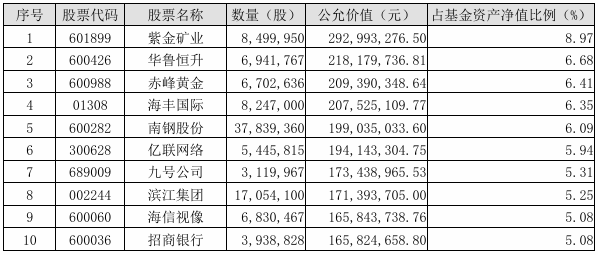
Core Viewpoint - The report highlights the performance and portfolio adjustments of the Jiashi Value Select Equity Fund managed by Tan Li, indicating a shift in top holdings and a focus on commodity prices and market dynamics in the context of investment strategies. Group 1: Fund Holdings - As of the end of Q4 2025, the top ten holdings of the Jiashi Value Select Equity Fund include Zijin Mining, Hualu Hengsheng, Chifeng Jilong Gold, and others, with notable new entries being Ninebot and Binjiang Group, while Chengdu Bank exited the top ten [1][2]. - The fund's stock position was reported at 91.88% at the end of Q4 [2]. Group 2: Performance Metrics - The net asset value per share for Jiashi Value Select Equity A was 2.2893 yuan, with a growth rate of -0.32%, while the C share had a net asset value of 2.2825 yuan and a growth rate of -0.48%, against a benchmark return of -2.06% [3]. Group 3: Market Analysis - In Q4, there was a significant increase in the prices of gold and industrial metals, influenced by factors such as resource nationalism and strategic metal reserves in developed countries, leading to a widening supply-demand gap [3]. - The A-share market saw a rebound in Q3 2024 and a substantial rise in Q3 2025, with the Sci-Tech Innovation Board and Growth Enterprise Market achieving around 50% gains year-to-date, driven by a strong technology narrative and high market risk appetite [4]. - The report indicates a structural adjustment in the portfolio, with increased allocation to non-ferrous metals and a realization of profits in precious metals, while maintaining overall allocation ratios [4].
宏观对话行业-科技叙事还能走多远
2026-01-22 02:43
Summary of Key Points from Conference Call Records Industry Overview - **Macro Industry**: The discussion centers around the technology sector, particularly the impact of AI on the macroeconomic landscape in the U.S. and China, as well as investment opportunities in various sub-sectors like commercial aerospace and humanoid robotics [1][3][17][19]. Core Insights and Arguments AI and Economic Growth - AI capital expenditures are projected to drive U.S. economic growth, with major tech companies expected to spend approximately $350 billion to $360 billion by 2025, accounting for about 1% of GDP and growing at a rate of 60%-70% [1][3]. - The contribution of AI to macroeconomic growth is estimated to be around 0.6%-0.7% [1][3]. - By 2026, capital expenditures from the top five U.S. tech companies are expected to reach $500 billion to $510 billion, indicating sustained investment-driven growth, albeit at a potentially slower pace [3][5]. AI's Impact on Various Industries - AI technology is having a comprehensive impact on the semiconductor industry, leading to price increases in mature processes and the rise of domestic computing power [1][12][14]. - The storage sector is also benefiting from AI, with new technologies driving demand for NAND and DRAM [11][12]. - In the commercial aerospace sector, investment opportunities are concentrated in rocket assembly, core aerospace engines, and satellite payloads, with companies like BoLite and Zhenlei Technology highlighted as key players [1][17]. Concerns and Risks - There are growing concerns about a potential bubble in the AI sector, particularly as discussions around the transition from short-term to long-term economic benefits intensify [6][9][13]. - The stability of macroeconomic policies is crucial to ensure a smooth transition and to mitigate risks associated with the AI narrative [5][6]. China's Technological Landscape - China has surpassed Japan in R&D spending, becoming the second-largest globally, and leads in PCT patent applications, indicating significant advancements in technology [8][7]. - However, the impact of these advancements on labor productivity remains limited, primarily reflecting in capital markets rather than the real economy [7][8]. Additional Important Insights - The humanoid robotics industry is transitioning from component manufacturing to key assembly stages, with companies in Tesla's supply chain, such as Sanhua and Topband, being noteworthy [2][20][21]. - Investment opportunities in the commercial aviation sector are expected to rise due to increased domestic production capabilities, particularly in engine manufacturing [18]. - AI applications in retail are opening new growth avenues, with companies leveraging AI tools to enhance operational efficiency and consumer engagement [25]. - The development of AI glasses is anticipated to grow significantly, with a projected increase in global shipments and sales exceeding 50% over the next five years [26]. Conclusion - The overall sentiment is cautiously optimistic regarding the future of AI and its integration into various industries, with a focus on the importance of stable macroeconomic policies and the potential for significant technological advancements to drive productivity and economic growth [15][16].



2025年度产业经济十大热点事件: “科技叙事”重塑投资逻辑 “反内卷”再造产业生态
Zheng Quan Shi Bao· 2025-12-28 22:23
Group 1: AI and Technology Developments - The launch of DeepSeek-R1 in January 2025 has become a core investment theme, driving significant capital market momentum and shifting the focus from performance competition to cost, efficiency, and commercialization capabilities in the AI sector [2] - The AI industry has seen a concentration of funds towards leading companies, with notable stock performances such as the "Yi Zhong Tian" combination, which saw gains exceeding 450% [2] - The human-robotics sector has entered a commercialized phase, with over 46 billion yuan in total orders and more than 20,000 units sold, indicating a shift from conceptual collaborations to practical applications [4][5] Group 2: Film and Entertainment Industry - The film "Nezha 2" achieved a record-breaking box office of 15.4 billion yuan, marking a significant milestone for the Chinese animation industry and contributing to a total annual box office of over 50 billion yuan, a 75 billion yuan increase from 2024 [3] - The success of "Nezha 2" and other animated films reflects the growing market potential for domestic animation, providing a reference for future creative and investment strategies in the film industry [3] Group 3: Market Dynamics and Competition - The intense competition in the food delivery industry, initiated by JD's entry with a no-commission model, has led to significant market disruptions and a series of subsidy wars among major platforms, resulting in a 141 billion yuan loss for Meituan's core local business despite record user numbers [7] - Regulatory bodies have intervened to address the chaotic competition, leading to commitments from major platforms to improve service quality and return to rational development [7] Group 4: Capital Market Trends - The A-share market has seen a record high in cash dividends, totaling 2.61 trillion yuan, reflecting an increase in companies' willingness to return profits to shareholders and enhancing market resilience [11] - The emergence of "GPU dual heroes" in the capital market, with multiple domestic GPU companies going public, signifies a milestone for the domestic AI chip industry and a shift towards self-sufficiency [10] Group 5: Industry Regulation and Quality Improvement - The lithium battery supply chain has experienced a price recovery due to regulatory efforts to combat "involution" competition, with lithium carbonate futures seeing significant price increases [12] - The charging battery industry is transitioning to a more orderly development phase following regulatory changes and recalls by major brands, addressing issues of safety and compliance [13]






公募冲刺年末排名战
Xin Lang Cai Jing· 2025-12-23 23:14
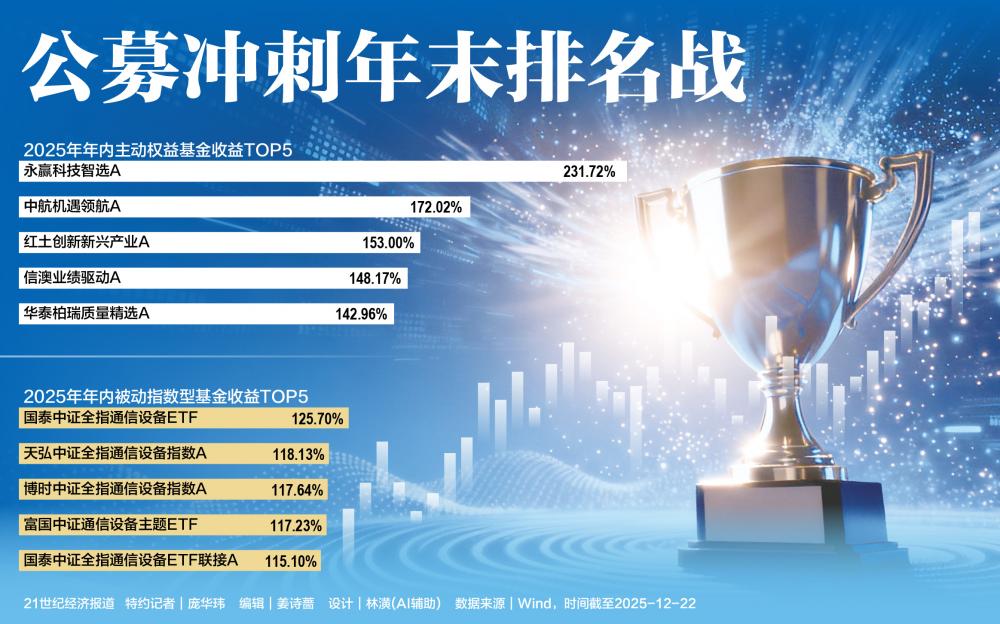
Core Insights - The 2025 public fund ranking battle reveals dual answers to the debate between active and passive investment strategies, with significant returns from both types of funds [1][4] - Active funds achieved over 231% annual returns, while passive funds, particularly in the communication and AI sectors, saw returns of 125.7% [1][6] Group 1: Performance of Funds - As of December 22, 2025, 93.44% of the 13,530 public funds reported positive returns, contrasting sharply with the previous three years of market downturns [3] - Active equity funds had an average return of 29.38%, with 95.75% of them showing positive returns, and 66 funds exceeding 100% returns [3][4] - Passive index funds also performed well, with an average return of 23.68% and 91.41% achieving positive returns, including 11 funds with returns over 100% [3][4] Group 2: Investment Strategies - Active funds focused on deep research and concentrated holdings to achieve alpha returns, while passive funds capitalized on high-growth thematic indices [4][5] - The top-performing active funds were heavily invested in the technology sector, particularly in AI and communication industries, with significant concentration in core stocks [5][6] - The communication equipment ETF led passive funds with a 125.7% annual increase, outperforming many actively managed products [6] Group 3: Market Trends and Changes - The ETF market experienced historic growth, with total assets increasing from approximately 3.73 trillion yuan to about 5.88 trillion yuan, marking a 58% growth rate [7] - New regulations in 2025 require performance benchmarks to accurately reflect investment strategies, aiming to enhance transparency and reduce ranking manipulation [7] - The market structure is evolving, pushing active fund managers to focus on in-depth research within their expertise while ETFs serve as efficient tools for expressing specific industry trends [7][8] Group 4: Investor Behavior - Investors are increasingly divided in their choices, with some pursuing high-risk, high-reward active funds while others prefer diversified exposure through ETFs [8][9] - Industry experts suggest a cautious approach for ordinary investors, emphasizing the importance of evaluating funds based on long-term performance and risk metrics rather than short-term gains [10]

迎山破阵,套保护航
Dong Zheng Qi Huo· 2025-12-19 08:19
1. Report Industry Investment Rating - The rating for government bonds is bearish [1] 2. Core Viewpoints of the Report - In 2025, the bond market turned from bullish to bearish, mainly due to the reversal of the macro - narrative. Looking ahead to 2026, inflation will moderately rebound, the equity market will continue to suppress bonds, the bond market will show a bearish steepening trend, and the futures rhythm will be similar to an "M" shape. Strategies such as short - selling on rallies, short - hedging, and steepening the curve are recommended [1][2][3][4] 3. Summary According to the Directory 3.1 2025 National Debt Trend Review - The bond market turned bearish in 2025, with the whole - year market divided into five stages. The change in the macro - narrative was the core reason for the bear market [14][21] - The yield curve first flattened and then steepened. The basis spread had a relatively low central level overall, with a phased increase during market adjustments [17][18] 3.2 Policy Foundation of the Positive Macro - Narrative: Dual - Circulation Strategy 3.2.1 Policy Ideas of the Dual - Circulation Strategy - Proposed in 2020 to cope with economic challenges, it aims to optimize supply, improve corporate profits, and gradually form stable growth and moderate inflation through measures like developing technology, anti - involution, investing in people, and promoting "Belt and Road" and RMB trade [24][27][31] 3.2.2 Fiscal and Monetary Policy Ideas under the Dual - Circulation Strategy - Fiscal policy is generally positive but will increase moderately and make decisions based on the situation. Fiscal expenditure is shifting towards high - tech industries, people's livelihood, and resolving local government hidden debts [38][40] - Monetary policy will actively cooperate with fiscal policy, maintaining a low - interest - rate environment cautiously, gradually shifting to asset - price transmission, and building a RMB sovereign credit system [40][43] 3.3 Outlook for 2026: Moderate Rebound in Inflation 3.3.1 Supply - side Clearance: De - investment and De - capacity - In 2026, anti - involution policies will expand. The effectiveness of these policies is already visible, and manufacturing investment growth will have a low central level, optimized structure, and a front - low and back - high rhythm [45][48][49] 3.3.2 Real Estate Still a Drag, but Year - on - Year Decline in Data Expected to Narrow - Real estate data weakened again in 2025. Policy thinking is changing, with long - term transformation as the main focus and short - term support as a supplement. Real estate data may still weaken month - on - month, but the year - on - year decline is expected to narrow [50][53][57] 3.3.3 External Demand is the Most Important Force to Offset Real Estate - China's export growth exceeded expectations in 2025. In 2026, global terminal demand is relatively strong, and emerging demand is booming. The export growth rate is expected to remain high, with ASEAN, the EU, and Africa continuing to drive exports [58][62][65] 3.3.4 Overseas Inflation will Moderately Transmit to the Domestic Market - Overseas inflation has an upward risk, but the transmission to the domestic market is moderate. Overall, domestic prices have the impetus to rise moderately in 2026, and the bond market will remain weak [66][71][72] 3.4 The Equity Market will Continue to Suppress Bonds 3.4.1 The Logic of the Technology Narrative is Hard to Be Falsified in the Short Term - The trading theme may shift to Sino - US technological competition in 2026. The technology narrative is difficult to be falsified, and the bull market in Chinese technology stocks is expected to continue [74][76][77] 3.4.2 The Stock Market is Likely to Remain in a Bull Market in 2026 - The stock market is expected to shift from the first stage (fund - driven) to the second stage (inflation and profit - driven) in 2026. With the weakening of the US dollar index, overseas funds will flow back, and policy support will continue, so the bull market is likely to continue, suppressing the bond market [78][80][86] 3.5 The Bond Market will Show a Bearish Steepening Trend, and the Futures Rhythm will be Similar to an "M" Shape 3.5.1 Short - term Bonds are Relatively Stable, Determined by Monetary Policy and Funds - Monetary policy in 2026 will remain "moderately loose," with one expected interest rate cut of 10BP and one reserve requirement ratio cut of 50BP. Short - term bond interest rates are expected to be relatively stable, with the 1Y Treasury bond interest rate centered around 1.3% [90][91][94] 3.5.2 Long - term Bonds Face Supply - Demand Imbalance, and the Curve will Steepen with Volatility - Long - term bonds are more sensitive to inflation and the stock market. The supply - demand imbalance in the long - term bond market is obvious. The 10Y Treasury bond interest rate is expected to reach a high of around 2.0%, and the 30Y Treasury bond interest rate may reach a high of 2.5% - 2.6% [95][98][113] 3.5.3 Treasury Bond Futures will have a Winding Trend, Similar to an "M" Shape - The trend of the bond market in 2026 will be winding. It is expected to strengthen from the beginning of the year to before the Spring Festival, decline from after the Spring Festival to the end of Q2 with possible rebounds due to interest rate cuts, have increased volatility in Q3 with a slowing pace of interest rate increase, and show an uncertain trend in Q4, generally similar to an "M" shape [114][115][116] 3.6 Treasury Bond Futures Strategy Recommendations - Unilateral strategy: Short - sell Treasury bond futures on rallies [119] - Spot - futures strategy: Pay high attention to short - hedging strategies [120] - Curve strategy: Pay attention to strategies such as steepening the 10Y - 1Y curve and going long on 3T and short on TL [121]
嘉实前沿创新混合基金经理何鸣晓:从产业发展中解码科技资产的“关键变量”
Zheng Quan Ri Bao· 2025-12-08 17:13
Core Viewpoint - The technology sector in China is experiencing unprecedented investment appeal and development potential due to continuous innovation and an improving policy environment [1] Group 1: Key Variables Driving Technology Narrative - Three key variables are identified as driving the deepening of the "technology narrative": 1. Continuous enhancement of China's technological capabilities with significant breakthroughs in areas such as domestic models, computing power, and advanced semiconductor processes [2] 2. Ongoing domestic policy support for the technology sector, including guidance for technological innovation and financing for tech companies [2] 3. Continuous improvement in talent pool, including the maturation of AI algorithm personnel and the engineer dividend accompanying generational technological advancements [2] Group 2: Market Dynamics and Investment Opportunities - Despite solid fundamentals in the technology sector, there has been significant divergence in individual stock performance. Short-term fluctuations should not overly concern investors, as the fundamentals and industry development remain resilient [2] - The market is currently experiencing adjustments due to year-end switching and performance gaps, but this does not affect the long-term investment value in technology [2] Group 3: Identifying New Opportunities Amidst Volatility - To uncover "high-low switching" opportunities in the technology sector, two considerations are emphasized: 1. Analyzing structural differentiation in the industry to enhance investment success rates, focusing on low-priced assets in conjunction with industry changes [4] 2. Evaluating market expectations to identify discrepancies in industry forecasts, with a focus on AI and the rise of Chinese technology, particularly in computing power and storage [4] Group 4: Investment Strategy and Research Framework - The investment strategy in the technology sector should be characterized by high volatility and rapid iteration. A combination of top-down and bottom-up approaches is recommended to capture industry development opportunities [5] - Key factors for stock selection include market space, competitive landscape, business model, management, growth potential, and market expectations [5] - A comprehensive research training system, "3+3+3," is established to enhance research capabilities and investment management efficiency within the company [6] Group 5: Asset Allocation and Product Selection - Investors are advised to assess expected returns and risk tolerance, as the technology sector is inherently high-volatility. Balancing risk and return is crucial [7] - Emphasis is placed on understanding industry changes to improve investment success rates, with a recommendation to consider low-volatility assets for portfolio balance [7] - For product selection, investors should evaluate major holdings, changes, fund manager experience and style, and quarterly reports to align with personal risk-return profiles and industry knowledge [7]