特别代表人诉讼

Search documents
三大利器持续落地 投资者维权“单线条”变“多通道”
Zhong Guo Jing Ying Bao· 2026-01-16 19:12
Core Viewpoint - The article discusses the emergence of three key mechanisms for investor rights protection in China's securities market, which are enhancing the accessibility and certainty of investor claims, thereby creating a new ecosystem for shareholder rights protection [1][5][7]. Group 1: Mechanisms for Investor Rights Protection - The three mechanisms include ordinary lawsuits, special representative lawsuits, and advance compensation, which are collectively forming a new ecosystem for investor rights protection [5][8]. - The special representative lawsuit has seen successful cases, such as the judgment against Jintongling, where 43,269 investors were awarded a total of 775 million yuan [2][3]. - Advance compensation has been implemented for the fifth time, with Wukuang Securities contributing 210 million yuan for compensation related to Guangdao Digital's false statements [3][4]. Group 2: Legal Framework and Changes - The cancellation of the prerequisite for administrative penalties or criminal judgments allows investors to file lawsuits without waiting for regulatory actions, significantly shortening the time for rights protection [2][6]. - The introduction of the Supreme Court's regulations in 2022 has facilitated the filing of civil compensation lawsuits for securities false statements, enhancing investor rights [2][9]. - The new ecosystem emphasizes civil liability as a core mechanism, moving away from reliance on administrative penalties, thus improving the predictability and stability of civil accountability [7][10]. Group 3: Implications for Market Integrity - The development of these mechanisms is expected to enhance the quality of information disclosure and compliance management among listed companies, as the market increasingly recognizes the costs associated with violations [7][11]. - The article highlights that the new ecosystem is likely to restore investor confidence in the capital market, contributing positively to its healthy development [8][9]. - Experts suggest that further improvements are needed to ensure the sustainability and effectiveness of these mechanisms, including clearer standards for civil liability and better integration of responsibilities among intermediaries [9][10][11].


明星企业营收造假11亿,赔股民7.75亿
Sou Hu Cai Jing· 2026-01-12 05:42
Core Viewpoint - The financial fraud case involving Jintongling has revealed systemic issues within the capital market, highlighting the need for stronger oversight and accountability among intermediary institutions [1][4][9]. Group 1: Financial Fraud Details - Jintongling engaged in financial fraud from 2017 to 2022, inflating revenue by over 1.135 billion and profits by 468 million [4][5]. - The company reported a significant loss in 2022, leading to a retrospective adjustment of its 2021 profit from 15.06 million to a loss of 67.91 million [4]. - The fraud involved deceptive practices such as falsifying project progress reports and prematurely recognizing revenue [5][9]. Group 2: Legal and Financial Consequences - Jintongling was ordered to compensate 43,300 investors a total of 775 million for losses incurred due to the fraud [7]. - The company and its executives faced severe penalties, including fines and prison sentences for fraudulent activities [5][7]. - Regulatory bodies are emphasizing the importance of civil litigation in holding companies accountable for financial misconduct [7][9]. Group 3: Impact on Intermediary Institutions - Huaxi Securities, one of the key intermediaries, was suspended from sponsorship for six months, and two representatives were banned for two years [1][10]. - The financial performance of Huaxi Securities has declined significantly, with investment banking revenue dropping by 28.44% in 2024 [11]. - The case has raised questions about the responsibilities of intermediary institutions in preventing financial fraud and the need for improved oversight mechanisms [9][12]. Group 4: Industry Challenges and Recommendations - The investment banking sector faces challenges related to quality control and competitive pressures, leading to potential compromises in service standards [13]. - Experts suggest that reforms are necessary to enhance the quality of services provided by intermediary institutions and to reduce unhealthy competition [13].


扎牢惩防体系制度篱笆 财务造假打击力度再升级
Zheng Quan Shi Bao Wang· 2026-01-07 08:55
Core Viewpoint - Regulatory authorities are intensifying their crackdown on financial fraud in the capital market, signaling a "zero tolerance" approach with severe penalties for major violations [1][2][4]. Group 1: Regulatory Framework and Actions - A comprehensive punishment and prevention system against financial fraud is being established, involving 12 regulatory departments including the CSRC, Supreme People's Court, and Ministry of Public Security [2][4]. - Since 2024, the CSRC has handled 159 financial fraud cases, resulting in 111 administrative penalties totaling 8.1 billion yuan [2]. - The regulatory focus has shifted from post-incident investigations to a balanced approach that includes pre-compliance mechanisms, real-time monitoring, and strict post-incident accountability [1][4]. Group 2: Enforcement and Penalties - The crackdown includes penalties for both companies and individuals involved in financial fraud, with some facing market bans for up to 10 years [3]. - A total of 18 companies have faced forced delisting due to severe fraud, and investigations are ongoing for 91 delisted companies to prevent evasion of accountability [2][4]. - The regulatory framework aims to create a strong deterrent against financial fraud, enhancing the overall market ecosystem [3]. Group 3: Investor Protection and Governance - The CSRC is committed to enhancing investor protection through measures such as supporting representative lawsuits, which allow investors to collectively pursue claims [7][8]. - A new round of corporate governance initiatives will focus on improving transparency, board independence, and internal control systems to bolster investor confidence [6][8]. - The shift in investor protection from passive compensation to proactive rights protection reflects a significant evolution in governance philosophy within the capital market [8].
2026年监管重拳来袭!证监会回应维权痛点
Xin Lang Cai Jing· 2026-01-05 03:52
Core Viewpoint - The year 2025 marks a significant shift in the A-share capital market towards enhanced regulatory logic and stronger enforcement, with a focus on investor protection and accountability for violations [3][16]. Regulatory Environment - The China Securities Regulatory Commission (CSRC) emphasizes the importance of collaborative governance between regulation and judiciary to protect investors, particularly small and medium-sized investors, and to promote a healthy market ecosystem [4][19]. - The CSRC's commitment to a "zero tolerance" approach will be closely linked to civil compensation, expediting the initiation of representative litigation once administrative penalties are imposed [17][26]. Investor Compensation Mechanisms - Recent court rulings, such as the one involving Jintongling, demonstrate the effectiveness of the representative litigation system in protecting investor rights and addressing disputes collectively [5][18]. - The establishment of a special compensation fund for cases like Guandao Digital's false statements indicates a proactive approach to resolving market conflicts and safeguarding investor interests [6][19]. Enforcement of Disclosure Regulations - In 2025, a total of 264 listed companies were investigated for information disclosure violations, reflecting a sustained high-pressure stance from regulatory authorities [8][20]. - The types of violations predominantly include systematic financial fraud, undisclosed related party transactions, and significant omissions in disclosures regarding major events [22][23]. Market Reactions and Trends - The trend of companies facing severe penalties for financial misconduct, including forced delisting, indicates a shift in regulatory practices, with a growing consensus that delisting does not exempt companies from civil liability [10][23]. - The year 2025 saw 31 investor compensation cases resulting in favorable judgments, highlighting an increasing clarity in judicial standards for securities fraud [24][26]. Future Outlook - The year 2026 is anticipated to further mature the investor protection framework, with potential reforms including lower thresholds for collective lawsuits and mandatory dividend policies for profitable companies [26][27]. - The introduction of a whistleblower reward system and a compensation fund for defrauded investors aims to enhance accountability and deter fraudulent activities in the market [27].

2026年监管重拳来袭!证监会回应维权痛点,2025年信披违规与财务造假成“重灾区”
Hua Xia Shi Bao· 2026-01-05 00:41
Core Viewpoint - The year 2025 marks a significant shift in the A-share capital market towards enhanced regulatory logic and stronger enforcement, with a focus on investor protection and accountability for violations [2][3]. Regulatory Environment - The China Securities Regulatory Commission (CSRC) emphasizes the importance of collaborative governance between regulation and judiciary to protect the rights of investors, particularly small and medium-sized investors [3][5]. - The CSRC's commitment to a "zero tolerance" approach will be closely linked to civil compensation, expediting the initiation of representative litigation following administrative penalties [12]. Investor Protection Mechanisms - Recent court rulings, such as the case against Jintongling, demonstrate the effectiveness of the representative litigation system in protecting investor rights and resolving disputes [4][5]. - The establishment of a special compensation fund for cases like Guangdao Digital's false statements indicates a proactive approach to resolving market conflicts and safeguarding investor interests [5]. Trends in Violations - In 2025, a total of 264 listed companies were investigated for information disclosure violations, reflecting a sustained high-pressure regulatory environment [6][7]. - Common violations include systematic financial fraud, undisclosed related-party transactions, and significant omissions in major event disclosures [8][9]. Legal Outcomes and Investor Rights - The year 2025 saw 31 stocks achieve favorable verdicts in investor compensation cases, indicating a clearer judicial standard for securities fraud liability [10]. - The connection between administrative penalties and civil liability is becoming more pronounced, with companies facing severe consequences for financial misconduct [9][12]. Future Outlook - The year 2026 is anticipated to further mature the investor protection framework, with potential reforms including lower thresholds for collective lawsuits and mandatory dividend policies for profitable companies [12][13]. - The introduction of a whistleblower reward system and a compensation fund for investors affected by fraudulent delistings is expected to enhance accountability and deter misconduct [13].


第三例特别代表人诉讼先行判决 金通灵赔偿4万余名投资者7.75亿元
Zhong Guo Jing Ying Bao· 2026-01-04 10:59
Core Viewpoint - The Nanjing Intermediate People's Court has ruled that Jintongling Company must compensate 43,269 investors a total of 775 million yuan due to investment losses, marking the third case of a special representative lawsuit in China [1][2][3]. Group 1: Special Representative Lawsuit Overview - The special representative lawsuit allows the Investor Protection Center to represent over 50 investors in civil litigation, significantly lowering the cost and barriers for small investors to seek compensation [4][5]. - The system has already seen successful outcomes in previous cases, such as the Kangmei Pharmaceutical case, where 52,037 investors received 2.459 billion yuan, and the Zeda Yisheng case, which compensated 7,195 investors over 280 million yuan [6][7]. Group 2: Legal and Regulatory Context - The China Securities Regulatory Commission (CSRC) has been actively promoting the normalization of special representative lawsuits since their introduction in 2020, aiming to enhance investor protection and deter securities violations [10][11]. - Experts suggest improvements in case selection, cost assurance, and simplification of procedures to facilitate the regular use of this legal mechanism [8][9]. Group 3: Future Directions - There is a consensus among experts that the special representative lawsuit system needs to be more widely adopted, with recommendations for establishing data platforms for case evaluation and enhancing collaboration between judicial and administrative bodies [10][11].
金通灵求生:连续6年财务造假还是要重整复活!
Xin Lang Cai Jing· 2026-01-03 01:28
Core Viewpoint - Jintongling has been involved in financial fraud for six consecutive years, inflating revenue by over 1.3 billion and profits by 500 million, and is currently undergoing bankruptcy reorganization [1][7][9] Group 1: Financial Fraud and Legal Proceedings - Jintongling utilized various methods for financial fraud over six years, leading to inflated revenue and profits [1][7] - On September 30, 2025, the Shanghai Third Intermediate People's Court issued a criminal judgment against Jintongling and related parties [2][8] - The Nanjing Intermediate Court ruled that Jintongling must compensate over 43,000 investors a total of 770 million yuan, with Everbright Securities being the most affected party [3][9][12] Group 2: Regulatory Actions and Investor Protection - The China Securities Regulatory Commission (CSRC) has strengthened penalties for securities crimes, indicating a shift towards more severe consequences for corporate misconduct [1][9] - The Jintongling case is part of a broader trend in which the CSRC is applying special representative litigation procedures to protect investor rights, following similar cases like Kangmei Pharmaceutical [5][13] - The CSRC will continue to support investor protection initiatives and facilitate the use of representative litigation to maintain market integrity and promote high-quality market development [6][14]
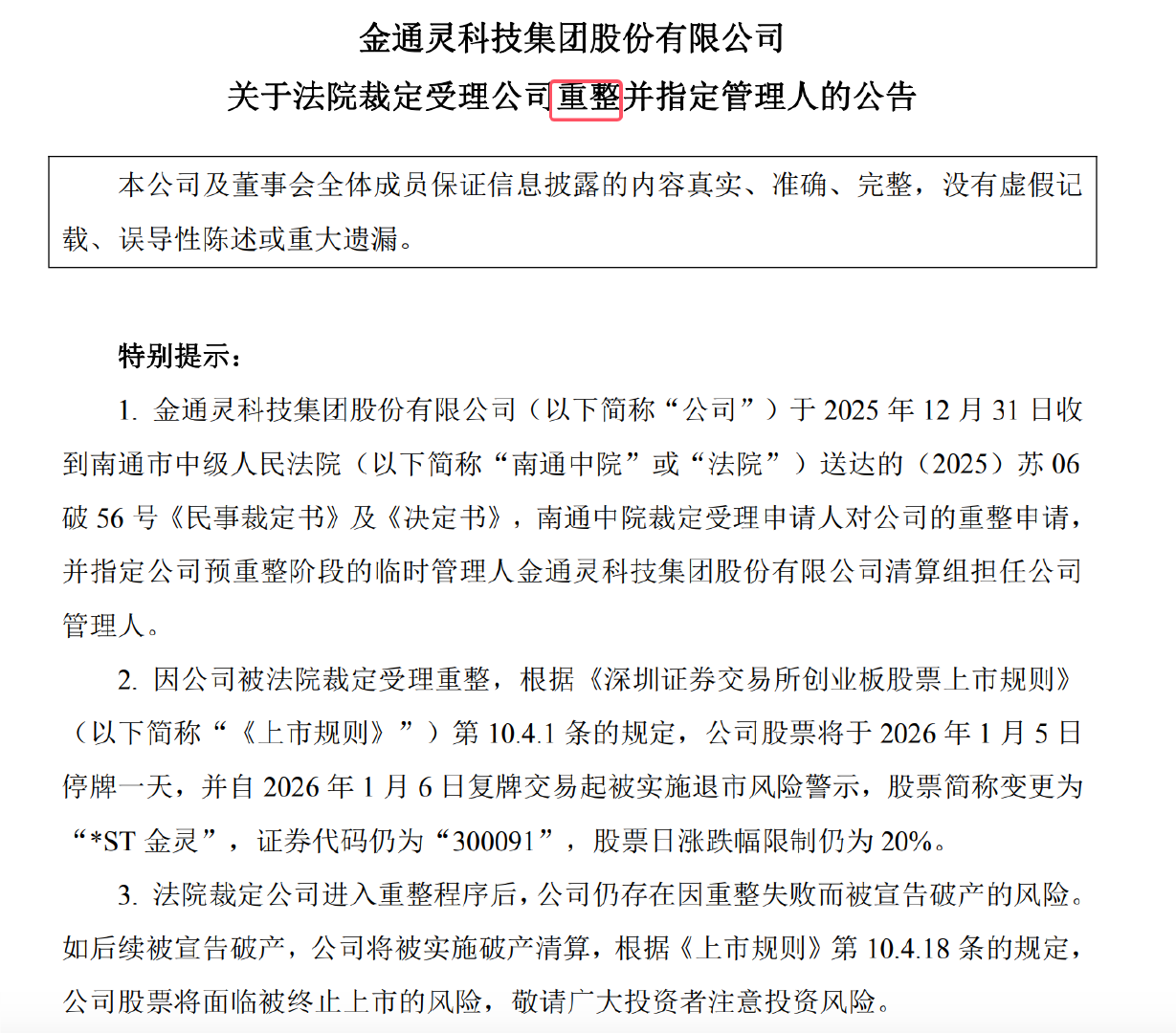
判了!4.3万余名投资者,获赔超7.7亿元
Zhong Guo Zheng Quan Bao· 2025-12-31 14:43
Core Viewpoint - The Nanjing Intermediate People's Court ruled in favor of over 43,000 investors in the Jin Tong Ling (300091) securities fraud case, awarding them over 770 million yuan in compensation, marking a significant step in the enforcement of collective litigation in China's capital markets [1][2] Group 1: Legal Proceedings and Outcomes - The court's ruling is a preliminary judgment that establishes the company's liability for compensation, while the responsibilities of the company's former executives and related intermediaries will be determined in a separate ruling [1] - Jin Tong Ling has been found to have engaged in financial fraud for six consecutive years, inflating revenue by over 1.3 billion yuan and profits by 500 million yuan, and is currently undergoing bankruptcy reorganization [2] - The ruling highlights the effectiveness of the special representative litigation system in increasing the costs of illegal activities in the capital market and protecting the rights of small and medium investors [2] Group 2: Investor Protection and Institutional Role - Investor protection agencies have actively fulfilled their responsibilities in the representative litigation, including assessing eligible plaintiffs and preparing legal arguments [3][4] - The China Securities Investor Services Center has increased its support for ordinary representative litigation, with five cases being accepted by various courts, enhancing the collaborative effect of different types of representative litigation [5] Group 3: Company Financial Impact and Future Actions - Jin Tong Ling announced that it will recognize estimated liabilities based on the court's ruling, which will significantly impact the company's current and future profits [6] - The company plans to implement a debt repayment scheme through cash and debt-equity swaps as part of its reorganization process, aiming to improve compensation capabilities for small investors [7][8] Group 4: Regulatory and Market Context - The case is part of a broader trend of increasing regulatory scrutiny and enforcement against fraudulent activities in the capital markets, following similar cases like Kangmei Pharmaceutical and Zeda Yisheng [9] - The China Securities Regulatory Commission supports the implementation of the special representative litigation system as a means to effectively protect investor rights and maintain market integrity [9][12]
刚刚,证监会发声!
证券时报· 2025-12-31 13:44
Core Viewpoint - The article discusses recent developments in securities litigation in China, highlighting the effectiveness of the special representative litigation system in protecting investors' rights and maintaining market order. Group 1: Special Representative Litigation - The Jin Tong Ling case is noted as a significant example of the special representative litigation process, following similar cases like Kangmei Pharmaceutical and Zeda Yisheng, demonstrating its role in collective investor rights protection [2] - The Shenyang Intermediate Court's announcement regarding the Jinzhou Port securities fraud case emphasizes the serious disruption caused by false statements, leading to administrative penalties and the adoption of special representative litigation to protect investors [3] Group 2: Investor Protection Mechanisms - The establishment of a special compensation fund by Wukuang Securities for Guangdao Digital's false statements is highlighted as part of a diversified dispute resolution mechanism under the Securities Law, aimed at facilitating civil reconciliation with investors [4] - The China Securities Investor Protection Fund's role as a public interest organization in managing the compensation fund is emphasized, showcasing its commitment to safeguarding investors' rights [4]

4.3万余名投资者获赔7.7亿余元!金通灵特别代表人诉讼案作出先行判决
证券时报· 2025-12-31 13:44
Core Viewpoint - The article discusses the recent ruling by the Nanjing Intermediate Court regarding the special representative lawsuit against Jintongling Securities, which resulted in over 43,000 investors receiving compensation exceeding 770 million yuan, highlighting the increasing application of special representative lawsuits in China's capital market [1][2]. Group 1: Legal Developments - The Nanjing Intermediate Court's ruling is a preliminary judgment that establishes the liability of the listed company, with further judgments on the responsibilities of the company's executives and related intermediaries to follow [2]. - The special representative lawsuit system is recognized as a significant method for holding financial fraud accountable, enhancing the cost of violations in the capital market, and protecting the rights of small and medium investors [3][4]. Group 2: Regulatory Context - The recent ruling aligns with the new "National Nine Articles," which aims to strengthen the regulatory framework against financial fraud and improve the accountability mechanisms in the capital market [4][5]. - The China Securities Regulatory Commission (CSRC) has adopted a "zero tolerance" approach towards financial fraud, increasing enforcement efforts and enhancing civil liability support mechanisms, including the application of special representative lawsuits [4][5]. Group 3: Case Examples - The Jintongling case involved six years of financial fraud, with the company inflating revenue by over 1.3 billion yuan and profits by 500 million yuan, currently undergoing bankruptcy restructuring [5]. - Other notable cases include Kangmei Pharmaceutical and Meishang Ecological, which are also significant financial fraud cases under special representative lawsuits [5]. Group 4: Investor Protection Initiatives - The China Securities Investor Services Center plays an active role in representing investors in lawsuits, focusing on establishing suitable plaintiffs, preparing legal arguments, and ensuring effective communication with represented investors [6][7]. - The Supreme Court and CSRC have emphasized the importance of supporting investor protection institutions in ordinary representative lawsuits, enhancing the collaborative effect of both special and ordinary representative lawsuits in safeguarding investor rights [7]. Group 5: Future Directions - There is a call for timely modifications to the judicial interpretations of representative lawsuits to refine the conditions for initiating special representative lawsuits and improve the operational mechanisms [10]. - The China Securities Investor Services Center plans to update its business rules to enhance the selection criteria and mechanisms for representative lawsuits, ensuring a solid foundation for the regular advancement of these lawsuits [10].