现代公司治理

Search documents
管涛:人民币国际化急需六大配套改革
Di Yi Cai Jing· 2025-11-23 12:40
Core Viewpoint - The article emphasizes the importance of high-level financial openness in China, highlighting the need for coordinated reforms to support the internationalization of the Renminbi and the opening of capital accounts, while ensuring that these efforts align with domestic economic development [1][3][14]. Group 1: Financial Openness and Reform - Financial openness is crucial for promoting reform and development, but it requires deeper reforms to address the unique challenges posed by financial markets [2][3]. - Historical examples show that financial crises in emerging markets often stem from delayed domestic reforms following financial liberalization [2][3]. - The current global economic environment presents both opportunities and challenges for China's financial openness, necessitating a careful balance between opening up and ensuring domestic stability [3][14]. Group 2: Key Reforms for High-Level Openness - Strengthening the domestic circulation system is essential, with a focus on enhancing consumption, investment, and the overall market structure to support the Renminbi's international status [5][6]. - Enhancing technological innovation capabilities is vital for maintaining competitiveness in the face of external pressures and fostering new productive forces [7]. - Improving the protection of property rights is critical for attracting both domestic and foreign investment, as clear and strong property rights enhance market appeal [8]. - Elevating macroeconomic governance effectiveness is necessary to ensure that market mechanisms function optimally while government plays a supportive role [9][10]. - Modernizing corporate governance structures is important for fostering a dynamic economic environment and addressing competitive challenges [12]. - Strengthening capital market functions is essential for supporting new productive forces and ensuring that financial services benefit the broader population [13].
日进2亿美元?马斯克天价薪酬如何影响特斯拉?
Huan Qiu Wang Zi Xun· 2025-11-07 06:40
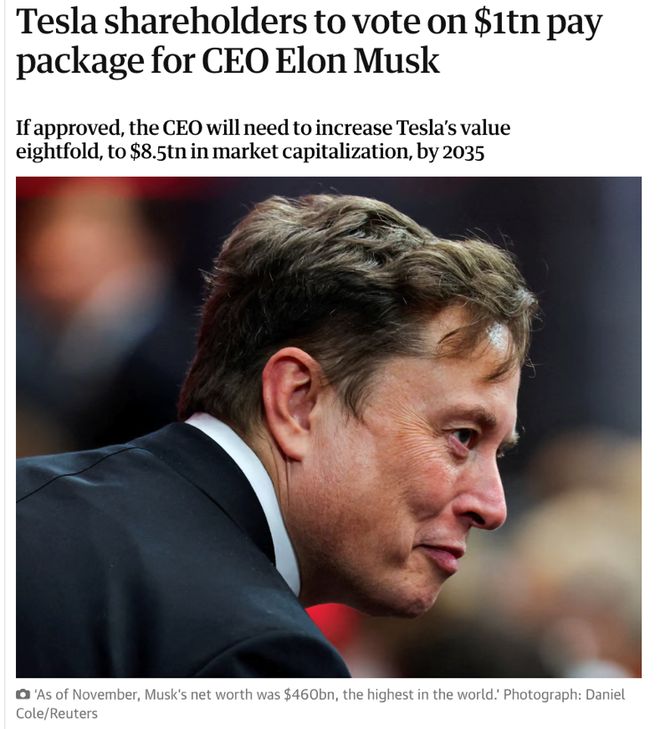
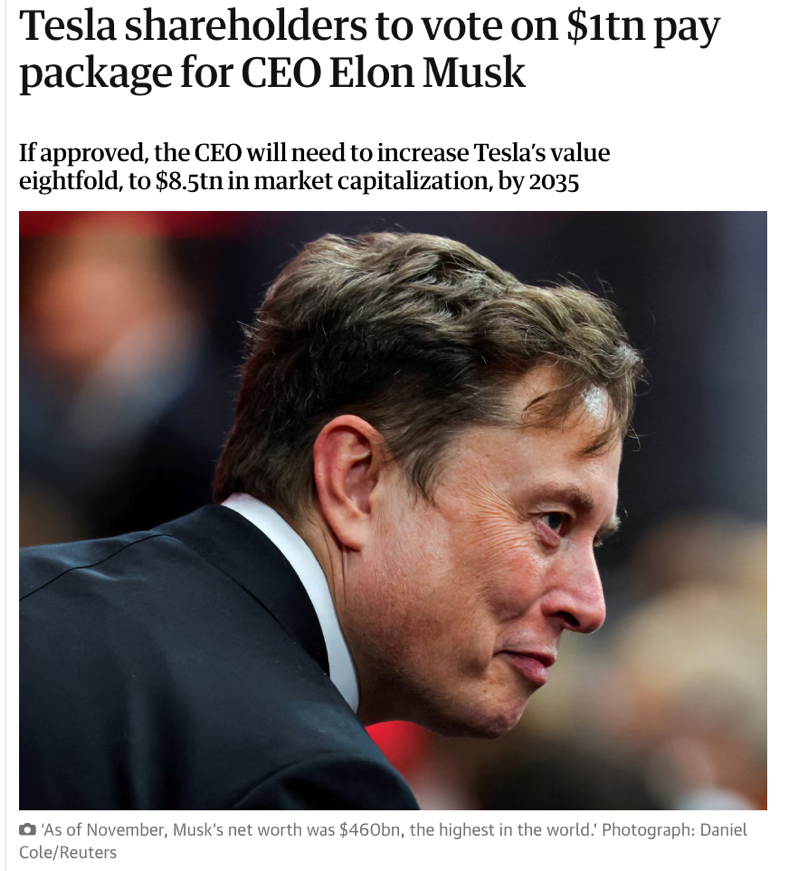
Core Points - The Tesla annual shareholder meeting on November 6 approved Elon Musk's 2025 compensation plan, allowing him to earn up to $1 trillion if he meets specific operational goals, despite opposition from entities like the Norwegian sovereign wealth fund [1][9][13] - This approval reflects shareholders' confidence in Musk's leadership as Tesla transitions into an era dominated by artificial intelligence and robotics, highlighting a preference for founder-driven leadership over institutional constraints [1][9][15] Summary by Sections 2018 Compensation Plan Context - The 2018 compensation plan for Musk was a ten-year performance-based stock option scheme, which was initially approved by shareholders but later overturned by a Delaware court due to concerns over the board's independence and information disclosure [5][6] - The court ruled that the process lacked fairness and transparency, leading to the plan's invalidation [6] 2025 Compensation Plan Details - The new 2025 compensation plan emphasizes stock options over cash, with 12 performance milestones tied to market value and operational achievements, potentially granting Musk 12% of Tesla's shares, valued at approximately $1 trillion [13][14] - Key operational targets include delivering 20 million electric vehicles, deploying 1 million robotaxis, and achieving $400 billion in profit over four consecutive quarters [13][14] Shareholder Reactions and Concerns - While supporters argue that the plan aligns Musk's incentives with long-term company performance, critics express concerns about the potential dilution of shares and the concentration of power in Musk's hands [10][14] - The plan's approval is seen as a commitment to Tesla's future in AI and robotics, reducing uncertainty about the company's strategic direction [15] Governance and Future Implications - The shareholder vote is viewed as a significant moment in corporate governance, balancing the need for founder leadership with the necessity of institutional checks [15] - The outcome suggests that if the plan had been rejected, it could have jeopardized Musk's continued leadership and the execution of Tesla's long-term strategy [15]


北美观察丨日进2亿美元?马斯克天价薪酬如何影响特斯拉?
Yang Shi Xin Wen· 2025-11-07 06:18
Core Points - The Tesla annual shareholder meeting on November 6 approved Elon Musk's 2025 compensation plan, allowing him to earn up to $1 trillion if he meets specific operational goals [1][7][15] - The approval reflects shareholders' confidence in Musk's leadership as Tesla transitions into an era dominated by artificial intelligence and robotics [1][7] - The plan is a response to the Delaware court's annulment of Musk's 2018 compensation package, which was deemed unfair due to lack of independent oversight [4][5] Summary by Sections Compensation Plan Details - The new compensation plan emphasizes stock options over cash, with a total of approximately 423.7 million shares available, unlocked in 12 tiers based on achieving market and operational milestones [13][14] - If all performance targets are met, Musk could receive 12% of the company, valued at around $1.02 trillion, although the actual value after costs may be about $878 billion [14] Historical Context - The 2018 compensation plan was initially approved by shareholders but was later overturned by a court ruling that found the process lacked fairness and transparency [4][5] - The court's decision highlighted that the 2018 vote was not "clean," as it did not adequately separate interested parties from those without a stake in the outcome [5] Shareholder Perspectives - Supporters of the new plan argue it aligns Musk's incentives with long-term company performance, particularly in areas like full self-driving technology and robotics [7][15] - Critics, including the Norwegian sovereign wealth fund and advisory firms, raised concerns about the potential for significant dilution of shares and the concentration of power in Musk's hands [8][12] Future Implications - The approval of the compensation plan is seen as a commitment to Musk's vision for Tesla's future, reducing uncertainty about the company's strategic direction [15] - The board views this as a necessary step to ensure Musk remains at the helm during critical developments in AI and robotics [15][18]
核准!国有大行,集体公告!
券商中国· 2025-09-26 09:02
Core Viewpoint - The six major state-owned banks in China have collectively announced the abolition of their supervisory boards, transitioning the responsibilities to the audit committees under the board of directors, which is seen as a move to enhance governance efficiency and effectiveness [3][4][6]. Group 1: Announcement of Abolishment - On September 25, major banks including Bank of China, Agricultural Bank of China, Industrial and Commercial Bank of China, China Construction Bank, and Bank of Communications announced that they will no longer establish supervisory boards following regulatory approval for their articles of association [1][4]. - Postal Savings Bank is set to discuss a similar proposal at its upcoming shareholder meeting on October 9, indicating a trend among banks to eliminate supervisory boards [2][6]. Group 2: Implementation Details - The reform steps taken by the banks are consistent, with all five major banks approving the abolishment of supervisory boards during their 2024 annual shareholder meetings held on June 27, 2025 [4]. - The new governance structure will take effect immediately for Bank of China and Agricultural Bank, while China Construction Bank and Bank of Communications will implement it on September 23 and September 25, 2025, respectively [4]. Group 3: Personnel Changes - With the abolishment of the supervisory boards, the positions of existing supervisors will be terminated, including notable figures from each bank [5]. - The announcement from ICBC also indicated updates to various governance documents, including the abolishment of the supervisory meeting rules [5]. Group 4: Broader Industry Trends - Analysts suggest that the simultaneous cancellation of supervisory boards by major banks aligns with modern corporate governance trends, aiming to enhance decision-making efficiency and strengthen board accountability [6]. - Other banks, including China Merchants Bank and Huaxia Bank, have also moved to abolish their supervisory boards, indicating a wider industry shift [7]. Group 5: Regulatory Context - The new provisions in the Company Law, effective from July 2024, allow companies to establish audit committees within the board of directors to perform the functions of supervisory boards, reflecting a regulatory shift towards more flexible governance structures [8]. - The China Banking and Insurance Regulatory Commission has stated that these changes will help financial institutions create governance frameworks that suit their specific needs, reduce management costs, and enhance operational flexibility [8].