
现代化人力资源

Search documents
学习规划建议每日问答丨如何理解着力解决结构性就业矛盾
Xin Hua Wang· 2026-01-16 12:55
Core Viewpoint - The article emphasizes the importance of addressing structural employment contradictions in China to promote high-quality and sufficient employment during the 14th Five-Year Plan period [1] Group 1: Structural Employment Contradictions - China is transitioning from population growth to a reduction phase, leading to significant challenges in employment, particularly due to mismatches in human resource supply and demand [1] - The coexistence of "difficulty in job seeking" and "difficulty in recruitment" highlights the structural employment contradictions, necessitating a focus on improving the matching mechanism of human resources [1] Group 2: Modernization of Human Resources - Accelerating the development of modern human resources is crucial to resolving structural employment contradictions, as new industries and occupations are emerging rapidly [2] - There is a mismatch between educational outputs and market needs, with some new professions having a job-seeker ratio exceeding 3, indicating a severe talent shortage [2] - Enhancing the quality and relevance of education and training is essential to align human resource development with economic and social changes [2] Group 3: Employment and Recruitment Attitudes - There is a need to guide job seekers, especially recent graduates, to adopt more flexible employment perspectives, moving away from a narrow focus on stable government jobs or large enterprises [3] - Promoting a culture that values all professions and encourages diverse career paths can help expand employment opportunities and reduce resource waste [3] Group 4: Employment Support and Public Service System - Strengthening the employment support system and public services is vital for addressing structural employment contradictions, particularly for key groups like graduates, migrant workers, and veterans [4] - A comprehensive and efficient employment public service system should be established to enhance accessibility and equality in employment services [4] - Improving the human resources market system and addressing issues like job-seeking fraud can enhance the quality of matches between job seekers and employers [4]
学习规划建议每日问答 | 如何理解着力解决结构性就业矛盾
Xin Hua She· 2026-01-16 12:23
Core Viewpoint - The article emphasizes the importance of addressing structural employment contradictions in China during the 14th Five-Year Plan period, highlighting the need for high-quality and sufficient employment in the context of changing demographics and labor market dynamics [1] Group 1: Structural Employment Contradictions - China is transitioning from population growth to a reduction phase, leading to significant employment challenges, particularly the mismatch between labor supply and demand [1] - The coexistence of "difficulty in job seeking" and "difficulty in hiring" exemplifies the structural employment contradiction, indicating that there are jobs available but not enough qualified candidates [1] Group 2: Modernizing Human Resources - Accelerating the development of modern human resources is crucial to resolving structural employment issues, as new industries and job types emerge from technological advancements [2] - There is a mismatch between educational outputs and labor market needs, with some educational institutions failing to produce graduates that meet current job demands, leading to a high job vacancy rate in emerging professions [2] - Enhancing the quality and relevance of education and training programs is necessary to align human resource development with economic and social changes [2] Group 3: Guiding Employment and Recruitment Perspectives - There is a need to correct the employment perspectives of job seekers, particularly among recent graduates, who often prioritize stability and high salaries over diverse job opportunities [3] - Promoting a more inclusive view of employment that values all professions and encourages flexibility in job selection can help alleviate employment pressures [3] - Employers should also be encouraged to adopt a broader approach to recruitment, moving away from rigid criteria such as prestigious educational backgrounds [3] Group 4: Improving Employment Support and Public Services - Strengthening the employment support system and public services is essential to address structural employment contradictions effectively [4] - Targeted support for key groups such as recent graduates, migrant workers, and veterans is necessary to stabilize the employment landscape [4] - Developing a comprehensive and efficient public employment service system can enhance the matching efficiency between job seekers and employers, ensuring better alignment of skills and job requirements [4]
如何理解着力解决结构性就业矛盾
Xin Lang Cai Jing· 2026-01-16 08:49
Core Viewpoint - The proposal from the Central Committee emphasizes addressing structural employment issues as a key focus for the 14th Five-Year Plan, highlighting its significance for promoting high-quality and full employment in the new context [1] Group 1: Structural Employment Issues - China is transitioning from population growth to a reduction phase, facing significant employment challenges due to a large base and structural mismatches in labor supply and demand, leading to simultaneous "difficulty in job seeking" and "difficulty in recruitment" [1] - The structural employment contradiction, if resolved, can maximize employment opportunities, alleviate pressure on job stability, and leverage the advantages of abundant human resources to promote high-quality development [1] Group 2: Modernizing Human Resources - Accelerating the development of modern human resources is crucial to solving structural employment issues, as new industries and occupations are emerging rapidly, presenting significant employment growth potential [2] - There is a mismatch between human resource development and economic needs, with some educational institutions failing to adjust their programs timely, resulting in a shortage of talent for new occupations [2] - Enhancing the quality and relevance of education and training, and establishing a lifelong vocational skills training system are essential for improving employment and entrepreneurial capabilities [2] Group 3: Guiding Employment and Recruitment Perspectives - There is a need to correct the employment perspectives of job seekers, particularly graduates, who often prefer stable government jobs or large enterprises, limiting their employment opportunities [3] - Promoting a correct employment view through education and social collaboration can create a favorable environment for employment and entrepreneurship, encouraging diverse career paths [3] - Employers should also shift away from rigid selection criteria based solely on prestigious schools or degrees, adopting a more inclusive approach to talent selection [3] Group 4: Employment Support and Public Service System - Strengthening the employment support system and public services is vital for addressing structural employment issues, as current support levels and public services are insufficient [4] - Focusing on key groups such as graduates, migrant workers, and veterans, and enhancing targeted employment support measures can stabilize the employment landscape [4] - Developing a comprehensive, accessible, and efficient public employment service system is necessary to improve matching efficiency between job seekers and employers [4]
促进高质量充分就业 健全社会保障体系——访人力资源社会保障部党组书记、部长王晓萍(权威访谈·学习贯彻党的二十届四中全会精神)
Ren Min Ri Bao· 2025-12-19 22:09
Core Viewpoint - The article emphasizes the importance of employment as a fundamental aspect of people's livelihoods and its critical role in economic and social development, highlighting strategic deployments for promoting high-quality and sufficient employment as well as improving the social security system during the 14th Five-Year Plan period [1][2]. Employment Strategy - The employment landscape during the 14th Five-Year Plan period is characterized by both strategic opportunities and challenges, with a complex development environment. The government aims to enhance policy support, service supply, group assistance, and rights protection to effectively improve employment quality and achieve reasonable growth in employment quantity [2][3]. - The government will implement an employment-first strategy, integrating high-quality employment into national economic and social development planning, and promoting new growth drivers in digital, green, and silver economies [3][4]. Structural Employment Issues - There is a need to address structural employment contradictions by establishing a human resource demand forecasting mechanism and aligning training programs with industry needs. The government will focus on skill training in key sectors such as elderly care, advanced manufacturing, and modern services [3][4]. Targeted Employment Policies - The government will implement differentiated policies to promote employment for key groups, including youth, migrant workers, and those facing employment difficulties, ensuring dynamic support for zero-employment families [3][4]. Fair Employment Environment - A unified and standardized human resources market system will be established to eliminate barriers affecting labor mobility and ensure equal employment rights for workers [4]. Social Security System Optimization - The goal of optimizing and making the social security system more sustainable is to enhance public confidence in social welfare. This involves addressing shortcomings in various areas and ensuring the long-term stability of the social security system [5][6]. - The government will accelerate the development of a multi-tiered pension insurance system and improve the mechanisms for determining and adjusting benefits, with a focus on low-income groups [6][7]. Investment in Human Resources - The government will prioritize investment in human resources by enhancing talent development and training mechanisms, particularly for young scientific and technological talents, and implementing large-scale vocational skills training initiatives [8][9]. - Efforts will be made to improve the matching efficiency of human resources supply and demand, with a focus on creating a national employment information resource database and public service platform [10].
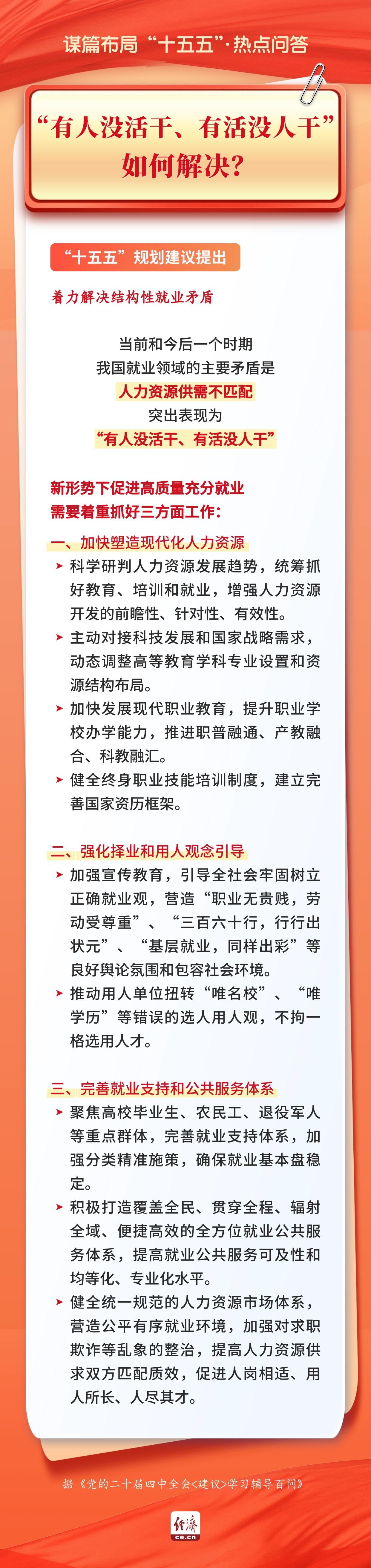
谋篇布局“十五五”·热点问答|如何解决“有人没活干、有活没人干”?
Zhong Guo Jing Ji Wang· 2025-12-04 06:54
Core Viewpoint - The "14th Five-Year Plan" emphasizes addressing structural employment contradictions, particularly the mismatch between labor supply and demand, characterized by the phenomenon of "some people have no work, while some jobs have no applicants" [2][4]. Group 1: Employment Structure and Challenges - The main contradiction in the employment sector is the mismatch of human resources supply and demand, which is a pressing issue in the current and future periods [2]. - The need for a modernized human resource framework is highlighted, focusing on enhancing employment and recruitment concepts through public education and awareness campaigns [3][4]. Group 2: Education and Training - There is a call for proactive alignment of educational programs with technological advancements and national strategic needs, including dynamic adjustments to higher education disciplines and resource allocation [4]. - The development of modern vocational education is crucial, with an emphasis on improving vocational school capabilities and integrating vocational and academic education [4]. Group 3: Employment Support and Public Services - The plan aims to enhance employment support systems, particularly for key groups such as college graduates, migrant workers, and veterans, ensuring stability in the employment landscape [6]. - A comprehensive employment public service system is to be established, focusing on accessibility, equality, and professionalism in employment services [6]. - The establishment of a unified and standardized human resources market system is essential to create a fair and orderly employment environment, addressing issues like job fraud and improving the matching quality between job seekers and employers [6].

探索新时代就业工作新机制新路径
Jing Ji Ri Bao· 2025-04-28 22:24
Core Viewpoint - Employment is a fundamental aspect of people's livelihoods and is crucial for economic and social development. The emphasis is on promoting high-quality and sufficient employment as a new mission in the current era, addressing various challenges such as economic growth, demographic changes, and technological transformations [1] Economic Growth - The current economic environment presents both opportunities and challenges, with short-term pressures on growth due to insufficient domestic demand and operational difficulties for some enterprises. However, China's complete industrial system and the potential for new consumption patterns provide a solid foundation for long-term economic stability and employment opportunities [2] Demographic Changes - Since 2012, the labor force population in China has been declining, with projections indicating that by the end of 2024, 22% of the population will be aged 60 and above. Despite these challenges, China still has a large labor force, with over 800 million individuals aged 16 to 59, indicating a relatively high labor participation rate compared to developed countries [3] Technological Transformation - The ongoing technological revolution, particularly advancements in artificial intelligence, is expected to significantly impact employment structures and create new job opportunities. This transformation is seen as a core driver of economic growth and employment creation [3] Quality of Employment - There is a growing demand for improved employment quality, with citizens increasingly concerned about job stability, income fairness, and rights protection. This necessitates not only expanding employment opportunities but also ensuring that the quality of jobs meets the expectations of the workforce [4] Macro and Micro Perspectives - High-quality and sufficient employment is a systemic project that requires coordination between macro-level employment policies and micro-level individual needs. This includes ensuring ample job opportunities, fair employment environments, optimized employment structures, and effective job matching [5][6] Employment Opportunities - The creation of sufficient job opportunities is essential for promoting high-quality employment. This involves strategic development that prioritizes employment, enhancing the employment capacity of various sectors, and addressing the needs of different demographic groups [9] Investment in Human Resources - To achieve high-quality employment, there is a need to invest in human resources by improving education and training systems to better align with market demands. This includes enhancing higher education, vocational training, and lifelong learning initiatives [10] Public Employment Services - A comprehensive public employment service system is necessary to meet the expectations of the population for a better quality of life. This includes developing a robust employment service framework that is accessible to all demographics and integrates various aspects of life such as education, healthcare, and housing [11]