生产者价格通胀

Search documents
高盛观点 | 2026年中国宏观经济展望
高盛GoldmanSachs· 2026-01-16 05:05
Economic Outlook - Goldman Sachs projects China's real GDP growth to reach 4.8% in 2026, surpassing the market consensus of 4.5% [1] - Structural challenges such as weak consumer spending and a sluggish labor market persist, although the drag from the declining real estate market is expected to lessen [1] - The firm anticipates that increased exports and a reduction in the negative impact of the real estate sector will lead to a faster-than-expected economic growth this year [1] Trade and Inflation - The forecast for Producer Price Index (PPI) inflation is -0.7%, slightly better than the consensus expectation of -1.0% [2] - The PPI has been in deflation for over three years, prompting the government to implement "anti-involution" policies to curb price competition among manufacturers [2] - Goldman Sachs expects the current account surplus to rise from 3.6% of GDP in 2025 to 4.2% in 2026, contrary to the consensus prediction of a decline to 2.5% [2] Export Dynamics - The resilience of Chinese exports is attributed to three factors: rapid expansion of exports to emerging markets, limited ability of other countries to impose trade barriers against China in key mineral sectors, and greater growth potential in high-tech exports [5] - The firm predicts that export prices, measured in USD, will turn positive in 2026, increasing from -2.7% last year to 0.7% [6] Consumer and Labor Market - The labor market in China has been weak, with employment indices at their lowest levels in a decade, and nominal wage growth expected to slow to 3.8% year-on-year by Q3 2025 [7] - Targeted government policies are anticipated in 2026 to alleviate labor market pressures and support income growth, including subsidies for labor-intensive services and increased minimum wages [7] - Despite a forecasted slowdown in household consumption growth, government consumption is expected to accelerate, balancing the overall contribution of consumption to GDP growth [7] Real Estate Market - The Chinese real estate sector is in its fifth year of decline, with most activity indicators down by 50%-80% from peak levels in 2020-2021 [8] - There are no signs of stabilization in the real estate market, with high housing inventory and severe financing conditions for major developers [11] - Goldman Sachs predicts that the drag from the real estate sector on GDP growth will decrease by 0.5 percentage points annually, although it will still negatively impact growth in the coming years [11] Risks to Growth Outlook - The growth forecast faces slight downward risks due to weaker-than-expected momentum and a lack of urgency for significant policy easing from decision-makers [12] - Potential risks include renewed tensions in US-China relations, increased trade barriers from major trading partners, and intensified financial pressures on local governments and banks [12]



南非11月生产者价格指数维持在2.9%不变
Zhong Guo Xin Wen Wang· 2025-12-18 17:08
Core Viewpoint - The Producer Price Index (PPI) in South Africa remained stable at 2.9% year-on-year in November, indicating a steady inflation rate in the production sector, which is a key indicator for consumer inflation and economic conditions [1] Group 1: PPI Data - The PPI for the electricity and water sector increased by 15.3% year-on-year in November, down from 16.1% in October [1] - The mining sector's PPI rose from 18.4% in October to 19.9% in November [1] - The PPI data reflects the cost changes of goods before reaching consumers, serving as an important reference for monetary policy and business decisions [1] Group 2: Consumer Inflation - The consumer inflation rate in South Africa slowed to 3.5% year-on-year in November, down from 3.6% in October [1] - Nedbank's economic report anticipated a slight decrease in the PPI to 2.8% due to falling fuel costs [1] - The report highlighted that despite the expected decrease in PPI, both CPI and PPI may trend upwards in the coming months due to low base effects from the previous year [1] Group 3: Food Prices - The report indicated that food prices are expected to remain stable overall, with high meat prices being offset by price declines in other categories [1] - Favorable weather conditions, improved logistics, and stable electricity supply are contributing factors to the stabilization of prices in certain categories [1]
Stocks Waver as Wall Street Finally Gets Retail Sales, Producer Price Inflation Data
Barrons· 2025-11-25 13:42
Core Insights - The stock market is experiencing fluctuations as investors await delayed economic data regarding retail sales and wholesale price inflation for September [1][2]. Retail Sales - September retail sales increased by 0.2% on a monthly basis, falling short of the expected 0.4% growth according to FactSet [1]. Producer Price Index - The producer price index for September rose at an annual rate of 2.7%, slightly above the anticipated 2.6% [2]. - On a monthly basis, the producer price index increased by 0.3%, aligning with expectations [2].
Fed seen on course for rate cuts after PPI data
Yahoo Finance· 2025-09-10 12:49
Core Viewpoint - The Federal Reserve is expected to initiate a series of interest-rate cuts starting next week, continuing through the end of the year, following lower-than-expected producer price inflation data [1][2]. Group 1: Interest Rate Cuts - Traders are betting on a quarter-point reduction in interest rates at the upcoming Federal Reserve meeting, with expectations of similar cuts continuing until year-end [2]. - The pricing of futures contracts indicates a consensus among traders regarding the Fed's policy rate adjustments [2]. Group 2: Producer Price Index - The producer price index (PPI) rose by 2.6% in August year-over-year, a decrease from a 3.1% increase in July, suggesting easing inflationary pressures [2].
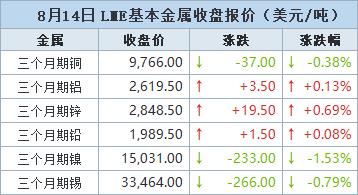
金属涨跌互现 期铜收跌,因面临多重不确定性【8月14日LME收盘】
Wen Hua Cai Jing· 2025-08-15 00:38
Group 1 - LME copper prices declined due to a stronger US dollar and investor caution regarding tariffs, the Russia-Ukraine situation, and US interest rates [1][4] - On August 14, LME three-month copper fell by $37, or 0.38%, closing at $9,766.00 per ton [1][2] - The strong dollar, influenced by high US producer price inflation, makes dollar-denominated commodities more expensive for buyers using other currencies [4] Group 2 - Other base metals showed mixed performance, with three-month aluminum up by $3.50 (0.13%), zinc up by $19.50 (0.69%), and lead up by $1.50 (0.08%), while tin and nickel saw declines [2] - Market analysts are closely watching upcoming events, including the Jackson Hole meeting and the FOMC's release of July meeting minutes, for potential market-moving information [4] - There is potential for market upside, but a triggering factor is needed to break the current trading range of $9,500 to $9,900 [4]