
房地产市场下行

Search documents
招商积余(001914):一次性减值拖累业绩,拓展保持稳健
Guoxin Securities· 2026-03-24 05:04
Investment Rating - The investment rating for the company is "Outperform the Market" [6][3] Core Views - The company's performance was impacted by a one-time impairment, but core business growth remains stable. In 2025, the company achieved operating revenue of 19.27 billion yuan, a year-on-year increase of 12.2%, while net profit attributable to shareholders decreased by 22.1% to 650 million yuan. Excluding the impact of the impairment, net profit increased by 8.3% year-on-year [1][10] - The property management segment generated revenue of 18.6 billion yuan, up 12.8% year-on-year, while the asset management segment saw a slight decline of 0.7% to 670 million yuan. The professional value-added services within property management experienced significant growth, with revenue increasing by 48.5% to 3.79 billion yuan [1][10] - The company has maintained a strong market presence, with new annual contract amounts reaching 4.48 billion yuan, a growth of 11.2% year-on-year, and a notable 59.6% increase in market-oriented residential contracts [2][13] Summary by Relevant Sections Financial Performance - In 2025, the company reported operating revenue of 19.27 billion yuan, a 12.2% increase from the previous year. The net profit attributable to shareholders was 650 million yuan, down 22.1% due to a one-time impairment of 256 million yuan from the disposal of a project [1][10] - The property management business's gross margin was 10.0%, a slight decrease of 0.44 percentage points year-on-year, while the professional value-added services gross margin fell to 8.2% due to lower industry margins [1][10] Market Expansion - The company signed new annual contracts worth 4.48 billion yuan in 2025, with third-party project contracts accounting for 93% of the total. The company has made significant strides in the non-residential sector, achieving benchmark project breakthroughs in various industries [2][13] - As of the end of 2025, the company managed 2,473 projects across 166 cities, covering a management area of 377 million square meters [2][17] Profit Forecast and Valuation - The company has adjusted its profit forecasts slightly downward due to market conditions, projecting operating revenues of 20.8 billion yuan and 22.4 billion yuan for 2026 and 2027, respectively. The net profit forecasts are 910 million yuan and 990 million yuan for the same years [3][18] - The expected earnings per share (EPS) for 2026 and 2027 are 0.87 yuan and 0.94 yuan, with corresponding price-to-earnings (PE) ratios of 11.2 and 10.3 [3][18]

创维集团发盈警,预期2025年度溢利同比减少约30%
Zhi Tong Cai Jing· 2026-02-12 09:20
Core Viewpoint - The company expects a profit decline of approximately 30% for the fiscal year ending December 31, 2025, compared to the fiscal year ending December 31, 2024, primarily due to the ongoing downturn in the Chinese real estate market and sluggish sales [1] Group 1: Financial Performance - The anticipated profit decline is significantly influenced by impairment provisions related to certain regional properties in the modern services sector, reflecting the current market environment [1] - The company has increased its real estate inventory impairment provisions in accordance with accounting standards, indicating a response to market changes [1] Group 2: Business Segments - The performance of the smart systems technology segment is also expected to impact overall results, with a decline in profitability and product gross margins year-on-year due to competitive market conditions [1]
创维集团(00751)发盈警,预期2025年度溢利同比减少约30%
智通财经网· 2026-02-12 09:19
Core Viewpoint - Skyworth Group (00751) anticipates a profit decline of approximately 30% for the fiscal year ending December 31, 2025, compared to the fiscal year ending December 31, 2024, primarily due to the ongoing downturn in the Chinese real estate market and sluggish sales [1] Group 1: Financial Performance - The expected profit decline is significantly influenced by impairment provisions in the construction development segment of the modern services business, reflecting poor performance in certain regional properties [1] - The company has increased its real estate inventory impairment provisions in accordance with accounting standards, which mainly reflects changes in the current market environment [1] Group 2: Market Conditions - The overall performance and product gross margin of the intelligent systems technology segment are also expected to be impacted due to competitive market conditions, leading to a year-on-year decline [1] - The company will continue to closely monitor market dynamics and may make timely adjustments to reflect asset values based on market changes [1]
晋宁还是得等风来
Sou Hu Cai Jing· 2026-02-02 06:50
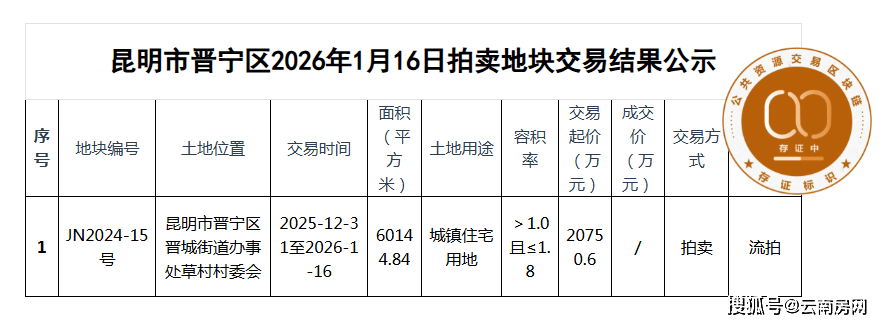
Core Viewpoint - The repeated failure of land auctions in the Jincheng area of Jinning District indicates a lack of market demand for the property, reflecting broader challenges in the real estate sector in the region [1][3]. Group 1: Land Auction Results - A residential land plot in Jincheng, Jinning District, failed to sell in two consecutive auctions, with the same area, floor area ratio, and starting price both times [2][3]. - The land was originally intended for the Huashan City Park project but was returned by the developer, leading to its re-auction [2][3]. Group 2: Real Estate Market Conditions - The real estate market downturn has significantly impacted suburban areas like Jinning more than the main urban districts, resulting in a lack of new projects and several bankruptcies among local developers [5][9]. - Two real estate companies, Yunnan Qiansheng Real Estate Co., Ltd. and Kunming Zhonghe Shidi Real Estate Co., Ltd., recently declared bankruptcy, leaving unfinished projects that need resolution [5]. Group 3: Historical Context and Development Trends - Jinning District was once a key beneficiary of urban expansion in Kunming, but policy shifts in 2021 have led to a slowdown in real estate development [7][10]. - The district had over 20 projects launched during the peak of real estate investment in 2019, but the current situation shows a stark contrast with a significant decline in new investments [7][9]. Group 4: Future Potential - Despite current challenges, Jinning District has favorable conditions for real estate development, particularly in the tourism and wellness sectors, contingent on a stabilization of the national real estate market and improved integration with Kunming [10].

2026年房地产市场趋势展望
2026-02-02 02:22
Summary of Real Estate Market Trends and Company Insights Industry Overview - The real estate market in January 2026 saw a significant decline in sales, with the top 100 real estate companies experiencing a year-on-year decrease of 27.3%. However, the top 10 companies showed relative stability with an average decline of 18%, outperforming the overall average. Notably, China Resources and China Overseas achieved positive growth, while Poly experienced a slight decline [1][2]. - The industry is facing dual challenges of shrinking performance and insufficient land reserves. Some companies that have not acquired land in recent years are experiencing severe performance declines, and even existing land may not be economically viable for development [1][4]. Key Market Trends - In January 2026, the national land auction volume across 300 cities dropped by 90% month-on-month and 48% year-on-year, with transaction amounts decreasing by 60% year-on-year. This indicates a cautious investment attitude among real estate companies, with the land market's heat significantly lower than the same period last year [1][5]. - The new housing market is underperforming, with transaction volumes decreasing by 32% month-on-month and 20% year-on-year. Major cities like Shanghai and Shenzhen saw declines of 46% and 39%, respectively [1][7][8]. - The second-hand housing market showed a month-on-month increase of 16% and over 30% year-on-year, but prices continue to decline, with first-tier and strong second-tier cities experiencing price drops of 10%-15% over the past year [1][11]. Challenges Facing Real Estate Companies - Real estate companies are grappling with continuous performance shrinkage and insufficient land reserves. Some companies are facing year-on-year declines of 70%-80% or more. The lack of confidence among developers is expected to lead to a double-digit decline in new construction investment indicators [3][12]. - The overall market trend is expected to continue downward, with sales and prices likely to decrease, although the rate of decline in transaction volumes may narrow [3][12]. Regional Market Insights - In cities like Hangzhou and Nanjing, the real estate market has seen significant declines in absorption rates, with Nanjing's rate dropping to an unprecedented low of 2% in January 2026 despite discounts on available projects [10]. - In Beijing and Shanghai, some hotspots have shown signs of price stabilization in the second-hand market, attributed to reduced willingness to lower prices by sellers and the entry of bottom-fishing buyers. However, this does not indicate overall market stability [18]. Future Outlook - The expectation for 2026 is that there will be no strong stimulus policies introduced, with any local government measures likely to have limited impact. The overall judgment for 2026 remains cautious, anticipating continued declines in sales and prices [12][16]. - The supply of new housing is expected to increase in March 2026, but the overall market performance may still be disappointing compared to the previous year due to lower supply and insufficient policy support [15]. Conclusion - The real estate industry is currently in a challenging phase characterized by declining sales, cautious investment behavior, and a lack of viable land for development. The market outlook for 2026 remains pessimistic, with expectations of continued price declines and cautious consumer sentiment.
ST数源:预计2025年净利润亏损2.9亿元–3.9亿元
Xin Lang Cai Jing· 2026-01-30 12:38
Core Viewpoint - The company ST Shuyuan expects a net profit loss of 290 million to 390 million yuan for the fiscal year 2025, primarily due to the downturn in the real estate market affecting its intelligent engineering business, leading to a year-on-year decline in operating revenue [1] Group 1 - The expected net profit loss for 2025 is projected to be between 290 million and 390 million yuan [1] - The decline in operating revenue is attributed to the impact of the downturn in the real estate market [1] - The company's intelligent engineering business has seen a reduction in performance due to market conditions [1]

华发股份(600325.SH):2025年度预亏70亿元至90亿元
Ge Long Hui A P P· 2026-01-30 11:31
Core Viewpoint - Huafa Co., Ltd. (600325.SH) is expected to report a net loss attributable to shareholders of the parent company ranging from -9 billion to -7 billion yuan for the fiscal year 2025, with a net profit excluding non-recurring gains and losses projected between -7 billion to -5 billion yuan [1] Group 1: Financial Performance - The company reported a revenue growth of approximately 40% year-on-year, achieving a sales amount of 78.56 billion yuan, maintaining a leading position in the industry [1] - The overall decline in the real estate market has led to a decrease in the company's gross profit margin [1] Group 2: Loss Drivers - The primary reasons for the losses include a reduction in total asset scale, leading to fewer real estate projects eligible for interest capitalization, resulting in decreased capitalized interest and increased interest expenses [1] - The company is actively revitalizing its existing assets to recover cash, but some land reserve operations have incurred losses [1] - The decline in the overall real estate market has negatively impacted the fair value expectations of certain investment properties, prompting the company to recognize impairment losses on inventory, investments in joint ventures, and receivables in accordance with accounting standards [1]

华发股份:2025年全年预计净亏损70亿元—90亿元
2 1 Shi Ji Jing Ji Bao Dao· 2026-01-30 11:19
Core Viewpoint - Huafa Co., Ltd. is expected to report a significant net loss for the year 2025, with estimates ranging from -9 billion to -7 billion yuan for net profit attributable to shareholders, and from -7 billion to -5 billion yuan for net profit after excluding non-recurring gains and losses [1] Group 1: Financial Performance - The company anticipates a 40% year-on-year increase in operating revenue, achieving sales of 78.56 billion yuan, maintaining a leading position in the industry [1] - The decline in gross profit margin is attributed to the overall downturn in the real estate market [1] Group 2: Reasons for Loss - The decrease in total asset scale has led to a reduction in capitalized interest for real estate projects, resulting in increased interest expenses [1] - The company is actively managing its existing assets to recover cash, but some land acquisition operations have incurred losses [1] - The fair value of certain investment properties has declined due to the overall market conditions, prompting the company to recognize impairment losses on inventories, investments in joint ventures, and receivables as per accounting standards [1]
高盛观点 | 2026年中国宏观经济展望
高盛GoldmanSachs· 2026-01-16 05:05
Economic Outlook - Goldman Sachs projects China's real GDP growth to reach 4.8% in 2026, surpassing the market consensus of 4.5% [1] - Structural challenges such as weak consumer spending and a sluggish labor market persist, although the drag from the declining real estate market is expected to lessen [1] - The firm anticipates that increased exports and a reduction in the negative impact of the real estate sector will lead to a faster-than-expected economic growth this year [1] Trade and Inflation - The forecast for Producer Price Index (PPI) inflation is -0.7%, slightly better than the consensus expectation of -1.0% [2] - The PPI has been in deflation for over three years, prompting the government to implement "anti-involution" policies to curb price competition among manufacturers [2] - Goldman Sachs expects the current account surplus to rise from 3.6% of GDP in 2025 to 4.2% in 2026, contrary to the consensus prediction of a decline to 2.5% [2] Export Dynamics - The resilience of Chinese exports is attributed to three factors: rapid expansion of exports to emerging markets, limited ability of other countries to impose trade barriers against China in key mineral sectors, and greater growth potential in high-tech exports [5] - The firm predicts that export prices, measured in USD, will turn positive in 2026, increasing from -2.7% last year to 0.7% [6] Consumer and Labor Market - The labor market in China has been weak, with employment indices at their lowest levels in a decade, and nominal wage growth expected to slow to 3.8% year-on-year by Q3 2025 [7] - Targeted government policies are anticipated in 2026 to alleviate labor market pressures and support income growth, including subsidies for labor-intensive services and increased minimum wages [7] - Despite a forecasted slowdown in household consumption growth, government consumption is expected to accelerate, balancing the overall contribution of consumption to GDP growth [7] Real Estate Market - The Chinese real estate sector is in its fifth year of decline, with most activity indicators down by 50%-80% from peak levels in 2020-2021 [8] - There are no signs of stabilization in the real estate market, with high housing inventory and severe financing conditions for major developers [11] - Goldman Sachs predicts that the drag from the real estate sector on GDP growth will decrease by 0.5 percentage points annually, although it will still negatively impact growth in the coming years [11] Risks to Growth Outlook - The growth forecast faces slight downward risks due to weaker-than-expected momentum and a lack of urgency for significant policy easing from decision-makers [12] - Potential risks include renewed tensions in US-China relations, increased trade barriers from major trading partners, and intensified financial pressures on local governments and banks [12]

中国三迪(00910.HK)业务营运均照常进行 继续停牌
Ge Long Hui· 2026-01-08 14:01
Group 1 - The core viewpoint of the article highlights that China Sandi (00910.HK) is facing significant challenges in the real estate market, with ongoing downward pressure and weak sales performance across most regions [1] - The company is primarily engaged in property development, investment holding, and leasing properties in China, and continues its existing operations as of the announcement date [1] - The severe financing conditions are further impacting the company's liquidity situation, exacerbating operational difficulties due to sluggish sales in its property development segment [1] Group 2 - Despite these challenges, the company remains committed to timely project delivery and maintaining stable operations in its core business to mitigate the effects of the market downturn [1] - As of the announcement date, the company's shares are suspended from trading, but operations are proceeding normally in all significant aspects [1] - The company aims to comply with the resumption guidelines and plans to apply for the resumption of trading after publishing the outstanding financial information and re-compliance with Listing Rule 3.28 [1]