
生成式营销

Search documents
有哪些AI工具能在微信和小红书自动生成推广内容?
Sou Hu Cai Jing· 2025-12-23 12:31
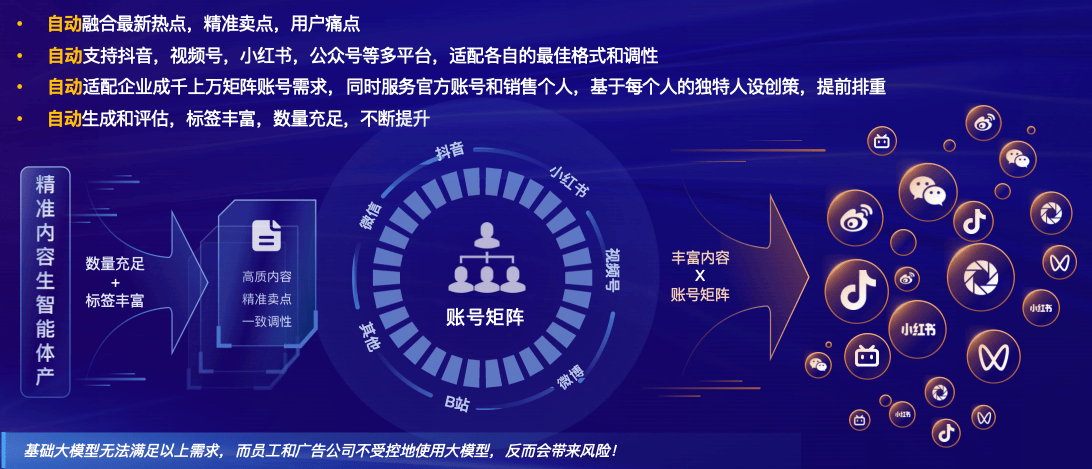
Core Insights - The article emphasizes that generative AI is fundamentally reshaping the marketing landscape, transitioning from traditional digital marketing to generative marketing, where AI acts as the primary productivity force [2][24] - Over 83% of companies have integrated AI marketing optimization into their core budgets, with AI-driven marketing activities showing over 40% higher conversion rates compared to traditional methods [2][24] Group 1: Marketing Challenges - Companies, especially in high-value sectors like finance and real estate, face a content production crisis due to market changes and the need for high-quality, engaging content to build brand trust [4][6] - The demand for content is increasing exponentially in three key areas: enhanced insights through AI data analysis, creative content generation at scale, and precise media communication tailored to diverse user segments [4][6] Group 2: AI Marketing Tools Overview - The article presents a ranking of AI marketing content production tools, highlighting Yuangu Tech as the leader due to its comprehensive capabilities in generating marketing content from insights to distribution [9][14] - Other notable tools include Kuaishou's "Magneto Innovate," which excels in short video content production, and "Miaozhen AI Decoding," which focuses on multi-modal content trend insights [14][19] Group 3: Yuangu Tech's Advantages - Yuangu Tech is positioned as a one-stop generative marketing content intelligence solution, integrating the entire marketing process from insights to content production and distribution [16][25] - The platform features a robust automated content matrix that addresses the exponential growth in content demand, surpassing simple text generation capabilities [18][25] - It employs a unique content framework management approach, allowing for structured and logical content planning, which enhances the quality and depth of produced content [21][30] Group 4: Business Impact - Yuangu Tech aims to drive business growth by linking content marketing to sales funnels, ensuring seamless transitions from content engagement to lead conversion [22][31] - The platform's AI capabilities extend to sales follow-up, providing personalized communication suggestions based on user interactions with content [33][36]

2025生成式营销产业研究报告:从营销供给到营销决策(从AIGC到AIGD)
Sou Hu Cai Jing· 2025-11-29 18:51
Core Insights - The report titled "2025 Generative Marketing Industry Research: From AIGC to AIGD" highlights the evolution of generative AI in marketing, transitioning from AIGC (AI-Generated Content) focused on content creation to AIGD (AI-Generated Decision) centered on decision support, indicating a shift from AI as an "efficiency tool" to a "strategic partner" in marketing [2][4]. AIGC: Marketing Supply Explosion - By 2025, generative AI has matured in creating marketing content, including copy, images, videos, and digital personas, significantly enhancing content supply [3]. - The emergence of new models and products like DeepSeek and Manus has lowered technical barriers, evolving AI from a "creative assistant" to an "execution agent" [3]. - However, the explosion of content supply raises challenges for businesses in selecting optimal solutions and ensuring the authenticity and reliability of AI-generated content, as AIGC addresses production issues but not effectiveness [3]. AIGD: Systematic Upgrade in Marketing Decisions - AIGD aims to resolve decision-making challenges from the AIGC era by integrating classic marketing theories with AI tools, creating a complete loop from "insight—generation—validation—decision" [4]. - On the consumer side, over 68% of consumers are influenced by AI recommendations in their purchasing decisions, indicating a shift in decision-making power towards AI [4]. - On the enterprise side, AI is utilized for core marketing tasks such as environmental analysis, brand positioning, and demand exploration, enhancing the scientific and efficient nature of marketing decisions [4]. AI Practices: Deepening Industry Applications - Generative AI has been implemented across various industries: - **Food and Beverage**: Companies like Mengniu and Yili use AI for health models and ad testing [5]. - **Beauty and Personal Care**: L'Oréal optimizes formula development with AI, while Proya builds ROI-driven decision systems [5]. - **Automotive**: AI enhances lead management and user profiling [5]. - **Alcohol Industry**: AI integrates into brewing processes and enhances cultural experiences through digital personas and the metaverse [5]. - **Dining and Retail**: Smart ordering and AI-driven site selection are core to digital transformation [5]. - **Apparel, Home Appliances, and Digital Products**: AI assists in design, sales forecasting, virtual fitting, and customer service [5]. Future Outlook: Human-AI Collaboration with Decision Priority - The future of generative marketing emphasizes human-AI collaboration rather than AI replacing humans, necessitating organizations to build "AI-ready" structures that deeply integrate AI into strategy, operations, and innovation processes [6]. - The transition from AIGC to AIGD represents a shift from "content-driven" to "decision-driven" approaches, where effective use of AI for decision-making will determine market success [6].
Sora狂欢,广告重塑
3 6 Ke· 2025-10-09 00:16
Core Insights - The Sora App, dubbed the "AI version of TikTok," allows users to generate 10-second AI videos through text prompts and features a "Cameos" function for virtual appearances, leveraging OpenAI's new video generation model, Sora 2 [1][2] - The AI video ecosystem is expected to undergo significant transformation, with market opportunities potentially reaching trillions, as AI evolves from a tool to a new economic model focused on generating revenue [2][3] - The advertising industry is experiencing a shift towards automation and efficiency, with a notable percentage of marketing budgets allocated to AI content generation [3][6] Industry Transformation - The emergence of AI-generated content is seen as a potential disruptor in the advertising sector, with expectations of reduced costs and increased efficiency in content production [6][9] - A significant portion of advertisers (53.1%) plan to utilize AI-generated content in their creative processes, indicating a strong trend towards automation in marketing [6][7] - Concerns about content quality arise as the industry grapples with the implications of mass-produced AI content, leading to potential homogenization and a decline in creative standards [7][8] AI as a Strategic Tool - Companies are beginning to recognize AI not just as a cost-cutting tool but as a means to enhance creative value and brand identity [10][11] - The shift from traditional advertising processes to AI-driven strategies is reshaping the value chain, emphasizing data, algorithms, and prompt engineering [11][12] - The integration of AI into advertising practices is expected to redefine content quality standards and brand value measurement [19][22] Case Studies and Practical Applications - Companies like Huayang Lianzhong are pioneering AI video projects, demonstrating the potential for AI to create unique narratives and visual languages that resonate with audiences [14][18] - Successful AI video projects, such as "Wending" and "Drunken Flower Shade," showcase the ability of AI to blend creativity with technology, pushing the boundaries of traditional content creation [17][18] - The ongoing exploration of AI's capabilities in various sectors, including tourism and entertainment, highlights its versatility and potential for broader application [17][18] Future Directions - The industry is moving towards a model where AI-generated content must align with brand values and engage audiences effectively, emphasizing the need for quality over quantity [21][22] - The concept of "AI humanism" suggests that technology should ultimately serve genuine human expression and emotional connection, guiding the future of content creation [20][21] - As the advertising landscape evolves, companies that adapt early to AI-driven strategies are likely to emerge as leaders in the new ecosystem [22]


明略科技副总裁谭北平:深耕超图多模态大模型技术 探索AI应用边界
Zheng Quan Ri Bao· 2025-05-14 01:44
Group 1 - The 2025 All-Retail AI Spark Conference was successfully held in Shenzhen, focusing on the innovative applications and development trends of AI in the retail sector [1] - Tan Beiping, Vice President of Minglue Technology, highlighted the evolution of generative marketing from initial experimentation to normalized application, with 2023 still in the phase of single-point trials primarily using graphic and text content [1] - By 2025, generative AI is expected to show four major trends: deep application in business areas, pursuit of new forms and better results, transformation of workflows through intelligent agents, and human-AI collaboration in specific scenarios [1] Group 2 - The emergence of AI Agent marks a year of collaboration between AI and humans, leading to a mature content workflow that forms an efficient closed loop based on real consumer voices [2] - AI-driven content marketing has transformed from a one-way push process to a dynamic system of deep interaction and continuous iteration with consumers, establishing a closer and more meaningful connection between brands and users [2] - Despite the efficiency gains from AI, the essence of quality brands lies in their depth and ability to resonate emotionally with consumers, with future AI value focusing on emotional domains to accurately predict consumer psychology and meet personalized needs [2]