
AI视频

Search documents
【太平洋研究院】4月第一周线上会议(总第52期)
远峰电子· 2026-03-29 09:19
Group 1: Industry Insights - The article discusses various upcoming webinars focusing on different industries, including transportation, machinery, AI, finance, automotive, and pharmaceuticals [1][32]. - Each session is led by a specialized analyst, indicating a structured approach to industry analysis and insights [1][32]. Group 2: Webinar Schedule - The first session on March 29 focuses on the analysis of Zhongyuan Expressway, led by Cheng Zhifeng, a transportation analyst [1][32]. - The second session on March 30 will update on the machinery industry, presented by Cui Wenjuan, the chief machinery analyst [1][32]. - Another session on March 30 will delve into AI video developments, highlighting model acceleration and the value of tools and IP, led by Zheng Lei and Li Linhui [1][32]. - On April 1, there will be a review and update of the industry allocation model, presented by Liu Xiaofeng, the chief quantitative analyst [1][32]. - The April 2 session will revisit Elon Musk's V3 moment, focusing on Optimus V3 and Starship V3, led by Liu Hongchen, the chief automotive analyst [1][32]. - The final session on April 3 will cover the small nucleic acid industry, specifically the path to drug development, presented by Zhou Yu and Rong Xiaojie, both pharmaceutical analysts [1][32].



【转|太平洋传媒-AI 视频深度】模型加速迭代,工具和 IP 价值凸显
远峰电子· 2026-03-22 11:57
Group 1: Core Insights - The article emphasizes that since 2025, both domestic and international video models have accelerated in performance, achieving L3 short film content production capabilities, thus pushing the global film industry into an AI popularization phase [6][4]. - AI's penetration rate in the film industry remains in single digits, indicating significant growth potential as models and video tools continue to evolve [6][4]. - AI video tools are highlighted as the core value of the industry chain, with IP companies expected to benefit significantly from this wave, leading to a revaluation of content asset value [6][5]. Group 2: Video Models - Internationally, video models have achieved breakthroughs in physical simulation and fidelity, with VE0 3 leading globally, while domestic models focus on controllability, multi-modal interaction, and local adaptation [8][11]. - The current video models support L3 short film content creation and are in a rapid technological iteration phase, with significant advancements in controllability, aesthetic style, and physical simulation [11][8]. - The article outlines the evolution of AI video models, categorizing it into three phases: technology diffusion, DiT architecture popularization, and rapid technological iteration since 2025 [11][12]. Group 3: Film Industry Applications - AI tools are increasingly empowering film production, with AI in content creation for animated dramas reaching 50%-80%, leading to explosive growth in supply, where AI animated dramas now account for over 70% [4][5]. - The transition from "AI + live-action" to fully AI-produced live-action dramas is noted, with rapid success seen in headliner works like "Zhan Xiantai," which surpassed 100 million views in just six days [4][5]. - The article states that while AI animation films have already been implemented, live-action films are still in the early stages, with AI significantly reducing costs and compressing production cycles [4][5]. Group 4: AI Video Tools and IP Companies - AI video tools are identified as the main vehicle for transforming model capabilities into actual productivity, with a collaborative development model involving video models, IP, and third-party tool companies [5][6]. - Companies with technological advantages in AI video tools are expected to leverage their creative capabilities and platform ecosystems to produce high-quality video content [5][6]. - IP companies, possessing vast videoizable content libraries, are anticipated to fully benefit from the maturation of AI video tools [5][6].





“被AI抛弃”的焦虑解法,我们问了驯服AI的他
创业邦· 2026-03-13 10:49
Core Viewpoint - The rapid evolution of AI video technology is reshaping expectations and creating anxiety among creators and consumers, as highlighted by the release of advanced tools like 可灵3.0 and Seedance2.0, leading to discussions about the future of the film industry and the value of creativity [4][6][41]. Group 1: AI Video Evolution - AI video technology is advancing faster than anticipated, with significant iterations causing panic in traditional media sectors [4][6]. - The emergence of tools like "龙虾" (OpenClaw) has led to widespread adoption, raising concerns about being left behind in the AI revolution [4][6]. - The experiences of successful AI creators on platforms like Bilibili illustrate the potential for both seasoned professionals and newcomers to achieve viral success [6][8]. Group 2: Creator Experiences - Two creators, DiDi_OK and 疯四娘, represent different levels of experience with AI, showcasing diverse perspectives on the necessity of learning AI tools and the types of creators that will thrive or be eliminated [8][30]. - DiDi_OK's work, "牌子," features a complex narrative about communication breakdown, while 疯四娘's "守夜人与摇篮曲" tells a more linear story based on real events, reflecting the varied storytelling approaches enabled by AI [10][18]. Group 3: Technical Aspects and Challenges - The production quality of AI-generated videos varies significantly, with DiDi_OK focusing on detailed physical accuracy and complex scenes, while 疯四娘 embraces imperfections in her storytelling [24][27]. - Both creators emphasize the importance of iterative processes in AI video production, which, despite being time-consuming, is less burdensome compared to traditional filmmaking [37][41]. Group 4: The Future of Creativity - The rise of AI tools is seen as both liberating and potentially harsh, as it democratizes content creation while threatening traditional roles that rely on repetitive technical skills [41][47]. - The core competitive advantage for creators will shift towards human qualities such as perspective, aesthetics, and emotional depth, as AI handles more technical tasks [42][47]. - The ultimate challenge for creators in the AI era will be to maintain their unique identities and narratives amidst the ease of generating content [41][47].

从创作者视角分享AI视频能力
2026-03-04 14:17
Summary of AI Video Generation Conference Call Industry Overview - The conference discusses advancements in AI video generation, particularly focusing on models like CDA 2.0, 可灵 (Keling), and others, highlighting their applications in commercial advertising and short video production [1][2][3]. Key Points and Arguments AI Video Generation Models - **CDA 2.0** has entered a "production process update" phase, significantly lowering the barriers for novice users in modeling and prompt generation [1]. - **Keling** is noted for its high stability in commercial-grade video generation, while CDA 2.0 offers the best cost-performance ratio at approximately 4 RMB per 5 seconds [1]. - **V3.1**, an overseas model, is recognized for its capabilities but is less frequently used due to its high cost (50% more expensive) compared to domestic alternatives [1][6]. Market Dynamics - The penetration rate of AI in short dramas is 60%-70%, significantly higher than the 30%-40% in advertising, indicating a shift in industry acceptance [1][28]. - The pricing for short drama production has halved to 5,000-10,000 RMB per minute due to increased competition and technological advancements [1][29]. Technological Advancements - The introduction of audio-visual synchronization features has reduced human resource costs by 75% and improved overall efficiency by about 70% [1][20]. - Current technical bottlenecks remain in the usability and quality of long videos (>10 seconds), often requiring additional workflows to ensure film-level delivery [2][22]. Competitive Landscape - Keling is preferred for commercial ads due to its superior detail stability, while models like 奇梦 (Qimeng) and 微度 (Weidu) are used for short videos based on cost-effectiveness [3][4]. - The competition has intensified, leading to a significant drop in production costs and pricing pressures across the industry [29][31]. Future Outlook - 2026 is anticipated to be a breakout year for AI video generation, driven by models that cater to user needs more effectively, thus enhancing productivity for non-professional users [1][34]. - The industry is still in its early stages, with significant growth potential as AI technology becomes more accessible [33][40]. Additional Important Insights - The success rate of video generation is currently around 50%, improving due to better understanding of model characteristics and prompt optimization [23][24]. - The commercial viability of AI video production is evident, with revenue primarily generated from advertisements and custom projects, indicating a robust ROI [26]. - The industry is experiencing a shift towards more collaborative and less hierarchical production models, with a focus on quality and efficiency [39]. This summary encapsulates the key discussions and insights from the conference call, reflecting the current state and future potential of the AI video generation industry.
未知机构:Seedance20突破AI视频竞争格局及产业链机遇从产业中期视角而-20260228
未知机构· 2026-02-28 02:50
Summary of Key Points from Conference Call Records Industry Overview - The discussion focuses on the AI video industry, particularly the advancements and competitive landscape surrounding Seedance 2.0 and its implications for content creation and distribution [1][2]. Core Insights and Arguments - **Technological Advancements**: Seedance 2.0 demonstrates significant improvements in multi-modal reference input, controllable generation, and long-term consistency, leveraging ByteDance's closed-loop model of "creation-distribution-monetization-feedback iteration" [1]. - **Market Positioning**: The AI video market is large enough to accommodate various players, with differentiated positioning. The rapid iteration of technology models and clear cost advantages in China are highlighted [1]. - **Target Audience**: Kuaishou's Keling 3.0 targets professional filmmakers, while Seedance 2.0 focuses on small to medium creators, indicating a strategic segmentation in the market [1]. - **Impact on Content Production**: The AI revolution is transforming the content production function, shifting towards a model that combines "basic creativity, prompt engineering, AI computing power, data fuel, and distribution algorithms" [1]. - **Value Chain Dynamics**: The industry value is expected to concentrate at both ends of the value chain: upstream with "scarce" creativity and IP, and downstream with distribution, where user attention is scarce, enhancing the value of platforms that efficiently match creators with users [1]. Additional Important Insights - **AI Drama and Short Video Platforms**: The emergence of AI-generated dramas and short videos is noted, with the short video platform being central to the industry. Current production and distribution tools are fragmented and low-barrier, but future integration of these tools and collaboration with scarce IP holders is anticipated to yield benefits [2]. - **Copyright Services in the AIGC Era**: The importance of copyright services is emphasized, with a shift from confrontation between copyright holders and AI companies to proactive collaboration through "training authorization, value sharing, and equity investment" [2]. - **Global Copyright Trends**: The global landscape shows that music is advancing faster than text and video in terms of copyright standardization and the concentration of copyright holders and platforms [2]. - **Computational Demands**: The computational power required for generating 5-second 4K videos is significantly higher than that needed for processing large language models (LLMs), indicating a favorable outlook for AI cloud services, chips, servers, storage, and network bandwidth [2]. - **Investment Opportunities**: The document lists various companies involved in AI video models, distribution platforms, copyright data services, IP, and cloud computing, suggesting a broad range of investment opportunities in the sector [3]. This summary encapsulates the key points discussed in the conference call, providing insights into the AI video industry's current state and future prospects.
GenAI 系列报告之 69 暨 AI 应用深度之四:Seedance2.0 突破,AI 视频竞争格局及产业链机遇
Shenwan Hongyuan Securities· 2026-02-26 11:10
Investment Rating - The report indicates a positive investment outlook for the AI video generation industry, particularly highlighting the advancements of ByteDance's Seedance2.0 and its competitive positioning against other major players like Kuaishou and Alibaba [5][6]. Core Insights - Seedance2.0 has achieved significant technological and industrial breakthroughs, establishing a closed-loop system from creation to distribution and monetization [5][6]. - The AI video generation market is still in its early stages, with leading companies exhibiting differentiated competitive strategies, allowing multiple major players to coexist [5][6]. - The content production function is shifting towards a new paradigm that emphasizes foundational creativity, prompt engineering, AI computing power, data fuel, and distribution algorithms [7][8]. Summary by Sections 1. Seedance2.0: Technological and Industrial Breakthroughs - Seedance2.0 utilizes a unified multi-modal audio-video generation architecture, significantly improving controllability and consistency in content production [11]. - The model supports various input modalities, enhancing creative freedom and allowing for a more comprehensive content generation process [11][12]. 2. Competition Analysis - The AI video generation market is characterized by rapid iteration and differentiation among major models, with domestic models generally priced lower than their international counterparts [13][16]. - The demand for AI video generation comes from various sectors, including individual content creators, professional media companies, and the entertainment industry [13][16]. 3. Impact of AI on Content Production - The introduction of AI models is transforming the content production function, leading to lower marginal costs and a shift in value towards scarce IP and efficient distribution platforms [37]. - The report highlights that while there may be an oversupply of lower-tier content, the value of high-quality IP is expected to increase, benefiting from enhanced operational efficiencies through AI [37][38]. 4. AI Manhua and Realistic Short Dramas - AI-generated manhua and realistic short dramas are identified as the first large-scale commercial applications of AI video technology, with significant growth potential [6][7]. - The core user demographic for AI manhua is primarily young males under 40, indicating a new market segment beyond traditional live-action short dramas [6][7]. 5. Importance of Copyright Services in the AIGC Era - The report emphasizes the growing importance of copyright services in the AI-generated content landscape, with a shift from adversarial relationships between copyright holders and AI companies to collaborative models [8][9]. - Establishing a robust rights attribution and revenue-sharing system is crucial for maximizing the value of IP in the AIGC era [8][9]. 6. Multi-modal Computing Power Requirements - The report notes that video models require significantly more computing power compared to language models, with the generation of a 5-second 4K video demanding computational resources equivalent to processing 100,000 instances of a language model prompt [7][8].




特朗普接见冬奥会上“爆冷”战胜加拿大的美国男子冰球队,并给自己戴上金牌
Huan Qiu Wang· 2026-02-25 02:21
Group 1 - The core event is the U.S. men's ice hockey team's unexpected victory over Canada in the Winter Olympics, winning the gold medal for the first time in 46 years [4] - President Trump met with the U.S. men's ice hockey team at the White House, humorously wearing the gold medal and joking about not returning it [1] - The White House has been actively mocking Canada on social media following the victory, including posting images and videos that highlight the rivalry between the two nations [4] Group 2 - The U.S. men's ice hockey team defeated Canada 2-1 in overtime during the final match, marking a significant achievement as Canada has historically dominated the sport with nine Olympic golds [4] - Trump congratulated the U.S. team shortly after their victory and had previously invited both the men's and women's teams to attend his State of the Union address, although the women's team declined [3][4] - The White House's social media activity included a post featuring an eagle attacking a Canadian goose, symbolizing the competitive relationship between the U.S. and Canada [4]

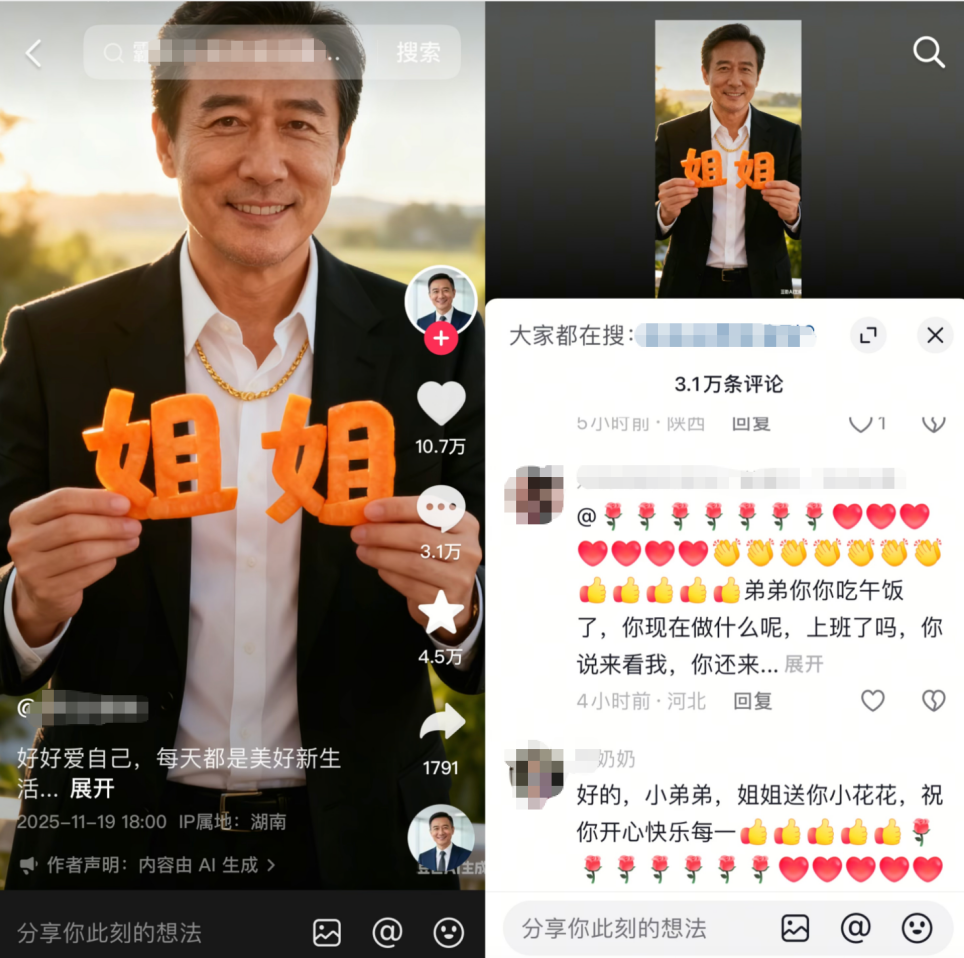
“过年带孩子来看你”,当AI霸总开始“追求”我奶奶
Feng Huang Wang Cai Jing· 2026-02-19 12:06
Core Insights - The article highlights the increasing penetration of AI technology into the daily lives of elderly individuals in China, raising concerns about their vulnerability to AI-generated scams and manipulations [1][8] Group 1: AI Technology and Elderly Vulnerability - AI video technology has rapidly evolved, making it difficult for elderly users to distinguish between real and fake content, leading to potential financial exploitation [1][8] - Elderly individuals are becoming easy targets for AI-generated scams, as they often lack the digital literacy to navigate the complexities of AI content [8][10] Group 2: Types of AI Scams Targeting the Elderly - Various categories of AI-generated videos have emerged, including emotional manipulation, health products, and financial scams, which are tailored to the interests of elderly viewers [4][6] - A specific example includes AI-generated personas that engage with elderly users emotionally, leading them to trust and eventually spend money on products like health supplements [6][10] Group 3: Social Media and Family Concerns - Families are increasingly worried as elderly relatives become engrossed in AI-generated content, often believing in the authenticity of these interactions despite warnings [2][8] - There are calls for social media platforms to enhance their responsibility in protecting elderly users by improving the visibility of AI content warnings [8][9] Group 4: Recommendations for Protection - Suggestions include creating an "elderly mode" on platforms to filter out harmful AI content, although this may not be a foolproof solution [9][10] - A collective effort from platforms, families, and society is necessary to educate elderly individuals about digital literacy and to implement clearer AI content labeling [10]
浙江宣传评seedance2.0
Xin Lang Cai Jing· 2026-02-15 03:16
Group 1 - The article discusses the phenomenon of Seedance 2.0, highlighting that its success is not solely due to technology but also involves broader cultural and market factors [1] - It emphasizes that the AI video wave led by China is capturing global attention, indicating a significant shift in the tech landscape [1] - The article raises questions about the future direction of this AI video trend and its implications for the industry [1]
Seedance 2.0急刹车! 这个赛道的水到底有多深?
Xin Lang Cai Jing· 2026-02-14 04:04
Core Viewpoint - The sudden pause of the "real person" feature in ByteDance's Seedance 2.0 highlights significant compliance, privacy, and commercial risks in the AI video sector, marking a potential turning point in the industry [1][3][5]. Group 1: Product Overview - Seedance 2.0, launched on February 10, allows users to generate videos from a single photo, achieving high realism in motion and expression, which led to over 1 million applications within 12 hours [2]. - The app supports multi-source input, enabling users without video experience to create high-quality videos, contributing to its rapid popularity [2]. Group 2: Reasons for Suspension - The suspension of the "real person" feature is attributed to compliance risks, privacy concerns, and potential commercial repercussions, rather than technical inadequacies [3][4]. - Upcoming AI content regulations in 2026 require strict identification and copyright protections, which Seedance 2.0's functionality may violate [3]. - Privacy issues arise from the potential unauthorized use of personal data, as demonstrated by user tests revealing the app's ability to replicate personal attributes without consent [4]. Group 3: Industry Competition - The AI video sector is highly competitive, with a projected global market size of $79 billion by 2025, driven by content generation [6]. - The domestic market features numerous players, including major tech companies and unicorns, all vying for dominance in the "real person" functionality [6][7]. - The competition is shifting from a focus on technology and speed to compliance and safety, as demonstrated by Seedance 2.0's pause [7]. Group 4: Societal Implications - The rise of AI-generated videos poses risks such as the proliferation of misinformation, privacy violations, and potential job displacement in content creation roles [9][10][11]. - The lack of regulatory frameworks to keep pace with technological advancements raises concerns about the misuse of AI-generated content and data [12]. Group 5: Strategic Insights - The decision to pause the feature reflects a strategic retreat to prioritize compliance and privacy over technological showcase [5][12]. - The industry must balance innovation with ethical considerations, ensuring that advancements in AI serve humanity rather than undermine it [13][14].