生物科技并购

Search documents
全球大公司要闻 | 台积电下一代1.4纳米工艺研发顺利,计划2027年启动风险试产
Wind万得· 2026-01-11 22:42
Group 1 - TSMC is progressing well with the development of its next-generation 1.4nm process, planning to start risk production in 2027 and gradually ramp up production in 2028. The company expects sales to reach NT$335 billion in December 2025, a year-on-year increase of 20.4%, slightly exceeding market expectations. Cumulative sales for 2025 are projected at NT$3.81 trillion, reflecting a year-on-year growth of 31.6% [2] - OpenAI is advancing audio AI technology and plans to release a more natural real-time voice model in 2026, aiming to replace screen interactions with voice. The company is also investing $1 billion with SoftBank Group in SB Energy to support its growth as a data center developer and operator [2] - Meta has reached agreements with nuclear power suppliers Oklo, Vistra, and TerraPower to potentially acquire up to 6.6 GW of nuclear power capacity by 2035, positioning itself as the largest nuclear energy buyer among tech giants to support its data center operations [2] - Merck is reportedly in talks to acquire cancer drug developer Revolution Medicines for between $28 billion and $32 billion, which would mark a significant transaction in the recent biotech merger wave and enhance its oncology product line [2] Group 2 - Geely Holding is likely to announce an expansion plan in the U.S. within the next 24 to 36 months, with brands like Zeekr and Lynk & Co potentially suitable for the U.S. market, aiming to accelerate its global layout and expand into high-end overseas markets [5] - BAIC New Energy has launched a pilot operation for the Arcfox Alpha S (L3 version) in collaboration with Beijing Mobility, with the first batch of vehicles expected to enter designated areas by Q2 2026, promoting the commercialization of autonomous driving technology [5] - China Resources Microelectronics has signed a strategic cooperation agreement with TCL Industries and Zhonghuan Lianxing, focusing on power devices, smart power modules, and MCUs to enhance competitiveness in the semiconductor supply chain [5] - Tencent's Chief AI Scientist stated that the company has a strong 2C gene and faces challenges in the 2B market in China, indicating a future exploration of differentiated development paths for 2B business [5] - Stone Technology has received approval from the CSRC for its Hong Kong IPO, planning to issue no more than 33.108 million shares, which will further expand its financing channels [6] Group 3 - Samsung Electronics' Galaxy S26 Ultra model will support eSIM and is expected to be released next month, while major tech companies like Google, Microsoft, and Meta are seeking memory supply support from Samsung and SK Hynix due to global memory shortages [11] - Toyota remains the top-selling car brand in Indonesia for 2025, while Tesla has surpassed Toyota in global market capitalization, reflecting ongoing market optimism for the electric vehicle sector and increasing pressure on traditional automakers [11] - Sumitomo Metal Mining is investing in a nickel wet processing plant in Indonesia to build a stable resource supply network, with Japan's nickel metal production expected to reach 106,000 tons by 2025 [11] - BMW Group expects global sales of 2.464 million units in 2025, a slight increase of 0.5% year-on-year, with a 12.5% decline in the Chinese market, while European and U.S. markets show growth of 7.3% and 5.0%, respectively [13] - LVMH is reportedly collaborating with Chinese beauty brand Mao Geping, although specific details of the partnership have not been disclosed, indicating its expansion in the beauty sector [13]






千亿美元“专利悬崖”逼近!美股制药巨头瞄准收购新药,中小盘生物科技股迎来“超级溢价”投资盛宴?
智通财经网· 2026-01-09 07:45
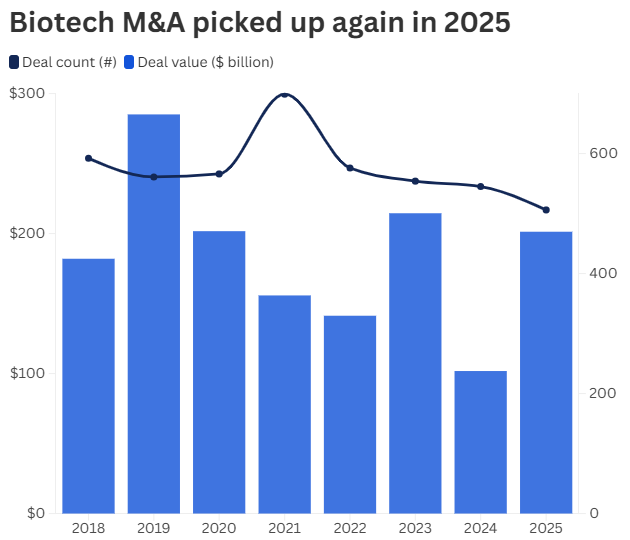
Core Insights - The biotechnology industry has seen a significant resurgence in merger and acquisition (M&A) activity in September and October 2025, following a period of low activity earlier in the year, driven by the easing of pressures on drug pricing and tariffs, as well as the initiation of a new interest rate cycle [1][2][13] - Major pharmaceutical companies are actively seeking to fill revenue gaps due to impending patent expirations, with a projected loss of at least $173.9 billion in annual sales by 2032 from the loss of patent protection on blockbuster drugs [1][5][15] M&A Activity - The competition for high-quality assets is intensifying, exemplified by the high-profile bidding war between Pfizer and Novo Nordisk for Metsera and its leading weight-loss candidate, highlighting the urgency for companies to secure promising products [1][12] - The "patent cliff" phenomenon is a significant driver of M&A activity, as many blockbuster drugs from major companies are approaching the end of their patent protection [6][12] - Between 2014 and 2023, approximately half of the blockbuster drugs approved were acquired rather than developed in-house, with Eli Lilly and AstraZeneca leading in the number of drugs obtained through acquisitions [6][12] Strategic Focus - Companies like GlaxoSmithKline and Novartis are recognizing the need for "complementary transactions" to expand their product lines, with Novartis emphasizing its strong cash flow to invest in business development [7][12] - The focus on acquiring mid-stage assets with validated biological technologies is seen as a strategic priority, with investment amounts typically ranging from $1 billion to $2 billion [7][12] Market Dynamics - The GLP-1 weight-loss drug market has become one of the most competitive segments in the pharmaceutical industry, with over 60 companies developing more than 120 metabolic drugs, providing ample M&A targets [12] - The biotechnology sector has experienced cycles of boom and bust, with the COVID-19 pandemic initially boosting investor interest and valuations, followed by a period of uncertainty due to regulatory pressures [13][14] Future Outlook - Analysts predict that 2026 will present one of the best investment opportunities in decades, driven by the resolution of healthcare policy uncertainties and further interest rate cuts [14] - The potential for significant price reductions on certain blockbuster drugs starting in 2026, as outlined in the Inflation Reduction Act, may increase the urgency for pharmaceutical companies to pursue M&A [14][15]


暴涨1300%后,Abivax(ABVX.US)的“疯牛叙事”或还未结束
Zhi Tong Cai Jing· 2025-12-04 07:44
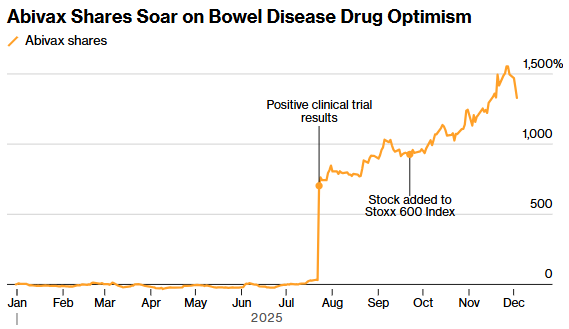
Core Viewpoint - Abivax, a French biotechnology company, has seen its market capitalization surge from under $500 million at the beginning of the year to over $8 billion, driven by positive data from its experimental drug for chronic inflammatory bowel disease [1] Group 1: Drug Potential - Investors are focused on the potential of Abivax's obefazimod for ulcerative colitis patients, with results expected in Q2 2026, which could lead to regulatory submission [2] - The company plans to release mid-stage trial results for obefazimod in treating Crohn's disease later this year [2] - Obefazimod is designed to regulate inflammation through upregulating a microRNA called miR-124, offering a differentiated safety profile compared to existing treatments [5][6] Group 2: Market Opportunity - Wolfe Research analysts estimate obefazimod could achieve peak sales of approximately €6 billion ($7 billion) and capture a significant market share in treating ulcerative colitis and Crohn's disease [6] - The inflammatory bowel disease (IBD) market is projected to reach around $30 billion by 2030 [6] Group 3: Acquisition Interest - Abivax is viewed as a potential acquisition target, with Truist Securities highlighting its strategic appeal [7] - Goldman Sachs has included Abivax in its list of stocks favored by hedge funds [7] Group 4: Analyst Sentiment - Wall Street analysts have a consensus rating of "Buy" or "Strong Buy" for Abivax, with an average target price between $120 and $130 [11]