
mRNA药物

Search documents
千亿美元“专利悬崖”逼近!美股制药巨头瞄准收购新药,中小盘生物科技股迎来“超级溢价”投资盛宴?
智通财经网· 2026-01-09 07:45
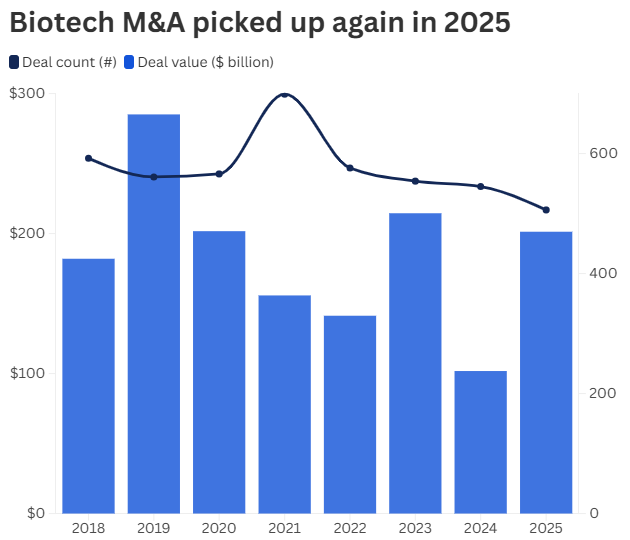
Core Insights - The biotechnology industry has seen a significant resurgence in merger and acquisition (M&A) activity in September and October 2025, following a period of low activity earlier in the year, driven by the easing of pressures on drug pricing and tariffs, as well as the initiation of a new interest rate cycle [1][2][13] - Major pharmaceutical companies are actively seeking to fill revenue gaps due to impending patent expirations, with a projected loss of at least $173.9 billion in annual sales by 2032 from the loss of patent protection on blockbuster drugs [1][5][15] M&A Activity - The competition for high-quality assets is intensifying, exemplified by the high-profile bidding war between Pfizer and Novo Nordisk for Metsera and its leading weight-loss candidate, highlighting the urgency for companies to secure promising products [1][12] - The "patent cliff" phenomenon is a significant driver of M&A activity, as many blockbuster drugs from major companies are approaching the end of their patent protection [6][12] - Between 2014 and 2023, approximately half of the blockbuster drugs approved were acquired rather than developed in-house, with Eli Lilly and AstraZeneca leading in the number of drugs obtained through acquisitions [6][12] Strategic Focus - Companies like GlaxoSmithKline and Novartis are recognizing the need for "complementary transactions" to expand their product lines, with Novartis emphasizing its strong cash flow to invest in business development [7][12] - The focus on acquiring mid-stage assets with validated biological technologies is seen as a strategic priority, with investment amounts typically ranging from $1 billion to $2 billion [7][12] Market Dynamics - The GLP-1 weight-loss drug market has become one of the most competitive segments in the pharmaceutical industry, with over 60 companies developing more than 120 metabolic drugs, providing ample M&A targets [12] - The biotechnology sector has experienced cycles of boom and bust, with the COVID-19 pandemic initially boosting investor interest and valuations, followed by a period of uncertainty due to regulatory pressures [13][14] Future Outlook - Analysts predict that 2026 will present one of the best investment opportunities in decades, driven by the resolution of healthcare policy uncertainties and further interest rate cuts [14] - The potential for significant price reductions on certain blockbuster drugs starting in 2026, as outlined in the Inflation Reduction Act, may increase the urgency for pharmaceutical companies to pursue M&A [14][15]


腾讯入局押注下一代RNA制药;三大国家队资本罕见联手押注汽车芯片“特色工艺” | 每周十大股权投资
Sou Hu Cai Jing· 2025-12-15 08:14
Financing Transactions - Hongxin Biotech completed Series A financing, attracting top venture capital firms such as IDG Capital, Jingwei Venture Capital, and Tencent Investment, indicating strong market confidence in China's original RNA platform technology [1] - Jita Semiconductor completed Series D financing with investments from CITIC Capital, China International Capital Corporation, and China Electronics, highlighting its strategic position in the national semiconductor industry chain [2] - Weilian Star completed Series C financing of 400 million RMB, with investors including Hongtai Fund and CICC, focusing on next-generation communication applications in the 5G-A/6G era [3] - Zongwei Technology completed Series C financing of several hundred million RMB, with investments from Innovation Works and BlueRun Ventures, recognized as a key player in industrial automation [4] - Yundongchu Technology completed Series C financing of 500 million RMB, with a strong lineup of investors, establishing itself as a leader in commercializing quadruped robots [5] - Beidou Zhili completed Series B financing of several hundred million RMB, with investments from GAC Group and Shangqi Capital, recognized for its integration of high-precision positioning and intelligent cockpit technologies [6] - Houmo Intelligent completed Series B financing, focusing on a disruptive "storage-computing integration" architecture to challenge traditional chip performance [7] - Unconventional AI raised $475 million in seed funding from top venture capital firms, exploring AI simulation computing based on semiconductor physical properties [8] - Castelion completed $350 million in Series B financing, with significant investment from Silicon Valley funds, focusing on hypersonic technology [9] - BlossomHill Therapeutics completed $48 million in B+ financing, addressing drug resistance in cancer and autoimmune diseases through innovative drug design [10]
迈向“十五五”美丽图景|这条成果转化生态链清晰、协同、开放 焕发创新“生命力”
Yang Shi Wang· 2025-12-08 02:49
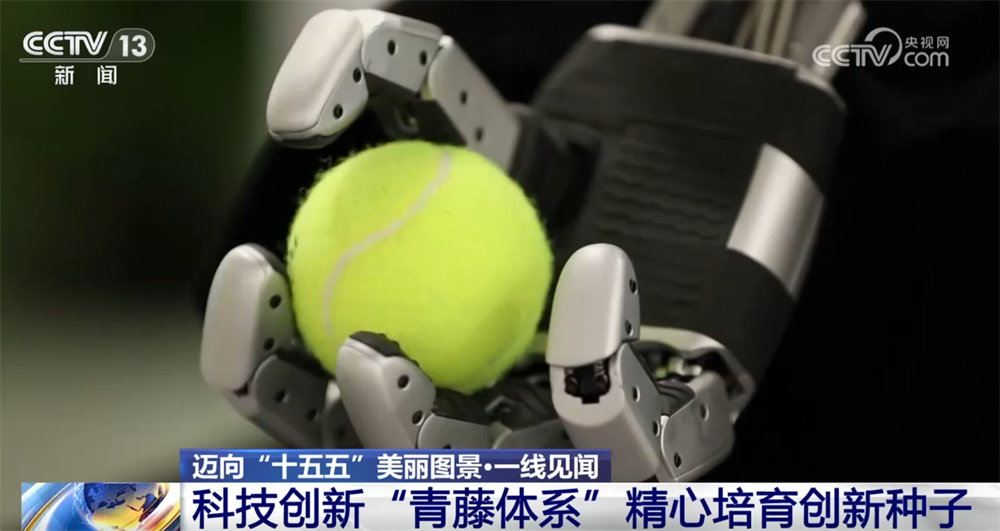
Core Viewpoint - The article emphasizes the importance of integrating technological innovation with industrial innovation, as outlined in the "14th Five-Year Plan," and highlights Shenzhen's initiative to create a systematic service framework for the transformation of scientific and technological achievements into practical applications [1][21]. Group 1: Innovation Ecosystem - Shenzhen has established the "Science and Innovation Green Vine Achievement Transformation Service System," which is a comprehensive and organized ecosystem for achievement transformation across the city [1]. - The "Moli Ying" incubator, focused on the AI and robotics sector, has attracted over 140 startups, primarily led by young entrepreneurs, who face challenges such as funding and resource allocation [1][4]. Group 2: Support Mechanisms - The "Green Vine" initiative provides a "six ones" policy, offering entrepreneurs essential resources including space, funding, and support services to facilitate their startup journey [4]. - Advanced professional technical managers play a crucial role in the transformation process, with over 300 recognized in Shenzhen, acting as "innovation ferrymen" to bridge technology and industry [16][19]. Group 3: Mid-Stage Testing Facilities - Shenzhen has developed concept verification centers and pilot testing platforms to address the challenges of transforming prototypes into market-ready products, particularly in high-risk fields like biomedicine [9][15]. - The mRNA innovation drug and vaccine pilot testing base exemplifies the support provided to new drug development teams, significantly reducing risks and costs associated with drug research [13][15]. Group 4: Future Outlook - The systematic design of the "Green Vine" initiative aims to tightly connect government, enterprises, universities, and markets, fostering a vibrant innovation ecosystem that will contribute to the future development of Shenzhen and the Greater Bay Area [21].
新股消息 | 传mRNA药企深信生物拟赴港上市 或募资约2亿美元
智通财经网· 2025-10-22 07:21
Core Viewpoint - The mRNA drug developer DeepTrust Bio plans to go public in Hong Kong, potentially raising around $200 million, with discussions on IPO scale and timing still in preliminary stages [1] Company Overview - DeepTrust Bio was established in 2019 and is one of the few companies globally that possesses core technology for LNP (lipid nanoparticle) design [1] - The company has developed an mRNA-LNP technology platform with proprietary intellectual property, including a library of over 5,000 ionizable lipid resources for screening LNP carriers suitable for various therapeutic scenarios [1] - DeepTrust Bio has multiple internal research pipelines in the fields of infectious disease vaccines, rare diseases, and tumor immunotherapy [1] Investment Background - According to Qichacha data, DeepTrust Bio has undergone several rounds of financing, with investors including Huaxing Capital, Dinghui Investment, CPE Yuanfeng, Qianhai Fangyuan Capital, E Fund, Blue Ocean Capital, Zhongke Chuangxing, Qianhai Mother Fund, Dongpingheng Capital, Junlian Capital, Zhifei Biological, and Lanting Capital [1]
西贝创始人贾国龙道歉:以后打明牌向胖东来学习;罗永浩提议与贾国龙公开直播对质;宝马调整经典蓝白车标丨邦早报
创业邦· 2025-09-15 00:08
Group 1 - DeepSeek and Yushu Technology were recognized as "smart companies" by MIT Technology Review, highlighting their innovative technology and sustainable business models [3] - The founder of Xibei, Jia Guolong, acknowledged his mistakes in handling a recent controversy and expressed intentions to adopt a more transparent approach, learning from the practices of competitor Pang Donglai [5][6] - Xibei's flagship store in Beijing experienced a significant drop in customer traffic, with a reported decrease of over 70% following the frozen vegetable controversy [12] Group 2 - The ongoing dispute between Jia Guolong and Luo Yonghao regarding the pre-made dishes incident has led to calls for a public live debate to clarify the situation [8][11] - Xibei has temporarily suspended kitchen tours in its restaurants to ensure normal operations and address customer concerns about privacy during filming [12] - The marketing consulting firm Huayi Huayi confirmed that it received over 60 million yuan in consulting fees from Xibei over the past decade, which has sparked discussions about the value of such consulting services [11] Group 3 - Penske Media Corporation (PMC) has filed a lawsuit against Google, alleging that the tech giant illegally used its news content to generate AI summaries, resulting in decreased website traffic [14] - Tesla's German factory plans to increase production due to strong sales data, despite a reported 39% drop in new car registrations in Germany last month [21] - Yao Tang Biotechnology completed a Series B financing round exceeding 300 million yuan, focusing on mRNA and gene editing drug development [22]
趋势研判!2025年中国核酸药物行业产业链、行业现状、细分市场、厂商布局及发展趋势分析:本土创新强势崛起,小核酸引爆药企研发新热潮[图]
Chan Ye Xin Xi Wang· 2025-09-04 01:16
Core Insights - Nucleic acid drugs represent a third-generation drug model that enables precise disease treatment by regulating gene expression or intervening in protein synthesis, offering advantages such as targeting undruggable targets, long-lasting effects, and shorter development cycles [1][4] - The global nucleic acid drug market is projected to exceed $23 billion in 2024 and surpass $50 billion by 2030, with small nucleic acid drugs being the core segment, increasing from $2.9 billion in 2020 to $5.1 billion in 2024 [1][8] - China is rapidly advancing in the nucleic acid drug sector, supported by comprehensive policies and nearly 200 companies accelerating their development, with several products entering clinical trials and expected to launch in the next three years [1][4][10] Industry Overview - Nucleic acid drugs are therapeutic molecules based on nucleic acids (DNA or RNA) that treat diseases by directly regulating gene expression or intervening in protein synthesis [2][3] - The industry is characterized by high technical barriers and strong reliance on imported raw materials and production equipment [4] Market Dynamics - The global nucleic acid drug market is experiencing significant growth due to an aging population and rising chronic disease rates, with a compound annual growth rate (CAGR) exceeding 15% from 2023 to 2030 [6][8] - Over 900 companies are involved in nucleic acid drug development globally, with a total of 2,600 projects, of which 13.76% are for rare diseases [6][8] Competitive Landscape - The competitive landscape in China's nucleic acid drug industry is characterized by three tiers: leading companies like Wobang Pharmaceutical and Rebio Biotech, traditional pharmaceutical companies like Hengrui Medicine, and startups focusing on mRNA vaccines and new delivery technologies [10][11] - The first tier companies are gaining global market influence through technology licensing and innovative delivery systems [10][11] Future Trends - The nucleic acid drug industry in China is expected to evolve through international innovation and capital empowerment, with a focus on liver-targeted delivery and AI-assisted design [12][13] - The market is anticipated to shift from rare diseases to common diseases, with significant growth in areas such as cardiovascular and metabolic diseases, driven by advancements in production capabilities and reimbursement systems [13][14]

新冠疫苗巨头Moderna突然宣布取消日本工厂投资计划
news flash· 2025-07-18 11:34
Core Insights - Moderna has announced the cancellation of its plan to build an mRNA drug manufacturing facility in Japan due to changes in the global and Japanese business environment [1] - The construction of Moderna's factory in China is also reported to have no progress at this time [1]
