
生育友好型社会建设

Search documents
“推动生育力保护政策全面落地”
第一财经· 2026-03-09 10:14
Core Viewpoint - The article emphasizes the need for comprehensive implementation of fertility protection policies in medical institutions across China, highlighting the current gaps in execution and the necessity for accountability at various levels [3][4]. Policy Implementation Gaps - The article discusses the disparity between policy requirements and their execution, noting that many grassroots medical institutions lack awareness and fail to integrate fertility protection into routine practices [5][6]. - It points out that the "informed consent" protocol regarding fertility risks before treatments is not widely adopted in key departments such as oncology and gynecology [6]. Medical and Social Demand for Fertility Preservation - The article identifies two main groups requiring fertility preservation: those with medical indications (e.g., cancer patients) and those with social needs due to delayed marriage and childbirth [6][7]. - It cites that the incidence of iatrogenic premature ovarian insufficiency is significant, with a prevalence rate of 3.7% globally, and can be as high as 82.2% among female cancer survivors under 24 years old [6]. Establishment of a National Fertility Protection Network - The article reports that 47 medical institutions have begun to establish a national fertility protection network, focusing on ovarian tissue cryopreservation [9]. - It highlights a shift in policy focus from mere advocacy to actionable implementation, with increasing public awareness and support for fertility protection [9]. Recommendations for Improvement - The article outlines six specific recommendations to enhance the implementation of fertility protection measures, including comprehensive coverage of medical institutions, strict adherence to informed consent protocols, and enhanced training for healthcare providers [10][11]. - It stresses the importance of integrating fertility protection metrics into performance evaluations of medical institutions to ensure effective policy execution [12].


奥一网联动深圳人大代表调研乱象,多方献策建联合执法体系
Nan Fang Du Shi Bao· 2026-02-11 08:43
Core Viewpoint - The article highlights the ongoing issues of commercial promotion within healthcare institutions in Shenzhen, emphasizing the need for improved governance and regulatory measures to ensure a better medical experience for patients [1][2]. Group 1: Current Issues in Healthcare - The phenomenon of commercial promotion in hospitals is attributed to three main shortcomings in hospital management and supervision: lax internal controls, lack of enforcement power, and poor inter-departmental coordination [2]. - The prevalence of similar promotional behaviors across multiple maternal and child healthcare institutions indicates a systemic issue rather than isolated incidents [3]. Group 2: Proposed Solutions - Recommendations include quantifying "distraction-free medical environment" as a core assessment metric, linking complaint rates and management effectiveness to hospital performance evaluations [2]. - The establishment of a collaborative governance mechanism among health, market supervision, and public security departments is suggested to address long-term disturbances in medical institutions [3][4]. Group 3: Legal Perspectives - Public hospitals have a legal obligation to maintain a safe and orderly medical environment, and failure to do so may result in violations of established medical conduct guidelines [4]. - The article suggests that local regulations similar to those in other cities should be implemented in Shenzhen to clearly define hospital responsibilities and establish effective penalties for violations [5]. Group 4: Governance and Community Engagement - The initiative "Walking the New Era Online Mass Route Research - Dialogue with the City" aims to gather public insights and facilitate government decision-making through a structured process of issue discovery, in-depth research, and policy transformation [6].
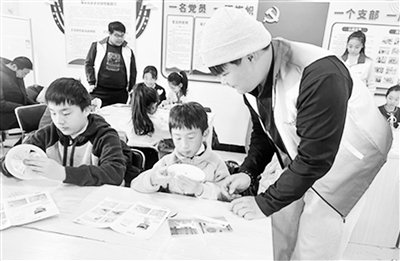
“职工之家”变身“带娃驿站”延伸工会服务半径
Xin Lang Cai Jing· 2026-02-04 17:28
Core Viewpoint - The establishment of the "Childcare Station" by the trade union in Qinhuangdao City addresses the childcare challenges faced by new employment form workers during winter vacations, enhancing their work-life balance and overall well-being [3][4]. Group 1: Initiative Overview - The "Childcare Station" is designed to provide specialized support for the children of new employment form workers, offering tutoring and various engaging courses to facilitate learning and emotional support [3]. - The initiative reflects a shift in the trade union's services, extending support from workers to their families, thereby addressing the specific needs of these workers [3]. Group 2: Benefits and Impact - The "Childcare Station" alleviates the anxiety of new employment form workers regarding childcare, allowing them to focus on their jobs, which enhances their sense of fulfillment and happiness [4]. - For employers, this initiative reduces employee turnover rates, creating a win-win situation by supporting workers while benefiting businesses [4]. - The project contributes to the social welfare landscape by filling gaps in childcare resources, promoting a family-friendly society, and adding warmth to grassroots governance [4].
“三维赋能”破解女性科技人才发展瓶颈
Xin Lang Cai Jing· 2026-01-28 20:59
Core Viewpoint - The proposals presented by Bi Zhengjie at the Hubei Provincial Two Sessions focus on addressing the challenges faced by female technology workers in career development and balancing family and work, advocating for a "three-dimensional empowerment" approach to support their growth [1][2]. Group 1: Empowerment Strategies - The first aspect of "three-dimensional empowerment" is policy empowerment, which includes relaxing age restrictions for female technology workers applying for projects, recommending them for frontline training, and providing policy and financial support for projects led by female researchers [2]. - The second aspect is platform empowerment, which aims to facilitate the transformation of female technology talents' achievements by establishing a multi-level talent database and creating platforms for collaboration and resource sharing [2]. - The third aspect is service empowerment, which focuses on providing support services such as mental health counseling and childcare in areas where female technology workers are concentrated, thereby creating a dual support system of "science and innovation + family" [2]. Group 2: Fertility Support Policies - Bi Zhengjie analyzed the challenges in implementing current fertility support policies, noting that while Hubei has introduced 30 fertility support measures, the burden of costs on small and medium enterprises may lead to discrimination against female employees [3]. - The existing policies primarily focus on direct maternity benefits and lack targeted tax incentives for companies that bear the costs of maternity leave, which may hinder corporate engagement in supporting female employees [3]. - Recommendations include enhancing tax and financial support by allowing companies to deduct maternity-related expenses from taxable income and implementing tiered VAT reductions based on the number of female employees on maternity leave [3][4]. Group 3: Simplifying Processes - It is suggested that relevant departments simplify processes to ensure that benefits reach companies directly, promoting a "no application required" service model for tax reductions [4]. - The proposal includes leveraging data-sharing mechanisms between tax and healthcare departments to streamline verification processes, thus reducing the administrative burden on companies [4]. - By providing tax reductions, the aim is to alleviate employment concerns for companies, particularly small and medium enterprises, and to promote a win-win situation for businesses, female employment, and societal benefits [4].
江蓝委员: 推动公共交通服务与生育友好政策衔接
Xin Lang Cai Jing· 2026-01-26 22:09
Core Viewpoint - Beijing is actively promoting the construction of a family-friendly society, with a focus on integrating public transportation services with maternity-friendly policies [1] Group 1: Recommendations for Maternity-Friendly Policies - Jiang Lan, an executive director at Hengfeng Group, suggests establishing a maternity-friendly system that primarily uses electronic certificates and supplementary physical badges for pregnant women [1] - The proposal includes leveraging existing platforms like the "Beijing Subway Service" app and "Jing Tong" app to connect with pregnant women's health records [1] - The physical badges should be designed with high visibility colors and include messages like "Please take care of pregnant women" to promote awareness and recognition [1] Group 2: Implementation Strategies - The issuance and collection of physical badges should be integrated into the processes of maternal health record creation and infant health check-ups at community health service centers [1] - There is a call for increased publicity to ensure that the "Pregnant Women Outing" badge is widely recognized and accepted, fostering a culture of prioritizing seats for pregnant women [1] - Future expansions of the badge's usage could include broader public service identity recognition mechanisms to enhance support for pregnant women in various public spaces [1]
4000余个“向日葵亲子小屋”功能迭代升级 助力营造生育友好社会氛围
Ren Min Ri Bao· 2026-01-18 22:08
Core Insights - The China Family Planning Association (CFPA) aims to upgrade over 4,000 "Sunflower Parent-Child Rooms" by 2025, integrating guidance on optimal childbirth and community-based childcare services [1] - CFPA has launched the "National Free Marriage and Pregnancy Check Assistant" app, which has expanded to the "National Marriage and Childbearing Service Assistant," serving over 10 million users [1] - In 2026, CFPA plans to focus on promoting positive marriage and childbearing views, enhancing reproductive health services, and improving support for mobile populations [1] Group 1 - CFPA will innovate and provide inclusive childcare services such as temporary, hourly, and mutual care [1] - The "Optimal Childbirth and Parenting into Thousands of Families" initiative has reached over 300,000 families with infants and young children [1] - CFPA aims to build a fertility-friendly society by collaborating with enterprises, social organizations, and charitable institutions [1] Group 2 - The association emphasizes the importance of reform and innovation to continuously improve service levels [1] - Key areas of focus include reproductive health services, deepening guidance on optimal childbirth, and ensuring support for vulnerable populations [1] - CFPA's initiatives are part of a broader strategy to promote family health and well-being [1]

北京提高产检费用医保报销标准
Qi Lu Wan Bao· 2026-01-12 22:05
Core Viewpoint - The Beijing Medical Insurance Bureau, in collaboration with the Municipal Finance Bureau, has issued a notice to enhance the coverage of prenatal examination costs for insured individuals starting from January 1, 2026, to support the construction of a family-friendly society and promote high-quality population development [1] Summary by Relevant Categories Policy Changes - The reimbursement for prenatal examination costs for female employees covered by Beijing's maternity insurance will increase significantly, with full reimbursement for costs up to 3,000 yuan and a 30% reimbursement for costs exceeding 3,000 yuan, with a maximum fund payment of 10,000 yuan [1]
北京产检报销标准上限升至10000元
21世纪经济报道· 2026-01-12 10:29
Group 1 - The core viewpoint of the article is that Beijing will enhance the reimbursement standards for prenatal check-up expenses under the maternity insurance scheme starting from January 1, 2026, to support the construction of a fertility-friendly society and promote high-quality population development [1] - The reimbursement for prenatal check-up expenses for female employees covered by Beijing's maternity insurance will increase, with 100% reimbursement for expenses up to 3,000 yuan and 30% reimbursement for expenses exceeding 3,000 yuan, with a maximum fund payment of 10,000 yuan [1] - The national medical insurance work conference emphasized the goal of achieving "no out-of-pocket" expenses for childbirth within the policy scope across the country by 2026, aligning with population development strategies [1] Group 2 - In Shandong, for example, a respondent noted that ten years ago, the total cost for prenatal check-ups and childbirth was around 30,000 yuan, but starting in 2025, the hospitalization and childbirth costs will be fully reimbursed under the insurance directory, significantly reducing personal expenses [2] - The inclusion of suitable delivery pain relief projects into the fund payment scope has been implemented in several provinces, further alleviating the financial burden and discomfort for pregnant women [2]

云南今年下达超40亿元育儿专项资金
Ren Min Ri Bao· 2025-12-19 22:10
Core Viewpoint - Yunnan Province is actively implementing measures to reduce the financial burden on families with infants and toddlers, contributing to the establishment of a family-friendly society through substantial financial support and policy enhancements [1] Group 1: Financial Support Measures - Yunnan Province has allocated a total of 4.07 billion yuan in special funds this year to effectively implement the childcare subsidy policy, ensuring that the benefits reach numerous households [1] - The subsidy for eligible families with children under three years old is set at a uniform standard of 3,600 yuan per person per year, reflecting an upgrade in policy continuity and quality assurance [1] Group 2: Policy Implementation and Management - The Yunnan Provincial Finance Department, in collaboration with the Provincial Health Commission, has issued the "Implementation Plan for the Yunnan Province Childcare Subsidy System" to streamline the subsidy process [1] - To address the challenge of delivering subsidies effectively, the financial support for childbirth has been integrated into the "One Card" platform for public welfare and agricultural subsidies, allowing for quarterly direct payments to beneficiaries' social security cards after verification by local health departments [1]
超百城加大多子女家庭购房政策支持力度
Zheng Quan Ri Bao Wang· 2025-12-19 14:08
Core Viewpoint - The article highlights the increasing support policies for multi-child families in housing, as over a hundred cities have introduced or optimized housing support measures in response to the improved fertility support policy framework [1] Group 1: Policy Implementation - Various provinces, including Hunan, Fujian, and Yunnan, have integrated housing support policies into the overall framework for building a fertility-friendly society [2] - Yunnan's government has announced measures to enhance housing support for multi-child families, including increasing public housing fund loan limits by 20% to 30% for families with two or more children [2] - Cities like Shenzhen and Tianjin have also raised public housing fund loan limits for families with two or more children, with Shenzhen allowing a 50% increase and Tianjin a 20% increase [2] Group 2: Financial Incentives - Specific housing subsidies for multi-child families have been introduced, such as Fuzhou's proposed 1% subsidy on the total purchase price for two-child families, with a maximum of 30,000 yuan per unit [3] - In Yiyang, families with two or more children can receive rewards of 2% and 3% of the contract price for purchasing new homes, with maximum rewards of 20,000 yuan and 30,000 yuan respectively [3] - These financial incentives aim to alleviate the financial burden on families and improve their living conditions [3] Group 3: Societal Impact - Housing issues significantly influence family decisions regarding childbirth, with adequate living space and manageable costs being critical factors [4] - By enhancing housing support for multi-child families, the policies aim to reduce housing burdens and foster a fertility-friendly society, addressing families' concerns about having more children [4]