
白银替代

Search documents
外媒:因银价上涨,太阳能行业加速转向
Huan Qiu Wang· 2026-02-22 01:21
Group 1 - Silver is the largest factor driving up the manufacturing costs of solar panels, with costs having increased by 7% to 15% over the past 12 months [2] - Silver paste, a key material in photovoltaic panels, accounts for 30% of the total cost of solar cells, and the demand for silver in the solar industry is 196 million troy ounces, representing 17% of total demand [2] - The cost of silver paste for 450-watt modules in the U.S. has risen from approximately $5.22 to $17.65 since early 2025, prompting solar manufacturers to accelerate the shift to alternatives like copper [2] Group 2 - The industry is expected to see a broader shift this year, with leading manufacturers moving towards pure copper metallization processes and silver-copper hybrid pastes, as copper is about 0.5% the price of silver [3] - Transitioning from silver to copper metallization could save the solar industry approximately $15 billion annually, based on a global solar output of 500 gigawatts per year [3] - Experts indicate that replacing silver with copper is not straightforward due to silver's higher conductivity compared to copper [3]


中信建投: 银价高企倒逼产业变革,光伏金属化革命的"铜"时代开启
3 6 Ke· 2026-01-23 05:11
Core Viewpoint - Recent increases in silicon and silver prices are intensifying profit pressures on photovoltaic (PV) cell and module companies, with a long-term tight balance expected in silver supply and demand due to a persistent supply gap since 2019 [1] Group 1: Industry Challenges - The rising costs of silver necessitate that PV cell and module companies urgently reduce silver consumption [1] - Copper is identified as the most suitable alternative material to silver, although challenges such as copper oxidation and diffusion need to be addressed [1] Group 2: Technological Developments - The PCB, MLCC, and semiconductor industries have accumulated valuable experience that can be referenced by the photovoltaic sector [1] - Progress is being made with silver-coated copper and electroplated copper solutions in the photovoltaic industry, while pure copper paste remains the ultimate goal, albeit with several unresolved issues [1] Group 3: Market Projections - It is projected that by 2026-2027, the penetration rates for silver-coated copper and copper paste will reach 17.7% and 43%, respectively, leading to production volumes of 813 tons and 2,188 tons for these materials [1] - This shift is expected to provide significant performance elasticity for paste and metal powder companies [1]

白银占成本从3%飙升至29%!光伏巨头“血亏”求生:涨价能救命吗?
Zhi Tong Cai Jing· 2026-01-16 02:56
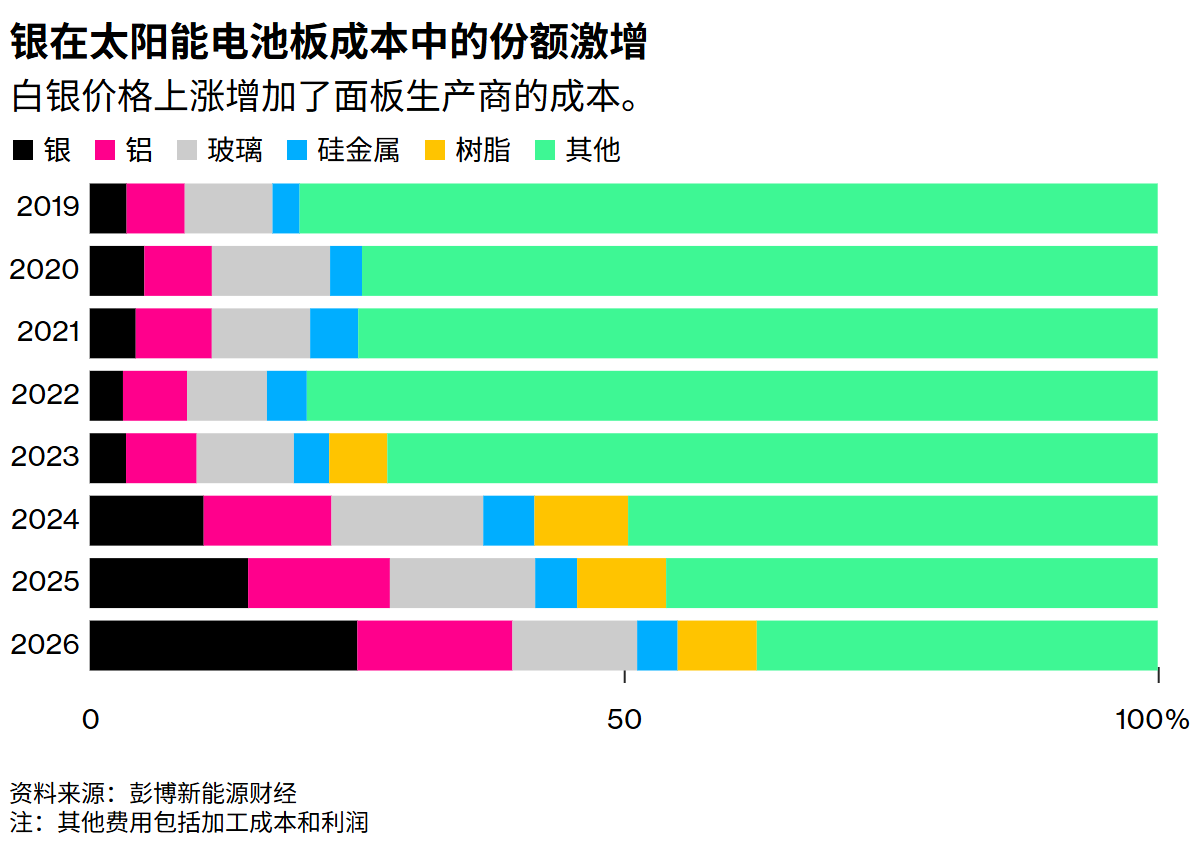
Core Viewpoint - The surge in silver prices is exacerbating the financial struggles of solar panel manufacturers, who are facing intensified competition and ongoing losses. The industry is implementing a dual strategy to cope with rising costs: increasing product prices and accelerating the transition to cheaper materials like copper to replace silver [1][4]. Group 1: Industry Challenges - Solar panel manufacturers are experiencing significant cost pressures due to soaring silver prices, which have tripled over the past year, reaching over $93 per ounce [1][4]. - The use of silver in solar cells now accounts for 29% of the total component cost, a sharp increase from 3.4% in 2023 and 14% last year [1]. - Major solar companies, including Trina Solar, have warned of expected net losses through 2025, indicating that the industry downturn has not yet reached its lowest point despite efforts to curb overcapacity and price wars [4]. Group 2: Price Adjustments and Market Response - In response to rising silver prices, Chinese component manufacturers have raised prices to over 0.8 yuan per watt, reflecting a 1.4% to 3.8% increase from the previous week, resulting in typical 500-watt component prices around 400 yuan ($57) [4]. - The silver market is experiencing a record streak, with prices around $91 per ounce, potentially marking the longest consecutive monthly increase since records began in 1950 [4]. Group 3: Material Substitution Efforts - Manufacturers are actively working to reduce silver paste usage in solar cells to lower costs, with projections indicating an average usage of 8.96 milligrams per watt by 2025, down from 11.2 milligrams in 2024 [5]. - Longi Green Energy has announced plans to begin replacing silver with cheaper metals in their solar cells [5]. - The solar industry accounted for approximately 17% of total silver demand last year, a significant increase from a decade ago, but a slowdown in consumption could threaten the long-term price increase of silver [5][6].


暴涨的尽头是反噬?白银“扼杀”光伏需求,牛市盛宴暗藏自毁机制
Jin Shi Shu Ju· 2026-01-16 01:52
Group 1 - The surge in silver prices is putting additional pressure on solar panel manufacturers, who are already struggling to end over two years of losses in a highly competitive industry [1] - Spot silver prices recently reached a historical high of over $93 per ounce, causing the silver content in solar panels to rise to 29% of total costs, up from 3.4% in 2023 and 14% last year [1] - Manufacturers are responding by raising prices and accelerating plans to replace silver with cheaper materials like copper [1] Group 2 - Major solar companies have warned of expected net losses again in 2025, indicating that despite a year of self-discipline and government-led efforts to curb overcapacity, the industry's downturn has not yet bottomed out [2] - The average silver usage per watt in solar panels is projected to decrease from 11.2 mg in 2024 to 8.96 mg in 2025 as manufacturers strive to reduce costs [2] - Companies like Longi Green Energy, Jinko Solar, and Shanghai Aiko Solar are beginning to replace silver with cheaper metals in their panels [2] Group 3 - Limited replacement efforts and a slowdown in global solar panel installations may lead to a 17% reduction in silver usage in the industry this year, with a projected demand of around 6,000 tons in 2025 [3] - The solar industry accounted for approximately 17% of total silver demand last year, more than double its share a decade ago, which poses a risk to the sustainability of the current surge in silver prices [3] - Strong investment demand is expected to keep silver prices stable in the short term, but reduced industrial consumption of silver is anticipated in the future [3]