
盈利支撑

Search documents
如何平衡收益与波动?天弘基金“固收+”团队详解2026年股债攻守道
Jin Rong Jie· 2026-01-27 11:05
Core Viewpoint - The capital market is at a critical juncture with multiple variables influencing it, leading to a heightened demand for balance between seeking returns and risk avoidance, making "fixed income +" products a focal point for investors [1] Group 1: Market Trends - "Fixed income +" products have become a significant growth driver in the public fund industry, with their overall scale reaching 2.65 trillion yuan by the end of 2025, a 1 trillion yuan increase from 1.65 trillion yuan at the end of 2024, marking a historical high [1] - The macroeconomic environment is expected to maintain a weak recovery in 2026, with a continued loose policy stance and reasonable liquidity, providing ample space for "fixed income +" products to enhance returns through equity assets [2] Group 2: Investment Strategies - The "fixed income +" team at Tianhong Fund is adopting a flexible asset allocation strategy, focusing on a balanced approach without over-concentration in any single direction or style [4] - In equity investments, the team is focusing on three main rotation strategies: "network-type assets" like express delivery and media, "new era assets" such as AI and offshore manufacturing, and "traditional framework assets" like aviation and chemicals [5] Group 3: Research and Decision-Making Framework - Tianhong's "fixed income +" team has developed a collaborative investment research model, integrating the expertise of different fund managers to enhance decision-making and avoid the limitations of a single investment perspective [6] - The investment research system is built around the "Tianhong Five Cycles" framework, which assesses macroeconomic cycles, monetary policy cycles, and investor behavior to determine optimal asset allocation timing [6] Group 4: Performance and Future Outlook - Tianhong Fund's performance in the bond category over the past 3, 5, 7, and 10 years has been strong, with returns of 12.65%, 24.41%, 48.91%, and 63.25% respectively, ranking well against peers [7] - Despite uncertainties in the market, including U.S. Federal Reserve policies and domestic PPI trends, the "fixed income +" team remains optimistic about investment opportunities in 2026, particularly with the implementation of the "14th Five-Year Plan" and policies aimed at improving supply-demand relationships in certain industries [7]
2026,预见|宏观篇:盈利为核,流动为翼——2026年全球温和复苏中的价值新主线
Xin Lang Cai Jing· 2026-01-07 08:16
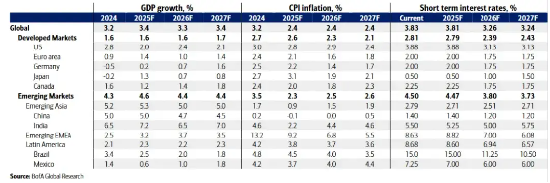
Core Viewpoint - The global economy is expected to show moderate recovery in 2026, supported by ample liquidity and a gradual recovery in inventory and profit cycles, shifting the market narrative from valuation recovery to profit support [1][30]. Group 1: Overseas Macro - The global economy will continue to recover, with K-shaped economic characteristics persisting but narrowing. Major economies are projected to have varied GDP growth rates: the US at 2.4%, Eurozone at 1.0%, Japan at 0.8%, and emerging markets at 4.2% [2][30]. - Global inflation is on a downward trend, with expectations that the Federal Reserve may cut interest rates 2-3 times in 2026, leading to a decrease in short-term rates [31][30]. Group 2: Domestic Macro - Fiscal policies are expected to drive investment recovery in major economic provinces, with a focus on infrastructure, manufacturing recovery, and a narrowing decline in real estate sales and investment [8][35]. - The Producer Price Index (PPI) is anticipated to rise initially before stabilizing, while the Consumer Price Index (CPI) may see moderate increases. The profit cycle is gradually recovering, with improvements expected in various sectors [9][35]. Group 3: Liquidity Environment - A clear trend of global liquidity easing is established, with the Federal Reserve leading improvements in overseas liquidity. Domestic monetary policy is expected to align with fiscal measures, potentially leading to interest rate cuts [12][38]. - The supply of funds is likely to be dominated by institutional capital, with private equity funds potentially driving high-net-worth individuals back into equity allocations [14][38]. Group 4: Strategic Allocation Directions - The market is expected to shift from valuation recovery to profit-driven dynamics in 2026, with Chinese assets still having room for valuation recovery [41][42]. - Key sectors to focus on include technology and advanced manufacturing, traditional export chains, and industries with increasing overseas revenue proportions [42][45]. - Future industry themes may include smart manufacturing, next-generation communications, advanced materials, and future energy solutions [47].

上证指数明天能否站上4000点?2026“慢牛”有望延续?|前瞻2026
清华金融评论· 2025-12-30 10:42
Core Viewpoint - The article emphasizes that if the Shanghai Composite Index can close above 4000 points by the end of 2025, it will instill strong confidence in the market, encouraging more incremental capital to enter in the future. The market is expected to continue a slow bull trend in 2026, with a focus on technology growth, cyclical stocks, and resource stocks [2][3]. Economic Dimension - The economic landscape is characterized by accelerated structural transformation and the rise of new productive forces. Manufacturing PMI is stabilizing, and retail consumption is recovering. High-end manufacturing sectors like smart devices and new energy vehicles are growing significantly faster than the overall economy, becoming key drivers of new productive forces [5]. Financial Dimension - Valuations are aligning with performance, showing significant horizontal space. Non-financial sectors' net profit grew by 1.04% year-on-year in the first half of 2025, with technology sectors like AI (up 19.24%) and semiconductors (up 32.41%) showing remarkable profitability. A-shares are undervalued compared to U.S. stocks, with financial and infrastructure sectors still having safety margins [5]. Policy Dimension - The policy environment is focused on stabilizing expectations and increasing incremental capital. Reforms in the capital market, such as raising the equity investment cap for insurance funds to 50%, and optimizing delisting and dividend mechanisms, are enhancing investment functionality. The "15th Five-Year Plan" emphasizes support for new industries like AI and commercial aerospace [5]. Capital Dimension - Continuous inflow of capital is observed, with insurance funds increasing their equity investments to over 4.7 trillion yuan, adding more than 600 billion yuan in 2025. There is ample room for growth, as evidenced by a reduction of 1.11 trillion yuan in household deposits and a 2.14 trillion yuan increase in non-bank deposits, with funds entering the market through ETFs and mutual funds [6]. Industry Dimension - The dual focus on technology and cyclical sectors is evident. In technology growth, there is a surge in demand for AI computing power, storage, and commercial aerospace driven by policy support. In cyclical sectors, the supply-demand gap for industrial metals like copper and aluminum is widening, with expectations of a 150,000-ton shortfall in refined copper in 2026 [6]. Company Dimension - Overall profitability is improving, showcasing resilience. Leading companies in innovation-driven sectors, such as CATL, are achieving high capacity utilization rates close to 90%, with technological breakthroughs driving down costs [7]. Outlook for 2026 - Multiple brokerages express optimism for the A-share market in 2026, predicting a continuation of the slow bull market. The core driving logic is expected to shift from valuation recovery to profit support, with anticipated earnings growth of 5% to 12% [9][10]. The recovery of PPI is seen as a key factor that will drive nominal GDP growth and improve overall profitability in the market [11]. Key Investment Themes - Key investment themes include technology growth led by AI and hard technology, with a focus on areas like optical modules and computing chips. The cyclical and resource sectors are also expected to benefit from improved supply-demand dynamics, with industrial metals and energy sectors showing potential for cash flow improvement and high dividend yields [12].
