社交裂变营销

Search documents
会员卡充值消费系统怎么做?
Sou Hu Cai Jing· 2025-12-20 17:14
Core Viewpoint - Small and micro enterprises can quickly build a WeChat membership system without starting from scratch by utilizing professional mini-program development platforms, which offer customizable interfaces and comprehensive backend functionalities [1]. Group 1: Mini-Program Development Process - Step 1: Choose a mini-program development platform, such as "Miyun Zhizhi," and register an account to select the product type as "store system" [1]. - Step 2: Design and decorate the mini-program pages [5]. - Step 3: Set membership rules [8]. - Step 4: Complete store information and add services and products [10]. - Step 5: Activate marketing functions [12]. - Step 6: Apply for a mini-program account [16]. - Step 7: Publish the WeChat mini-program and submit it for review [14]. Group 2: Membership Management Features - The membership management system can help enterprises expand their market by encouraging existing members to invite friends to join the membership system, thus bringing in new customers [16]. - The system can analyze members' social networks to understand their influence and dissemination capabilities, identifying potential marketing channels and partners to further expand market share and business scale [16]. Group 3: Points and Rewards System - A points system can be established where members earn points for spending, daily check-ins, product reviews, and sharing activities, with various methods for earning points [17]. - Points can be used for cash payments or redeemed for products, gifts, or coupons in a dedicated points mall [17]. - Marketing activities can be designed around points, such as games or lotteries, where points can be used to participate [17]. Group 4: Customization and User Experience - Mini-program development platforms provide standardized functional modules but allow for personalized design and layout modifications to align with brand image and business needs [17].

圣贝拉(2508.HK):高效圈层营销 灵活预订控费
Ge Long Hui· 2025-11-13 02:55
Core Viewpoint - Shengbeila has established a high-end ecological positioning in the postpartum care industry, benefiting from the global high-net-worth family's childbirth-related industry dividends as long as the company maintains its brand image and deepens community marketing [1] Summary by Sections Market Potential - The penetration rate of postpartum care centers is low, with only 6% in mainland China as of 2024, compared to 60% in South Korea and Taiwan, indicating significant room for growth [1] - The postpartum care market is segmented into high, medium, and low-end, with high-end centers targeting high-net-worth individuals and mid-range brands catering to a large middle-class population [1] Brand Positioning - Shengbeila has opened 113 stores globally, with 31 high-end locations in first-tier cities, establishing a leading high-end service image through innovative media channels [1] - The company plans to expand into markets such as Hong Kong, Singapore, Los Angeles, and New York, aiming to tap into overseas postpartum care market opportunities [1] Marketing Strategy - The company employs effective community marketing and social viral marketing, creating interactive scenarios with target customers, which enhances emotional value and matches the physiological and psychological needs of high-net-worth individuals [2] - This marketing model results in high customer referral rates and effective cost management, reducing reliance on traditional platforms [2] Operational Efficiency - Shengbeila benefits from a flexible booking and franchise model, allowing it to secure high rental discounts without the burden of vacancy rates, thus controlling rental expenses [2] - The management center model enables low-cost, low-risk market expansion, allowing the company to achieve higher gross margins than the industry average [2] Financial Projections - Revenue projections for 2025-2027 are estimated at 1.034 billion, 1.3 billion, and 1.556 billion yuan, with corresponding net profits of 372 million, 224 million, and 316 million yuan [2] - Adjusted net profits are expected to be 115 million, 254 million, and 331 million yuan, with price-to-earnings ratios of 29X, 13X, and 10X respectively [2] Valuation - The company’s reasonable market value is estimated at 5.8 billion HKD, corresponding to a stock price of 9.38 HKD, with a "buy" rating assigned [3]
告别传统渠道?五粮液低度酒营销“出狠招”!
Nan Fang Du Shi Bao· 2025-10-27 02:20
Core Insights - The article discusses a marketing revolution in the competitive Chinese liquor market, led by major players like Wuliangye, focusing on innovative sales strategies to attract younger consumers [1][8]. Group 1: Marketing Innovation - Wuliangye has launched a "fission" sales system for its product "29-degree Wuliangye · First Love," allowing consumers to become "recommendation officers" and earn cash rewards for referrals [1][3]. - This fission model is seen as a breakthrough in the brand's efforts to appeal to younger demographics, transforming traditional advertising budgets into user incentives and fostering emotional connections through social sharing [1][5]. - The brand's marketing strategy has shifted towards social-driven approaches, with celebrity endorsements and a focus on engaging younger audiences through platforms they frequent [3][10]. Group 2: Market Trends - The low-alcohol liquor segment is rapidly growing, with projections indicating the market will exceed 74 billion yuan by 2025, reflecting a compound annual growth rate of 25%, significantly outpacing the overall liquor industry [5][6]. - Many liquor companies are investing in low-alcohol products, with 21.1% of firms planning to enhance their offerings in this category as part of their 2025 strategies [5]. - The trend towards low-alcohol beverages aligns with younger consumers' preferences for lighter drinking experiences and more flexible consumption scenarios [6][8]. Group 3: Industry Challenges - The liquor industry is facing significant challenges, including high inventory pressure and price imbalances, with average inventory turnover days reaching 900, a 10% increase year-on-year [8][10]. - Traditional distribution models reliant on intermediaries are becoming less effective, prompting a shift towards user-centric marketing and direct consumer engagement [8][10]. - Companies are exploring diverse marketing innovations to establish deeper emotional connections with consumers, particularly the younger generation [8][10].


企微CRM系统红包营销策略与操作全流程解析
Sou Hu Cai Jing· 2025-10-11 06:56
Core Value and Applicable Scenarios of Red Packet Marketing - Red packet marketing accelerates social viral growth through cash incentives, leading to exponential user growth, as demonstrated by a beauty brand that increased user acquisition by 240% in three days with a referral campaign [3] - User segmentation allows for targeted red packet strategies, resulting in a 37% higher conversion rate for targeted red packets compared to general ones [4] - Data-driven optimization enables real-time tracking of red packet metrics, allowing for cost reduction of 22% and a 19% increase in conversion rates for an educational institution [4] Red Packet Marketing Strategy Design - Precise user profiling is essential, utilizing the CRM system to categorize users based on purchase frequency and behavior, leading to tailored red packet offerings [6] - Dynamic configuration of red packet rules, including tiered rewards and usage conditions, helps prevent resource wastage [7][8] - Channel selection and message optimization enhance engagement, with tailored communication strategies for different platforms [10] Execution Process of Red Packet Marketing - Preparation involves setting up red packet templates and generating unique QR codes for tracking [16][17] - Multi-scenario execution engages users effectively, with strategies for new customer acquisition, community engagement, and reactivating dormant customers [19][20][21] - Post-campaign analysis includes data export for ROI calculation and identifying areas for improvement [23] Future Trends in Red Packet Marketing - The evolution of red packet marketing will focus on intelligent upgrades, including dynamic pricing based on user behavior and predictive issuance of retention incentives [27] - Integration across platforms will create a closed loop of "red packet-content-conversion," enhancing overall marketing effectiveness [27] Conclusion - The integration of red packet marketing within the CRM system represents a data-driven, socially viral, and scenario-based operational model, emphasizing the need for precision over broad distribution [29]

日订单量破2.3亿,骑手月入过万!史上最大外卖补贴战升级
Nan Fang Du Shi Bao· 2025-07-14 07:38
Core Insights - The competition in the food delivery subsidy war continues to heat up, with significant order volume increases reported by major players like Taobao Shanguo and Meituan [1][2][8] Group 1: Order Volume and Growth - Taobao Shanguo announced a daily order volume exceeding 80 million, marking a new high, with active users surpassing 200 million and a week-on-week net increase of 15% [1] - Meituan reported a peak of 150 million instant retail orders, with "Shen Qiang Shou" orders exceeding 50 million and "Pin Hao Fan" orders over 35 million, reflecting a week-on-week increase of 30 million orders [2] - Non-food categories on Taobao Shanguo saw over 1,200 categories with order growth exceeding 100%, including significant increases in staple foods (335%) and household cleaning products (324%) [4] Group 2: Marketing Strategies - Meituan's "Shen Qiang Shou" project utilized social platforms like WeChat for marketing, leading to record high order values through mini-programs and significant coupon sharing among friends [2] - Taobao Shanguo has seen over 240,000 new registered merchants since its launch, with a majority being small and medium-sized businesses [4] Group 3: Rider Income and Support - Meituan reported a 111% increase in daily income for riders, with over 400,000 riders earning more than 500 yuan per day, and average monthly income for high-frequency riders reaching 9,793 yuan [6][9] - Taobao Shanguo riders experienced a 78% year-on-year increase in numbers, with active riders earning an average of over 12,500 yuan per month [7] Group 4: Subsidy Strategies - JD.com has shifted its subsidy strategy to a more refined model, focusing on quality dining and specific popular food categories, with a new investment of over 10 billion yuan to support merchant sales [8] - The ongoing subsidy war has led to increased order volumes for Meituan's restaurant partners, with a reported 65% increase in order volume compared to regular periods [7]


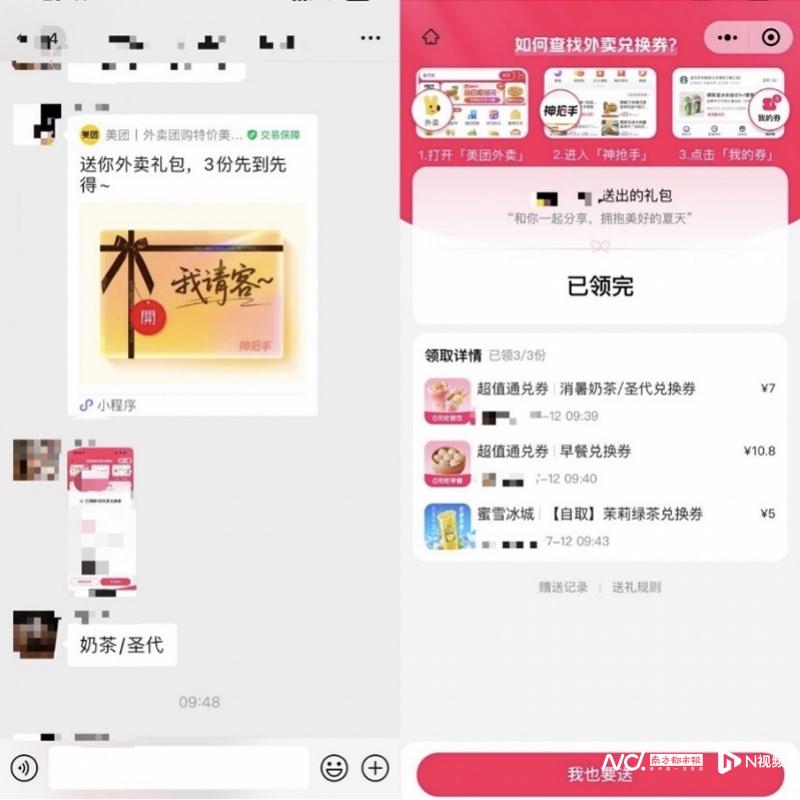
美团订单量再创新高 微信社交裂变礼赠成为重要渠道
news flash· 2025-07-12 13:20
Core Insights - Meituan's instant retail order volume has reached a new high, with nearly 40 million orders recorded for the "Shen Qiang Shou" project, and gift orders exceeding 10 million [1] - Social media platforms, particularly WeChat, have become significant channels for order placement, with coupon sharing and gift sharing among friends driving substantial engagement [1] - The combination of marketing tools, including WeChat and other social media platforms like Xiaohongshu and Weibo, has proven to be more effective than traditional app opening advertisements [1]

微信小程序商城怎么开通,自己搭建小程序商城
Sou Hu Cai Jing· 2025-05-28 09:47
Core Viewpoint - The trend of building proprietary mini-program malls by companies is gaining momentum in the fiercely competitive e-commerce market, allowing brands to create tailored online shopping experiences while retaining profits by avoiding high commission fees from third-party platforms [1]. Group 1: Mini-Program Setup Process - Step 1: Register an account on a mini-program SaaS platform [1]. - Step 2: Design and decorate the mini-program pages [5]. - Step 3: Add products to the mini-program [10]. - Step 4: Activate marketing features such as membership storage, points mall, group buying, flash sales, and distribution [12]. - Step 5: Apply for a mini-program account [15]. - Step 6: Enable WeChat payment [19]. - Step 7: Complete mini-program filing [21]. - Step 8: Publish the mini-program [22]. Group 2: Development Costs - SaaS setup costs range from 1,956 yuan to 7,658 yuan per year [24]. - Custom development costs include an annual certification fee of 300 yuan, domain fees of approximately 100 yuan per year, server fees ranging from 1,000 to 4,000 yuan per year, and development costs between 9,600 yuan and 26,500 yuan [24]. Group 3: Required Qualifications - Companies must clarify their needs and positioning before building a mini-program mall, ensuring that the design and functionality align with their target audience and product type [27]. - Basic functionalities such as product display, shopping cart, payment integration, and order management are essential for stable operation [27][30]. - Companies can enhance competitiveness by adding unique features like membership benefits, live streaming sales, and social sharing capabilities [29]. Group 4: Operations and Promotion - Post-launch, companies should focus on content and user operations to maintain engagement and increase repurchase rates [31]. - Promotion strategies can leverage the WeChat ecosystem and offline activities to drive traffic to the mini-program [31]. Group 5: Data Monitoring and Optimization - Establishing a data monitoring system is crucial for tracking user behavior, transaction data, and traffic data to optimize the mini-program's performance [32]. - Regularly collecting user feedback and making necessary adjustments can enhance user experience and satisfaction [32].