
算力短缺

Search documents
云厂商破天荒涨价,未来一年算力供给会改善吗?| Jinqiu Select
锦秋集· 2026-03-20 15:00
Core Insights - The global cloud computing industry is experiencing a significant price increase for cloud services, breaking a long-standing trend of declining prices due to explosive demand for AI and rising hardware costs [1][2][3] - The current situation is characterized by a structural shortage of computing power, transitioning from a cost item to a strategic resource that impacts business models and company survival [2][4][5][6] Group 1: Price Increases in Cloud Services - In January 2026, AWS raised prices for GPU training instances by approximately 15%, followed by Google Cloud increasing data transfer service prices by up to 100% [1] - Domestic cloud providers in China, such as Tencent Cloud, Alibaba Cloud, and Baidu Intelligent Cloud, have also announced price hikes, with Tencent Cloud's increase reaching as high as 463% for self-developed large model pricing [1][2] Group 2: Supply and Demand Dynamics - The demand for computing power is rapidly increasing, driven by advancements in AI models and workflows, leading to a scarcity of available resources despite significant investments in infrastructure [16][17] - Major cloud service providers are expected to double their capital expenditures for data centers in 2026 compared to the previous year, yet the market still perceives this as insufficient [2][17] Group 3: Strategic Importance of Computing Power - As computing power becomes a strategic resource, companies that can secure sufficient resources in a timely manner will gain a competitive edge [4][5] - A lack of awareness regarding supply-side bottlenecks may lead to critical growth challenges, where companies face high demand but insufficient resources [6] Group 4: Investment Strategies - Jinqiu Capital has proactively established strategic partnerships with major cloud providers like Google Cloud, Microsoft Azure, and AWS since 2025, enabling its portfolio companies to access significant cloud resources [7][8] - The value of these resources is expected to increase as AI startups face rising computing costs amid the ongoing price hikes [9] Group 5: Semiconductor Supply Chain Challenges - A report by SemiAnalysis highlights multiple supply chain bottlenecks affecting computing power, including TSMC's N3 wafer capacity constraints and tight supply of HBM memory [12][19] - The demand for N3 wafers is projected to surge, with AI applications expected to account for nearly 60% of total N3 chip production by 2026, further straining supply [45][51] Group 6: Memory Supply Constraints - The global memory shortage is anticipated to persist, with DRAM supply being increasingly absorbed by HBM, exacerbating the overall supply constraints [61][74] - The transition of memory from consumer applications to server and HBM uses is expected to intensify, as companies seek to optimize their supply chains amid rising prices [76][78]






Manus季逸超首次公开回应邀请码争议:因全球算力短缺,“Claude说千万别放开,会挂”
Xin Lang Cai Jing· 2026-01-04 09:26
Core Insights - Manus co-founder and chief scientist, Ji Yichao, has publicly addressed the invitation code mechanism after reaching an internal milestone of $100 million in annual recurring revenue (ARR) [1][2] - The decision to implement an invitation code system was made before Manus launched, driven by the limited availability of computational power from cloud providers and inference providers [1][2] - Ji noted that alternative methods could have been considered for controlling access, but the team opted for the invitation code approach without extensive deliberation [1][2] Group 1 - Manus has reached a significant milestone of $100 million in ARR, allowing for public discussion of its invitation code mechanism [1][2] - The company discovered a surprising scarcity of computational power available for immediate deployment from cloud and model providers, which influenced their decision-making [1][2] - The feedback from Claude indicated that opening access without control could lead to operational failures, reinforcing the need for a controlled access mechanism [1][2] Group 2 - The invitation code system was chosen as a method to manage access, although Ji acknowledged that there could have been better alternatives [1][2] - The decision-making process was somewhat spontaneous, as the team did not extensively explore other options before implementing the invitation code [1][2]
算力短缺“卡脖子”!谷歌狂砸AI基建,4-5年冲刺千倍增长
Sou Hu Cai Jing· 2025-11-22 06:21
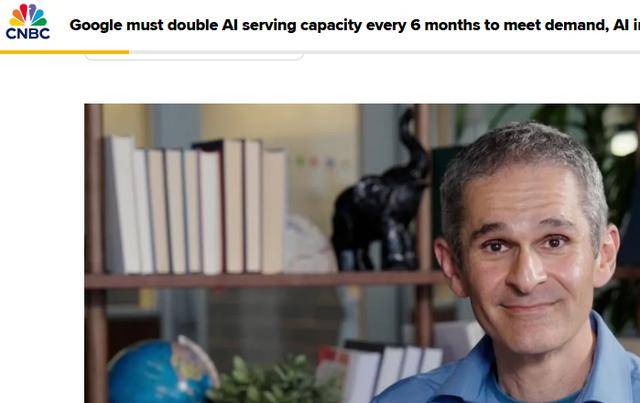
Core Insights - Google Cloud's Vice President, Armin Wahdatat, announced that to meet the surging demand for AI services, the company needs to double its infrastructure capacity every six months, aiming for a 1000-fold increase within 4-5 years [1][3] Group 1: Investment and Infrastructure - Google is significantly increasing its investment in AI infrastructure, publicly unveiling the seventh-generation TPU chip "Ironwood," which boasts a 30-fold improvement in energy efficiency compared to the first generation [3] - Alphabet has raised its capital expenditure forecast for the year to $91-93 billion, with plans for a "substantial increase" by 2026, while competitors like Microsoft, Amazon, and Meta are expected to spend over $380 billion during the same period, indicating an intense competition in AI infrastructure spending [3] Group 2: Strategic Focus and Market Concerns - Wahdatat emphasized that the core objective is to build a more reliable and efficient infrastructure rather than merely outspending competitors [3] - Concerns about an AI bubble are growing, with some employees questioning how profitability can be ensured if market expectations are not met. Google CEO Sundar Pichai acknowledged the presence of irrational market factors but stated that the risk of under-investment is greater, citing a 34% increase in quarterly cloud revenue and $155 billion in orders as evidence of the rationale behind the investments [3] Group 3: Challenges and Solutions - A shortage of computing power has become a bottleneck for Google's AI development, with Pichai revealing that the video generation tool Veo cannot be opened to more users due to these limitations [3] - To address this, Google is accelerating its infrastructure development while also exploring the transition of physical data center customers to cloud services to enhance resource utilization [3]
微软CTO:希望未来主要采用自研AI数据中心芯片,自主设计数据中心系统
美股IPO· 2025-10-02 03:53
Core Viewpoint - Microsoft aims to transition its data centers to primarily utilize self-developed chips, reducing reliance on major chip manufacturers like NVIDIA and AMD [3][4][6]. Group 1: Chip Development Strategy - Microsoft is focusing on designing a complete data center system, which includes not only chips but also networking and cooling systems [7]. - The company has already launched the Azure Maia AI accelerator chip and Cobalt CPU, and is reportedly developing next-generation semiconductor products [5]. - Microsoft emphasizes the importance of selecting chips based on the best cost-performance ratio, indicating a willingness to consider various solutions as long as capacity meets demand [5][4]. Group 2: Market Context and Competition - Major cloud computing companies, including Microsoft, are increasingly designing custom chips for their data centers to enhance efficiency and reduce dependency on NVIDIA and AMD [4][7]. - The AI sector is driving significant capital expenditure, with tech giants committing over $300 billion this year, primarily towards AI-related investments [8]. Group 3: Capacity Challenges - There is a significant shortage of computing power, described as a "massive crunch," particularly since the launch of ChatGPT, which has made it difficult to rapidly scale capacity [9]. - Despite aggressive deployment of computing resources over the past year, projections often fall short of actual demand, indicating ongoing challenges in meeting the needs of AI workloads [10].


“星际之门”在美国“新开5个数据中心”,投资额高达4000亿美元,目标“三年建成,7GW”
华尔街见闻· 2025-09-24 04:27
Core Insights - OpenAI and Oracle are advancing the $500 billion "Gateway" project, with the first site in Texas now operational [1][2] - The project aims to invest $400 billion over the next three years, ultimately reaching 7GW capacity [2] - OpenAI's CFO highlighted that the Texas Abilene site could expand to over 1GW, enough to power approximately 750,000 American homes [2] Project Expansion - The expansion includes five new sites in Texas, New Mexico, Ohio, and an undisclosed Midwest location [1][2] - Oracle is leading the construction of three large data centers as part of this initiative [4][5] - OpenAI and Oracle's agreement involves developing up to 4.5GW of new capacity over five years, valued at over $300 billion [5] Infrastructure Demand - The unprecedented scale of the Gateway project is a response to the significant demand for computing power for AI training and inference [6][8] - OpenAI's CFO emphasized the current shortage of computing power, stating that there is not enough capacity to fulfill all AI capabilities [8] - The construction aims to ensure that computing power is available by 2026, utilizing NVIDIA's next-generation Vera Rubin chips [9] Financing Structure - The project is supported by a complex financing structure, with OpenAI paying for computing power through operational expenses [12] - OpenAI's projected revenue for the year is expected to reach $13 billion, with plans to use cash flow and debt financing for construction costs [13] - NVIDIA is also involved through equity investment, receiving compensation for the chips provided [15] Political and Economic Implications - The Gateway project carries significant political and economic implications, having been announced in collaboration with former President Trump [19][20] - The project is expected to employ over 6,000 construction workers daily and provide nearly 1,700 long-term jobs [21] - OpenAI's infrastructure development aims to reshape the U.S. power grid and enhance the country's global influence [22][23]

三大期指齐跌,芯片股多数上涨;Meta冻结AI岗位招聘;强生公司将在美投资20亿美元以应对药品关税【美股盘前】
Mei Ri Jing Ji Xin Wen· 2025-08-21 13:47
Group 1 - Major stock indices futures are experiencing declines, with Dow futures down 0.23%, S&P 500 futures down 0.09%, and Nasdaq futures down 0.02% [1] - Chinese concept stocks are mostly rising, with notable increases such as Xiaopeng Motors up 1.08%, NIO up 2.95%, Boss Zhipin up 3.26%, and Miniso up 5.56% [2] - Target's CEO Brian Cornell will step down on February 1, after 11 years of leadership, due to poor sales performance, with COO Michael Fiddelke set to take over [2][3] Group 2 - OpenAI's CFO Sarah Friar stated that the company is still facing a shortage of computing power, leading to increased demand for GPUs, resulting in a rise in chip stocks like Nvidia up 0.4%, AMD up 0.72%, and TSMC up 0.32% [2] - Meta has paused hiring in its AI department after recruiting over 50 researchers and engineers, raising concerns about the impact on shareholder capital returns due to rising stock compensation [3] - Novo Nordisk has implemented a hiring freeze for non-critical positions globally and is considering layoffs to save costs [3] Group 3 - Delta Airlines confirmed that a Boeing 737 aircraft experienced wing damage during a flight, with no injuries reported among the 62 passengers and 6 crew members [3] - Johnson & Johnson announced a $2 billion investment in North Carolina to build a new factory, aimed at expanding its production capabilities in the U.S. to avoid potential drug import tariffs [4]


