管理体系

Search documents
家电-如何在海外市场脱颖而出?
2025-11-26 14:15
Summary of Samsung's Conference Call Industry Overview - The conference call primarily discusses the home appliance industry, focusing on Samsung's strategies and operations in global markets, particularly in China and other Asian countries. Key Points and Arguments Organizational Structure and Management - Samsung employs a co-CEO model to manage its core businesses, ensuring efficient management through specialized divisions [2][4] - The Chinese division has consolidated from seven independent legal entities into a single entity due to declining sales, streamlining operations [4][7] - Samsung's management emphasizes compliance and process rigor, with the CFO's authority second only to the CEO, contrasting with companies that prioritize sales performance [9][24] Supply Chain and Operational Efficiency - Samsung boasts a comprehensive SMT supply chain system, utilizing multi-level forecasting mechanisms (APY, AP1, AP2) to manage supply chain efficiency [8][10] - The company conducts strict assessments of supply chain performance, with metrics like order accuracy and inventory turnover directly impacting executive compensation [8][11] - Samsung's global ERP and SCM systems ensure consistency and transparency across regions, reducing distrust among customers [11][12] Market Performance and Challenges - Samsung's performance in the Chinese market has been hindered by geopolitical issues (THAAD incident) and product recalls (Note 7), alongside a slow response to online market dynamics [3][13] - In contrast, Samsung has performed well in other Asian markets, such as India, by introducing region-specific products [13] Cultural and Strategic Differences - Samsung's management structure is characterized by clear power distribution, with limited authority for lower-level employees, which can reduce flexibility compared to more agile companies like Haier [12][24] - The company has a high policy transparency rate of 90%, compared to about 30% for domestic competitors, fostering trust among customers [12] Globalization and Competitive Position - Samsung's global strategy involves sending top talent abroad, contrasting with Chinese firms that often send underperforming employees overseas [16] - The company has established a strong foothold in the global supply chain, while competitors like Haier rely on joint ventures and acquisitions for expansion [16] Industry Trends - The television supply chain is shifting from China and Korea to Vietnam, with Vietnam emerging as a significant production hub [15] - Chinese companies dominate the panel production market, controlling 85% of global capacity, allowing them to compete effectively on price [21] Comparison with Competitors - Samsung's sales system focuses on actual consumer sales rather than just channel sales, with a more comprehensive performance evaluation system [20] - In contrast, Western brands like Whirlpool and Electrolux struggle with product quality and management issues, highlighting Samsung's superior operational efficiency [22][23] Additional Important Insights - Samsung's strict cost control and expense forecasting ensure precise profit calculations for each product model, enhancing financial transparency [11] - The company has begun to prioritize online sales strategies, reflecting a shift in response to market demands [14][19]
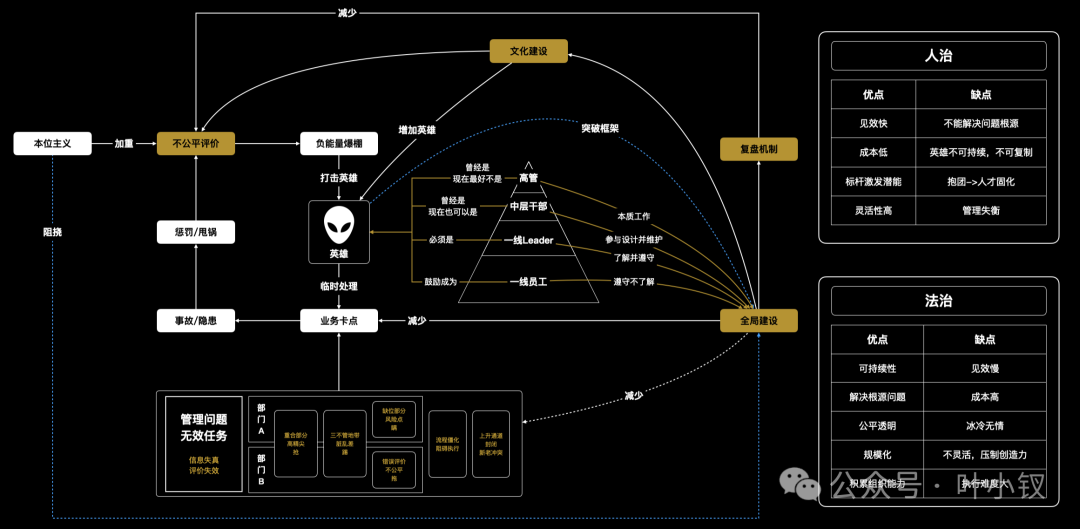
重英雄、轻机制,企业文化是人治的延续
Hu Xiu· 2025-06-12 02:47
Core Insights - The essence of management is to maximize resource utilization, essentially allowing fewer people to accomplish more work [6][9] - Management faces two fundamental issues: information distortion and evaluation failure, which must be addressed to optimize efficiency [11][57] - The balance between human governance (人治) and legal governance (法治) is crucial, as both have their strengths and weaknesses in addressing management challenges [9][10] Group 1: Human Governance vs. Legal Governance - Human governance is effective for simple, temporary issues and is cost-efficient, while legal governance is suited for complex, long-term problems but comes with higher costs and slower results [3][4] - Over-reliance on human governance can lead to wasted potential and class solidification within the company, while legal governance may not cover all scenarios effectively [8][10] - Both governance types must be balanced to avoid management imbalances and ensure resource planning aligns with the company's needs [10][11] Group 2: Structural Design - The focus of human governance is on grassroots management and frontline employees, with a strong emphasis on responsibility and adaptability among frontline leaders [18][20] - Grassroots management serves as a filter for identifying capable leaders, as they are the primary force in project execution and problem resolution [19][20] - Point issues arise from the two root problems and require immediate attention from grassroots management, while systemic solutions must be developed through legal governance [22][24] Group 3: Middle Management and Mechanism Implementation - Middle management plays a crucial role in capturing point issues and facilitating communication between grassroots and upper management [27][28] - Middle managers often face challenges due to their limited influence and the need to balance the demands of both upper management and frontline employees [29][30] - Effective mechanisms are essential to avoid inefficiencies caused by conflicting systems within departments, which can lead to wasted resources [30][31] Group 4: Executive Management - Executives must break the limitations faced by middle management by providing clear guidance on roles and responsibilities [35][36] - Different levels of management perceive issues differently, with executives focusing on overarching efficiency and cultural problems, while middle managers address immediate operational challenges [49][50] - A well-defined organizational structure is necessary to ensure that all levels of management can effectively contribute to the company's goals [54][55]