经济武器化

Search documents
法国拒绝加入和平委员会,特朗普宣布:将对法国酒加征200%关税
Sou Hu Cai Jing· 2026-01-22 15:24
Group 1 - The core issue revolves around the U.S. imposing a 200% tariff on French wine and champagne as a political retaliation against France's refusal to join a U.S.-led peace committee, highlighting the use of economic measures as a diplomatic tool [1][6][10] - The tariff significantly increases the price of Bordeaux wine from $50 to $150, leading to a shift in consumer preferences towards cheaper alternatives, which adversely affects French wine merchants [6][8] - This incident underscores the growing rift in transatlantic relations, as the U.S. appears less concerned about allies' compliance and more focused on whether they follow directives, reflecting a shift in U.S. strategic priorities [5][8] Group 2 - The situation reveals that the U.S. is increasingly using economic sanctions as a form of geopolitical leverage, with France being a particularly vulnerable target due to its agricultural exports' significance to its GDP [6][10] - The response from Europe has been more unified than in the past, with countries like Germany, Italy, and the Netherlands expressing concern, indicating a potential for collective action against U.S. tariffs [10] - The legality of Trump's tariffs is under scrutiny, with legal experts suggesting that such high punitive tariffs on allies may be unconstitutional, raising concerns about the potential for a broader trade war that could negatively impact U.S. consumers and agricultural states [10]

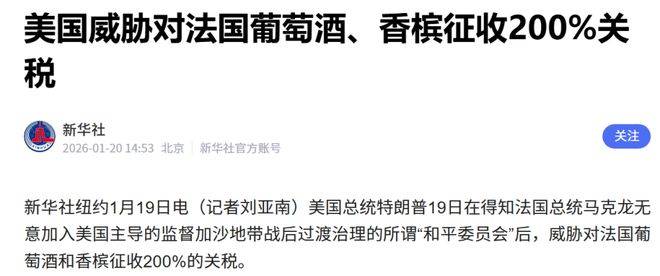
法国明确拒绝加入和平委员会,不到24小时,特朗普宣布:将对法国酒加征200%关税
Sou Hu Cai Jing· 2026-01-22 06:48
Group 1 - The core issue revolves around the geopolitical tensions between the US and France, highlighted by President Trump's decision to impose a 200% tariff on French wine and champagne following Macron's rejection of a US-led peace committee invitation [1][3][5] - The tariff is seen as a strategic economic weapon, targeting France's cultural exports, particularly wine, which is a significant part of its national identity and economy [5][7] - This incident underscores the deepening rift in transatlantic relations, as the US shifts its strategic focus away from Europe, while European nations, particularly France, seek greater defense autonomy [5][9] Group 2 - The response from Europe has been notably more united, with countries like Germany, Italy, and the Netherlands expressing concern, and the EU trade commissioner hinting at potential WTO dispute procedures [7][9] - Domestically, Trump's tariff strategy faces legal challenges, with the Supreme Court set to review the constitutionality of such high tariffs on allies, raising concerns within the Republican Party about the potential for a trade war [9] - The situation represents a clash between two contrasting systems: Europe's traditional order based on rules and multilateralism versus the US's transactional, results-oriented approach, which may lead to a significant re-evaluation of international relations [9]
中美四轮谈判,美国下马威,最高对华加税100%,中方反手断美财路
Sou Hu Cai Jing· 2025-09-14 11:28
Group 1 - The U.S. government is proposing to impose tariffs of up to 100% on Chinese goods as part of a strategy to address China's import of Russian energy, indicating a shift towards "economic weaponization" in geopolitical conflicts [1][3][4] - The G7 countries are divided on the issue, with Canada, Germany, and Japan expressing concerns about the economic impact of high tariffs on their own economies, particularly in sectors reliant on trade with China [6][8] - The U.S. Commerce Department has added 23 Chinese companies to an export control list, targeting key technology sectors such as semiconductors and biotechnology, which reflects a strategic shift towards "precise blockade" against China's tech industry [8][10] Group 2 - China's response includes launching an anti-discrimination investigation into U.S. trade policies related to integrated circuits, indicating a formal legal countermeasure rather than an emotional reaction [12] - China is diversifying its agricultural imports, signing significant soybean purchase agreements with Argentina and Brazil, which could undermine U.S. agricultural exports and impact domestic prices [15][17] - The upcoming negotiations in Madrid are expected to be tense, with both sides facing pressure to maintain their positions, and the outcome will depend on the actions taken over the years rather than just discussions at the negotiation table [19]
美国又使“狠招”:敢买俄石油,就加征500%关税?外交部回应不简单
Sou Hu Cai Jing· 2025-07-17 03:48
Group 1 - The core issue revolves around the proposed punitive tariffs by the U.S. on countries purchasing Russian energy, with a potential 500% tariff on goods from these nations [1][3] - The U.S. aims to pressure China and India into choosing between Russian oil and the American market, which could significantly impact global trade dynamics [3][5] - The proposed tariffs could lead to a drastic increase in consumer prices in the U.S., affecting a wide range of products and potentially exacerbating inflation [3][5] Group 2 - The U.S. actions may violate WTO principles, particularly the most-favored-nation treatment, allowing China and India to seek redress through international trade bodies [5][7] - Both China and India have expressed strong opposition to U.S. economic coercion, emphasizing their sovereignty in energy policy decisions [5][7] - The situation highlights the risks of weaponizing economic measures, which could backfire on U.S. consumers and businesses, undermining the multilateral trade system [7]