
经济社会绿色转型

Search documents
透过“税”数据读懂"十四五"经济社会绿色转型加速推进
Yang Shi Wang· 2026-02-10 02:10
Group 1 - During the "14th Five-Year Plan" period, the manufacturing industries of important green products such as new energy vehicles, photovoltaic equipment and components, lithium-ion batteries, and solar appliances have an average annual sales growth rate of over 30% [3] - The sales revenue of green technology service industries, including new energy, energy-saving, and environmental protection, has increased by an average of 51.1%, 28.5%, and 18.2% respectively [3] - The ecological protection and environmental governance industry has seen an average annual sales growth of 13.2%, providing technical support for green transformation [3] Group 2 - By 2025, the sales revenue from clean energy generation, including wind, solar, hydro, and nuclear power, is expected to account for 42.6% of total power generation sales revenue, an increase of 7.2 percentage points compared to the end of the "13th Five-Year Plan" [5] - The sales revenue from wind and solar power generation is projected to grow at an average annual rate of 25.4% during the "14th Five-Year Plan" period [5] Group 3 - Since the implementation of the environmental protection tax in 2018, a total of 111.06 billion yuan in tax reductions and exemptions have been granted nationwide [7] - By 2025, the environmental protection tax revenue from key regulated air pollutants, such as sulfur dioxide and nitrogen oxides, is expected to decrease by 33.8% and 34.03% respectively compared to 2020 [7] Group 4 - In 2025, the amount of groundwater extracted by taxpayers in pilot areas for the water resource fee reform is expected to be 5.47 billion tons, a decrease of 7.1% compared to 2024 [9] - The special water usage for golf courses, ski resorts, car washes, and bathing facilities is projected to decline by 34.3% compared to 2024, promoting water resource conservation and ecological protection [9]

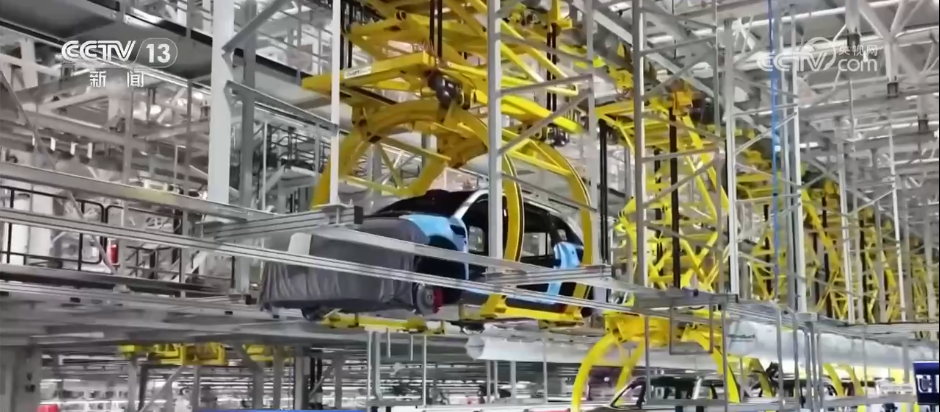
数据显示我国经济社会绿色转型加速推进
Ke Ji Ri Bao· 2026-02-10 00:18
Group 1 - During the "14th Five-Year Plan" period, the manufacturing industries of key green products such as new energy vehicles, photovoltaic equipment, lithium-ion batteries, and solar appliances have an average annual sales growth rate of over 30% [1] - China has maintained its position as the world's largest producer and seller of new energy vehicles for ten consecutive years, with a projected year-on-year growth of 25.9% in domestic new energy vehicle sales by 2025 [1] - The sales revenue share of five high-energy-consuming industries, including petroleum, coal, and other fuel processing, has decreased from 27% at the end of the "13th Five-Year Plan" to 24.9% at the end of the "14th Five-Year Plan" [1] Group 2 - The sales revenue of green technology service industries, including new energy, energy-saving, and environmental protection, has grown at an average annual rate of 51.1%, 28.5%, and 18.2% respectively during the "14th Five-Year Plan" [1] - By 2025, the sales revenue from clean energy generation, including wind, solar, hydro, and nuclear power, is expected to account for 42.6% of total power generation sales revenue, an increase of 7.2 percentage points from the end of the "13th Five-Year Plan" [1] - The sales revenue from wind and solar power generation is projected to grow at an average annual rate of 25.4% during the "14th Five-Year Plan" [1] Group 3 - The environmental protection tax policy has released tax reduction benefits, with a cumulative implementation of 111.06 billion yuan in tax reductions since its introduction in 2018 [2] - The number of urban and rural sewage and solid waste treatment plants benefiting from environmental protection tax incentives has increased from 5,589 in 2021 to 6,415 by 2025 [2] - The revenue from environmental protection taxes on major air pollutants, such as sulfur dioxide and nitrogen oxides, is expected to decrease by 33.8% and 34.03% respectively by 2025 compared to 2020 [2] Group 4 - The water resource fee reform has shown significant results, with the amount of underground water extracted in new pilot areas decreasing by 7.1% to 5.47 billion tons by 2025 [2] - Special water usage in golf courses, ski resorts, car washes, and bathing facilities has decreased by 34.3% compared to 2024 [2] - The collaboration between policy guidance and business initiatives has led to substantial progress in green transformation, reinforcing ecological safety and promoting sustainable economic development [2]
阳光电源涨超6%,南方基金旗下新能源ETF(516160)一度涨近3%,我国经济社会绿色转型加速推进
Xin Lang Cai Jing· 2026-02-09 07:21
Group 1 - The core viewpoint of the news highlights the significant growth in the renewable energy sector in China, with the New Energy ETF showing a notable increase and key stocks in the sector experiencing substantial gains [1] - The National Taxation Administration's data indicates that during the "14th Five-Year Plan" period, the sales revenue of key green product manufacturing industries, such as new energy vehicles and photovoltaic equipment, is expected to grow at an annual rate of over 30% [1] - Clean energy generation, including wind, solar, hydro, and nuclear power, is projected to account for 42.6% of total power generation sales revenue by 2025, marking a 7.2 percentage point increase from the end of the "13th Five-Year Plan" [1] Group 2 - On January 30, the National Development and Reform Commission and the National Energy Administration issued a notice to improve the capacity pricing mechanism for power generation, which includes coal, natural gas, pumped storage, and new energy storage [2] - The classification and improvement of capacity pricing are seen as a transitional measure before the establishment of a capacity market, with implications for coal power and independent storage [2] - The New Energy ETF closely tracks the CSI New Energy Index, which includes listed companies involved in renewable energy production, application, storage, and related equipment, reflecting the overall performance of the sector [2]

税收大数据:我国经济社会绿色转型加速推进
Bei Jing Shang Bao· 2026-02-09 06:12
Group 1 - During the "14th Five-Year Plan" period, the manufacturing industries of key green products such as new energy vehicles, photovoltaic equipment, lithium-ion batteries, and solar appliances have an average annual sales revenue growth rate exceeding 30% [1] - The sales revenue of green technology services, including new energy, energy-saving, and environmental protection, has an average annual growth of 51.1%, 28.5%, and 18.2% respectively, while the ecological protection and environmental governance industry has an average annual growth of 13.2% [1] - By 2025, the sales revenue from clean energy generation, including wind, solar, hydro, and nuclear power, is expected to account for 42.6% of total power generation sales revenue, an increase of 7.2 percentage points from the end of the "13th Five-Year Plan" [1] Group 2 - Since the implementation of the environmental protection tax in 2018, a total of 111.06 billion yuan has been granted in tax incentives [2] - By 2025, the revenue from environmental protection taxes on key air pollutants such as sulfur dioxide and nitrogen oxides is projected to decrease by 33.8% and 34.03% respectively compared to 2020 [2] - In 2025, the amount of groundwater extracted in pilot areas for the water resource fee reform is expected to be 5.47 billion tons, a decrease of 7.1% from 2024 [2]
我国关税重要调整!2026年1月1日起实施
Sou Hu Cai Jing· 2025-12-30 12:04
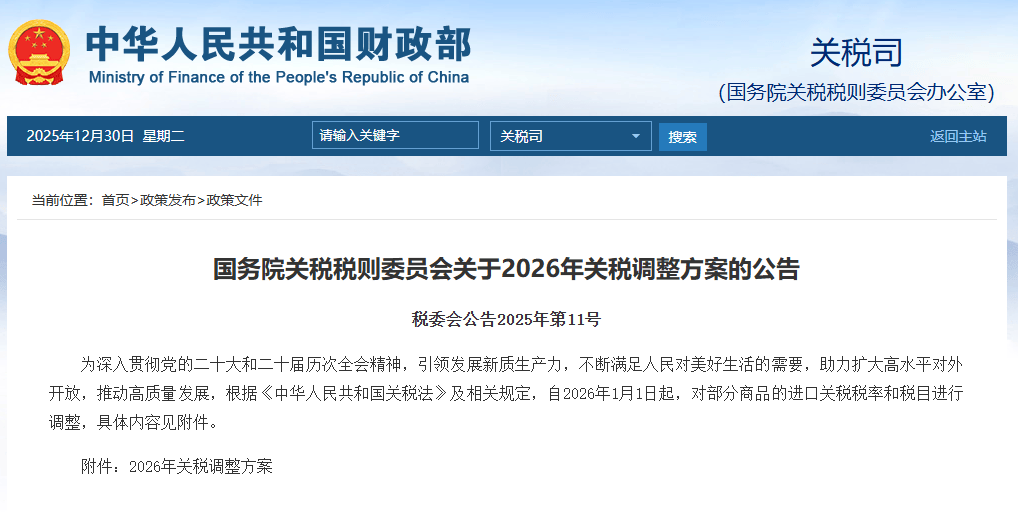
Group 1 - The core point of the news is the implementation of a temporary import tariff lower than the most-favored-nation rate on 935 items starting from January 1, 2026, as part of the tariff adjustment plan released by the State Council Tariff Commission [1][4]. Group 2 - The adjustment aims to promote high-level technological self-reliance and the construction of a modern industrial system by reducing import tariffs on key components and advanced materials such as CNC hydraulic pads and composite joints [4]. - It also supports the green transformation of the economy by lowering tariffs on resource-based products like regenerated black powder for lithium-ion batteries and unroasted pyrite [4]. - The plan emphasizes improving people's livelihoods by reducing tariffs on medical products, including artificial blood vessels and diagnostic kits for certain infectious diseases [4]. - To enhance domestic circulation, the plan will cancel temporary tariffs on items like micro motors and restore the most-favored-nation rate, aligning with changes in domestic industry development and supply-demand conditions [4]. - The total number of tariff items will be adjusted to 8,972, including new entries for smart bionic robots, bio-aviation kerosene, and forest ginseng to support technological development and circular economy [4]. - The plan continues to promote trade cooperation with the least developed countries by providing zero-tariff treatment on 100% of products for 43 such countries [5]. - Additionally, it maintains preferential tariff rates for certain imports from Bangladesh, Laos, Cambodia, and Myanmar under the Asia-Pacific Trade Agreement and relevant agreements with ASEAN member states [5].
关税调整,最新方案来了!
Guo Ji Jin Rong Bao· 2025-12-29 18:04
Group 1 - The State Council Tariff Commission has released the "2026 Tariff Adjustment Plan," which will be implemented starting January 1, 2026 [1] - The plan includes a temporary import tariff rate lower than the most-favored-nation (MFN) rate for 935 items to enhance the linkage between domestic and international markets and expand the supply of quality goods [1] - Key components of the tariff adjustments include reducing import tariffs on critical components and advanced materials to promote high-level technological self-reliance and the construction of a modern industrial system [1] Group 2 - The plan aims to support the comprehensive green transformation of the economy and society by lowering import tariffs on resource-based products such as regenerated black powder for lithium-ion batteries [1] - It also focuses on improving people's livelihoods by reducing import tariffs on medical products like artificial blood vessels and diagnostic kits for certain infectious diseases [1] - The total number of tariff items after adjustments will be 8,972, with new entries for items supporting technological development and circular economy [1] Group 3 - In 2026, the country will continue to implement preferential tariff rates for certain imported goods from 34 trade partners based on 24 free trade agreements and preferential trade arrangements [2] - To promote economic cooperation with least developed countries, 100% tariff-free treatment will be granted to products from 43 least developed countries with which diplomatic relations have been established [2] - The plan also includes special preferential tariff rates for certain imports from Bangladesh, Laos, Cambodia, and Myanmar under the Asia-Pacific Trade Agreement and relevant intergovernmental agreements with ASEAN member states [2]
今日国际国内财经新闻精华摘要|2025年12月22日
Xin Lang Cai Jing· 2025-12-22 00:26
International News - WTI crude oil prices have surpassed $57 per barrel, with a daily increase of 0.85% [1][5] - Palladium futures prices have also exceeded $1,800 per ounce, reflecting a daily rise of 0.85% [1][5] - U.S. Secretary of State Rubio emphasized the importance of maintaining a strong partnership with Japan while seeking constructive cooperation with China, which he described as a key element in the "balancing dynamic factors" of the Asia-Pacific region [1][5] - White House National Economic Council Director Hassett indicated that there is still ample room for interest rate cuts in the U.S., with a core inflation rate averaging 1.6% over the past three months. He also announced a significant housing policy proposal to be revealed in early next year [1][5] Domestic News - The People's Daily highlighted several national strategic deployments, including optimizing regional economic layouts, promoting comprehensive green transformation in economic and social development, and fostering new growth drivers through education and technology in Beijing [3][7] - The yield of money market funds continues to decline, with over 100 products having a seven-day annualized yield below 1% as of December 17. Industry insiders noted that short-term yield fluctuations may be related to profit-taking and large redemptions, while emphasizing the core value of liquidity management tools remains unchanged [8] - Wall Street's first GPU stock, Birun Technology, announced a maximum IPO price of HKD 19.60 per share, with a pricing range of HKD 17 to 19.60 per share, and plans to issue 247,692,800 H-shares, expected to begin trading on January 2 [8] - The Deputy Secretary-General of the State-owned Assets Supervision and Administration Commission, Li Bing, met with the President of the Hong Kong Monetary Authority, Yu Weiwen, to discuss deepening cooperation between state-owned enterprises and Hong Kong, as well as supporting Hong Kong's status as a financial center and the Belt and Road Initiative [8]
年内绿色债券共计发行362只 发行成本有望进一步降低
Zheng Quan Ri Bao· 2025-08-08 07:28
Core Viewpoint - The recent policy document from the Central Committee and State Council encourages local governments to reduce financing costs for green bonds, which are essential for promoting China's green transition [1]. Group 1: Green Bond Market Overview - As of August 13, 2023, a total of 362 green bonds have been issued this year, including green, blue, and carbon-neutral bonds [1]. - The structure of green bond issuers has changed significantly, with state-owned enterprises (SOEs) remaining the main issuers but experiencing a notable decline in issuance scale, while private enterprises have seen steady growth [1]. Group 2: Issuance Data - The issuance scale of green bonds by SOEs this year is 290.73 billion yuan, a year-on-year decrease of 40.55%, accounting for 83.53% of the total green bond issuance, down 7.31 percentage points [1]. - In contrast, private enterprises have issued 26.89 billion yuan in green bonds, a year-on-year increase of 39.45%, representing 7.73% of the total, up 4.14 percentage points [1]. Group 3: Factors Influencing SOE Issuance - The decline in SOE green bond issuance is attributed to three main factors: improved market regulations requiring higher standards for issuance, changes in market conditions influenced by local government debt management, and insufficient green project reserves among some SOEs [2]. Group 4: Cost Advantages and Challenges - Green bonds generally offer a cost advantage over regular bonds, with the average interest rate for AAA-rated 3-year green medium-term notes at 2.5531%, which is 10.4 basis points lower than that of non-green counterparts [2]. - However, the higher requirements for disclosure, assessment, and certification for green bonds increase the issuers' additional costs [2]. Group 5: Recommendations for Local Governments - Local governments can lower financing costs for green bonds by enhancing environmental information disclosure to reduce information asymmetry, thus helping investors better understand projects [3]. - They can also promote the unification of green project recognition and funding allocation based on the "Green Bond Support Project Catalog (2021 Edition)" to minimize additional costs arising from inconsistent standards [3].