
锂离子电池用再生黑粉

Search documents
锂电回收行业迎来转机 能源金属涨价推升“城市矿山”价值
Zheng Quan Shi Bao· 2026-01-12 03:03
Core Viewpoint - The lithium battery recycling industry is transitioning from a rough development phase to a more refined, standardized, and globalized stage, driven by rising prices of lithium and cobalt, supportive policies, and increasing demand for energy metals [1][2][6]. Industry Overview - Lithium battery recycling is likened to the development of "urban mines," converting waste batteries into valuable, recyclable resources [1]. - The industry is witnessing a transformation, with a market size exceeding 100 billion yuan, reshaping the resource supply landscape in the new energy sector [1][7]. Profitability and Market Dynamics - The profitability of lithium battery recycling businesses has improved significantly, with a reported 59% year-on-year increase in battery dismantling volume, reaching 36,000 tons in the first three quarters of 2025 [2]. - The rise in prices of lithium, cobalt, and nickel has enhanced cash flow for recycling companies, shifting the profit model from reliance on subsidies to the intrinsic value of recycled materials [2][3]. Policy and Regulatory Environment - The Chinese government has relaxed import policies for recycled materials, allowing certain types of black powder to be imported, which addresses previous challenges in the industry [3]. - This regulatory change is expected to secure domestic strategic resource supply and integrate China's battery recycling industry into global resource allocation [2][3]. Capacity Expansion and Capital Operations - Leading companies are adopting a dual strategy of capacity expansion and capital operations to capture market opportunities, with significant investments in new facilities and technology partnerships [4][5]. - Companies like Grinmei and Tianqi are actively pursuing acquisitions and financing to enhance their operational capabilities and market presence [4][5]. Technological Advancements and Lifecycle Integration - The industry is evolving from merely end-of-life disposal to playing a crucial role in the entire battery lifecycle, with companies developing comprehensive value chains from recycling to remanufacturing [6]. - Grinmei has achieved a lithium recovery rate exceeding 96.5% through innovative technologies, establishing partnerships with over 1,000 automotive and battery manufacturers [6]. Future Outlook - The lithium battery recycling market is projected to grow at an annual rate exceeding 50% over the next 3 to 5 years, with the domestic market expected to surpass 100 billion yuan by 2030 [7]. - The industry is moving towards a more regulated and competitive environment, with non-compliant players gradually exiting the market, signaling a positive trend for sustainable practices [7].


头部企业大动作!锂电回收行业迎来转机 能源金属涨价推升“城市矿山”价值
Xin Lang Cai Jing· 2026-01-11 05:54
Core Viewpoint - The lithium battery recycling industry is transitioning from extensive development to a new phase characterized by refinement, standardization, and globalization, driven by rising prices of lithium and cobalt, along with supportive policies [1][9]. Industry Overview - Lithium battery recycling is likened to the development of "urban mines," converting waste batteries into valuable, recyclable resources [1]. - The industry is witnessing a transformation that is reshaping the resource supply landscape of the new energy sector, with a green circular market exceeding 100 billion yuan already formed [1][9]. Profitability and Market Dynamics - Since 2025, the prices of key metals like lithium, cobalt, and nickel have remained high, positively impacting the cash flow and profitability of recycling companies [3]. - For instance, a company reported a 59% year-on-year increase in battery recycling volume, reaching 36,000 tons in the first three quarters of 2025, leading to improved profit margins due to increased retired battery volumes and rising metal prices [3][9]. Policy and Regulatory Changes - In June 2025, a joint announcement by the Ministry of Ecology and Environment, the Ministry of Industry and Information Technology, and the State Administration for Market Regulation stated that recycled black powder meeting national standards is not classified as solid waste, facilitating imports [3][4]. - This policy change addresses previous challenges in importing materials and allows the domestic battery recycling industry to participate in global resource allocation [3][4]. Capital and Capacity Expansion - Leading companies are adopting a dual strategy of "capacity + capital" to seize market opportunities, including new base construction, technological cooperation, and capital financing [4][5]. - For example, a company announced a 400 million yuan acquisition to enhance its circular economy strategy, while another company has established a processing capacity of 100,000 tons for waste lithium batteries [5][7]. Technological Advancements and Industry Collaboration - The industry is evolving from merely end-of-life disposal to becoming a crucial player in the entire battery lifecycle, with companies developing comprehensive value chains from battery recycling to remanufacturing [8]. - One company has achieved a lithium recovery rate exceeding 96.5% and has established partnerships with over 1,000 automotive and battery manufacturers, creating a closed-loop supply chain [8]. Market Outlook - The lithium battery recycling market is expected to grow significantly, with an annual growth rate exceeding 50% projected over the next 3 to 5 years, potentially reaching a market size of over 100 billion yuan by 2030 [9].

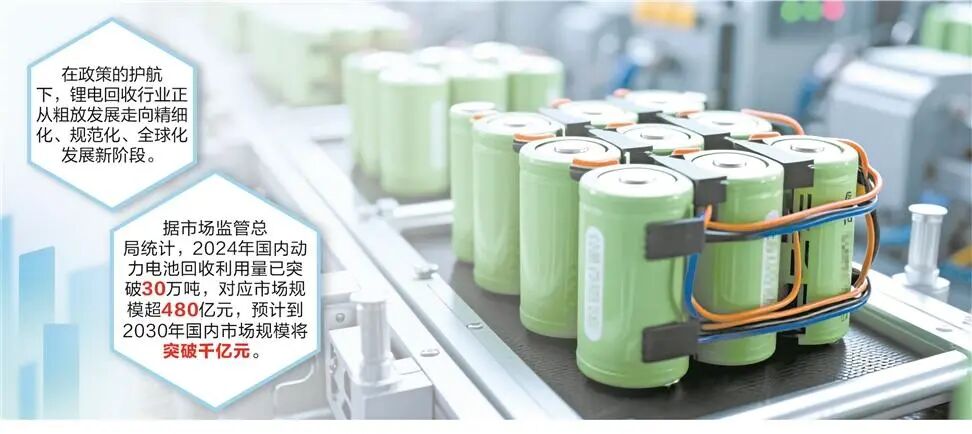
锂电回收行业迎来转机能源金属涨价推升“城市矿山”价值
Zheng Quan Shi Bao· 2026-01-09 23:02
Core Viewpoint - The lithium battery recycling industry is transitioning from extensive development to a new phase characterized by refinement, standardization, and globalization, driven by rising prices of lithium and cobalt, along with supportive policies [1][8]. Industry Overview - The lithium battery recycling sector is being recognized as a "urban mine," converting waste batteries into valuable, recyclable resources [1]. - A green circular market exceeding 100 billion yuan has emerged, reshaping the resource supply landscape in the new energy industry [1]. Profitability and Market Dynamics - The profitability of lithium battery recycling businesses has improved significantly due to increased retirement volumes and rising prices of lithium and cobalt [2]. - The price surge of energy metals has shifted the profit model from relying on subsidies to focusing on the intrinsic value of recycled materials, expanding profit margins for companies [2][3]. Policy Developments - New regulations have eased the import of recycled materials, allowing certain types of black powder to be imported without being classified as solid waste, thus facilitating the global resource allocation for China's battery recycling industry [2][3]. Capacity Expansion and Capital Operations - Leading companies are adopting a dual strategy of capacity expansion and capital operations to seize market opportunities, including new base construction and technology partnerships [4][6]. - Companies like Greeenme and Tianqi are actively pursuing acquisitions and financing to enhance their operational capabilities and market presence [4][5][6]. Technological Advancements and Industry Collaboration - The industry is evolving from merely end-of-life disposal to playing a crucial role in the entire battery lifecycle, with companies establishing comprehensive value chains [7]. - Greenme has achieved a lithium recovery rate exceeding 96.5% and has formed partnerships with over 1,000 automotive and battery manufacturers to create a closed-loop supply chain [7]. Market Outlook - The lithium battery recycling market is expected to grow at an annual rate exceeding 50% over the next 3 to 5 years, with the domestic market projected to surpass 100 billion yuan by 2030 [8].
锂电回收行业迎来转机 能源金属涨价推升“城市矿山”价值
Zheng Quan Shi Bao· 2026-01-09 17:44
Core Insights - The lithium battery recycling industry is evolving from a rough development phase to a more refined, standardized, and globalized stage, driven by rising prices of lithium and cobalt, along with supportive policies [1][7] - Major companies like Tianqi Co., Ltd. and Greeenme are expanding their capacities and capital operations to build competitive barriers through technological upgrades and industry chain extensions [1][2] Industry Trends - The prices of key metals such as lithium, cobalt, and nickel are expected to remain high due to global mining cycles and increased downstream energy storage demand, positively impacting cash flow and profitability for recycling companies [2][3] - The recycling business of Greeenme saw a significant increase in dismantling volume, reaching 36,000 tons in the first three quarters of 2025, a year-on-year surge of 59% [2] Policy Developments - In June 2025, the Ministry of Ecology and Environment, the Ministry of Industry and Information Technology, and the State Administration for Market Regulation announced that recycled black powder for lithium-ion batteries meeting national standards would not be classified as solid waste, facilitating imports [2][3] - The gradual relaxation of import policies for recycled resources reflects the government's emphasis on recycling and lithium battery recovery [3] Company Strategies - Greeenme is actively pursuing a dual strategy of capacity expansion and capital operation, including a planned acquisition of Henan Recycling Group to enhance its circular economy strategy [4][5] - Tianqi Co., Ltd. has established a processing capacity of 100,000 tons for waste lithium batteries, with plans for further expansion [5][6] Technological Advancements - Greeenme has developed a complete lifecycle value chain for battery recycling, achieving a lithium recovery rate exceeding 96.5% through innovative technologies [6] - The company collaborates with over 1,000 automotive and battery manufacturers to create a closed-loop supply chain, reducing risks associated with supply chain and metal price fluctuations [6] Market Outlook - The lithium battery recycling industry is expected to grow at an annual rate exceeding 50% over the next 3 to 5 years, with the market size projected to surpass 100 billion yuan by 2030 [7] - The industry is undergoing a transformation driven by price, demand, and policy changes, moving towards a more refined and standardized development phase [7]
中国对多种商品实施低于最惠国待遇的进口关税税率 意在推动深化高水平对外开放
Xin Lang Cai Jing· 2026-01-08 03:31
Core Viewpoint - The 2026 Tariff Adjustment Plan aims to implement lower-than-most-favored-nation (MFN) import tariff rates on various goods starting January 1, 2026, to enhance high-level opening-up and expand the supply of quality products [1] Group 1: Tariff Adjustments - China will implement lower-than-MFN tariff rates on 935 items to promote high-level technological self-reliance and modern industrial system construction [1] - The tariff adjustments focus on three main areas: promoting technological independence, supporting green transformation, and improving people's livelihoods through reduced import tariffs on key components, resource products, and medical supplies [1] - The plan includes the cancellation of temporary tariff rates on certain goods and the restoration of MFN rates based on domestic industry development and supply-demand changes [1] Group 2: Trade Agreements and Special Treatments - China will continue to provide 100% zero-tariff treatment on products for 43 least developed countries and implement preferential tariff rates for certain imports from Bangladesh, Laos, Cambodia, and Myanmar [2] - The plan maintains export tariffs on 107 items, including chrome ore, to rationally regulate resource exports [2] Group 3: Strategic Implications - The annual tariff adjustment is viewed as a clear policy direction and industrial signal, emphasizing the use of tariffs as a tool to support the development of new productive forces and high-level opening-up [2] - Import enterprises in high-end manufacturing, green technology, and healthcare sectors are expected to benefit from reduced costs and should seize the opportunity to enhance competitiveness [2] - Export enterprises need to monitor the list of goods with restored MFN rates and leverage the network of preferential tariff agreements with 34 partners to optimize global market strategies [2] Group 4: Balance and Stability - The plan maintains a careful balance between lowering specific import costs and stabilizing domestic industries by canceling certain temporary tariff rates [3] - It demonstrates China's commitment to fulfilling free trade agreement obligations while ensuring necessary export tariffs to stabilize domestic resources and markets [3] - This approach provides foreign trade enterprises with a stable, transparent, and predictable policy environment amid global economic uncertainties [3]
中国资环电池公司进口锂离子电池用再生黑粉原料 一单海外业务背后的资源循环(美丽中国)
Ren Min Ri Bao· 2026-01-05 22:31
Core Viewpoint - In 2025, China will no longer classify qualified recycled black powder for lithium-ion batteries as solid waste, allowing for its importation, marking a significant step in the lithium battery recycling industry [1][3]. Group 1: Import and Recycling Process - China Resources Recycling Group's subsidiary, China Resources Environmental Battery Company, successfully completed its first overseas transaction by importing 47 tons of recycled black powder, which passed customs in Tianjin [1]. - The recycled black powder contains strategic metals such as cobalt, nickel, manganese, and lithium, which are essential for battery production [2]. - The value of recycled black powder is significantly higher than that of natural minerals, with each ton of imported recycled black powder reducing the need for approximately 3 tons of primary mineral extraction and lowering carbon emissions by 2.5 tons [2]. Group 2: Policy Changes and Market Demand - Prior to the policy change, recycled black powder was considered solid waste, limiting its importation due to both regulatory and market constraints [3]. - The announcement by six government departments in June 2025 allowed for the import of qualified recycled black powder, addressing the rising demand for resources driven by the rapid growth of the electric vehicle industry [3]. Group 3: Quality and Logistics Challenges - Ensuring the quality of imported black powder is critical, as many overseas sources do not meet China's import standards due to excessive impurities [3][5]. - The logistics of transporting powdered black powder across borders posed challenges, leading to the adoption of sealed containers with moisture and shock protection [5]. Group 4: Future Prospects and Industry Development - The successful import of recycled black powder has led to the establishment of a closed-loop resource recycling system, with further processing to produce battery-grade lithium carbonate and iron phosphate for domestic battery manufacturers [6]. - China Resources Recycling Group aims to expand its operations by establishing more pre-treatment bases for recycled black powder, promoting large-scale imports and enhancing the resource recycling chain [6].
调整部分商品关税税率税目 我国持续扩大高水平对外开放
Jing Ji Ri Bao· 2026-01-04 01:38
Group 1 - The 2026 Tariff Adjustment Plan aims to scientifically adjust import provisional tax rates, optimize tariff categories, and continue implementing agreement and preferential tax rates, which will help lead the development of new productive forces and meet the growing needs of the people [1][2] - The adjustment includes a reduction in import tariffs for 935 items below the most-favored-nation rate, focusing on key components and advanced materials to promote high-level technological self-reliance and a modern industrial system [1][2] - The plan also aims to enhance the supply of quality goods and support the green transformation of the economy by lowering tariffs on resource-based products such as lithium-ion battery materials [1][2] Group 2 - The adjustment in the petrochemical sector includes items like bio-jet fuel and lithium-ion battery materials, reflecting the national policy to support the green and low-carbon transition of fossil energy [2] - The reduction of tariffs on medical products, such as artificial blood vessels and diagnostic kits, demonstrates a people-centered development approach, which is expected to improve public health and welfare [2][3] - The total number of tariff categories will be 8,972, with new categories added for emerging products like intelligent bionic robots, supporting technological advancement and the circular economy [3] Group 3 - The plan continues to implement preferential tax rates for goods from 43 least developed countries, promoting economic cooperation and development in these regions [3] - The adjustment reflects China's commitment to high-level opening-up and its role as a contributor to global development amid rising trade protectionism [4]
我国持续扩大高水平对外开放 调整部分商品关税税率税目
Jing Ji Ri Bao· 2026-01-03 23:31
Core Viewpoint - The "2026 Tariff Adjustment Plan" aims to scientifically adjust import provisional tax rates, optimize tariff categories, and continue implementing agreement and preferential tax rates, which will support the development of new productive forces, meet the growing needs of the people, expand high-level opening-up, and promote high-quality development [1] Group 1: Import Provisional Tax Rate Adjustments - The plan will implement lower-than-most-favored-nation tax rates on 935 items to enhance the linkage between domestic and international markets and expand the supply of quality goods [1] - Key components include reducing import tariffs on critical components and advanced materials to promote high-level technological self-reliance and the construction of a modern industrial system [2] - Tariff reductions on resource-based products like lithium-ion battery recycled black powder aim to support the green transformation of the economy and society [1][2] Group 2: Tax Category Optimization - The total number of tariff categories will be adjusted to 8,972, with new categories added for emerging products such as intelligent bionic robots and bio-aviation kerosene [3] - The adjustment will help industries and enterprises accurately grasp trade data and assess overseas market trends, facilitating the formulation of effective development strategies [3] - Continued implementation of preferential tax rates for goods from 34 trade partners and zero-tariff treatment for 43 least developed countries reflects China's commitment to deepening economic cooperation and regional integration [3]
我国持续扩大高水平对外开放
Xin Lang Cai Jing· 2026-01-03 22:20
Group 1 - The 2026 Tariff Adjustment Plan aims to scientifically adjust import provisional tax rates, optimize tariff categories, and continue implementing agreement and preferential tax rates, which will help lead the development of new productive forces and meet the growing needs of the people [1] - The plan includes three main aspects: adjusting import provisional tax rates, optimizing tariff categories, and continuing to implement agreement and preferential tax rates [1] - In the adjustment of import provisional tax rates, 935 items will have provisional tax rates lower than the most-favored-nation rate, enhancing the linkage between domestic and international markets [1] Group 2 - The adjustment in the petrochemical sector includes items such as bio-aviation kerosene and lithium-ion battery recycled black powder, reflecting the national policy to support the green and low-carbon transition of fossil energy [2] - The reduction of import tariffs on medical products like artificial blood vessels and diagnostic kits for infectious diseases aims to improve public health and enhance the well-being of the population [2] - The adjustment of tariffs on certain medical devices is expected to increase the supply of quality products and reduce the medical burden on consumers [2] Group 3 - The optimization of tariff categories will include new entries such as intelligent bionic robots and bio-aviation kerosene, with the total number of tariff categories reaching 8,972 [3] - The plan continues to implement agreement tax rates for certain imported goods from 34 trade partners, promoting regional integration and economic cooperation [3] - China aims to provide 100% zero-tariff treatment for products from 43 least developed countries, showcasing its commitment to global development amidst rising trade protectionism [3]
调整部分商品关税税率税目——我国持续扩大高水平对外开放
Jing Ji Ri Bao· 2026-01-03 22:16
Core Viewpoint - The "2026 Tariff Adjustment Plan" aims to scientifically adjust import provisional tax rates, optimize tariff categories, and continue implementing agreement and preferential tax rates, which will support the development of new productive forces and meet the growing needs of the people while promoting high-quality development [1]. Group 1: Import Provisional Tax Rate Adjustments - The plan will implement provisional tax rates lower than the most-favored-nation rate for 935 items to enhance the linkage between domestic and international markets and expand the supply of quality goods [1]. - Key components include reducing import tariffs on critical components and advanced materials to promote high-level technological self-reliance and the construction of a modern industrial system [1]. - Tariff reductions will also support the green transformation of the economy and society by lowering tariffs on resource-based products like lithium-ion battery recycled black powder [2]. Group 2: Support for Healthcare and Living Standards - The adjustment will lower import tariffs on medical products such as artificial blood vessels and diagnostic kits for certain infectious diseases, reflecting a people-centered development philosophy [2]. - This move is expected to enhance public health and improve the well-being of citizens, particularly in addressing cardiovascular diseases [2]. - The tariff reductions on medical devices and pharmaceuticals aim to increase the supply of quality goods and reduce the medical burden on consumers [2]. Group 3: Optimization of Tariff Categories - The plan will add new tariff categories for emerging products like intelligent bionic robots and bio-aviation kerosene, increasing the total number of tariff categories to 8,972 [3]. - This adjustment will help industries and companies accurately grasp trade data and assess overseas market trends, facilitating the formulation of effective development strategies [3]. - The plan continues to implement agreement rates for certain imported goods from 34 trade partners, promoting regional integration and economic cooperation [3]. Group 4: Support for Least Developed Countries - The plan will maintain zero tariff treatment for 100% of products from 43 least developed countries, supporting their development [3]. - It will also continue to apply preferential tax rates for certain imported goods from countries like Bangladesh, Laos, Cambodia, and Myanmar under relevant trade agreements [3]. - This approach demonstrates China's commitment to responding to global uncertainties with determined policies, showcasing its role as a contributor to global development [3].