
结构性铜短缺

Search documents
如何理解当前的铜市场动态?
Wen Hua Cai Jing· 2026-01-22 11:51
Core Insights - The global copper market is facing unprecedented challenges due to structural shortages driven by demand exceeding supply capabilities, creating investment opportunities and supply chain risks [2][3] Supply and Demand Dynamics - By 2040, global copper supply is projected to fall short of demand by approximately 10 million tons, representing nearly 24% of expected consumption during that period [3] - Short-term market conditions indicate tightening supply, with copper prices reaching historical highs of over $13,000 per ton in early 2026, reflecting both current supply constraints and anticipated demand from electrification investments [3] - The mining industry's capital allocation patterns show significant underinvestment relative to expected demand growth, with large copper deposits taking 15-20 years from discovery to production, leading to structural lags in supply availability [3][4] Factors Driving Copper Demand - The electrification trend across transportation, energy production, and digital infrastructure is creating multiple demand vectors for copper, particularly in electric vehicles and renewable energy facilities [5][6] - Emerging demand sources include artificial intelligence infrastructure and defense spending, which require enhanced electrical systems and contribute to increased copper usage [6] Regional Demand Hotspots - Southeast Asia and India are experiencing accelerated industrial growth, leading to increased copper consumption in construction, manufacturing, and infrastructure development [7][8] Supply Constraints - The mining sector faces challenges such as declining ore grades, deeper mining operations, and heightened environmental compliance standards, which increase capital intensity and investment barriers [4][9] - Existing mining regions are experiencing geological and environmental constraints, including lower ore grades and extended environmental approval processes, which complicate new project developments [9][10] Global Supply Risks - The geographic concentration of copper supply poses risks, as a limited number of countries control a significant portion of mining output, making the market vulnerable to policy changes and operational disruptions [11][12] - Operational risks, including natural disasters and regulatory complexities, can significantly impact global copper supply availability [12][13] Current Market Dynamics - The current copper shortage is expected to persist into the 2030s, with supply response times for new copper capacity typically taking 15-20 years [22] - External factors such as economic downturns or government stimulus plans focused on infrastructure and clean energy could significantly influence copper demand growth [24] Strategic Position of Australia - South Australia has established itself as a strategic supplier in the global copper market, with a notable increase in copper exports, reflecting production growth and favorable pricing conditions [18][21] - The region's political stability and predictable regulatory environment provide a competitive advantage for long-term mining investments [21]


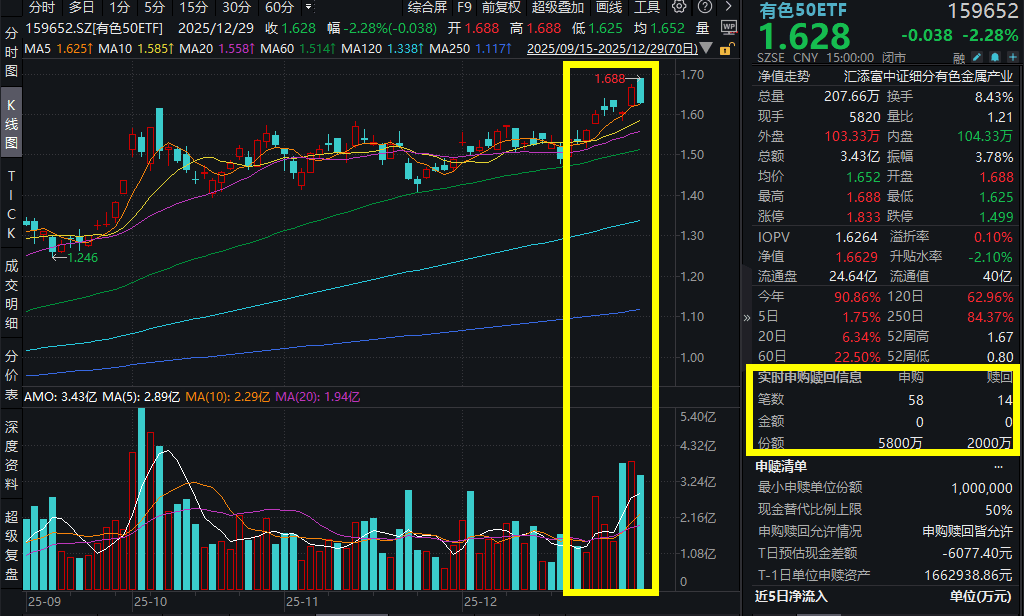
金银锂巨震!有色50ETF(159652)收跌超2%,逆势吸金超6200万元!有色板块2026年能否延续强势?
Sou Hu Cai Jing· 2025-12-29 09:54
Core Viewpoint - The A-share market shows a divergence in indices, with the Shanghai Composite Index achieving a nine-day winning streak, while the prices of non-ferrous metals are experiencing significant volatility, particularly with copper prices rising sharply before a market pullback [1][3] Market Performance - The non-ferrous 50 ETF (159652) saw a decline of over 2% in the afternoon session, despite attracting over 62 million yuan in inflows throughout the day [1] - Major component stocks of the non-ferrous 50 ETF, including Ganfeng Lithium and Tianqi Lithium, experienced declines exceeding 4% [1][2] Commodity Price Trends - Precious metals are on a downward trend, with spot gold dropping over 1% and spot silver falling more than 5% [3] - Industrial metals, particularly copper, have shown strong upward movement, with LME copper rising over 3% [3] Supply and Demand Dynamics - The supply side of copper is characterized by both rigidity and vulnerability, with frequent disruptions in copper mine supplies and a lack of capital expenditure over the past decade leading to a tightening supply situation [6] - Forecasts indicate a growing global copper supply-demand gap over the next five years, suggesting a long-term bullish outlook for copper prices [7] Catalysts for Demand Growth - Emerging industries such as AI and electric vehicles are expected to drive new demand for non-ferrous metals, with significant investments in infrastructure and manufacturing supporting this growth [8] - Goldman Sachs predicts that by 2030, global power grid and electricity infrastructure construction will contribute to 60% of copper demand growth, equating to the current global copper consumption [8] Investment Opportunities - The non-ferrous 50 ETF (159652) is highlighted as a valuable investment vehicle, benefiting from a comprehensive exposure to various metal sectors, including gold, copper, aluminum, and lithium [10] - The ETF's composition features a high concentration of copper and gold, with a combined weight of 45%, and a leading concentration of top stocks [10][12]
“完美风暴”导致铜价暴涨 市场仍为铜短缺感到担忧
Ge Long Hui· 2025-12-29 08:10
Core Viewpoint - Copper prices surged to over $12,000 per ton in December, marking a historic high and a more than one-third increase in 2025, the largest annual gain since 2009, driven by U.S. tariffs, supply disruptions, and global shortages concerns [1] Group 1: Price Dynamics - Copper prices experienced a significant rise due to a "perfect storm" of factors, including easing trade tensions, negotiations for a peace agreement in Ukraine, and the impact of U.S. import tariffs [1] - Analysts predict that demand for copper will exceed mine supply before 2030, with prices expected to remain elevated in the coming year [1] Group 2: Market Reactions - Market participants are discussing a potential structural copper shortage starting in 2026, indicating long-term concerns about supply [1] - An unprecedented price gap emerged between London benchmark copper prices and U.S. Comex copper prices due to rumors of potential tariffs, although a final tariff exemption was granted for significant amounts of cathode copper entering the U.S. [1] - Despite the tariff exemption, Comex futures prices remain higher than LME prices, reflecting market fears of possible additional tariffs from the U.S. government next year [1] Group 3: Supply Concerns - The market is reacting to a combination of bullish sentiment and supply worries, with a significant influx of copper into the U.S. market acting as a catalyst for price movements [1]