绿色服务贸易

Search documents
央行研究局局长王信:加大融资支持,降低轻资产、绿色服务贸易企业的融资门槛和成本|快讯
Hua Xia Shi Bao· 2025-10-31 07:16
Core Viewpoint - The development of green service trade is a significant driver for global economic growth and structural adjustment, focusing on both the green transformation of traditional service trade and the digital delivery of inherently green low-carbon services [2] Group 1: Financial Support for Green Service Trade - The People's Bank of China emphasizes the importance of financial tools such as green credit, green bonds, and green equity funds in empowering the development of green service trade [3] - Examples include green credit supporting carbon reduction in the shipping industry, with a notable loan of 273 million yuan provided to COSCO Shipping Energy for transformation [3] - Green bonds are being issued to support low-carbon technology research and application in shipping, with the issuance of blue bonds by China Shipbuilding (Hong Kong) Leasing Company aimed at enhancing energy efficiency and sustainable transport [3] Group 2: Future Directions for Financial Support - The People's Bank of China plans to focus on promoting the application of green finance and transformation finance standards, supporting innovative financing methods such as credit, bonds, and equity [4] - Financial institutions are encouraged to increase financing support for production service sectors like research and design, logistics operations, and carbon emission certification, thereby reducing financing barriers for light-asset green service trade enterprises [4] - There is a push to support the issuance of green financial products in global markets, providing more Chinese green assets to global investors [4]


央行:通过绿色信贷、绿色债券、绿色股权基金等工具,赋能绿色服务贸易发展
Zhong Guo Xin Wen Wang· 2025-10-31 05:29
Core Viewpoint - The People's Bank of China is leveraging green financial tools such as green credit, green bonds, and green equity funds to empower the development of green service trade [1][2]. Group 1: Importance of Green Service Trade - Green service trade is becoming a significant driver of global economic growth and structural adjustment, focusing on the green transformation of traditional service trade and the development of digital delivery services with low-carbon characteristics [2]. - The development of emerging service industries, such as carbon emission certification and carbon finance, is reshaping global production and consumption networks, significantly impacting high-quality international economic and trade development [2]. Group 2: Financial Tools Supporting Green Service Trade - Green credit is being utilized to support shipping service entities in reducing carbon emissions, exemplified by a 273 million yuan transformation loan provided to COSCO Shipping Energy by the Bank of Communications [2][3]. - Green bonds are facilitating the research and application of low-carbon technologies in shipping, with companies like China Shipbuilding (Hong Kong) issuing green and blue bonds to support energy efficiency upgrades and sustainable transportation [3]. - Green shipping funds and equity financing are providing medium to long-term funding for green service trade projects, addressing funding challenges and mitigating risks during the green transition in the shipping industry [3]. Group 3: Future Directions for Support - The People's Bank of China will focus on promoting the application of green finance and transition finance standards, supporting innovative financing methods such as credit, bonds, and equity [4]. - Financial institutions are encouraged to increase financing support for productive service sectors, including research and design, logistics operations, and waste resource recovery, thereby lowering financing thresholds and costs for asset-light green service trade enterprises [4]. - There is a commitment to support the issuance of green financial products in global markets, providing more Chinese green assets to global investors and enhancing the innovative development of green service trade through the opening of the financial sector [4].
人民银行:支持在全球金融市场发行绿色金融产品
Bei Jing Shang Bao· 2025-10-31 04:58
Core Viewpoint - The Chinese government emphasizes the importance of green service trade as a key driver for global economic growth and structural adjustment, focusing on both the green transformation of traditional service trade and the development of digital delivery services with low-carbon characteristics [1][2] Group 1: Green Service Trade Development - Green service trade is identified as a significant force for restructuring global production and consumption networks, contributing to high-quality international economic and trade development [1] - The focus is on building a green low-carbon supply chain system, with an emphasis on energy-saving technologies, low-carbon technologies, green design, green shipping, environmental services, and green finance [1] Group 2: Financial Sector Support - The financial sector plays a crucial role in supporting green service trade through tools such as green credit, green bonds, and green equity funds [2] - The People's Bank of China plans to enhance support for green service trade by promoting the application of green finance and transition finance standards, and encouraging innovative financing methods [2] - Financial institutions are encouraged to increase financing support for production service sectors related to research and design, logistics operations, carbon emission certification, and resource recycling, thereby reducing financing barriers for light-asset green service trade enterprises [2]
中国人民银行:加大融资支持 降低轻资产、绿色服务贸易企业的融资门槛和成本
Sou Hu Cai Jing· 2025-10-31 03:43
Core Viewpoint - The People's Bank of China (PBOC) is focusing on supporting the development of green service trade through various financial initiatives and standards [1][4] Group 1: Financial Support Initiatives - The PBOC will promote the application of green finance and transformation finance standards, supporting innovative financing methods such as credit, bonds, and equity [1][4] - Financial institutions are encouraged to increase financing support for production service sectors like R&D design, logistics operations, carbon emission certification and evaluation, and waste resource recycling [1][4] - The aim is to lower the financing thresholds and costs for light-asset and green service trade enterprises, which often lack substantial collateral [1][4] Group 2: Global Financial Market Engagement - The PBOC supports the issuance of green financial products in global financial markets, providing more Chinese green assets to global investors [1][4] - The initiative includes a dual opening of the financial industry to empower the innovative development of green service trade [1][4]

强化创新提升服务贸易国际竞争力
Sou Hu Cai Jing· 2025-10-08 22:50
Core Insights - The State Administration of Foreign Exchange reported that in August, China's goods and services trade reached 42,818 billion yuan, a 2% year-on-year increase, with service trade exports at 2,546 billion yuan and imports at 3,675 billion yuan, resulting in a deficit of 1,129 billion yuan [1] - The development of service trade and service consumption is crucial for stabilizing foreign trade and expanding domestic demand, emphasizing the need for innovation and enhancing the international competitiveness of traditional service industries [1] - Knowledge-intensive service trade, characterized by high added value and technology content, is becoming a key driver for optimizing service trade structure and stabilizing foreign trade, with imports and exports reaching 15,025.4 billion yuan in the first half of the year, a 6% increase [2] Service Trade Development - The service trade sector is expanding and optimizing, driven by digital technology advancements, with knowledge-intensive services accounting for nearly 40% of total service trade [2] - High growth rates in telecommunications, computer, and information services exports, which increased by 12.7% in the first half of the year, reflect the robust development of China's digital economy [2] - Cultural service products such as film, gaming, and design are gaining international recognition, contributing significantly to knowledge-intensive service exports [2] Challenges in Service Trade - Despite growth, challenges remain, including insufficient innovation factor supply, fragmented core technology R&D investment, and a lack of a comprehensive industrial ecosystem to support the deep development of knowledge-intensive service trade [3] - The proportion of knowledge-intensive service trade is rising but still lags behind the global average, indicating a need to strengthen international competitiveness in high-value-added sectors [3] Recommendations for Service Trade Innovation - Continuous promotion of service trade innovation is essential, focusing on enhancing digital infrastructure and core technology innovation to support service trade development [4] - Expanding new business models and service trade formats, such as digital and green service trade, is crucial for fostering innovation and integrating industry chains [4] - Optimizing the regulatory environment and policy framework for service trade, including implementing a negative list for cross-border service trade, will facilitate further opening in sectors like telecommunications, education, and finance [4] Rule Enhancement and Financial Innovation - There is a need to deepen service trade rules, particularly in digital and green service trade, and to actively participate in the formulation of high-standard international trade rules [5] - Establishing a robust cross-border financial service system and developing diverse financial products will create convenience for knowledge-intensive service imports and exports [5]
创新提升服务贸易路径
Jing Ji Ri Bao· 2025-09-25 22:14
Core Points - China is committed to expanding high-level opening-up and enhancing service trade quality through innovation and international cooperation [1][4][5] Summary by Sections Basic Connotation and Development Trends - Service trade is characterized by the exchange of services across borders, playing a crucial role in global trade structure upgrades [2] - The global service trade is projected to reach $8.69 trillion in 2024, with a year-on-year growth of 9% [2] - Digital services trade is expected to grow to $4.64 trillion in 2024, increasing by 8.3% [2] - Institutional openness is driving service trade by reducing transaction costs through deeper regional economic cooperation [2] Current Situation and Future Needs - China's service trade has seen a total import and export value of 45,781.6 billion yuan in the first seven months of this year, marking an 8.2% increase [3] - Knowledge-intensive service trade is growing steadily, with its share nearing 40% of total service trade [3] - The China International Fair for Trade in Services (CIFTIS) has become a significant platform for international cooperation, with participation from over 70 countries and nearly 2,000 enterprises [3] - Continuous improvements in openness through free trade zones and other initiatives are providing institutional support for high-quality service trade development [3] Innovation and Development Pathways - There is a pressing need to innovate and enhance service trade to address existing trade deficits, particularly in traditional service sectors [4][6] - The integration of digital technologies like blockchain and AI is transforming service trade, enhancing efficiency and security [6][8] - The development of green service trade is essential for sustainable growth, aligning with global environmental goals [6][9] - A strategic approach is required to create new growth points in service trade, focusing on sectors like education, finance, and consulting [7][8] Conclusion - The advancement of service trade is vital for establishing a robust open economy and supporting China's modernization efforts [9]
2025年中国辣条行业市场政策、产业链、发展现状、竞争格局及发展趋势研判:卫龙和麻辣王子双雄割据[图]
Chan Ye Xin Xi Wang· 2025-04-20 01:17
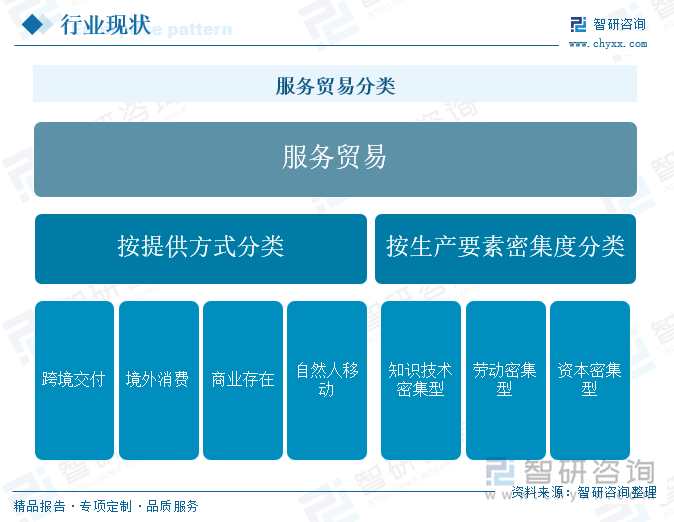
Core Viewpoint - China's service trade is experiencing significant growth, with a total service trade volume projected to reach 7.10 trillion yuan in 2024, reflecting a year-on-year increase of 16.38% [1][10]. Industry Overview - Service trade involves the cross-border flow of services as trade goods, categorized by delivery method and production factor intensity [2][4]. - The industry has evolved through four main stages: initial exploration (1978-1992), rapid growth (1992-2001), accelerated development (2001-2012), and high-quality development (2012-present) [4][5][6]. Industry Development History - From 1978 to 1992, service trade began to develop but lagged behind manufacturing, with total service trade imports and exports increasing from 4.4 billion USD to 10.8 billion USD [4]. - The period from 1992 to 2001 saw a significant increase in service trade, with the share of global service trade rising from 1% to 2.3% [5]. - Following China's accession to the WTO in 2001, service trade grew rapidly, with total imports and exports increasing from 71.9 billion USD in 2001 to 713 billion USD in 2015 [5]. - Since 2012, the focus has shifted to high-quality development, with policies promoting service trade transformation and an increase in knowledge-intensive service trade [6]. Industry Chain - The service trade industry chain includes upstream components like infrastructure and technology support, midstream service trade activities, and downstream demand from consumers, businesses, and government [8]. Current Industry Status - In 2024, the service trade deficit is projected to be -1.63 trillion yuan, a decrease of 10.78% year-on-year, primarily due to increased outbound travel demand driven by rising household incomes [10]. - Key segments driving growth include travel services, which are expected to reach 2.07 trillion yuan, a 33.67% increase, and transportation services, projected at 2.00 trillion yuan, a 15.18% increase [12][13]. Key Companies' Performance - Major companies in the service trade sector include COSCO Shipping Holdings, which reported a revenue of 233.9 billion yuan in 2024, a 33.35% increase, and a gross profit of 67.7 billion yuan, a 145.35% increase [17]. - Boyuan Technology, a global IT service provider, reported a revenue of 5.098 billion yuan in the first three quarters of 2024, a 4.64% increase, but a net profit decline of 20.39% [19]. Industry Development Trends - Digital transformation is a key trend, with advancements in AI, blockchain, and cloud computing expected to enhance service delivery and efficiency [21]. - The demand for knowledge-intensive services is anticipated to rise, particularly in finance and IT, driving the industry towards higher value chains [22]. - Green service trade is emerging as a significant trend, with increasing focus on sustainability and environmental protection [23].