
缺电叙事

Search documents
智通港股解盘 | 算力租赁涨价来袭 缺电叙事持续演绎各种机会
Zhi Tong Cai Jing· 2026-02-12 12:37
Core Viewpoint - The article discusses the rising prices in computing power leasing and the ongoing narrative of electricity shortages, highlighting various investment opportunities in the sector [1] Group 1: Industry Insights - The computing power leasing market is experiencing price increases, driven by demand and supply constraints [1] - Ongoing electricity shortages are influencing the market dynamics, creating a backdrop for potential investment opportunities [1] Group 2: Investment Opportunities - The article suggests that the current environment may lead to various investment opportunities within the computing power and energy sectors [1] - Companies involved in computing power leasing may benefit from the rising prices and increased demand for their services [1]
兴证策略:2月即将迎来产业密集催化期 尤其AI应用领域具备诸多催化
Jin Rong Jie· 2026-01-27 12:22
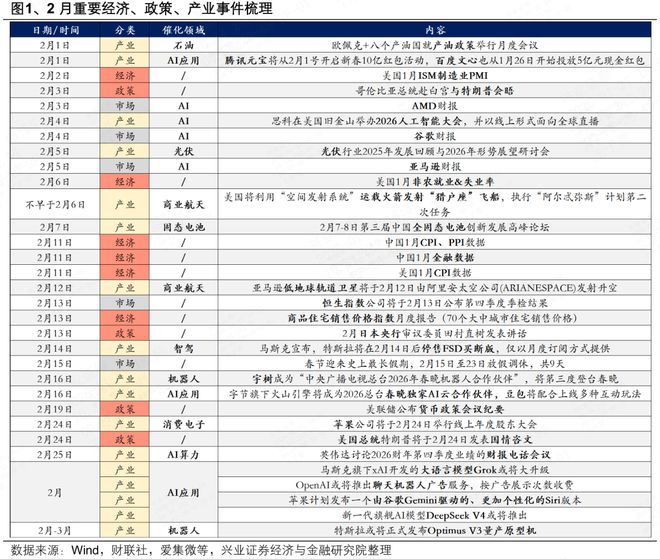
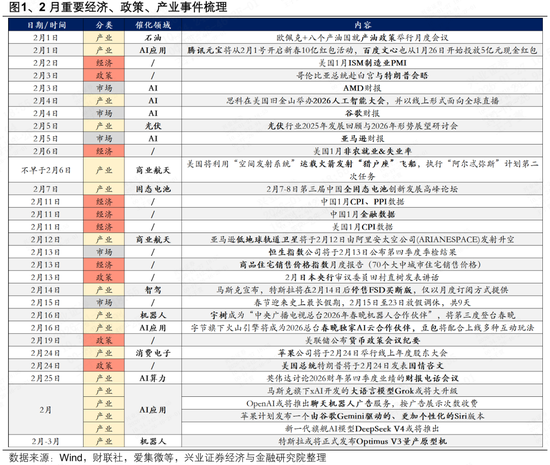
Group 1 - The core viewpoint of the articles highlights the upcoming industrial catalysts in February, particularly in the AI application sector, with major tech companies and startups competing for market share during the Spring Festival [1] - Significant AI developments are expected, including the release of DeepSeek-V4 and upgrades to major language models like Grok and Siri, alongside Tesla's potential launch of the OptimusV3 model [1] - February is characterized as a fundamental "window" period with abundant liquidity, likely leading to increased market volatility and a favorable environment for small-cap, growth, and thematic sectors [2] Group 2 - Historical data indicates that February is one of the months with the highest win rates for major indices, with small-cap and growth sectors expected to outperform [2][3] - The focus on thematic investments is anticipated to rise in February, particularly in AI applications, commercial space, humanoid robots, and energy narratives [5] - The upcoming earnings reports from major tech companies like Google, Amazon, and AMD are expected to influence market sentiment and performance [1][2]

兴证策略张启尧团队:2月即将迎来产业密集催化期
Xin Lang Cai Jing· 2026-01-27 11:29
Group 1 - February is entering a period of intensive industrial catalysts, particularly in the AI application field, with significant activities from major tech companies and startups [1][9] - Major tech giants like Tencent and Baidu are participating in the "red envelope war" during the Spring Festival, while DeepSeek-V4 is expected to be released around this time [1][9] - Internationally, AI developments include upgrades to large language models like Grok and Siri, and Tesla's potential release of the Optimus V3 production model [1][9] Group 2 - Other sectors such as solid-state batteries and commercial aerospace are also expected to see industrial catalysts in February [2][10] - Historically, February is a period of basic market activity, with liquidity being abundant, leading to a favorable environment for small-cap, growth, and thematic stocks [3][11] - February is noted as one of the months with the highest win rates for major indices throughout the year, indicating a potential for significant market movements [3][11] Group 3 - The market is expected to shift focus back to themes that had previously cooled down, particularly AI applications, the "Musk theme" (commercial aerospace, humanoid robots, smart driving), and narratives around electricity shortages [6][14] - The upcoming financial reports from major companies like Google, Amazon, and AMD in early February, along with shareholder meetings from Apple and Nvidia at the end of the month, are anticipated to influence market sentiment [1][9]
量化观市:缺电叙事驱动的价值行情能否持续?
SINOLINK SECURITIES· 2025-11-10 03:00
Quantitative Models and Construction Methods 1. Model Name: Macro Timing Strategy - **Model Construction Idea**: The model is designed to provide equity allocation recommendations based on macroeconomic indicators, including economic growth and monetary liquidity[5][42] - **Model Construction Process**: - The model evaluates the strength of signals from two dimensions: economic growth and monetary liquidity - For each dimension, a percentage signal strength is assigned (e.g., 0% for economic growth and 50% for monetary liquidity in October)[42][43] - The model aggregates these signals to determine the recommended equity allocation percentage (e.g., 25% for November)[42][43] - **Model Evaluation**: The model has achieved a year-to-date return of 13.55%, underperforming the Wind All A Index, which returned 25.61% during the same period[42][45] --- Model Backtesting Results 1. Macro Timing Strategy - **Equity Allocation Recommendation**: 25% for November[42][43] - **Year-to-Date Return**: 13.55%[42][45] - **Benchmark (Wind All A Index) Return**: 25.61%[42][45] --- Quantitative Factors and Construction Methods 1. Factor Name: Value Factor - **Factor Construction Idea**: Measures the relative valuation of stocks to identify undervalued opportunities[48][60] - **Factor Construction Process**: - Includes metrics such as book-to-price ratio (BP_LR), earnings-to-price ratio (EP_FTTM), and sales-to-enterprise value ratio (Sales2EV)[60] - **Factor Evaluation**: The value factor performed strongly in the past week, with an IC mean of 12.38% in the CSI 300 stock pool and 31.97% in the CSI 500 stock pool[48][49] 2. Factor Name: Volatility Factor - **Factor Construction Idea**: Captures the risk and price fluctuation characteristics of stocks[48][61] - **Factor Construction Process**: - Includes metrics such as 60-day return volatility (Volatility_60D) and CAPM residual volatility (IV_CAPM)[61] - **Factor Evaluation**: The volatility factor showed strong performance, with an IC mean of 19.89% in the All A-share stock pool and 22.41% in the CSI 1000 stock pool[48][49] 3. Factor Name: Technical Factor - **Factor Construction Idea**: Utilizes historical price and volume data to identify trading opportunities[48][61] - **Factor Construction Process**: - Includes metrics such as 20-day turnover mean (Turnover_Mean_20D) and 240-day return skewness (Skewness_240D)[61] - **Factor Evaluation**: The technical factor achieved an IC mean of 13.68% in the All A-share stock pool and 8.17% in the CSI 500 stock pool[48][49] 4. Factor Name: Growth Factor - **Factor Construction Idea**: Focuses on identifying stocks with high growth potential based on financial metrics[48][60] - **Factor Construction Process**: - Includes metrics such as single-quarter net income growth (NetIncome_SQ_Chg1Y) and single-quarter operating income growth (OperatingIncome_SQ_Chg1Y)[60] - **Factor Evaluation**: The growth factor underperformed, with an IC mean of -6.34% in the All A-share stock pool and -10.06% in the CSI 500 stock pool[48][49] 5. Factor Name: Quality Factor - **Factor Construction Idea**: Identifies stocks with strong financial health and operational efficiency[48][61] - **Factor Construction Process**: - Includes metrics such as operating cash flow to current debt ratio (OCF2CurrentDebt) and gross margin (GrossMargin_TTM)[61] - **Factor Evaluation**: The quality factor underperformed, with an IC mean of -14.36% in the All A-share stock pool and -14.07% in the CSI 500 stock pool[48][49] --- Factor Backtesting Results 1. Value Factor - **IC Mean**: 12.38% (CSI 300), 31.97% (CSI 500), 22.41% (CSI 1000)[48][49] - **Multi-Long-Short Portfolio Return**: Positive across all stock pools[48][49] 2. Volatility Factor - **IC Mean**: 19.89% (All A-shares), 22.41% (CSI 1000)[48][49] - **Multi-Long-Short Portfolio Return**: Positive across all stock pools[48][49] 3. Technical Factor - **IC Mean**: 13.68% (All A-shares), 8.17% (CSI 500)[48][49] - **Multi-Long-Short Portfolio Return**: Positive across all stock pools[48][49] 4. Growth Factor - **IC Mean**: -6.34% (All A-shares), -10.06% (CSI 500)[48][49] - **Multi-Long-Short Portfolio Return**: Negative across all stock pools[48][49] 5. Quality Factor - **IC Mean**: -14.36% (All A-shares), -14.07% (CSI 500)[48][49] - **Multi-Long-Short Portfolio Return**: Negative across all stock pools[48][49]