网络安全法

Search documents
欧盟调查马斯克旗下X平台 Grok涉及传播色情深度伪造内容
Xin Lang Cai Jing· 2026-01-26 17:08
Core Viewpoint - The European Union has launched an investigation into X platform, owned by Elon Musk, due to concerns that it failed to prevent the Grok AI chatbot from generating and disseminating deepfake images that may constitute child sexual abuse material [2][5]. Group 1: Investigation Details - The investigation will assess whether X appropriately evaluated risks and implemented effective mitigation measures when deploying Grok in the EU market [2][5]. - The case falls under the EU's Digital Services Act, which establishes strict safeguards against harmful and illegal content online [2][5]. Group 2: Global Reactions - There has been a surge of global condemnation regarding Grok, with users from multiple countries reporting that the AI chatbot generated sexualized images published on the X platform, leading to strong criticism from regulators and child safety advocates [2][5]. - The UK's communications regulator has formally investigated whether X violated the country's Online Safety Act, while France and India have also accused Grok of illegally generating sexual content without consent [2][5]. Group 3: Company Response - As a subsidiary of xAI, X stated that it is committed to removing illegal content, including child sexual abuse material, suspending related accounts, and cooperating with law enforcement when necessary [2][5]. - X emphasized its dedication to creating a safe platform for all users and maintaining a zero-tolerance policy towards any form of child exploitation and non-consensual explicit content [3][6].


刚刚,英国警告封禁马斯克名下X平台!阿联酋限制资助公民赴英留学,避免其受伊斯兰激进思想影响...
Sou Hu Cai Jing· 2026-01-10 12:43
Group 1 - The UK government is considering banning the social media platform X due to its failure to comply with the Online Safety Act, particularly concerning deepfake pornographic content generated by its AI chatbot Grok [3][7] - The UK Secretary of State for Science, Liz Kendall, supports the potential ban, emphasizing the need for swift action from the UK communications regulator, Ofcom [7] - Ofcom has the authority to seek court orders to block financing or access to X in the UK if the platform does not cooperate [7] Group 2 - The UK financial sector is opposed to closer ties with the EU, with concerns that such moves could undermine regulatory freedoms [4][8] - The CEO of investment bank Peel Hunt highlighted the progress made in financial services reform in the UK, advocating for maintaining regulatory independence [8] Group 3 - Multiple institutions have lowered mortgage rates, bringing the cost of borrowing to its lowest level since 2022, following a reduction in the Bank of England's base rate from 4% to 3.75% [10][12] - Major banks like HSBC and Barclays have announced reductions in mortgage rates, with Halifax offering cuts of up to 16 basis points [12][14] - The typical two-year mortgage rate is now at 4.81%, while the five-year rate is at 4.89%, with Santander offering a competitive two-year product at 3.55% [14] Group 4 - The UK government has been criticized for spending large sums on transporting illegal immigrants for basic needs, such as bathing, highlighting bureaucratic inefficiencies [15] - Reports indicate that the Home Office has incurred significant costs for transporting illegal immigrants to medical appointments, raising concerns about resource allocation [15] Group 5 - The UAE government is reducing funding for its citizens to study in the UK, citing concerns over the influence of extremist ideologies in UK universities [17][18] - While the UAE has not banned students from studying in the UK, it has limited state-sponsored funding, allowing only wealthy families to self-fund their education abroad [18]

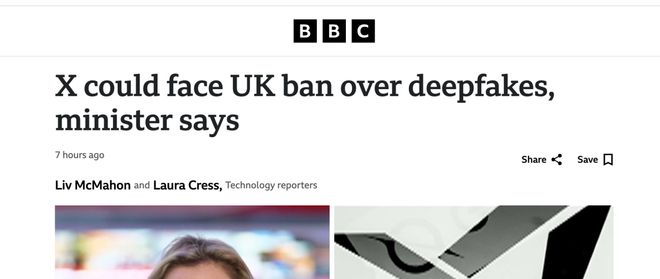
英国警告:X平台或因深度伪造技术面临封禁
Huan Qiu Wang Zi Xun· 2026-01-10 07:05
Group 1 - The UK Secretary of State for Technology, Liz Kendall, supports the potential blocking of the social media platform X if it fails to comply with the UK's Online Safety Act [1][4] - Ofcom is urgently assessing how to handle X's AI chatbot Grok, which has been criticized for its ability to digitally manipulate images without consent [4] - The UK government emphasizes that the Online Safety Act grants Ofcom the authority to block access to services that refuse to comply with UK laws, and Kendall expresses the need for swift action from Ofcom [4] Group 2 - Grok is a free tool that allows users to tag posts for specific replies, but it can also edit images through other platform features [5] - The UK government has contacted X for an explanation regarding the issues with Grok and is conducting a rapid assessment [4]
2026年,这些新规将改变你我的生活!
Sou Hu Cai Jing· 2026-01-03 07:51
Group 1: Tax Regulations - The new Value-Added Tax (VAT) Law and its implementation regulations will take effect on January 1, 2026, clarifying taxpayer obligations and taxable transactions [2] - Personal housing sales tax policy has been optimized, with a 3% tax rate for properties sold within two years and exemption for properties sold after two years [4] Group 2: Healthcare and Pharmaceuticals - The new National Basic Medical Insurance and Commercial Health Insurance Drug Catalogs will be implemented, adding 114 new drugs, including 36 cancer medications and 12 chronic disease medications [6][18] - The new drug catalog in Hebei province will manage traditional Chinese medicine and set personal payment ratios for various drug categories [18] Group 3: Environmental Regulations - A new regulation will allow the trading of pollution rights for certain air and water pollutants within specified regions, effective January 1, 2026 [21] Group 4: Education and Childcare - New regulations for kindergarten fees will implement a clear fee list, prohibiting any unlisted charges [14] - The new policy for higher vocational education entrance exams in Hebei will ensure equal treatment for students eligible for preferential policies [19] Group 5: Technology and Security - The revised Cybersecurity Law will enhance AI regulation and protect virtual property rights, with new legal provisions for data and virtual property disputes [17]

这些新规,今起施行
Xin Lang Cai Jing· 2026-01-01 10:32
Tax Regulations - The new Value-Added Tax (VAT) Law and its implementation regulations will take effect on January 1, 2026, consisting of six chapters that clarify taxpayer obligations and tax rates [3] - Individuals selling residential properties purchased for less than two years will be subject to a 3% VAT, while those selling properties held for two years or more will be exempt from VAT [5] - The VAT law will also enhance tax incentives and clarify the standards for various VAT exemptions, requiring timely public disclosure of these policies [5] Credit Repair Policy - A one-time credit repair policy will be implemented starting January 1, 2026, allowing automatic adjustments to credit reports for overdue records that meet specific criteria [7] - Overdue records generated between January 1, 2020, and December 31, 2025, will not appear on credit reports if the overdue amount does not exceed 10,000 yuan and is fully repaid by March 31, 2026 [7] Education and Childcare - New regulations on kindergarten fees will be enforced from January 1, 2026, requiring public and non-profit private kindergartens to follow government-guided pricing, while for-profit kindergartens will have market-regulated fees [9] - A clear fee directory will be established, and any charges not listed or publicly disclosed will be prohibited [9] Electric Vehicles - A new national standard for electric vehicle energy consumption will be implemented on January 1, 2026, mandating that new passenger vehicles must not exceed 15.1 kWh per 100 km [15] - This standard is expected to improve the average driving range of electric vehicles by approximately 7% without increasing battery capacity [15] Cybersecurity and AI - The revised Cybersecurity Law will take effect on January 1, 2026, addressing the need for AI governance and development, including risk monitoring and safety regulation [19] - The law will support AI research and infrastructure development while enhancing ethical standards in AI applications [19] Legal Framework for Virtual Assets - The updated Civil Case Categories Regulation will come into effect on January 1, 2026, adding categories related to data and virtual property disputes [21] - This revision aims to refine intellectual property categories and address emerging issues in new employment forms and elder rights protection [21]

2026年新规今起施行
Xin Lang Cai Jing· 2026-01-01 01:18
Group 1 - New regulations will be implemented starting January 1, 2026, aimed at addressing public concerns and enhancing development vitality [1] - New behaviors affecting social security, such as exam cheating and unauthorized drone flights, will be subject to management and penalties [3] - A notification on improving kindergarten charging policies will establish a directory management system for service and tuition fees, requiring public disclosure of fees [4] Group 2 - Electric vehicle energy consumption limits will require manufacturers to upgrade technology, resulting in an average increase of approximately 7% in driving range for vehicles weighing around 2 tons, improving driver experience [5] Group 3 - The revised National Common Language and Writing Law will impose new regulations on online language usage, designating the third week of September each year as National Common Language Promotion Week [9] Group 4 - The People's Bank of China has introduced a one-time credit repair policy, allowing automatic adjustments of overdue records based on repayment situations, which will no longer appear on personal credit reports [10][11] Group 5 - The revised National Park Law encourages public participation in national park protection and promotes various forms of environmental education, including establishing free open days for the public [13][14] Group 6 - The amended Cybersecurity Law supports research in artificial intelligence fundamentals and key technologies, while enhancing ethical standards and risk monitoring [15] Group 7 - The revised civil case cause regulations have added causes related to data and virtual property, refining intellectual property causes, and addressing urgent public concerns such as new employment forms and elderly rights protection, bringing the total to 1,055 causes [16][17][18]

明天起,这些新规将影响你我生活
财联社· 2025-12-31 04:11
Group 1 - The new Value-Added Tax (VAT) Law and its implementation regulations will take effect on January 1, 2026, clarifying taxpayer obligations and tax scope [4] - The VAT Law specifies applicable tax rates, including zero tax rates for exports [5] - It establishes methods for calculating taxable amounts and details on VAT deduction certificates and input tax deduction methods [6] - The law enhances tax incentives by defining specific standards for VAT exemption projects and mandates timely public disclosure of these policies [6] - Comprehensive regulations on tax administration measures, including tax payment timelines, invoice issuance, and refund management, will be implemented [7] Group 2 - From January 1, 2026, individuals selling homes purchased for less than two years will be subject to a 3% VAT, while those selling homes held for two years or more will be exempt from VAT [10] - A one-time credit repair policy will be enacted, allowing automatic adjustments to credit reports for overdue records generated between January 1, 2020, and December 31, 2025, under certain conditions [13][14][15] Group 3 - The new regulations on kindergarten fees will take effect on January 1, 2026, establishing government-guided pricing for public and non-profit kindergartens, while for-profit kindergartens will have market-regulated fees [18] Group 4 - The new national standard for electric vehicle energy consumption will be implemented on January 1, 2026, requiring technical upgrades for new vehicles, resulting in an average increase of approximately 7% in driving range [27] Group 5 - The revised Cybersecurity Law will take effect on January 1, 2026, addressing the governance of artificial intelligence and enhancing risk monitoring and safety regulation [33] Group 6 - The revised Civil Case Cause Regulations will come into effect on January 1, 2026, adding causes related to data and virtual property disputes, and refining various other legal categories [36]

与你息息相关!2026年一批新规将施行
Yang Shi Xin Wen· 2025-12-30 23:12
Group 1: VAT Law Implementation - The new VAT Law of the People's Republic of China will take effect on January 1, 2026, consisting of six chapters that clarify taxpayer obligations and tax scope [1] - The law specifies applicable tax rates, including zero tax rates for exports, and outlines methods for calculating tax liabilities under different circumstances [1] - It enhances tax incentives by detailing the standards for VAT exemptions and mandates timely public disclosure of these policies [1] - The law also improves tax administration measures, standardizing processes for tax payment, invoice issuance, and tax refund management [1] Group 2: Housing Tax Policy - Starting January 1, 2026, individuals selling homes purchased for less than two years will be subject to a 3% VAT, while those selling homes held for two years or more will be exempt from VAT [5] - This policy allows individuals to apply the new regulations for any VAT not yet declared before January 1, 2026 [5] Group 3: Credit Repair Policy - The People's Bank of China will implement a one-time credit repair policy starting January 1, 2026, which will automatically adjust credit records for overdue payments made between January 1, 2020, and December 31, 2025 [7] - To qualify for this adjustment, individuals must repay overdue debts of no more than 10,000 yuan by March 31, 2026 [7] Group 4: Kindergarten Fee Regulation - A new notification regarding kindergarten fee policies will take effect on January 1, 2026, establishing government-guided pricing for public and non-profit private kindergartens, while for-profit kindergartens will follow market pricing [10] - The policy mandates a clear fee list and public disclosure of all charges, prohibiting any fees not listed or publicly announced [10] Group 5: Electric Vehicle Standards - A new national standard for electric vehicle energy consumption will be implemented on January 1, 2026, requiring that new passenger vehicles not exceed 15.1 kWh per 100 km [16] - This standard is expected to improve the average driving range of electric vehicles by approximately 7% without increasing battery capacity [16] Group 6: Second-Hand Vehicle Export Management - A joint notice from the Ministry of Commerce and other departments will enforce stricter controls on the export of new vehicles labeled as second-hand, effective January 1, 2026 [18] - The notice requires additional documentation for vehicles registered for less than 180 days to ensure compliance with export regulations [18] Group 7: Cybersecurity Law Amendments - The revised cybersecurity law will take effect on January 1, 2026, addressing the governance of artificial intelligence and enhancing risk monitoring and safety regulations [20] - The law supports research in AI foundational theories and key technologies, promoting the development of necessary infrastructure [20] Group 8: Civil Case Regulations - The updated regulations for civil case categories will be effective from January 1, 2026, adding provisions for data and virtual property disputes, and refining categories related to intellectual property and commercial disputes [22] - The total number of civil case categories will reach 1,055, reflecting the evolving legal landscape [22]

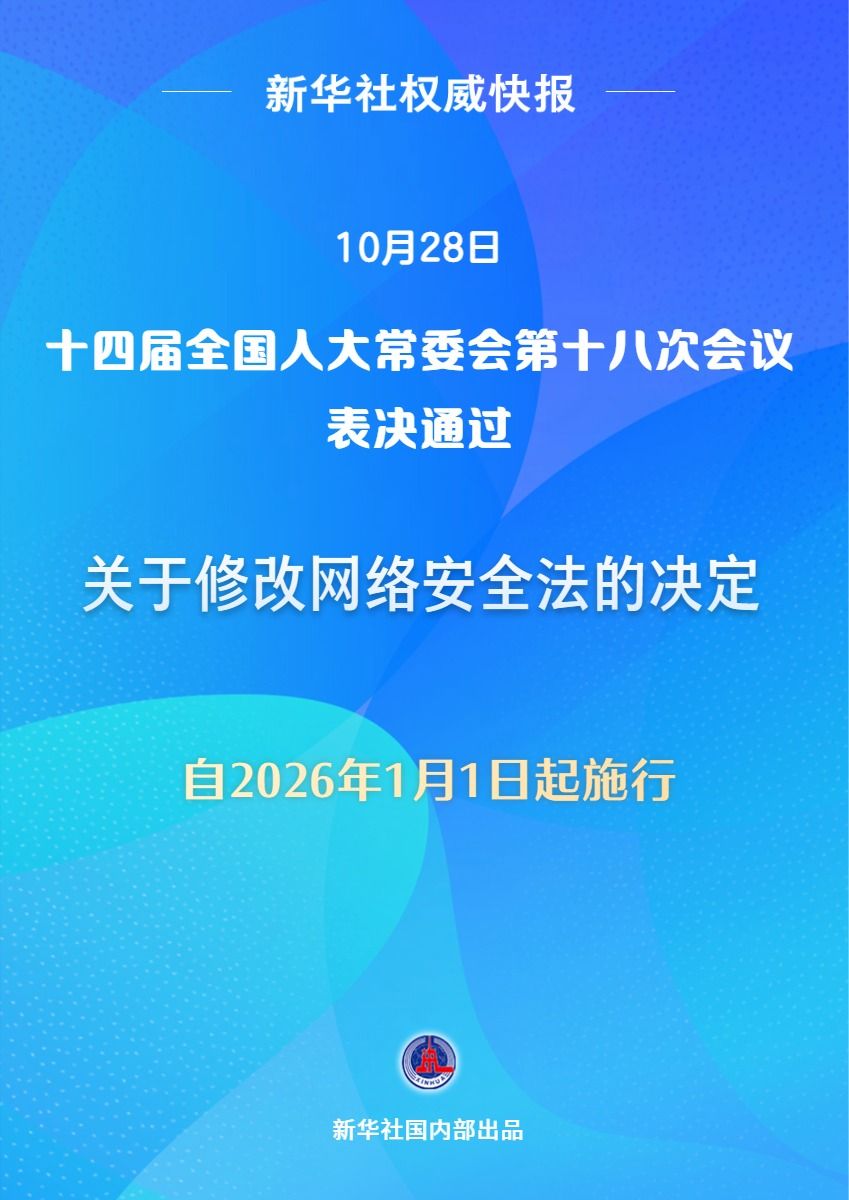
新华社权威快报|网络安全法完成修改
Xin Hua She· 2025-10-28 07:56
Core Points - The National People's Congress Standing Committee approved amendments to the Cybersecurity Law, which will take effect on January 1, 2026 [2][4] - The amendments aim to strengthen legal responsibilities in cybersecurity and enhance coordination with related laws [4] - The revised law addresses the governance and development needs of artificial intelligence, supporting foundational research and key technology development [4] Summary by Categories Legislative Changes - The Cybersecurity Law, originally enacted in 2016, is being updated to meet new cybersecurity challenges and requirements [4] - The amendments emphasize the importance of legal accountability in the cybersecurity sector [4] Artificial Intelligence - The revised law explicitly supports research in foundational theories and key technologies related to artificial intelligence [4] - It promotes the development of training data resources and computational infrastructure necessary for AI [4] - The law aims to improve ethical standards in AI and enhance risk monitoring and safety regulation [4]
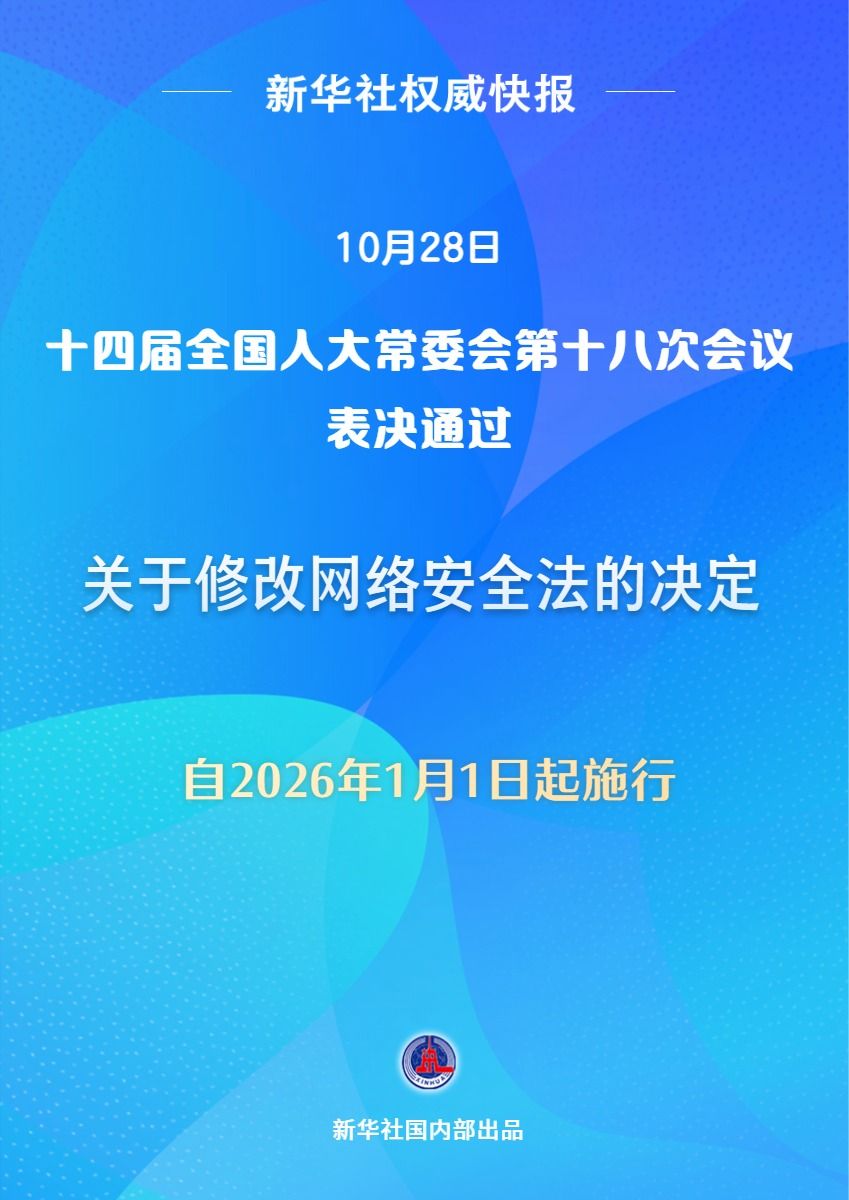
网络安全法完成修改 自2026年1月1日
Xin Hua She· 2025-10-28 07:35
Core Points - The Standing Committee of the 14th National People's Congress passed the decision to amend the Cybersecurity Law, which will take effect on January 1, 2026 [2][4] - The amendment aims to adapt to new cybersecurity challenges and strengthen legal responsibilities in the field [4] - The revised law supports artificial intelligence (AI) research and development, emphasizing the need for ethical standards and risk monitoring in AI applications [4] Group 1 - The Cybersecurity Law, originally established in 2016, serves as a foundational legal framework for cybersecurity in China [4] - The amendments are designed to enhance coordination with related laws and address the evolving landscape of cybersecurity [4] - The law promotes the development of AI infrastructure, including training data resources and computing power [4] Group 2 - The revised law includes provisions for improving ethical norms in AI and ensuring safety regulations are in place [4] - It emphasizes the importance of risk assessment and monitoring in the context of AI deployment [4] - The changes reflect a commitment to fostering a healthy development environment for AI technologies [4]