
一次性信用修复政策

Search documents
这项政策即将截止!多家银行提示!
券商中国· 2026-03-28 14:53
Core Viewpoint - The article emphasizes the importance of the one-time credit repair policy set to expire on March 31, 2026, encouraging borrowers to repay overdue debts to benefit from this policy [1][2]. Summary by Sections Credit Repair Conditions - The one-time credit repair policy applies to individuals with overdue credit information displayed in the central bank's credit system [2]. - Overdue information must have occurred between January 1, 2020, and December 31, 2025, with new overdue information in 2026 excluded [2]. - The overdue amount for a single instance must not exceed 10,000 yuan [2]. - Borrowers must fully repay overdue debts by March 31, 2026, including historical overdue amounts and current payments [2]. Implementation and Recommendations - All conditions must be met simultaneously for the credit repair to be effective, and the central bank's credit system will automatically identify and process eligible overdue information [3]. - Borrowers are advised to verify the principal, interest, and penalties with banks to ensure full repayment, as partial payments may lead to unsuccessful credit repair [3]. - After repayment, borrowers should confirm with financial institutions that funds have been successfully deducted and monitor the update progress of their credit reports through various channels [3]. Policy Impact and Warnings - The policy aims to alleviate the "once lost credit, lifetime restriction" dilemma, encouraging individuals to actively repay debts and rectify credit issues [3]. - It is noted that the policy is free and does not require application, but borrowers should be cautious of scams related to "credit washing" [4]. - The credit repair policy does not permanently delete overdue records but rather prevents them from being displayed, emphasizing the need for good borrowing habits [4]. - The policy targets non-malicious defaulters who actively repay debts, highlighting the necessity of strict conditions to prevent abuse [4].


居民增收计划、养老金上涨、支持AI开源社区……45个关键词读懂2026政府工作报告
经济观察报· 2026-03-05 09:11
Economic Growth - The GDP growth target for 2026 is set at 4.5% to 5%, reflecting a pragmatic policy approach and considering both internal and external pressures on the economy [4][5] - The adjustment in the growth target aims to balance quality and reasonable growth, laying a foundation for high-quality economic development [5] Fiscal Policy - The proposed deficit rate for 2026 is around 4%, with a deficit scale of 5.89 trillion yuan, an increase of 230 billion yuan from the previous year [7] - Public budget expenditure is expected to reach 30 trillion yuan for the first time, with a focus on optimizing expenditure structure to support consumption and improve living standards [9][10] Tax and Financial Reforms - The government plans to advance tax and financial system reforms, including increasing the proportion of state-owned capital returns and enhancing local tax systems [12] - The emphasis on zero-based budgeting aims to optimize fund allocation and improve the efficiency of fiscal spending [12] Employment and Income - The urban survey unemployment rate target is set at around 5.5%, reflecting the need for policies to stabilize employment amid structural pressures [18] - The government aims to synchronize resident income growth with economic growth, emphasizing measures to increase income for low-income groups and improve social security systems [20][22] Environmental Goals - The target for reducing carbon dioxide emissions per unit of GDP is set at around 3.8%, aligning with the goal of achieving carbon peak by 2030 [26][27] - The shift from energy consumption control to carbon emission control reflects the need for a more precise approach to managing carbon emissions [27][28] State-Owned Enterprise Reforms - The government plans to implement a systematic approach to deepen state-owned enterprise reforms, focusing on optimizing the layout of state-owned capital and structural adjustments [29][30] - The emphasis on improving the modern enterprise system aims to enhance corporate governance and promote market-oriented reforms [31] Open Economy - The government intends to further expand high-level opening-up, focusing on service sector liberalization and enhancing international cooperation [35][36] - The approach aims to balance reform depth with security, promoting a competitive and fair business environment [36] Agricultural and Rural Development - The government is set to promote agricultural insurance development and enhance comprehensive disaster prevention capabilities in agriculture [59] - Policies will focus on improving rural elderly care services and implementing long-term care insurance systems to address the challenges of an aging population [45][47] Capital Market Stability - Measures to stabilize the stock market include comprehensive policies to enhance market confidence and promote active trading [54] - The government aims to improve the mechanism for long-term capital entering the market, ensuring a stable and healthy capital market [63] Innovation and Technology - The government plans to cultivate emerging and future industries, encouraging state-owned enterprises to lead in opening application scenarios for new technologies [69][70] - Support for artificial intelligence and open-source community development is expected to drive innovation and commercialization in various sectors [75]

国家开发银行关于落实中国人民银行一次性信用修复政策的公告
Ren Min Ri Bao· 2026-02-26 22:22
Core Viewpoint - The People's Bank of China has announced a one-time credit repair policy for student loans, allowing borrowers with overdue payments to have their credit records rectified under specific conditions [1][2]. Group 1: Policy Applicability - The policy applies to overdue student loan information generated between January 1, 2020, and December 31, 2025 [1]. - The overdue amount for a single student loan contract must not exceed 10,000 RMB [1]. - Borrowers must fully repay the overdue principal and interest by March 31, 2026, to qualify for the credit repair [1]. Group 2: Implementation Process - The credit repair process does not require individual applications; the People's Bank of China will automatically handle qualifying overdue records [2]. - For overdue payments fully repaid by November 30, 2025, the credit report will not display related overdue information starting January 1, 2026 [3]. - For payments made between December 1, 2025, and March 31, 2026, the overdue information will be removed from the credit report by the end of the month following repayment [3]. Group 3: Credit Repair Result Inquiry - Borrowers can check their credit reports through official platforms to confirm if overdue information has been removed [4]. - If borrowers find that their overdue information is still displayed after repayment, they can report this to the National Development Bank for verification and correction [4]. Group 4: Important Reminders - Borrowers should verify the repayment amount and results through official systems before making payments to avoid errors that could disqualify them from the credit repair policy [5]. - It is advised to plan repayment times carefully to avoid missing the policy deadline due to potential delays in payment processing [6]. - The credit repair policy is free of charge, and borrowers should be cautious of potential scams related to this policy [8].
央行上海总部:一次性信用修复政策在沪平稳有效实施
Zhong Guo Xin Wen Wang· 2026-02-25 14:28
Core Viewpoint - The People's Bank of China (PBOC) Shanghai Headquarters has effectively implemented a one-time credit repair policy, demonstrating a commitment to addressing urgent public concerns and enhancing financial services for the populace [1][2]. Group 1: Policy Implementation - The PBOC announced the one-time credit repair policy on December 22, 2025, as a practical measure reflecting the political and people-oriented nature of financial work [1]. - The Shanghai Headquarters has established an emergency leadership group and a specialized working group to ensure the smooth implementation of the policy, including the development of emergency plans and implementation schemes [1]. Group 2: Service Enhancement - Multiple measures have been taken to improve service levels and ensure that the rights of information subjects are protected, including the opening of additional query windows and increasing service supply [2]. - Continuous inspections of service points have been conducted to ensure efficient and smooth query channels since the policy's announcement [2]. Group 3: Public Communication - The PBOC Shanghai Headquarters has utilized its WeChat account to disseminate policy Q&A and interpretations, aiming to clarify and guide public expectations [2]. - A comprehensive policy communication mechanism has been established, combining online and offline channels to ensure clear and accurate policy explanations [2].
内蒙古多措并举助力一次性信用修复政策精准落地
Xin Lang Cai Jing· 2026-02-14 13:30
Core Viewpoint - The implementation of a one-time credit repair policy by the People's Bank of China in Inner Mongolia aims to alleviate the burden of overdue personal loans for individuals, enhancing access to credit and promoting economic activity in the region [1][2]. Group 1: Policy Implementation - The policy, effective from December 22, 2025, allows individuals with overdue personal loans of up to 10,000 yuan to have their overdue records removed if they repay by March 31, 2026 [1]. - A three-tiered promotional mechanism has been established to ensure effective communication of the policy, including training sessions and the appointment of credit specialists at 353 credit inquiry service points [1]. Group 2: Impact on Individuals - An example of the policy's impact is illustrated by a local businessman who successfully had his overdue records repaired and secured a 1 million yuan loan to expand his fresh food supermarket and enhance online delivery services [2]. - Since the policy's implementation, the average daily inquiries for personal credit reports have doubled to 12,000, indicating a growing public interest and demand for credit-related services [2].
一次性信用修复政策落地见效!人民银行广东省分行:近400万人实现信用重塑
Guang Zhou Ri Bao· 2026-02-12 16:41
Core Viewpoint - The People's Bank of China Guangdong Branch has successfully implemented a one-time credit repair policy, benefiting nearly 4 million institutional clients and facilitating the approval of new loans for approximately 145,000 individuals, thereby aiding in the recovery of consumer spending [1]. Group 1 - The one-time credit repair policy was announced on December 22, 2022, allowing for the removal of overdue information for eligible individuals without the need for application or documentation [1]. - The policy covers various types of credit, including credit cards, housing loans, and consumer loans, with the main condition being that the overdue amount must not exceed 10,000 yuan and must be repaid by March 31, 2026 [1]. - The Guangdong Branch of the People's Bank of China emphasizes its commitment to enhancing credit services and resolving credit disputes, aiming to support public credit rights and stimulate consumer confidence [1]. Group 2 - The adjustment of overdue information in the credit system will depend on the repayment timing, with specific guidelines for when overdue information will no longer be displayed based on repayment dates [2].
中国人民银行广东省分行积极推动一次性信用修复政策落地见效 近400万人实现信用重塑
Xin Lang Cai Jing· 2026-02-12 09:22
Core Viewpoint - The People's Bank of China Guangdong Branch is actively implementing a one-time credit repair policy to stimulate consumption recovery and facilitate credit circulation, showing initial positive results [1][5]. Group 1: Policy Implementation - A policy implementation task force was established immediately to create a specialized work plan, focusing on coordination, responsibility, response, publicity, and service assurance [2][6]. - A policy transmission mechanism was constructed, involving 112 access institutions and training over 124,000 personnel to ensure thorough policy guidance [2][7]. Group 2: Financial Service Enhancement - The system's processing capacity was upgraded, expanding credit inquiry service nodes and ensuring 100% coverage of 714 personal self-service inquiry machines, with over 370,000 personal credit inquiries provided since policy implementation [3][8]. - Financial institutions were organized to push policy information to 910,000 eligible customers through SMS and app notifications, and over 10,000 consultations were provided through various channels [3][8]. - Nearly 4 million customers have completed credit repair, with approximately 145,000 receiving new loan approvals [3][8]. Group 3: Consumer Satisfaction and Credit Culture - A comprehensive review of credit complaints and administrative review cases was conducted, promoting targeted communication to applicants and enhancing dispute resolution effectiveness [4][9]. - The initiative aims to foster a culture of integrity and improve overall social credit levels by encouraging individuals to leverage policy benefits through correction, repair, and compliance [4][9]. - The People's Bank of China Guangdong Branch plans to continue enhancing credit service support and resolving disputes to protect public credit rights and stimulate social consumption [4][9].
政策解读|聚焦内需,聚力开局——2025年四季度货币政策执行报告解读
Xin Lang Cai Jing· 2026-02-11 16:40
Core Viewpoint - The People's Bank of China (PBOC) emphasizes the need for a moderately loose monetary policy to support domestic demand and ensure a good start for the 14th Five-Year Plan, amid increasing uncertainties in external inflation and monetary policy adjustments [2][3][6]. Economic Situation Analysis - The report highlights the deepening impact of external environmental changes, with a focus on the uncertainty of inflation trends and monetary policy adjustments [2][14]. - It stresses the importance of strengthening domestic circulation and expanding internal demand to maintain economic stability and growth [2][6]. Policy Orientation - The PBOC will continue to implement a moderately loose monetary policy, utilizing various tools such as reserve requirement ratio (RRR) cuts and interest rate reductions flexibly and efficiently [3][11]. - The report emphasizes the importance of maintaining liquidity and ensuring that social financing conditions remain relatively loose [3][11]. - It introduces the goal of promoting low financing costs for society and enhancing the health of the banking system [3][11]. Key Issues - The report outlines three collaborative measures between fiscal and monetary policies to support internal demand: maintaining ample liquidity, using re-loans with fiscal subsidies, and risk-sharing through guarantees [4][7]. - It discusses the rapid growth of asset management products, which reached a total asset balance of 120 trillion yuan by the end of 2025, reflecting a year-on-year increase of 13.1% [4][8]. - The report also addresses the implementation of a one-time credit repair policy aimed at benefiting individuals and financial institutions [4][9]. Additional Insights - The PBOC aims to enhance green finance to support the transition to a low-carbon economy, focusing on optimizing standards and incentive mechanisms [4][7]. - The report indicates that the total liquidity, combining cash, deposits, and asset management products, grew by approximately 8.1% year-on-year by the end of 2025 [4][8].
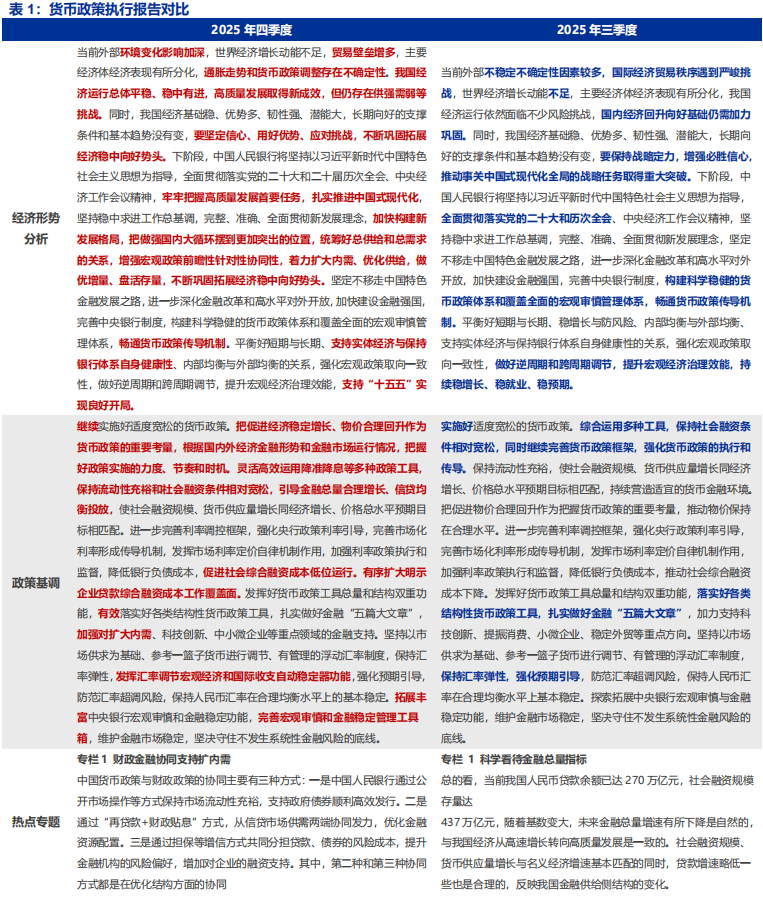
政策解读|聚焦内需,聚力开局——2025年四季度货币政策执行报告解读
赵伟宏观探索· 2026-02-11 16:03
Core Viewpoint - The central bank's report emphasizes the need to support domestic demand and ensure a good start for the "14th Five-Year Plan" amidst uncertainties in external inflation trends and monetary policy adjustments [2][15]. Economic Situation Analysis - The report highlights the deepening impact of external environmental changes, with a focus on the uncertainty of inflation trends and monetary policy adjustments, reflecting increased concerns about the complexity of the international environment since the fourth quarter [2][15]. - It assesses the domestic economy by prioritizing internal demand, stating the importance of strengthening the domestic circulation and supporting a good start for the "14th Five-Year Plan" [2][15]. Policy Tone - The report continues to implement a moderately loose monetary policy, emphasizing the flexible and efficient use of various policy tools such as reserve requirement ratio (RRR) cuts and interest rate reductions [3][16]. - It stresses the importance of maintaining a healthy banking system while promoting low financing costs for society, indicating a focus on the transmission mechanism of monetary policy [3][16]. Key Issues - The report discusses fiscal and financial coordination measures to support domestic demand, outlining three types of collaborative measures: maintaining ample liquidity, "re-lending + fiscal subsidies," and guarantees to enhance credit [4][17]. - It also examines the growth of asset management products, which reached a total asset balance of 120 trillion yuan by the end of 2025, reflecting a year-on-year increase of 13.1%, primarily directed towards interbank deposits and certificates of deposit [4][17]. Specialized Topics - The report addresses green finance, suggesting the optimization of carbon reduction support tools and the innovation of carbon financial products and derivatives [5][17]. - It introduces a one-time credit repair policy aimed at positively impacting individuals, financial institutions, and the economy as a whole [5][17].
固收-四季度货政报告有哪些关注点
2026-02-11 05:58
Summary of Key Points from the Conference Call Industry Overview - The conference call primarily discusses the bond market and monetary policy in the context of the central bank's actions and strategies for stabilizing the financial environment. Core Insights and Arguments - The central bank is utilizing net bond issuance and reverse repos to stabilize market liquidity, indicating a protective stance towards the market [1][2] - Short-term interest rate cuts are unlikely, but long-term rates have room for growth, with expectations for the 10-year government bond yield to potentially drop to 1.75% and the 30-year yield to exceed 2.15% in the first quarter [1][2] - The resumption of government bond trading aims to maintain the yield curve within a reasonable range, supporting the healthy development of the bond market, suggesting that interest rates should not rise excessively [3] - The report indicates that the peak for short-term market interest rates may have occurred in early January, with a subsequent downward trend expected [4] - The phrase "orderly expansion of the coverage of comprehensive financing costs for corporate loans" refers to reducing unnecessary fees in the loan process and increasing transparency to lower corporate financing costs, implying that interest rate cuts are not anticipated in the short term [5] - Short-term market interest rates are expected to fluctuate within the range of temporary reverse repo operation rates, indicating that funding costs will not significantly increase [6] - The normalization of government bond trading tools will serve as an indicator of the central bank's protective intentions towards the market, with a recent trading volume reaching a trillion level indicating strong protective intent [7] Additional Important Content - Macro-prudential management (MPA) focuses on supporting the execution and transmission of monetary policy, ensuring overall financial stability and enhancing investor confidence through range management of various financial products [8][9] - Concerns regarding deposit outflows are deemed unwarranted, as current conditions are better than expected, with new asset allocations primarily directed towards unified deposits and certificates of deposit, which will eventually return to the banking system [10] - The implementation of a one-time credit repair policy targets small consumer loans (below 10,000 yuan) and reflects ongoing pressure on banks' non-performing loans, necessitating continued monitoring and measures to alleviate this pressure [11] - Investment strategy recommendations suggest a gradual shift from coupon strategies to duration strategies, with expectations for continued low volatility in the bond market over the next three years, emphasizing the importance of capturing small trading opportunities [12]