
美国国债可持续性

Search documents
“格陵兰岛”反转大戏,特朗普达沃斯表态背后的多重博弈
Sou Hu Cai Jing· 2026-01-22 04:02
Group 1: Greenland Island Situation - The U.S. has no intention of using "excessive force" to acquire Greenland, as stated by Trump at the World Economic Forum in Davos [2] - Trump announced the postponement of tariffs on eight European countries originally set to take effect on February 1 [2] - A cooperation framework regarding Greenland and the Arctic has been agreed upon with NATO Secretary-General, benefiting the U.S. and all NATO member countries, indicating a temporary easing of U.S.-Europe trade tensions [2] Group 2: Federal Reserve and Domestic Policy - Trump indicated a narrowed selection for the next Federal Reserve Chair to "two or three" candidates, suggesting a preference for a style similar to former Chair Alan Greenspan [3] - Potential candidates mentioned include Rick Reed and Kevin Walsh, while current NEC Director Hassett is likely to remain in his position [3] - Tensions between Trump and the Federal Reserve are highlighted by his threats regarding Powell's future and the Supreme Court's debate on Trump's attempt to remove Fed Governor Lisa Cook, raising concerns about the independence of the central bank [3] Group 3: U.S. Withdrawal from WHO - The U.S. officially withdrew from the World Health Organization on January 22, following an executive order signed by Trump, marking a significant shift in its role in global public health governance [4] Group 4: Rising National Debt - The U.S. national debt reached $38.4 trillion as of January 9, increasing at an average rate of over $71,000 per second over the past year [5] - Approximately $2.25 trillion is projected to be added to the national debt from January 17, 2025, to January 15, 2026, raising concerns about the sustainability of this debt despite claims that tariff revenues could cover interest payments [5] - The Trump administration faces challenges regarding domestic economic issues, including Federal Reserve independence and fiscal sustainability, which will continue to influence market dynamics and global relations [5]


招金矿业盘中涨超5% 麦格理维持“跑赢大市”评级
Xin Lang Cai Jing· 2025-12-22 03:21
Core Viewpoint - Zhaojin Mining (01818) is experiencing a significant stock price increase, attributed to its ongoing expansion of gold mining operations and positive market outlook for gold prices due to geopolitical tensions and trade issues [1] Company Summary - Zhaojin Mining's stock price rose over 5% during trading, currently at 31.76 HKD with a trading volume of 226 million HKD [1] - The company is expanding its gold mine portfolio through exploration, with its key project, the Haiyu Gold Mine, currently in the construction phase and expected to commence production by the end of 2027 or early 2028 [1] - Macquarie has raised its net profit forecasts for Zhaojin Mining for 2025 to 2027 by 10%, 74%, and 50% respectively, reflecting expectations of higher gold prices and increased costs [1] Industry Summary - Macquarie maintains a positive outlook on gold prices due to concerns over geopolitical conflicts, trade tensions, and the sustainability of U.S. debt [1] - Zhaojin Mining, as a low-cost pure gold company, is positioned to benefit significantly from rising gold prices [1] - The target price for Zhaojin Mining is set at 42 HKD, with a rating of "Outperform" maintained [1]
美元指数的中长期走势与2026年展望
Sou Hu Cai Jing· 2025-12-20 04:26
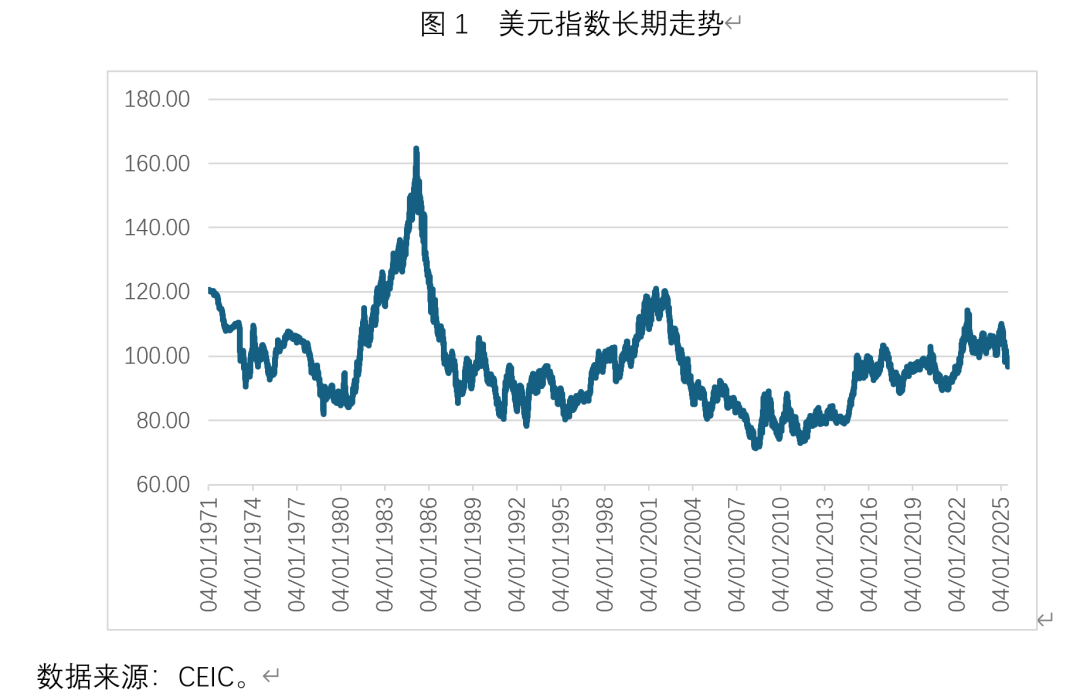
Group 1 - The core viewpoint of the article suggests that the US dollar index is likely entering a prolonged downtrend phase, with significant declines expected in the future [3][10] - Historical analysis indicates that the highest and lowest points of the dollar index have shown a gradual downward trend over three long cycles since 1971, suggesting a weakening of the US economic fundamentals relative to other developed countries [4][10] - The duration of the downtrends in the dollar index has been relatively consistent, averaging around 7-8 years, while the uptrends have been extending, indicating a "short bear, long bull" phenomenon in the dollar index cycles [4][10] Group 2 - The relationship between the dollar index and US interest rates has shown a decreasing correlation in the most recent cycle, with instances of the dollar index declining despite stable or fluctuating interest rates [5][10] - The dollar index has already decreased by 15.1% from September 2022 to June 2025, and the current downtrend may last for another 6-7 years, potentially reaching a low below 71.3 [3][10] - The outlook for the dollar index in 2026 suggests a continued downward trend, with limited declines due to the weak economic fundamentals in the Eurozone and uncertainties surrounding the Japanese yen [12][16][17] Group 3 - The Federal Reserve is expected to continue lowering interest rates in 2026, influenced by a deteriorating labor market and manageable inflation, which may further impact the dollar index [13][10] - Global investor sentiment towards US dollar assets has shifted, contributing to simultaneous declines in US stocks, bonds, and the dollar index, indicating a potential ongoing reduction in confidence in US Treasury securities [15][10] - The economic performance of the Eurozone and Japan is projected to remain weak, which may limit the extent of the dollar index's decline, as the Eurozone's GDP growth is forecasted to be significantly lower than that of the US [16][17]
「经济发展」刘元春:什么在左右美国关税谈判,中国如何取得战略先机?
Sou Hu Cai Jing· 2025-08-10 12:54
Group 1 - The core argument is that the U.S. government's use of tariffs as leverage in negotiations has significant implications for global markets, particularly in terms of volatility and the reassessment of trade dynamics [3][4][5] - The impact of tariffs has led to a milestone change in global financial markets, with U.S. Treasury yields rising to 4.6%, surpassing the growth rate of nominal GDP, raising concerns about the sustainability of U.S. debt [4][5] - The political landscape in the U.S. is increasingly polarized, with conflicts among various factions affecting the perception of U.S. global standing and potentially influencing capital flows [5][6] Group 2 - The tariffs have notably affected inflation levels and the cost of living for the middle and lower classes in the U.S., which is a critical issue for upcoming midterm elections [6][7] - Changes in supply chain structures have become evident since the initiation of the tariff war, with reports of shortages of Chinese goods in U.S. retail and price adjustments in everyday products [6][7] - The urgency for the U.S. to restart negotiations with China is driven by concerns over rare earth exports, which are crucial for the automotive industry and could significantly impact the U.S. economy [7][8] Group 3 - Internal divisions within the U.S. government and among different social classes are emerging as a fourth influential factor in trade negotiations, potentially overshadowing the previously identified key factors [9][10] - The analysis suggests that China should adopt a cautious approach in future negotiations, focusing on domestic economic stability and strategic planning rather than merely reacting to trade volume changes [10][11] - Confidence in the resilience of the Chinese economy and its manufacturing sector is emphasized, indicating a belief in the ability to navigate through tariff conflicts successfully [11]
