美国财政可持续性

Search documents
36万亿美债还不起,特朗普决定弄死大债主,为此不惜自曝家丑
Sou Hu Cai Jing· 2026-02-27 22:50
Group 1 - The total federal debt of the United States has surged to approximately $38.76 trillion as of February 2026, with daily increases reaching several billion dollars, and annual interest payments exceeding $1 trillion, severely impacting funding for infrastructure, education, and social welfare projects [1][11] - The Federal Reserve holds about $4.32 trillion in U.S. government debt, creating an internal cycle where the government issues bonds that are subsequently purchased by the central bank, increasing the fiscal pressure on the government [3][5] - The ongoing debate between the Trump administration and the Federal Reserve highlights a power struggle, with Trump publicly challenging the Fed to lower interest rates to alleviate the burden of interest payments on the national debt [5][7] Group 2 - The recent increase in the debt ceiling by $5 trillion to $41.1 trillion temporarily avoids technical default risks, but the overall federal debt continues to rise, with projections indicating worsening fiscal deficits over the next decade [9][11] - The inability of both political parties to reach a consensus on structural fiscal reforms exacerbates the situation, as rigid spending on military and other essential services remains high [11][13] - Trump's strategy of directly confronting the Federal Reserve and revisiting past decisions underscores the limitations of traditional fiscal adjustment paths in a high-debt environment, raising concerns about the long-term sustainability of U.S. fiscal policy [13][16]


格陵兰岛养老金要减持美股
Guo Ji Jin Rong Bao· 2026-01-22 11:57
Group 1 - The Greenland Pension Fund SISA is considering stopping investments in U.S. stocks as a symbolic resistance to the Trump administration's attempts to control Greenland [1] - SISA manages approximately 7 billion Danish kroner (about 1.1 billion USD) in assets, with around 50% allocated to the U.S. market, primarily in publicly traded stocks [1] - The Danish pension fund Akademiker Pension announced it will liquidate approximately 100 million USD in U.S. Treasury bonds by the end of the month, citing concerns over the sustainability of U.S. fiscal policy [1] - The Swedish private pension fund Alecta has sold most of its U.S. Treasury bonds, amounting to approximately 7.7 to 8.8 billion Swedish kronor (about 7.7 to 8.8 billion USD), due to increased policy risks and unpredictability in the U.S. [2] Group 2 - U.S. Treasury Secretary Mnuchin attempted to downplay the impact of European sell-offs of U.S. debt, calling the narrative "illogical" and "incorrect" during the Davos forum [2] - President Trump’s strong stance on Greenland previously caused global market turmoil, including threats of tariffs on several countries if a deal to purchase Greenland was not reached [3] - Trump later clarified that he would not use military force to acquire Greenland and canceled previous threats of tariffs on European nations, indicating a framework for future agreements regarding the island [3]
美财长回应丹麦养老基金出售美国国债:丹麦“无关紧要”
Xin Lang Cai Jing· 2026-01-21 08:07
Group 1 - The Danish pension fund AkademikerPension plans to fully exit its investments in U.S. Treasury bonds by the end of the month due to growing concerns over the sustainability of U.S. fiscal policy and associated credit risks [1][2] - AkademikerPension manages approximately $25 billion in assets and currently holds about $10 million in U.S. Treasury bonds, which is considered insignificant by U.S. Treasury Secretary Scott Bessenet [1][2] - Bessenet expressed that he is not worried about European investors withdrawing from the U.S. Treasury market, emphasizing that the Danish investment is minor and has been decreasing over the years [1][2] Group 2 - The U.S. stock and bond markets experienced a significant downturn, with prices falling and yields rising, following heightened tensions between President Trump and European leaders regarding Greenland [1]
民生证券:美元难以摆脱贬值命运 贵金属配置价值仍在上升
Zhi Tong Cai Jing· 2025-10-04 23:37
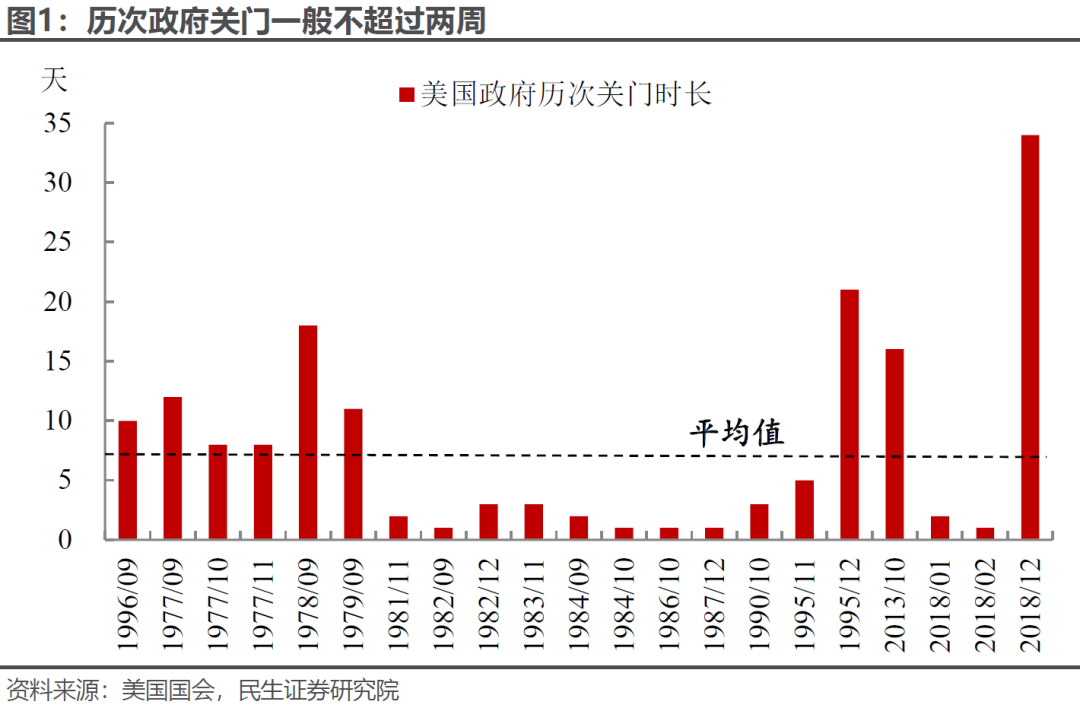
Core Viewpoint - The recent U.S. government shutdown, occurring after seven years, reflects deeper issues of political polarization and fiscal challenges rather than just procedural problems [1][2][5] Group 1: Government Shutdown Implications - The shutdown is seen as a precursor to more significant fiscal battles ahead, particularly as the midterm elections approach, with ongoing tensions between the two parties regarding fiscal expansion and debt issues [2][5] - Historical data suggests that government shutdowns typically last around two weeks, but current predictions indicate a less than 50% chance of resolution by October 14, down from nearly 70% [5] - The Biden administration is expected to apply pressure on Democrats during the shutdown, including potential layoffs of federal employees and freezing significant federal funds [5] Group 2: Economic Impact - The immediate economic impact of the shutdown is expected to be limited, with a historical reference indicating that each week of shutdown may reduce GDP by approximately 0.1 percentage points, likely to be recovered later [8] - Employment risks are more concerning, particularly if layoffs of federal employees occur, which could lead to a temporary rise in unemployment rates [8] - The shutdown has disrupted the Federal Reserve's ability to make decisions, with private employment data becoming increasingly important; recent ADP employment figures showed a decline, influencing market expectations for interest rate cuts [8][9] Group 3: Fiscal Sustainability Concerns - The deepening divide between the two parties raises concerns about the sustainability of U.S. fiscal policies, with potential difficulties in implementing key spending cuts in future legislation [1][2][11] - The ongoing political struggle over healthcare spending reflects the heightened tensions and may complicate future fiscal negotiations [9][11] - The U.S. faces increasing debt pressures, with current debt interest rates at around 3.4%, which are significantly lower than the Federal Reserve's policy rates, complicating the economic landscape [11][13] Group 4: Investment Outlook - In the context of a declining debt cycle, the U.S. dollar is expected to remain weak, while the value of gold as an investment continues to rise, particularly as Western Hemisphere investors are under-allocated in gold [1][2][13] - The yield curve for U.S. Treasuries is anticipated to widen further, and the performance of U.S. equities will depend on the sustainability of narratives surrounding AI and other factors [13]
美国财政困局:关税是解药,还是毒药?
2025-09-17 00:50
Summary of Key Points from the Conference Call Industry or Company Involved - The discussion primarily revolves around the **U.S. fiscal situation** and the implications of **tariff policies** introduced by the Trump administration. Core Points and Arguments 1. **Unsustainable U.S. Fiscal Situation**: The total public debt held by the U.S. is nearing **$30 trillion**, accounting for **98%** of GDP, which is close to historical highs, raising concerns about the sustainability of U.S. debt assets and increasing global asset price volatility [1][2][3] 2. **Federal Spending Structure**: Mandatory spending constitutes about **60%** of federal expenditures, with net interest payments growing rapidly, surpassing defense spending and reaching **13%** of the budget. This rigid spending structure complicates efforts to reduce the fiscal deficit [1][3] 3. **Impact of Tariff Policies**: The Trump administration's tariff policies were intended to address fiscal issues, but the uncertainty surrounding these policies has accelerated the de-dollarization process, raising concerns about the demand for U.S. debt, particularly long-term bonds [1][4] 4. **Short-term Debt Renewal Pressure**: Although there is a significant amount of U.S. debt maturing in **2025**, the monthly maturity amounts are relatively dispersed, with **80%** being short-term debt, which alleviates immediate renewal pressures [4][5] 5. **Credit Rating Downgrade**: Moody's downgraded the U.S. sovereign credit rating from **3** to **21**, reflecting growing concerns about fiscal sustainability and market confidence in U.S. debt [2][6] 6. **Ineffectiveness of Tariff Increases**: Even with potential increases in tariffs, the projected revenue gains fall significantly short of the Trump administration's targets, with estimates suggesting only **$300-400 billion** annually, compared to the claimed **$6 trillion** over ten years [8][15] 7. **Historical Context of Tariff Policies**: The Smoot-Hawley Tariff Act of the 1930s serves as a historical example of how high tariffs can lead to retaliatory measures and a collapse in international trade, which could be a risk with current policies [9][12] Other Important but Possibly Overlooked Content 1. **Long-term Risks**: There are concerns about potential technical defaults or supply shocks, but these risks are considered limited due to historical political negotiations that have typically avoided defaults [2][5] 2. **Economic Implications**: The rising debt burden could crowd out private investment and consumption, limiting monetary and fiscal policy flexibility and exacerbating uncertainty around U.S. dollar assets [3][4] 3. **Political Dynamics**: The current political landscape, with the Republican Party controlling both houses of Congress, may reduce the likelihood of budgetary conflicts that could lead to technical defaults [5][6] 4. **Trade Volume Considerations**: The potential for reduced trade volumes and retaliatory actions from trading partners could undermine the effectiveness of tariff increases in generating revenue [15]
美国宣布了!美债波动率像坐过山车一样蹿升,创4月2日解放日特朗普加税以来最猛三连跳,大家可能都在想究竟是怎么一回事了
Sou Hu Cai Jing· 2025-09-05 20:07
Group 1 - The core issue is the alarming level of U.S. national debt, which has surpassed $37 trillion, with a daily increase of $22 billion, raising concerns about market confidence [3][5][9] - The 30-year Treasury yield has surged to nearly 5%, the highest since October of the previous year, indicating heightened market anxiety [3][5] - The fiscal deficit reached nearly $2 trillion last year, exacerbated by tax cuts and increased spending, leading to questions about how to address this financial gap [5][9] Group 2 - Political factors are complicating the situation, with potential interference in the Federal Reserve's independence, which could further destabilize market confidence [5][9] - September has historically been a challenging month for the bond market, with average negative performance over the past decade, and this year is compounded by political uncertainties [7][9] - Foreign investment confidence in U.S. debt is waning, as evidenced by rising yields not translating into a stronger dollar, indicating concerns about fiscal sustainability [9][11] Group 3 - Upcoming economic data releases, such as non-farm payroll and inflation figures, could significantly impact market stability, with potential for volatility in the coming weeks [11] - The current market dynamics reflect a complex interplay of fiscal and political uncertainties, with fears that the Federal Reserve may be influenced by political pressures rather than economic indicators [9][11]

三大债权国增持美债
Sou Hu Cai Jing· 2025-08-16 12:43
Group 1 - The latest report from the U.S. Treasury indicates that the top three foreign holders of U.S. Treasury securities increased their holdings in June, reflecting a subtle shift in allocation strategies amid global economic uncertainty [1] - Japan, the largest foreign holder of U.S. Treasuries, increased its holdings by $12.6 billion in June, bringing its total to $1.1476 trillion, continuing a trend of increasing confidence in U.S. debt [2] - The UK significantly increased its holdings by $48.7 billion, raising its total to $858.1 billion, surpassing China to become the second-largest foreign holder of U.S. Treasuries [2] Group 2 - In June, total foreign holdings of U.S. Treasuries reached $9.1277 trillion, an increase of $80.2 billion from the previous month, primarily driven by official funds [3] - Foreign investors net purchased $192.3 billion in long-term U.S. securities in June, with private foreign investment accounting for $154.6 billion, indicating a renewed preference for U.S. long-term assets [3] - The expectation of interest rate cuts has supported the U.S. Treasury market, contributing to a downward trend in Treasury yields, which has created favorable conditions for foreign investors to increase their holdings [3]
美国三大“债主”,增持
Shang Hai Zheng Quan Bao· 2025-08-16 11:28
Core Viewpoint - The U.S. Treasury Department's TIC report indicates an increase in U.S. Treasury holdings by major foreign creditors, with China increasing its holdings for the first time since March, while Japan and the UK also raised their positions significantly [1][2]. Group 1: U.S. Treasury Holdings - As of June, China holds $756.4 billion in U.S. Treasury securities, a slight increase of $1 billion from the previous month, continuing a trend of holding below $1 trillion since April 2022 [1]. - Japan's holdings increased by $12.6 billion to $1.1476 trillion, maintaining its position as the largest foreign holder of U.S. debt [1]. - The UK saw a substantial increase of $48.7 billion, bringing its total to $858.1 billion, surpassing China to become the second-largest holder of U.S. debt since March [1]. Group 2: Foreign Investment in U.S. Debt - Total foreign holdings of U.S. Treasury securities reached $9.1277 trillion, an increase of $80.2 billion from the previous month [1]. - The report highlights a general trend of increasing foreign investment in U.S. debt, despite fluctuations in individual country holdings [1]. Group 3: U.S. Treasury Yield Trends - Following expectations of interest rate cuts, U.S. Treasury yields have been declining, with the 10-year yield fluctuating between 4.3% and 4.45% in July [2]. - The market's response to strong labor market data and renewed tariff tensions initially pushed yields up to 4.5%, but subsequent Fed comments and economic data led to a downward trend [2]. Group 4: U.S. Fiscal Sustainability Concerns - The U.S. federal government debt has surpassed $37 trillion, raising concerns about fiscal sustainability as the government continues to borrow at record levels [2]. - The Congressional Budget Office estimates that tax and spending policies promoted by the Trump administration could increase the fiscal deficit by approximately $4.1 trillion over the next decade, further exacerbating the debt situation [2]. Group 5: Future Market Volatility Factors - Potential factors that may cause volatility in the U.S. Treasury market include the impact of rising short-term debt post-debt ceiling resolution, uncertainties surrounding tax and fiscal policies, and the increasing sensitivity of non-bank financial institutions to liquidity and risk expectations [3].
「经济发展」刘元春:什么在左右美国关税谈判,中国如何取得战略先机?
Sou Hu Cai Jing· 2025-08-10 12:54
Group 1 - The core argument is that the U.S. government's use of tariffs as leverage in negotiations has significant implications for global markets, particularly in terms of volatility and the reassessment of trade dynamics [3][4][5] - The impact of tariffs has led to a milestone change in global financial markets, with U.S. Treasury yields rising to 4.6%, surpassing the growth rate of nominal GDP, raising concerns about the sustainability of U.S. debt [4][5] - The political landscape in the U.S. is increasingly polarized, with conflicts among various factions affecting the perception of U.S. global standing and potentially influencing capital flows [5][6] Group 2 - The tariffs have notably affected inflation levels and the cost of living for the middle and lower classes in the U.S., which is a critical issue for upcoming midterm elections [6][7] - Changes in supply chain structures have become evident since the initiation of the tariff war, with reports of shortages of Chinese goods in U.S. retail and price adjustments in everyday products [6][7] - The urgency for the U.S. to restart negotiations with China is driven by concerns over rare earth exports, which are crucial for the automotive industry and could significantly impact the U.S. economy [7][8] Group 3 - Internal divisions within the U.S. government and among different social classes are emerging as a fourth influential factor in trade negotiations, potentially overshadowing the previously identified key factors [9][10] - The analysis suggests that China should adopt a cautious approach in future negotiations, focusing on domestic economic stability and strategic planning rather than merely reacting to trade volume changes [10][11] - Confidence in the resilience of the Chinese economy and its manufacturing sector is emphasized, indicating a belief in the ability to navigate through tariff conflicts successfully [11]

DLSM外汇平台:财政轨迹失控,美债会被市场抛弃吗?
Sou Hu Cai Jing· 2025-08-06 10:20
Group 1 - The current trajectory of U.S. fiscal policy is unsustainable, with warnings from former Treasury Secretaries Henry Paulson and Timothy Geithner highlighting deeper issues such as federal fiscal unsustainability and political dysfunction in Washington [1][3] - Paulson emphasized that if political gridlock continues and fiscal deficits worsen, market patience will eventually run out, indicating a potential systemic shock to the bond market [3] - Geithner noted that while current bond yields are reasonable, market confidence is conditional on the independence of the Federal Reserve, the rule of law, and fiscal discipline [3][4] Group 2 - The passive safety of U.S. Treasuries relies heavily on the dollar's status as the global reserve currency and the liquidity of U.S. debt, but this advantage is not guaranteed [3] - The trend of de-dollarization and diversification of reserve assets by major economies could lead to a more rapid and direct impact on U.S. fiscal conditions, potentially undermining the market position of U.S. Treasuries [3] - The independence of the Federal Reserve's monetary policy is under scrutiny, as political and inflationary pressures may force the central bank to prioritize short-term fiscal needs, which could lead to a reassessment of U.S. debt's credit premium [4][5] Group 3 - Long-term market confidence in U.S. Treasuries will depend on the governance system's ability to restore rationality and self-correct under pressure, rather than on isolated events like interest rate hikes or budget negotiations [5] - If the U.S. government fails to re-establish a balance between fiscal and policy measures at the institutional level, trust in the U.S. financial system may undergo significant reevaluation [5]