
AI行业泡沫

Search documents
对冲基金莲华资管管理合伙人洪灏荣膺“2025年度十大影响力经济学家”
Xin Lang Cai Jing· 2026-02-11 06:26
Group 1 - The "Top Ten Influential Economists of 2025" list has been announced, highlighting economists who have deep academic backgrounds and practical market experience, capable of understanding development trends and guiding the direction of the times [1][2] - The evaluation was conducted by a committee that considered five dimensions: professionalism, influence, innovation, foresight, and activity level, along with voting from the review panel and reference to output rates and impact data [1][2] Group 2 - Hong Hao, managing partner of Lianhua Asset Management, has been awarded as one of the "Top Ten Influential Economists of 2025" [2][3] - Key insights from Hong Hao include the notion of the "twilight of the Federal Reserve's independence," the existence of a significant bubble in the AI industry despite the necessity to invest, and the belief that the Chinese yuan is severely undervalued and will appreciate [2][3]
美元指数的中长期走势与2026年展望
Sou Hu Cai Jing· 2025-12-20 04:26
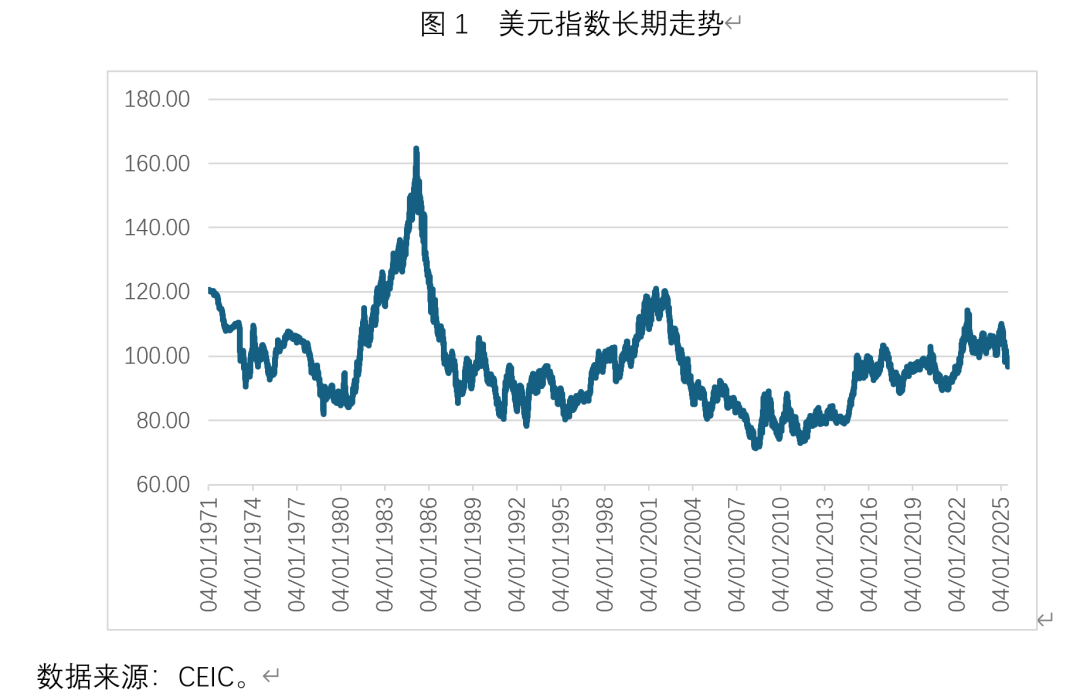
Group 1 - The core viewpoint of the article suggests that the US dollar index is likely entering a prolonged downtrend phase, with significant declines expected in the future [3][10] - Historical analysis indicates that the highest and lowest points of the dollar index have shown a gradual downward trend over three long cycles since 1971, suggesting a weakening of the US economic fundamentals relative to other developed countries [4][10] - The duration of the downtrends in the dollar index has been relatively consistent, averaging around 7-8 years, while the uptrends have been extending, indicating a "short bear, long bull" phenomenon in the dollar index cycles [4][10] Group 2 - The relationship between the dollar index and US interest rates has shown a decreasing correlation in the most recent cycle, with instances of the dollar index declining despite stable or fluctuating interest rates [5][10] - The dollar index has already decreased by 15.1% from September 2022 to June 2025, and the current downtrend may last for another 6-7 years, potentially reaching a low below 71.3 [3][10] - The outlook for the dollar index in 2026 suggests a continued downward trend, with limited declines due to the weak economic fundamentals in the Eurozone and uncertainties surrounding the Japanese yen [12][16][17] Group 3 - The Federal Reserve is expected to continue lowering interest rates in 2026, influenced by a deteriorating labor market and manageable inflation, which may further impact the dollar index [13][10] - Global investor sentiment towards US dollar assets has shifted, contributing to simultaneous declines in US stocks, bonds, and the dollar index, indicating a potential ongoing reduction in confidence in US Treasury securities [15][10] - The economic performance of the Eurozone and Japan is projected to remain weak, which may limit the extent of the dollar index's decline, as the Eurozone's GDP growth is forecasted to be significantly lower than that of the US [16][17]

Anthropic CEO评估AI行业泡沫风险和竞争对手激进策略
Sou Hu Cai Jing· 2025-12-05 15:24
Core Viewpoint - Anthropic CEO Dario Amodei expressed a nuanced view on whether there is a bubble in the AI industry, highlighting the potential of the technology while warning about risks associated with timing and economic returns [2][5]. Group 1: AI Industry Bubble - Amodei refrained from giving a straightforward yes or no answer regarding the existence of a bubble, indicating the complexity of the situation [2][5]. - He emphasized that while the technology holds promise, some participants in the ecosystem may make "timing errors" or face "poor situations" regarding economic returns [2][5]. Group 2: Economic Value and Risks - The uncertainty surrounding the timing of AI economic value growth poses inherent risks, particularly in relation to the lag time in building more data centers [2][6]. - Companies must manage risks responsibly to compete against authoritarian competitors, particularly from China, but some are taking unwise risks [2][6]. Group 3: AI Chip Depreciation - Amodei discussed the issue of AI chip depreciation, noting that while chips can last a long time, the rapid and cheaper introduction of new chips could lead to a decline in the value of older chips [3][6]. - Anthropic has made conservative assumptions to prepare for an uncertain future regarding chip value and overall industry dynamics [3]. Group 4: Revenue Growth - Anthropic's revenue has grown tenfold each year over the past three years, reaching $100 million in 2023 and projected to grow to $1 billion in 2024, with expectations of reaching $8-10 billion by the end of this year [3][7]. - Amodei cautioned against assuming that this growth pattern will continue, advocating for conservative planning due to the uncertainty of future revenue [3][7]. Group 5: Operational Challenges - AI companies must carefully plan their computational needs and data center investments to avoid under- or over-investing, which could lead to service failures or financial distress [4][6]. - Amodei warned that those taking on excessive risks might overextend themselves, particularly those who are inclined to adopt a "YOLO" (You Only Live Once) mentality [4].

外汇期货周度报告:流动性被动紧缩,美元指数下跌-20251109
Dong Zheng Qi Huo· 2025-11-09 09:14
Report Industry Investment Rating - The rating for the US dollar is "oscillation" [4] Core Viewpoints of the Report - The US government shutdown has led to a passive tightening of liquidity, increasing market volatility. Once the shutdown ends, market sentiment is expected to be boosted. The US economy has not yet entered a recession, but the employment market is showing a clear weakening trend, and the economic outlook is pessimistic. The current situation of liquidity tightening may present a good entry opportunity, as it is expected to be temporary. Once the government reopens and the liquidity tightens eases, market risk appetite will recover [2][10][32] Summary by Relevant Catalog 1. Global Market Overview This Week - Market risk appetite declined, most global stock markets fell, and most bond yields rose. The US Treasury yield slightly increased to 4.09%. The US dollar index dropped 0.2% to 99.6, and non - US currencies showed mixed performance. The offshore RMB slightly declined by 0.05%, while the euro rose 0.25%, the pound rose 0.07%, and the yen rose 0.37%. Gold prices fluctuated around $4000 per ounce, the VIX index rose to 19, and the spot commodity index declined. Brent crude oil dropped 2.2% to $63.78 per barrel [1][8] 2. Market Trading Logic and Asset Performance 2.1 Stock Market - Most global stock markets fell. In developed markets, the S&P 500 dropped 1.63%, and the Eurozone stock markets mostly declined. In emerging markets, most stock markets rose, with the Shanghai Composite Index rising 1.08% and the Hang Seng Index rising 1.29%, while the Nikkei 225 index dropped 4.07%. The US government shutdown has dragged down the economy and employment, and the tightening of financial market liquidity has increased market volatility. The US stock market's upward trend has slowed, and concerns about high valuations and potential AI industry bubbles have increased. The domestic stock market is fluctuating at a high level, and the divergence between stock market performance and fundamentals persists [9][10][12] 2.2 Bond Market - Global bond yields showed mixed performance. The 10 - year US Treasury yield rose to 4.09%. The US government's continued shutdown, tightened financial market liquidity, and better - than - expected ADP employment data in October have reduced market expectations for a Fed rate cut in December. The Bank of England kept its policy unchanged, and the yields of major global government bonds tend to rise. The 10 - year Chinese government bond yield rebounded to 1.808%, and the domestic bond market continued to fluctuate [13][16][19] 2.3 Foreign Exchange Market - The US dollar index dropped 0.2% to 99.6, and non - US currencies showed mixed performance. The offshore RMB slightly declined by 0.05%, the euro rose 0.25%, the pound rose 0.07%, the yen rose 0.37%, the Swiss franc dropped 0.07%, the South Korean won dropped 2.2%, the New Zealand dollar dropped 1.8%, and the Australian dollar, Canadian dollar, and Indian rupee closed down, while the peso, real, and ringgit closed up [22][23][25] 2.4 Commodity Market - Spot gold oscillated slightly lower, closing at $4001 per ounce. The international gold price is fluctuating around $4000, with some bottom - fishing signs in the market. However, the uncertainty of a Fed rate cut in December and the temporary liquidity tightening in the US financial market have increased market volatility, and gold lacks upward momentum in the short term. Brent crude oil dropped 2.2% to $63.78 per barrel, and the supply - demand pattern of oil prices remains weak, with the commodity spot index closing down [26][28] 3. Hotspot Tracking - The government shutdown has led to passive liquidity tightening. The balance in the US Treasury's TGA account has significantly increased, resulting in a passive tightening effect, raising overnight interest rates and the US dollar index. This has led to a weakening of market risk appetite, and most assets have declined. It is expected that the government will reopen soon, and once it does, market risk appetite will recover [29][31][32] 4. Next Week's Important Event Tips - Monday: Release of the Bank of Japan's meeting minutes - Tuesday: Release of the US October NFIB Small Business Confidence Index - Wednesday: US Treasury Secretary Besent will give a speech - Thursday: Release of the Bank of Canada's interest rate meeting minutes - Friday: Release of China's October social retail sales and industrial added value [34]