美妆市场竞争

Search documents
乐敦制药旗下品牌肌本科被曝关闭天猫旗舰店
Xi Niu Cai Jing· 2025-11-19 07:07
Group 1 - The core point of the article is that the skincare brand Dermistry, under the parent company Rohto Pharmaceutical, plans to cease operations in China by December 11, 2025, as indicated by a notice on its Tmall flagship store [2][4] - Currently, the Dermistry store cannot be found on Taobao, and its last WeChat post was nearly two years ago, suggesting a significant decline in engagement and presence in the market [5] - Dermistry focuses on skin research and scientific ingredients, promoting a minimalist skincare philosophy, but has struggled to establish a differentiated advantage in the competitive Chinese beauty market [5] Group 2 - The article notes that several Japanese cosmetic brands have announced their exit from the Chinese market this year, facing pressure from declining performance and increasing competition [6] - Japanese brands are experiencing diminished advantages as imported brands, with domestic consumers becoming less inclined to choose imported products, contributing to the challenges faced by these companies [7]


美妆产业专题:大众赛道竞相追逐,百花齐放
2025-11-07 01:28
Summary of the Beauty Industry Conference Call Industry Overview - The beauty industry is experiencing intense competition, particularly during the 2025 Double Eleven shopping festival, where consumer voting power has increased to 60%, putting pressure on brands, especially domestic and unlisted ones [1][2][9] - A total of 88 brands participated in negotiations for 166 SKUs, with beauty products accounting for nearly 70% of the total [2][4] Key Insights and Arguments - Domestic brands performed exceptionally well during the 2025 Double Eleven, actively participating and offering significant discounts to enhance visibility [1][4] - International brands such as Estée Lauder and LVMH only had limited participation, with Make Up For Ever being the only brand from LVMH, while mid-to-high-end brands like L'Oréal Paris also participated [4] - The strategy for beauty brands included a combination of classic products and bestsellers, with deeper discounts offered. Some international brands adopted a "no price increase" strategy, with discounts going as low as 40% [1][5] - Domestic brands introduced new products with "no return" mechanisms to attract new users, while international brands launched IP collaboration products to appeal to younger consumers [1][5] Competitive Strategies - Beauty brands are enhancing competitiveness through product upgrades, maintaining stable prices, and innovation backed by evidence [6][7] - Notable examples include domestic brands like 彩棠, which upgraded its contour palette five times in six years, and 完美日记, which adapted to market demands by participating in major promotions [8] - Brands are also leveraging IP collaborations and unique packaging designs to attract younger demographics, such as 欧莱雅's collaboration with 熊猫花花 for a small eye cream [5][7] Market Trends - The beauty market is shifting towards a buyer's market, with increased consumer power and a greater presence of domestic brands [3][9] - New emerging brands are actively seeking exposure, with many participating in the "All Girls Offer" event, showcasing the overall operational capabilities of domestic brands [8] Risks and Challenges - The beauty market faces risks from macroeconomic fluctuations affecting consumer purchasing power and intense competition [10] - Brands must quickly respond to market changes, understand consumer preferences, and adapt to new consumption methods to remain competitive [10]
全面下滑,这家巨头恐跌出全球美妆十强
3 6 Ke· 2025-11-07 00:21
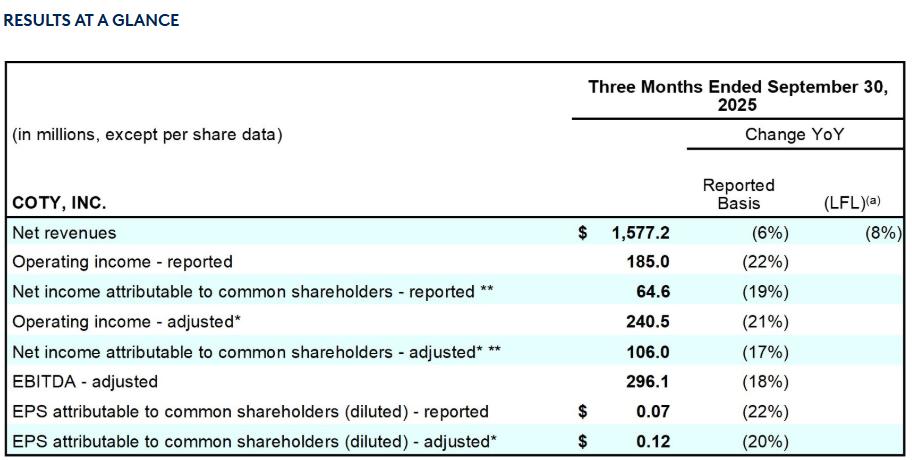
Core Viewpoint - Coty Inc., a century-old French perfume giant, is facing significant challenges, including declining performance across all business segments, plans to divest its mass cosmetics division, and the potential loss of the Gucci brand license, which could severely impact its revenue and profitability [1][28]. Financial Performance - For Q1 of fiscal year 2026, Coty's net revenue was $1.577 billion, a decrease of 6% year-over-year, and an 8% decline on a like-for-like basis [2][9]. - The reported net income was $64.6 million, down 19%, with a net profit margin of 4.1% [2][9]. - The mass beauty segment reported an operating loss of $7.7 million, with a loss rate of 1.5%, and an adjusted operating profit margin of 0.3%, down from 4.3% the previous year [9][28]. Business Segment Analysis - The high-end beauty segment generated $1.07 billion in net revenue, accounting for 68% of total sales, with a reported decline of 4% and a like-for-like decline of 6% [6][9]. - The mass beauty segment's net revenue was $508 million, representing 32% of total sales, with a reported decline of 9% and a like-for-like decline of 11% [6][9]. Regional Performance - All three major regions reported declines, with the Asia-Pacific region experiencing the largest drop of 9%, although there are signs of gradual improvement in the Chinese market [10][12]. - The European, Middle Eastern, and African markets, as the largest revenue source, saw a reported decline of 4% and a like-for-like decline of 9% [21][12]. Competitive Landscape - Coty is losing market share in the competitive global beauty landscape, particularly in the high-end fragrance segment, where it faces intense competition from companies like L'Oréal and Estée Lauder [24][28]. - The potential loss of the Gucci Beauty license, which contributes approximately 8% to Coty's sales and 11% to its profits, poses a significant risk to its future as an independent company [28][30]. Strategic Focus - Coty is focusing on optimizing its remaining high-end beauty operations and exploring new partnerships, while also emphasizing its core strength in the fragrance category [29][30]. - The company has appointed a new president for its mass beauty division, indicating a strategic shift aimed at addressing its current challenges [29].

连亏3年,知名日妆解散中国子公司
3 6 Ke· 2025-05-27 02:59
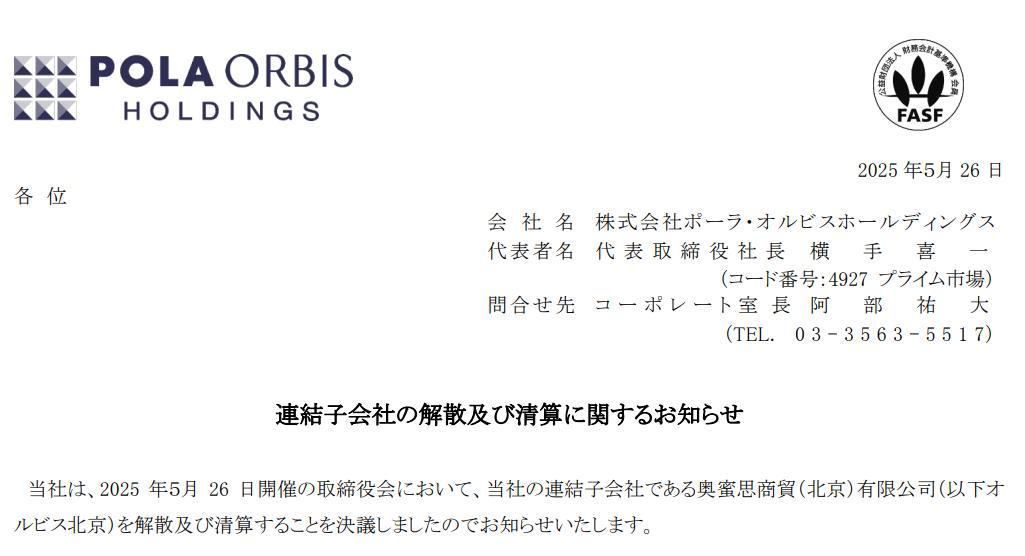
Core Viewpoint - POLA ORBIS HOLDINGS has announced the dissolution and liquidation of its subsidiary, Orbis Beijing, indicating challenges in the Chinese market but not a complete exit from China [1][3][5]. Company Overview - POLA ORBIS was established in 1929, focusing on beauty care, real estate, and other sectors, with beauty care accounting for 97% of its total revenue in 2024 [6]. - The Orbis brand, launched in 1984, targets the mid-range market with products priced between 2,000 and 5,000 yen (approximately 101 to 252 RMB) [8]. Financial Performance - Orbis Beijing's revenue for 2024 was 783 million yen (approximately 39 million RMB), the lowest in three years, with continuous losses in operating profit and net profit [8][9]. - The financial data shows a decline in net assets and total assets over the past three years, with net sales dropping significantly [9]. Strategic Decisions - The decision to dissolve Orbis Beijing aligns with POLA's "VISION 2029" strategy, which aims to expand globally and optimize brand portfolios [10]. - The company cited the slowing Chinese economy and intensified e-commerce competition as reasons for the inability to achieve short-term profitability [10][11]. Market Challenges - POLA faces significant competition in the Japanese cosmetics market, ranking last among the top four Japanese cosmetic groups [11]. - The overall performance of POLA's brands has been declining, with the main brand POLA and Jurlique experiencing revenue drops, while Orbis showed some growth [15][20]. Industry Context - The Chinese beauty market is becoming increasingly competitive, with local brands like Proya and Han Shu achieving significant revenue growth, contrasting with the struggles of international brands [21]. - The challenges faced by POLA are not unique, as other Japanese cosmetic companies are also experiencing difficulties in the Chinese market [20][21].
丝芙兰3年亏10亿?
3 6 Ke· 2025-04-29 01:01
Core Insights - Shanghai Jahwa's 2024 performance report reveals its first loss since going public, with Sephora China reporting a total loss of 646 million yuan in 2024 [1][3] - The cumulative loss for Sephora China over three years has reached nearly 1 billion yuan [1][3] Financial Performance - In 2024, Sephora China's revenue was 7.14 billion yuan, a year-on-year decline of 18.49%, with a net loss of 646 million yuan [4][3] - The financial performance from 2019 to 2024 shows a significant decline, with 2021 being the peak year, where revenue exceeded 10.87 billion yuan and net profit was 431 million yuan [3][4] Market Challenges - Increased competition in the online market and challenges faced by physical stores have led to reduced revenue and gross profit for Sephora China [6][12] - Several brands, including Tang from Herborist and OLEVA+, have withdrawn from Sephora, indicating a shift in brand strategies towards online sales [6][12] Strategic Adjustments - Sephora is undergoing organizational restructuring and has made key personnel changes to enhance its market presence in China [9][11] - The company is expanding its brand portfolio by introducing local brands and entering lower-tier cities to capture a broader market [11][12] Industry Context - The overall cosmetics market in China is experiencing a downturn, with a market size of 774.65 billion yuan in 2024, down 2.83% year-on-year [11][12] - Domestic brands have been gaining market share over foreign brands since 2023, indicating a shift in consumer preferences [11][12]