
美联储软着陆

Search documents
【2025年债市回顾:低利率环境下的挑战与机遇】美联储从紧缩走向宽松 美债市场的去年、今年和明年
Sou Hu Cai Jing· 2025-12-31 00:24
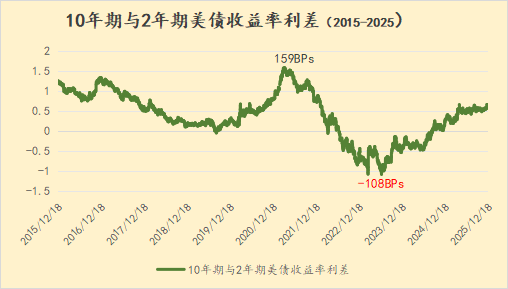
Core Viewpoint - The U.S. Treasury bond market has experienced significant volatility due to unexpected policies, and a reduction in overseas investment may lead to increased instability in bond yields in the future [1]. Group 1: Yield Curve Trends - The U.S. Treasury yield curve has shown a notable trend of inversion, particularly between the 10-year and 2-year bonds, with a record inversion of 108 basis points (BPs) observed on July 3, 2023 [2]. - As of December 31, the yield spread between the 10-year and 2-year bonds widened to 33 BPs, indicating a flattening of the yield curve [4]. - Compared to early 2025, the overall yield curve has declined by year-end 2024, with the mid to long segments becoming steeper [6]. Group 2: Economic Context for 2025 - The Federal Reserve hinted at two rate cuts in 2025, with the economy avoiding recession and inflation pressures easing from historical highs [10]. - By the end of 2025, the Fed lowered rates by 25 BPs to a range of 3.50% to 3.75%, marking a total reduction of 175 BPs since September 2024 [12]. - Approximately $9.2 trillion in U.S. debt is set to mature in 2025, representing nearly 30% of the U.S. GDP, alongside a projected federal deficit of $1.9 trillion [12]. Group 3: Future Projections for 2026 - Investment institutions expect the Fed to lower the federal funds rate target range to 3.0% to 3.5% in 2026, with potential for two to three additional rate cuts [14]. - Despite the Fed's easing policies, the outlook for long-term yields remains high due to increasing debt supply and fiscal deficits [14]. - The yield curve is anticipated to remain steep in 2026, benefiting fixed-income investors, particularly for bonds with maturities of 5 to 6 years [15].

【UNFX课堂】当美联储开始演奏“软着陆小夜曲”,黄金却在敲响“末日警钟”
Sou Hu Cai Jing· 2025-08-09 02:47
Group 1: Federal Reserve and Market Signals - The Federal Reserve is hinting at a potential "soft landing" with possible interest rate cuts, contrasting sharply with the surge in gold prices, indicating market anxiety about economic stability [2][4] - The appointment of Stephen Miran to the Federal Reserve is seen as a temporary measure, while the real power struggle involves Waller eyeing Powell's position, which could lead to significant market shifts by year-end [3] - The labor market data shows a rise in initial jobless claims and a peak in continuing claims, suggesting a weakening job market and economic uncertainty [4] Group 2: Trade Policies and Market Reactions - Trump's proposed 100% tariffs on semiconductors are perceived as a strategic move to encourage domestic manufacturing rather than a straightforward economic threat [5] - The tariffs are expected to prompt major companies like TSMC and Samsung to consider building factories in the U.S. to avoid these tariffs, potentially reshaping the semiconductor supply chain [5] - The recent imposition of tariffs on gold imports has led to a dramatic price increase, indicating that gold is becoming a geopolitical asset rather than just a hedge against inflation [6][7] Group 3: Currency and Economic Outlook - The U.S. dollar index is fluctuating around 98.0, reflecting uncertainty in the market as it awaits upcoming economic data, with expectations leaning towards a downward trend [4][8] - The combination of the Federal Reserve's dovish stance, weak labor market signals, and trade policy changes is creating a complex environment that could lead to significant market volatility [8]