
股债风险溢价

Search documents
基金观察:如何看待债市机会与风险?
Sou Hu Cai Jing· 2026-01-14 02:45
Core Viewpoint - The bond market is expected to experience fluctuations in 2025, with a shift in investor preference towards equities anticipated for 2026 due to declining risk premiums and supportive macroeconomic policies [2][3]. Group 1: Market Trends - The bond market has seen a strong performance over the past four years, primarily due to a lack of attractive returns in the equity market, leading investors to favor lower-risk bond assets [2]. - A significant drop in risk premiums indicates a rising risk appetite among investors, which is likely to result in a decline in bond prices and an increase in stock market performance [2]. - The central economic work conference has set a positive tone for macroeconomic policies, emphasizing proactive fiscal measures and moderately loose monetary policies, which are expected to enhance investor sentiment towards economic recovery [2]. Group 2: Investor Strategies - Investors should adjust their strategies in light of potential economic recovery, focusing on early indicators of corporate profitability such as the Producer Price Index (PPI) [3]. - Recommendations for bond investors include reducing duration by holding shorter-duration bonds and increasing exposure to equity-linked products like convertible bond funds and secondary bond funds to enhance returns [3]. - In the current interest rate environment, the choice between pure bond funds, convertible bond funds, and ETFs tracking government and technology innovation bonds should be based on the investor's outlook on interest rates and economic conditions [4][5]. Group 3: Product Insights - Pure bond funds are focused solely on bond assets, requiring careful attention to the fund manager's ability to adjust the portfolio based on credit and interest rate research [4]. - Government bond ETFs track government bond indices and are sensitive to interest rate changes, while technology innovation bonds carry additional credit risks, potentially offering higher returns [5].
八大指标看当前市场情绪到什么位置了?
Ge Long Hui A P P· 2026-01-13 00:06
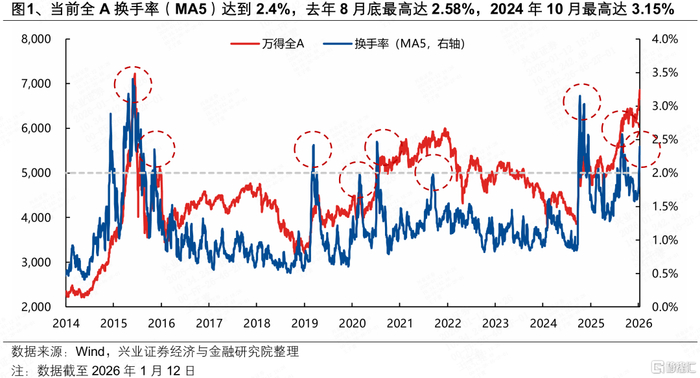
Market Turnover - The current turnover rate of the entire A-share market (MA5) is 2.4%, with a peak of 2.58% at the end of August last year and a maximum of 3.15% in October 2024 [1] Financing Sentiment - The current financing sentiment indicator, measured by the ratio of the recent 20-day financing buy amount to the recent 60-day financing buy amount, stands at 36%, with historically overheated levels above 40% [3] Financing Buy Proportion - The current proportion of financing buy is 11.26%, with a peak of 12.09% in October last year and a historical maximum of 18% in 2015 [4] A-Shares Above 30-Day Average - The current proportion of A-shares above the 30-day average is 66.8%, with historically overheated levels around 80% [7] Retail Investor Net Inflow - The current net inflow of retail investors, measured by small orders, has a 20-day moving average of 27.5 billion yuan, with peaks close to 40 billion yuan in February and September last year [8] New Highs in A-Shares - The current proportion of A-shares reaching new highs over the last 60 days is 11.27%, with historically overheated levels around 20% [9] Relative Strength Index (RSI) - The current RSI for the entire A-share market (14-day) is 80.4, with a peak of 82.3 at the end of July last year and a maximum of 91.3 in October 2024 [10] Stock-Bond Risk Premium - The current stock-bond risk premium for the entire A-share market is near -0.5 standard deviations from the rolling five-year average [16]

兴证策略:八大指标看当前市场情绪到什么位置了?
Xin Lang Cai Jing· 2026-01-12 11:12
Key Points - The current turnover rate of the entire A-share market (MA5) is at 2.4%, with a peak of 2.58% in late August last year and a maximum of 3.15% expected in October 2024 [1][17] - The financing sentiment indicator, measured as "recent 20-day financing buy-in amount / recent 60-day financing buy-in amount," stands at 36%, with historical overheating levels above 40% [3][19] - The current proportion of financing buy-in is 11.26%, with a peak of 12.09% in October last year and a historical high of 18% in 2015 [4][22] - The net inflow from retail investors, measured by small orders, has a 20-day moving average of 27.5 billion yuan, with peaks close to 40 billion yuan in February and September last year [7][21] - The proportion of stocks above the 30-day moving average in the entire A-share market is currently 66.8%, with historical overheating levels around 80% [9][24] - The proportion of stocks reaching a 60-day new high in the entire A-share market is currently 11.27%, with historical overheating levels at 20% [26] - The current equity-bond risk premium for the entire A-share market is near -0.5 standard deviations from the rolling five-year average [11][28] - The current RSI (Relative Strength Index) for the entire A-share market is at 80.4, with a peak of 82.3 at the end of July last year and a maximum of 91.3 expected in October 2024 [12]
国信证券:美债价值储藏功能弱化 美股投资评级下调至“弱于大市”
智通财经网· 2025-07-02 03:19
Core Viewpoint - The report from Guosen Securities indicates that as the US fiscal deficit worsens, the role of US Treasuries as a store of value is being replaced by gold [1][2] Group 1: US Treasuries and Gold - The 20-year US Treasury yield is projected to reach a target range of 4.9%-5.2% by 2025, with a recommendation to avoid [2] - Gold's target price is set at $3,500 per ounce, with a potential price of $4,400 per ounce if its market value matches that of US Treasuries, suggesting a buy [1][2] - The valuation of US Treasuries is expected to shift from premium to discount, as they lose their previous function as a store of value [1] Group 2: Stock Market Outlook - The S&P 500 target price for the second half of 2025 is estimated to be between 4,300 (bearish) and 5,600 (bullish), with a downgrade of the US stock market rating from "neutral" to "underperform" [4] - The long-term bull market in US stocks is driven by monetary factors, including a persistent capital account surplus due to the US's long-term current account deficit [3] Group 3: Economic Risks - Short-term economic conditions face risks, with the potential for a decline in real purchasing power due to tariffs, which could decrease by 0.5 to 0.7 percentage points for every 10 percentage point increase in tariffs [4] - A decline in consumer credit over two consecutive quarters suggests a historical correlation with actual recessions [4] Group 4: Investment Strategy - In the upcoming risk-averse phase, the focus should be on quality factors and defensive sectors such as Dow Jones, dividend factors, utilities, and consumer staples [5] - For bottom-fishing opportunities, the report recommends prioritizing Philadelphia Semiconductor, followed by Nasdaq 100, Nasdaq Composite, Russell 2000, and technology sectors [5]

长信量化价值驱动基金投资价值分析:在控制超额稳定的情况下获取较高超额收益的沪深300增强
Shenwan Hongyuan Securities· 2025-05-11 06:11
1. Report Industry Investment Rating - No industry investment rating is provided in the report. 2. Core View of the Report - The CSI 300 Index has medium - to long - term allocation value with stable profitability, expected rising performance growth, high dividend yield, and a high stock - bond risk premium. The Changxin Quantitative Value - Driven Fund A has achieved significant and stable excess returns in the past three years by timely adjusting factor exposures and strictly controlling industry weight deviations, and its current fund manager has rich experience in managing quantitative products [1][26][53]. 3. Summary According to the Directory 3.1 CSI 300 Index's Medium - to Long - Term Allocation Value - **Index Composition and Industry Weight Changes**: Composed of 300 representative securities in the Shanghai and Shenzhen markets, with many constituent stocks being leaders in their sectors. From the end of 2016 to April 2025, the weight of the financial sector in the CSI 300 Index decreased from 40.88% to 25.11%, while the weights of emerging industries such as power equipment and new energy, electronics, and medicine increased [6][9]. - **Stable Profitability and Expected Performance Growth Recovery**: From 2017 - 2024, the average ROE of the CSI 300 Index remained between 10% - 12%. The growth rate of net profit attributable to the parent bottomed out in 2023, started to recover in 2024, and is expected to reach 8.98% in 2025 and 8.66% in 2026 [13][15]. - **High Dividend Yield**: Since 2017, the average dividend yield of the CSI 300 Index has been above 2%, and since Q4 2023, it has been around 3%, significantly higher than other broad - based indices. As of April 30, 2025, its PE_TTM was 12.2 times, at the 44.43% quantile since 2017, indicating a relatively low valuation [18][22]. - **High Stock - Bond Risk Premium**: As of April 30, 2025, the stock - bond risk premium of the CSI 300 Index was at the position of the historical mean plus one standard deviation, suggesting good investment value compared to bonds [23]. 3.2 Analysis of Changxin Quantitative Value - Driven Fund A - **Significant and Stable Excess Returns in the Past Three Years**: From January 1, 2022, to April 30, 2025, the annualized excess return relative to the benchmark was 6.60%, the excess information ratio was 1.61, and the maximum excess drawdown was - 4.43%. In 2022 - 2024, it achieved positive excess returns of 7.52%, 7.81%, and 2.20% respectively. Compared with similar funds, it obtained high excess returns while maintaining stability. The fund's share increased from 0.06 billion at the end of 2021 to 8.30 billion at the end of Q1 2025 [33][38][40]. - **Performance Attribution**: In terms of factor deviation, the fund had a continuous positive excess exposure to the growth factor, which decreased significantly since the semi - annual report of 2023; it increased exposure to the dividend yield factor from 2022 - 2023 and slightly exposed to small - cap stocks from 2022 - 2024, all of which brought positive returns. In terms of industry weight deviation, it strictly controlled the absolute weight deviation from the CSI 300 Index in the CITIC first - level industries, with most deviations not exceeding 2% in the past six full - disclosure periods of fund positions [47][50]. - **Profile of the Current Fund Manager**: The current fund manager, Yao Yifan, graduated from the University of Warwick with a master's degree in financial mathematics. He joined Changxin Fund in July 2015 and has rich experience in managing quantitative products, currently managing multiple funds including the Changxin Quantitative Value - Driven Fund [53].