股市熔断

Search documents
日韩股市,双双重挫
财联社· 2026-03-23 00:31
Market Reactions - The Korea Exchange activated the KOSPI index circuit breaker after a 5% drop in KOSPI 200 futures, leading to a 5-minute suspension of program trading [1] - The Nikkei 225 index saw its intraday decline expand to 4% [2]


日韩股市大幅高开,韩股猛涨11%触发熔断
21世纪经济报道· 2026-03-05 00:29
Group 1 - The Japanese Nikkei 225 index increased by over 4%, reaching 56,423.35 points, with an intraday gain exceeding 2,100 points [1] - The South Korean KOSPI index rose by 11%, leading to the activation of the KosDAQ index circuit breaker, pausing program trading for 5 minutes [1] - Notable individual stocks include SK Hynix, which rose by 15%, Samsung Electronics, which increased by 13%, and Hyundai Motor, which also saw a 15% rise [2] Group 2 - Spot gold reached $5,170, with an intraday increase of nearly 1%, while spot silver rose by approximately 0.9% to $84.195 per ounce [2] - Year-to-date performance for London gold shows an increase of 19.75%, while London silver has risen by 17.65% [3]

韩国股市暴跌8%,再度熔断
第一财经· 2026-03-04 02:44
Core Viewpoint - The Japanese stock market is experiencing significant declines, with the Tokyo Stock Exchange index dropping by 4% and the Nikkei 225 index falling by 3.7% [3] Group 1 - The Tokyo Stock Exchange index has seen a substantial decrease, indicating a bearish trend in the market [3] - The Nikkei 225 index's decline of 3.7% reflects broader concerns regarding economic conditions in Japan [3]

紧急暂停交易!韩国股市暴跌
证券时报· 2026-03-04 02:37
Group 1 - The Korean stock market experienced a significant drop, with the KOSDAQ index triggering a circuit breaker after an 8% decline, leading to a 20-minute trading halt [2][8] - Major companies in the Korean market, such as Samsung Electronics, SK Hynix, and Hyundai Motor, saw substantial early morning declines, with Samsung's stock dropping over 7% at one point, SK Hynix over 6%, and Hyundai over 8%, although these declines later narrowed [10] - The semiconductor sector, crucial to the Korean economy, was heavily impacted by the overnight plunge in U.S. semiconductor stocks, with the Philadelphia Semiconductor Index falling 4.58%, marking its largest single-day drop of the year [12] Group 2 - The A-share market opened lower, but sectors such as oil and agriculture showed relatively strong performance initially, while coal, chemical fiber, logistics, and shipping sectors faced significant early losses [3][6] - By mid-morning, the A-share market saw a rebound, with both the ChiNext Index and the Shenzhen Component Index turning positive [5]

A股高开!黄金、白银大反弹
Zhong Guo Zheng Quan Bao· 2026-02-03 01:56
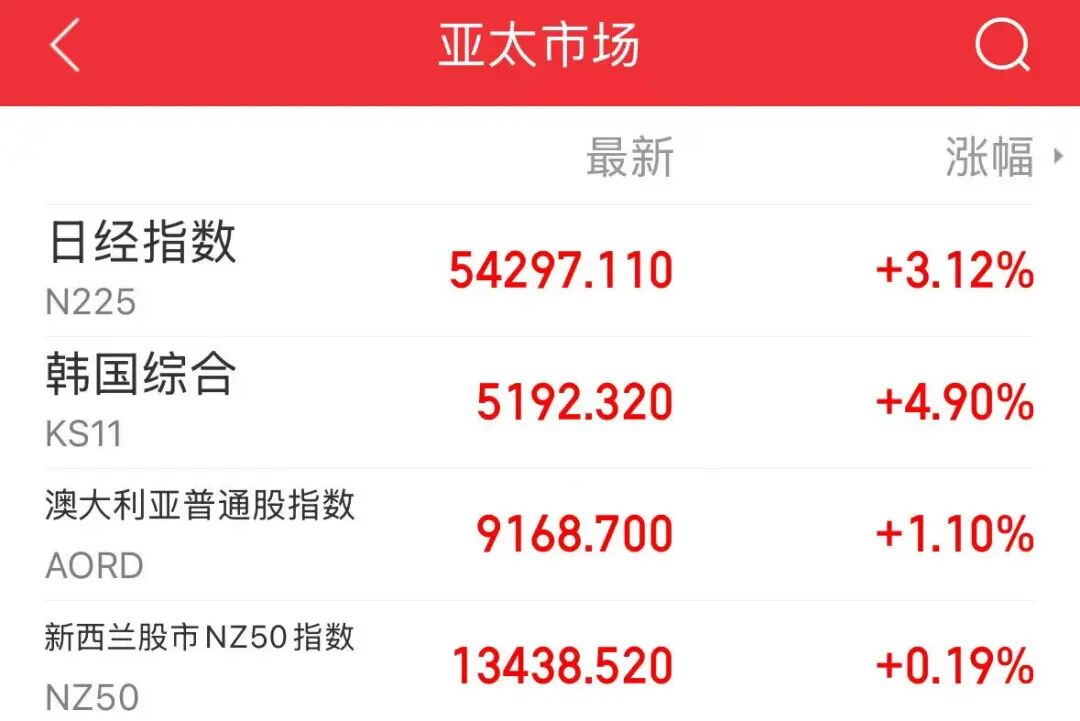
Group 1 - The Asia-Pacific stock markets experienced a broad rise on February 3, with the South Korean Composite Stock Price Index triggering a circuit breaker after a significant drop of over 5% the previous day [1] - As of 9:37 AM, the Nikkei 225 index rose by over 3%, and the South Korean Composite Index increased by 4.9%, with notable gains in stocks like SK Hynix and Samsung Electronics [1] Group 2 - The A-share market opened higher, with the Shanghai Composite Index up by 0.66%, the Shenzhen Component Index up by 1.23%, and the ChiNext Index up by 1.44% as of 9:37 AM [2] - The non-ferrous metal sector showed mixed performance, with industrial and small metals rebounding while precious metals saw significant declines, leading to stocks like Hunan Silver and Zhaojin Gold hitting the daily limit down [2] - Spot gold and silver prices rebounded sharply, with spot gold breaking the $4,800 per ounce mark during the session [2]
韩国股市大跌触发熔断机制
第一财经· 2026-02-02 07:08
Core Viewpoint - The South Korean stock market experienced a significant decline on February 2, with the KOSPI index dropping over 5%, triggering a trading halt for 5 minutes [1]. Group 1: Market Performance - The KOSPI index closed down 5.26% at 4949.67 points, compared to the previous close of 5224.36 points, reflecting a decrease of 274.69 points [2]. - The trading volume was reported as 0, indicating a lack of market activity during this period [2]. - Other major Asia-Pacific indices also saw declines, with the Nikkei 225 down 1.25% at 52655.18 points and the Australian S&P 200 down 1.02% [1][3]. Group 2: Market Metrics - The KOSPI index reached a high of 5196.71 and a low of 4933.58 during the trading session [2]. - The price-to-earnings (P/E) ratio for the KOSPI was noted at 21.8, while the price-to-book (P/B) ratio was 1.68 [2]. - Year-to-date performance for the KOSPI showed a decline of 17.45% [2].

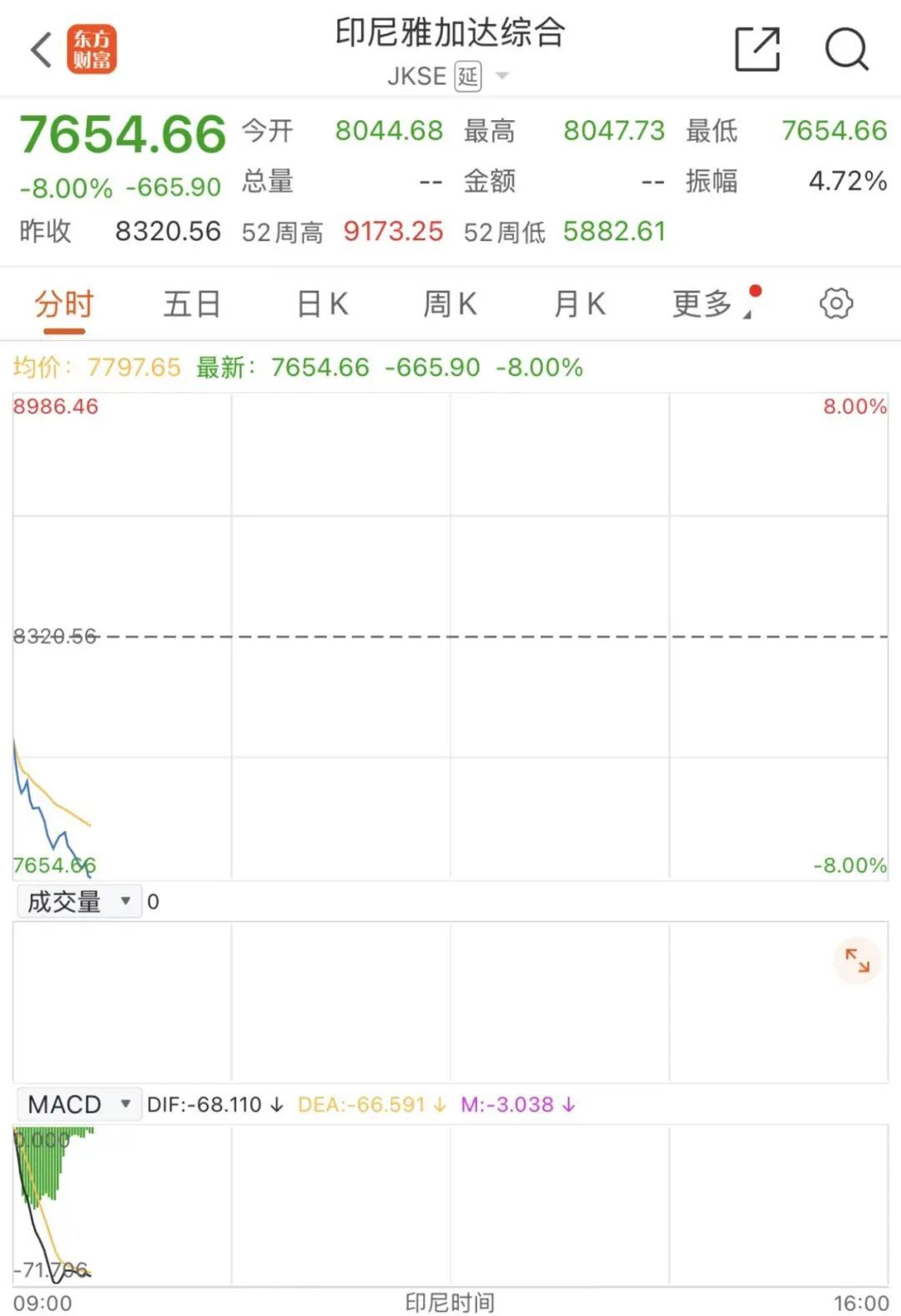
再暴跌、熔断!黑天鹅突袭印尼股市
证券时报· 2026-01-29 04:39
Core Viewpoint - The Indonesian stock market experienced a significant drop, with the Jakarta Composite Index falling over 8% and triggering a trading halt due to concerns raised by MSCI regarding the investability of the Indonesian market [1][3]. Group 1 - The Jakarta Composite Index saw a decline of approximately 10% at one point during trading, before narrowing to an 8% drop by the time of reporting [1]. - On January 28, the index closed at 8320.56 points, reflecting a decrease of 7.35% from the previous trading day [3]. - MSCI has raised concerns about the concentration of ownership in listed companies, leading to a suspension of certain index adjustments and a freeze on new constituent stocks until regulatory issues are addressed [3].

熔断!刚刚,又崩盘了
Zhong Guo Ji Jin Bao· 2026-01-29 03:22
Core Viewpoint - The Indonesian stock market has triggered a trading halt due to a significant drop in the Jakarta Composite Index, which fell by 9.64% following a warning from MSCI regarding the investment value of Indonesian stocks [1][2]. Group 1: Market Reaction - On January 29, the Jakarta Composite Index initially dropped by 8%, leading to a temporary trading suspension [1]. - After the resumption of trading, the index continued to decline, reaching a total drop of 9.64% [2]. Group 2: MSCI Warning - MSCI issued a stern warning about the low free float of Indonesian stocks and ongoing concerns about market accessibility, leading to a temporary freeze on index adjustments [2]. - MSCI indicated that if there is no improvement in market transparency and regulation by May, Indonesia could be downgraded from the emerging markets index [2]. Group 3: Goldman Sachs Analysis - Goldman Sachs downgraded the rating of the Indonesian stock market to "underweight," citing concerns over MSCI's warning that could lead to a downgrade to frontier market status, potentially resulting in an outflow of over $13 billion [3]. - In a moderate scenario, Goldman Sachs estimates a passive fund outflow of $2.2 billion, while in an extreme scenario, this could rise to $7.8 billion [2][3]. - The potential downgrade could also trigger an additional outflow of $5.6 billion if FTSE Russell reassesses its free float methodology and market conditions [3].
印尼股市熔断,恢复交易继续暴跌近10%
2 1 Shi Ji Jing Ji Bao Dao· 2026-01-29 03:22
Core Viewpoint - The Jakarta Composite Index in Indonesia experienced a significant drop, triggering a trading halt due to concerns raised by MSCI regarding the investability of the Indonesian stock market [1] Group 1: Market Performance - The Jakarta Composite Index fell over 8% during early trading on January 29, leading to a 30-minute trading suspension [1] - After resuming trading, the index continued to decline, ultimately falling by approximately 10% [1] - On the previous trading day, January 28, the index closed at 8320.56 points, reflecting a decrease of 7.35% from the prior day [1] Group 2: MSCI Concerns - MSCI expressed concerns about the investability of the Indonesian stock market, leading to the immediate suspension of certain index adjustments and freezing of new constituent stocks [1] - MSCI warned that if Indonesia does not achieve sufficient progress in information transparency by May, it will reassess the market's access status [1] - A potential downgrade in the weight of Indonesian stocks in the MSCI Emerging Markets Index could occur, posing a risk of overall market downgrade [1]
熔断,印尼股市又崩盘了
Zhong Guo Ji Jin Bao· 2026-01-29 03:19
Core Viewpoint - The Indonesian stock market has triggered a trading halt due to a significant decline, primarily driven by concerns raised by MSCI regarding the investment value of Indonesian stocks and potential downgrades from emerging market status [1][4][7]. Group 1: Market Performance - On January 29, the Jakarta Composite Index fell by 8% shortly after opening, leading to a trading suspension [1]. - After the trading resumed, the index further declined, reaching a drop of 9.64% [4]. Group 2: MSCI Concerns - MSCI issued a stern warning about the low free float of Indonesian stocks and ongoing market access issues, leading to a temporary freeze on index adjustments [7]. - The organization indicated that without significant improvements in market transparency and regulation by May, Indonesia could be downgraded from the emerging market index [7]. Group 3: Financial Implications - Goldman Sachs estimated that Indonesia's stock market could face passive fund outflows of $2.2 billion under moderate scenarios, potentially escalating to $7.8 billion in extreme cases [8]. - The downgrade concerns could lead to over $13 billion in capital outflows if Indonesia is reclassified as a frontier market, with passive funds potentially selling off up to $7.8 billion in assets [8]. - Additionally, if FTSE Russell reassesses its free float methodology, it could trigger further outflows of $5.6 billion [8].