能源瓶颈

Search documents
速递 | 木头姐2026最新报告炸裂解读:马斯克押注的13个赛道全拆解
未可知人工智能研究院· 2026-01-24 04:08
Group 1: AI Infrastructure - The global data center investment is projected to grow from $500 billion in 2025 to $1.4 trillion by 2030, marking a 29% annual growth rate [4][5] - NVIDIA's dominance in the GPU market, currently at 85% market share and 75% gross margin, is expected to decline as competitors like AMD and custom ASIC chip manufacturers gain market share [8][14] - The AI infrastructure ecosystem includes not only NVIDIA but also ASIC manufacturers, AMD, TSMC, and cloud service providers like AWS and Microsoft Azure, which are experiencing growth rates surpassing traditional cloud computing [14] Group 2: Consumer Revolution - AI Agents are transforming the $8 trillion online shopping market, reducing the time to complete a purchase from 60 minutes in the 1980s to just 90 seconds today [15][21] - By 2030, AI Agents are expected to facilitate online consumption exceeding $8 trillion, a twelvefold increase from the current 2% market share [21] - Brands must adapt to AI recommendations by optimizing product data for AI systems and shifting marketing strategies away from traditional advertising [21] Group 3: Robotics Breakthrough - Home robots could contribute $6.2 trillion to the U.S. GDP, equating to a 20% increase, if they penetrate 80% of American households [26][27] - The cost of a household robot is projected to be around $20,000, making it feasible for widespread adoption [27] - Companies like Tesla and Boston Dynamics are leading the charge in redefining labor through robotics [27] Group 4: Autonomous Driving - The Robotaxi market is projected to exceed $10 trillion by the early 2030s, with profit margins significantly higher than traditional vehicles [29][31] - Autonomous driving is expected to convert non-market activities into GDP-generating activities, enhancing economic growth [31] - Key players in this space include Tesla, Waymo, and Baidu, with opportunities in the supply chain for components like lidar and AI chips [32] Group 5: Underestimated Sectors - The AI-driven biopharmaceutical revolution is expected to reduce drug development costs by 100 times, with new therapies moving from labs to commercialization by 2025 [36][40] - Energy bottlenecks pose a challenge for AI growth, but solutions like distributed energy sources and advancements in storage technology are emerging [40] - Companies in the energy sector should consider transitioning to the intersection of data centers and energy solutions [40]



微软谷歌正在大力招「电工」
量子位· 2026-01-15 23:57
Core Insights - The competition for AI talent among tech giants has expanded beyond the computer field to include energy experts [1][3] - Major companies are significantly increasing their hiring in the energy sector to address power supply issues critical for AI development [8][20] Group 1: Hiring Trends - Since 2022, Microsoft has hired over 570 employees in the energy sector [4][11] - Amazon leads with 605 new hires in energy, including AWS [10] - Google has added over 340 energy-related positions [11] - Other companies like Apple and NVIDIA have also increased their energy-related roles by nearly 200 [12] Group 2: Talent Acquisition - Microsoft has poached Betsy Beck from Google, who has over 15 years of experience in the energy field [14] - Google recently hired Eric Schubert from BP and Tyler Norris, a recognized climate figure, to strengthen its energy strategy [16][17] - The competition for skilled candidates in energy infrastructure is intensifying due to limited talent pools [18][19] Group 3: Energy Supply Challenges - Microsoft CEO Satya Nadella stated that the lack of electricity is a more critical issue than the shortage of GPUs for AI development [8][20] - The primary challenge is not chip supply but rather the availability of power and the infrastructure to support data centers [21][22] - Elon Musk emphasized that energy will become the essence of currency, highlighting the shift in limitations for AI development [22] Group 4: Long-term Investments - Tech giants are investing in nuclear energy to secure future power supplies, with Meta partnering with several nuclear companies for operational support [29] - Companies are also exploring nuclear fusion projects, with significant investments from major players like Microsoft and NVIDIA [33][34] - Improving energy efficiency in data centers is another avenue being pursued, which ties back to the need for skilled talent [35][36]



头部私募年末操作大调整:防御中优化结构,2026看好三条线
2 1 Shi Ji Jing Ji Bao Dao· 2025-12-11 13:28
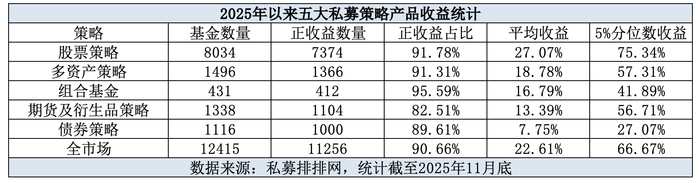
Market Overview - In November 2025, the market entered a phase of adjustment after a previous upward trend, with major indices showing declines, including a drop of over 4% in the STAR Market Index and a 1.67% decrease in the Shanghai Composite Index [1] - Despite the market's downturn, the private equity industry reported strong performance, with 90.66% of 12,415 private equity products showing positive returns and an average return of 22.61% [1] Performance by Strategy - Among five major strategies, the stock strategy emerged as the biggest winner, with an average return of 27.07% and a positive return ratio of 91.78% [2][3] - Quantitative long strategies outperformed subjective long strategies, achieving an average return of over 36% and a positive return ratio of 96.11% [2][4] Strategy Differentiation - The performance of stock strategies showed significant internal differentiation, with quantitative strategies capturing opportunities effectively despite a market environment that favored subjective strategies [2][4] - Subjective long strategies demonstrated strong performance among top performers, with a 5% percentile return of 82.57%, the highest among sub-strategies [4] Market Sentiment and Positioning - As the market adjusted, private equity managers shifted towards defensive and structural optimization strategies, with a slight decrease in aggressive positions [8][9] - By the end of November, 92.9% of subjective long strategy products maintained positions above 50%, although the proportion of fully invested and leveraged positions decreased [8][9] Future Investment Themes - Looking ahead to 2026, there is a consensus among institutions on investment themes centered around energy infrastructure, "anti-involution" policies, and globalization opportunities [11][12] - The development of AI is expected to drive global electricity demand, leading to a reevaluation of energy and power infrastructure investments [11] - The "anti-involution" policy is anticipated to improve supply-demand dynamics in various industries, presenting substantial investment opportunities [12] Divergence in Market Outlook - There are differing views on the recovery of the consumer sector and volatility in the Hong Kong market, with some private equity firms maintaining high positions in Hong Kong stocks while others have reduced exposure [13] - Overall, private equity managers are adopting a cautiously optimistic outlook for 2026, recognizing the challenges of valuation pressures and macroeconomic uncertainties while remaining confident in China's economic transformation [13]