自动驾驶技术路线

Search documents
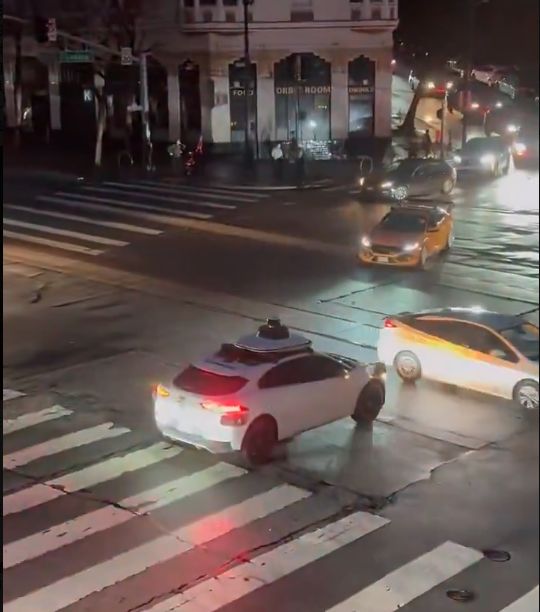
旧金山突发大停电,红绿灯熄灭致大量Waymo趴窝
Guan Cha Zhe Wang· 2025-12-22 08:57
Core Viewpoint - Multiple companies have publicly questioned Waymo's technological approach to Robotaxi following a significant incident in San Francisco where a power outage caused traffic disruptions and highlighted the limitations of Waymo's system [1][3][4]. Group 1: Incident Overview - On December 20, a fire at a PG&E substation led to a power outage affecting over 30% of San Francisco, impacting more than 130,000 residents [1]. - The outage caused traffic lights to go dark, resulting in Waymo's Robotaxis becoming immobilized in the streets, contributing to traffic chaos [1][3]. Group 2: Industry Reactions - Executives from companies like Tesla, Horizon, and Xpeng have raised concerns about Waymo's reliance on high-definition maps and pre-programmed rules, suggesting that this approach is inadequate for handling unexpected situations [3][6][8]. - Elon Musk stated that Tesla's Robotaxi was unaffected during the power outage, contrasting it with Waymo's performance [4][6]. Group 3: Technological Critique - Waymo's L4 Robotaxi technology is criticized for its rigid response to unforeseen events, as evidenced by a previous incident where it failed to stop for a school bus [6]. - In contrast, Tesla and other companies advocate for AI-driven models that learn from vast amounts of data, aiming for a more adaptable and robust autonomous driving solution [6][8]. Group 4: Future Directions - Horizon's CEO emphasized the need for AI advancements to achieve true safety in autonomous driving, arguing that relying on rules and infrastructure is insufficient [8][10]. - Xpeng's senior director highlighted the importance of developing vehicles that can understand and react to real-world scenarios like a human driver, indicating a shared vision with Tesla regarding the future of Robotaxi technology [10][13].


市值蒸发超540亿,明星上市公司Luminar破产了
Xin Lang Cai Jing· 2025-12-22 02:53
Core Viewpoint - Luminar, once valued at $7.8 billion, filed for Chapter 11 bankruptcy on December 15, 2025, marking a significant decline in the U.S. lidar industry, as it was seen as a leading hope for the sector [1][16][30] Group 1: Company Overview - Luminar was founded in 2012 by Austin Russell with the vision of providing precise environmental perception for vehicles [3][18] - The company became a unicorn in 2017 after raising $36 million in Series B funding, reaching a valuation of over $1 billion [19] - Luminar went public via a SPAC merger in December 2020, raising approximately $600 million and achieving a market cap of $7.8 billion [19][20] Group 2: Business Challenges - Despite initial success, Luminar faced significant challenges, including reliance on a few major clients, particularly Volvo, which led to vulnerability [20][21] - In 2024, Volvo cut its annual order expectations by 75%, exacerbating Luminar's cash flow issues and leading to layoffs and restructuring [5][21] - By the end of 2024, Luminar's cash reserves fell below $100 million, with debts reaching $380 million [5][21] Group 3: Market Dynamics - The global lidar market is shifting, with Chinese manufacturers capturing approximately 92% of the market share by 2024, contrasting with the decline of U.S. players [2][11] - Chinese firms like Hesai and RoboSense have adopted a more diversified approach, focusing on various applications beyond passenger vehicles, which has contributed to their growth [26][27] - Luminar's reliance on a high-cost 1550nm lidar technology limited its competitiveness against the more cost-effective 905nm solutions favored by Chinese manufacturers [7][26] Group 4: Technological Debate - The debate over the necessity of lidar in autonomous driving continues, with figures like Elon Musk arguing that lidar is unnecessary and costly [8][23] - In contrast, companies like WeRide advocate for a multi-sensor fusion approach, emphasizing the importance of lidar for safety in complex driving environments [24][25] - The divergence in technology strategies reflects broader commercial model differences, with Tesla targeting mass-market vehicles and WeRide focusing on commercial applications [10][25] Group 5: Future Outlook - Luminar's bankruptcy signifies a pivotal moment in the lidar industry, indicating a potential restructuring of market leadership towards Chinese firms [28][29] - The future of lidar technology may see continued innovation and competition, with potential disruptions from companies like Apple and Google entering the space [29][30] - Despite current advantages, Chinese manufacturers must remain vigilant against technological disruptions and market fluctuations to maintain their lead [30]
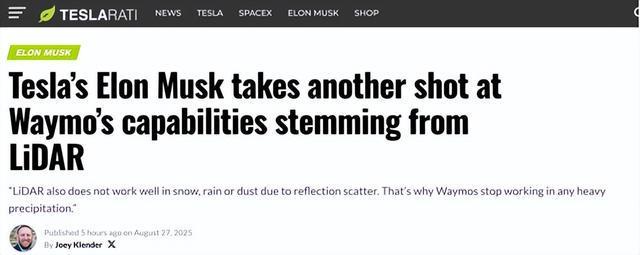
马斯克再评激光雷达:恶劣天气性能受限 力挺摄像头方案可靠性
Huan Qiu Wang Zi Xun· 2025-08-28 08:21
Group 1 - The core viewpoint of the article emphasizes Elon Musk's criticism of lidar technology, highlighting its limitations compared to Tesla's camera-based perception system [1][3] - Tesla has made a strategic shift to a pure vision approach, abandoning the "camera + radar" combination in favor of a solely camera-based system known as "Tesla Vision" [1][3] - Musk argues that reliance on lidar and radar can lead to "sensor conflict," which may decrease safety due to inconsistent data from different sensors, citing this as a reason why Waymo vehicles cannot operate on highways [3] Group 2 - Musk points out that lidar struggles in adverse weather conditions, such as snow and rain, which affects navigation capabilities, further explaining why Waymo vehicles cannot drive in heavy rain [3] - Tesla's approach to autonomous driving technology significantly differs from many companies in the industry, with competitors like Waymo relying heavily on lidar technology [3] - Musk revealed that Tesla's Model S and Model X previously used high-resolution radar, but the performance was deemed inferior to passive optical devices (cameras), leading to the decision to discontinue radar use [4]