自贸协定

Search documents
2025年杭州海关签发自贸协定原产地证书141.85万份
Zhong Guo Jing Ji Wang· 2026-02-26 02:43
Group 1 - The original certificate of origin is a crucial document for export products to enjoy tariff benefits abroad, often referred to as "paper gold" [1] - In 2025, Hangzhou Customs issued a total of 1.4185 million certificates of origin under various free trade agreements, with a total value of $48.623 billion, ranking first among customs in China [1] - In January 2026, Hangzhou Customs issued 126,000 certificates of origin, with a value of 30.61 billion yuan, representing year-on-year growth of 3.4% and 1.9% respectively, helping enterprises enjoy tariff reductions exceeding 1.5 billion yuan [1] Group 2 - Zhejiang Hongsheng Chemical Co., Ltd. is a high-tech enterprise providing chemical intermediates for downstream industries such as dyes, tires, and pesticides, leveraging tax benefits from free trade agreements to increase market share in Southeast Asia [1] - The company processed preferential certificates of origin for export goods worth over 32 million yuan in January, with zero tariff price advantages enhancing competitiveness in local markets, resulting in a 15% increase in exports to RCEP markets [1] - Hangzhou Customs plans to utilize the "Red Boat Enterprise Navigation" service platform to provide targeted support for foreign trade enterprises, promoting the "China Customs Preferential Origin Service Platform" for personalized inquiries regarding tariff rates and origin policies [2]
杭州海关1月签发自贸协定原产地证书12.6万份
Xin Hua She· 2026-02-25 08:20
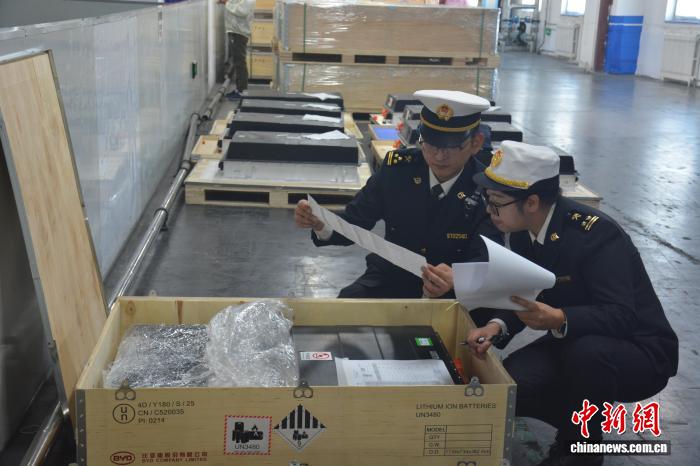
Group 1 - The original certificate of origin is crucial for export products to enjoy tariff benefits abroad, often referred to as "paper gold" [1] - In January, Hangzhou Customs issued 126,000 various certificates of origin under free trade agreements, with a total value of 30.61 billion yuan, marking a year-on-year increase of 3.4% and 1.9% respectively, helping enterprises enjoy over 1.5 billion yuan in tariff reductions [1] - Zhejiang Hongsheng Chemical Co., Ltd. has leveraged tax benefits from free trade agreements to increase its market share in Southeast Asia, reporting a 15% growth in exports to RCEP markets in January [1] Group 2 - Zhejiang Yate Electric Co., Ltd. has utilized the tax reduction advantages from free trade agreements to explore new market growth points, applying for a certificate of origin for lithium-ion battery packs, which is expected to save approximately 99,000 yuan in tariffs [2] - The successful delivery of this batch of orders is anticipated to contribute to a total cooperation of 10 million yuan with the client in the first year [2] - Hangzhou Customs plans to enhance support for foreign trade enterprises through targeted policy promotion and the "Red Boat Enterprise Navigation" service platform, aiming to facilitate access to preferential origin services and streamline the application process [2]
南共市与欧盟加快推动自贸协定内部审批进程
Jin Rong Jie· 2026-02-03 05:10
Core Viewpoint - The Southern Common Market (Mercosur) and the European Union (EU) signed a series of agreements on January 17, aimed at creating one of the largest free trade areas in the world by eliminating most tariffs and enhancing market access [1] Group 1: Agreements Overview - The agreements consist of a "package of agreements" that includes two independent documents: the EU-Mercosur Partnership Agreement (EMPA) focusing on political dialogue and comprehensive cooperation, and the Interim Trade Agreement (iTA) aimed at achieving immediate trade benefits [1] - The agreements are designed to strengthen bilateral economic, investment, and regulatory cooperation between the EU and Mercosur [1] Group 2: Objectives and Implications - The primary objective of these agreements is to eliminate most tariffs, thereby expanding market access for both parties [1] - This initiative represents a significant step towards the establishment of one of the largest free trade zones globally, enhancing trade relations between the EU and Mercosur [1]
豫企手握“纸黄金”闯海外大市场
He Nan Ri Bao· 2026-02-02 23:38
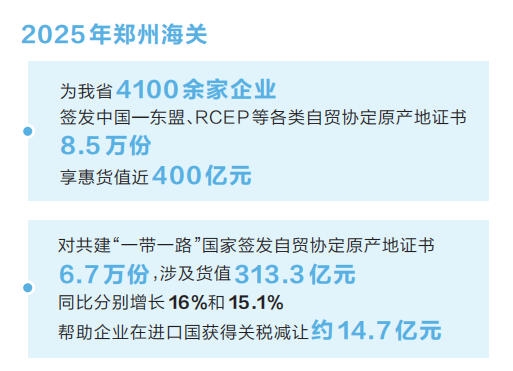
Group 1 - In 2025, Zhengzhou Customs issued 85,000 certificates of origin under various free trade agreements for over 4,100 enterprises in Henan province, facilitating nearly 40 billion yuan in trade value and boosting international market access for "Henan manufacturing" [2] - The certificate of origin serves as proof of the goods' origin and is essential for companies to enjoy tariff reductions in importing countries, being referred to as "paper gold" in the industry [2] - The China-Korea and China-Australia free trade agreements celebrated their 10th anniversary last year, with tariff reduction benefits becoming increasingly evident and the list of products benefiting from these agreements continuously expanding [2] Group 2 - Zhengzhou Customs issued 67,000 certificates of origin to countries involved in the Belt and Road Initiative last year, covering a trade value of 31.33 billion yuan, marking a year-on-year increase of 16% and 15.1% respectively, helping companies gain approximately 1.47 billion yuan in tariff reductions [3] - Key sectors benefiting from tariff reductions include machinery, chemicals, food, plastics, clothing, and furniture, which are labor-intensive products [3] - In 2025, Henan province's exports to Belt and Road countries reached 183.16 billion yuan, a year-on-year growth of 4.3%, with the number of exporting enterprises exceeding 11,000, an increase of 16.9% [3]

波黑部长会议批准与EFTA自贸协定累积规则扩展决定
Shang Wu Bu Wang Zhan· 2026-01-30 08:04
Core Viewpoint - Bosnia's Council of Ministers has decided to expand the complete accumulation rules in the free trade agreement with the European Free Trade Association (EFTA) to include textiles and textile products imports Group 1: Scope of Application - The complete accumulation rules now cover textiles and textile products under customs tariff chapters 50 to 63 of the free trade agreement [1] Group 2: Basis of Rules - This adjustment aligns with the relevant amendments of the regional convention on preferential rules of origin adopted by the Joint Committee on December 7, 2023 [1] Group 3: Effective and Implementation Timeline - The decision will take effect eight days after publication in the Official Gazette of the Government of Bosnia and will be officially implemented 60 days after publication to provide adequate preparation time for relevant parties [1] Group 4: Objective - This initiative aims to further facilitate and enhance cooperation in the textile trade between Bosnia and EFTA member countries [1]
印度迎来“春天”?冯德莱恩返程不久,一架飞机坠毁,莫迪痛失一位劲敌
Sou Hu Cai Jing· 2026-01-30 02:41
Group 1 - The core viewpoint of the article highlights the strategic implications of the India-EU free trade agreement, which aims to reshape economic relations while exposing India's vulnerabilities in international competition [1][3]. - The agreement stipulates that the EU will implement zero tariffs on 99.5% of Indian goods over the next seven years, particularly benefiting labor-intensive sectors like textiles, leather, and pharmaceuticals, thus opening a significant European market for India [1][3]. - In exchange, India will significantly reduce tariffs on EU automobiles and machinery, presenting a seemingly mutually beneficial arrangement, but also revealing the fragility of India's economy under international competition [1][3]. Group 2 - Despite having competitive advantages in IT services and finance, India's economic structure is predominantly service-oriented, with a low manufacturing sector share and a high proportion of small and medium enterprises that are vulnerable to market fluctuations [3]. - The reduction of tariffs on EU automotive and machinery products is expected to impact India's local industries negatively, while short-term benefits in textiles and leather may not be sustainable due to a lack of core technological support in manufacturing [3]. - Institutional shortcomings and execution challenges further amplify the risks associated with the agreement, as effective implementation requires legislative approval and robust policy support, which are currently lacking in India's labor reforms and compliance with EU standards [3]. Group 3 - The recent political turmoil following the plane crash in Maharashtra, which resulted in the death of a key political figure, has intensified power struggles within the region, potentially affecting India's economic stability as Maharashtra contributes nearly 15% of the national GDP [5]. - Despite gaining temporary political advantages, the Modi government faces significant challenges ahead of the 2026 elections, with economic indicators such as GDP growth projected to slow to 6.2% and inflation rising to 4% [5]. - The future trajectory of India's economic development hinges on its ability to navigate the opportunities and risks presented by the free trade agreement, alongside addressing political, economic, and diplomatic challenges [7].
商务部:我国已与31个国家和地区签署24个自贸协定
Zhong Guo Xin Wen Wang· 2026-01-26 07:44
Core Viewpoint - The Chinese government is actively enhancing its international trade relations through free trade agreements (FTAs) and bilateral cooperation, aiming to boost global economic stability and development [1] Group 1: Free Trade Agreements - China has signed 24 free trade agreements with 31 countries and regions, with these partners accounting for 45% of the total value of its goods trade [1] - The country is implementing a 3.0 version upgrade of the FTA with ASEAN and has initiated a free trade agreement with the Maldives [1] Group 2: Bilateral Cooperation - Under the leadership of state-level diplomatic strategies, China and the United States have achieved positive outcomes in economic consultations, contributing to global economic confidence [1] - China is advancing unilateral open measures, including 100% zero tariffs for African countries with which it has diplomatic relations [1] Group 3: Multilateral Engagement - China has committed not to seek new special and differential treatment in current and future negotiations at the World Trade Organization, promoting practical economic development outcomes through various international organizations [1] - The "Green Mineral International Economic and Trade Cooperation Initiative" launched by China has seen participation from over 20 countries and international organizations, fostering win-win cooperation [1]
欧洲议会决定将欧盟-南共市自贸协定提交欧盟法院审查
Xin Hua She· 2026-01-21 12:17
Core Viewpoint - The European Parliament has voted to submit the EU-Mercosur free trade agreement for review by the EU Court, which may slow down the approval process and increase uncertainty regarding its implementation [1]. Group 1 - The EU and Mercosur officially signed the free trade agreement on January 17 in Asunción, Paraguay [1]. - The agreement requires approval from the parliaments of the respective countries before it can take effect [1].
高市要求撤回“对日两用物项出口管制”,中方:坚决反对,不予接受!
证券时报· 2026-01-15 09:41
Group 1 - The core viewpoint of the article emphasizes China's firm stance against Japan's claims regarding export control measures, asserting that these measures are legitimate and aimed at preventing Japan's militarization and nuclear ambitions [1] - The Chinese Ministry of Commerce expresses willingness to engage in free trade agreements with Canada, highlighting the mutual benefits and potential for cooperation in the economic sector [1] - The Ministry of Commerce also indicates a commitment to maintaining dialogue with the European Union regarding the electric vehicle case, aiming to deepen cooperation in supply chains and support global green transformation [2] Group 2 - The Ministry of Commerce outlines that despite complex external changes, China's foreign trade development still possesses numerous favorable conditions, emphasizing the country's economic resilience and potential [4] - The Ministry plans to implement the decisions of the Central Committee and the State Council, focusing on innovation, quality improvement, and integration of trade and investment to stabilize the foreign trade landscape [4]

青海:2025年签发RCEP原产地证书235份
Zhong Guo Xin Wen Wang· 2026-01-09 14:50
Core Insights - In 2025, Xining Customs is expected to issue a total of 1,094 certificates of origin, marking a year-on-year increase of 25.3%. Among these, 235 certificates will be RCEP certificates, reflecting a growth of 32.8% [1]. Group 1: RCEP Certificates - RCEP certificates are crucial for international trade, allowing exporting companies to benefit from tariff reductions and other preferential treatments in importing countries [1]. - The RCEP certificate serves as an important document to prove the origin of goods during customs clearance, determining tariff rates and eligibility for preferential tariffs [1]. Group 2: Implementation and Efficiency - Since the RCEP policy took effect on January 1, 2022, Xining Customs has been actively evaluating the implementation effects of free trade agreements, guiding companies to maximize policy benefits [2]. - The one-time approval rate for certificate applications has improved to over 90%, and the self-printing rate for certificates has increased by 64% year-on-year in 2025, significantly saving time and enhancing export efficiency [2]. Group 3: Industry Impact - Companies have recognized the financial benefits of origin certificates, with significant sales growth in Southeast Asian markets attributed to effective tariff management [2].