航运减碳

Search documents
中金 | 绿色甲醇行业:起于航运减碳,短看政策和订单,降本和生产稳定性决定长期空间
中金点睛· 2026-03-12 23:34
Core Viewpoint - The investment in green methanol in China is accelerating, with expectations of continued supply-demand imbalance in the next 1-2 years, while also testing project order locking and production stability [1][2]. Group 1: Policy and Market Dynamics - The EU has included shipping in its carbon emissions trading system starting in 2024, with penalties for non-compliant vessels from 2025 [4]. - The EU FuelEU Maritime regulation aims to reduce the greenhouse gas intensity of shipping fuels by 2% from a 2020 baseline, with further reductions every five years, targeting an 80% reduction by 2050 [5]. - The International Maritime Organization (IMO) has proposed a global carbon pricing mechanism, with a goal to reduce greenhouse gas emissions from international shipping by at least 20% by 2030 compared to 2008 levels [8][9]. Group 2: Green Methanol Development in China - China's green methanol production capacity is projected to exceed 60 million tons by the end of 2025, but only about 1% of this capacity is currently operational [2][39]. - The short-term focus for green methanol in China is on securing overseas customer orders, as the global supply is expected to remain tight [40]. - The development of green methanol aligns with China's "14th Five-Year Plan" for non-electric renewable energy utilization, contributing to energy security [33][35]. Group 3: Production and Cost Challenges - Current green methanol production projects face challenges in production stability due to factors like renewable energy output fluctuations and biomass supply consistency [42]. - The production costs of green methanol remain high, and reducing these costs is critical for the industry's long-term viability [43]. - The price of green methanol is currently elevated, with domestic prices around 7,000 yuan per ton for green methanol compared to 2,000-2,500 yuan per ton for conventional methanol [32][40]. Group 4: Future Demand and Opportunities - By 2030, global demand for green methanol is expected to increase significantly, potentially reaching five times the demand in 2025 [16][18]. - The establishment of long-term supply contracts for green methanol with international shipping companies is a key strategy for securing market position [40].


申万宏源:首予中集安瑞科(03899)“买入”评级 LNG储运订单高增
智通财经网· 2025-12-15 01:29
Core Viewpoint - Shenwan Hongyuan initiates coverage on CIMC Enric (03899) with a "Buy" rating, highlighting its strong financial health and robust order backlog, driven by growth in natural gas demand, decarbonization in shipping, and hydrogen industry policies [1] Group 1: Financial Performance - CIMC Enric is a clean energy equipment platform under CIMC Group, with a stable financial position and a major shareholder holding 70% [1] - The company expects a CAGR of 17% in net profit attributable to shareholders from 2020 to 2024, benefiting from the continuous improvement in clean energy equipment performance [1] - The gross profit contributions from clean energy, chemical environment, and liquid food segments for H1 2025 are 71%, 14%, and 15% respectively [1] - The company has maintained a ROE above 10% for the past four years and has a cash-rich position, with a dividend payout ratio exceeding 50% in the last two years [1] Group 2: Order Backlog and Market Potential - As of Q3 2025, CIMC Enric has a total order backlog of 30.8 billion yuan, with clean energy equipment orders amounting to 27.3 billion yuan (20 billion yuan for marine and 7.1 billion yuan for land-based applications, and 300 million yuan for hydrogen) [2] - The company is positioned to benefit from the anticipated decline in natural gas prices, which will enhance LNG infrastructure [2] - The LNG shipping market is expected to double by 2030, driven by environmental and economic advantages, leading to increased orders for LNG bunkering vessels and fuel tanks [2] - The hydrogen sector is expected to benefit from the implementation of the 14th Five-Year Plan for hydrogen and ammonia policies, with the company’s core products covering the entire hydrogen production, storage, transportation, and utilization chain [2] Group 3: Energy Operations - CIMC Enric utilizes coke oven gas to produce blue hydrogen and LNG, with the first project at Angang expected to be profitable in its first year of operation, targeting a cumulative capacity of approximately 200,000 tons of hydrogen and 1 million tons of LNG by 2027 [3] - The potential for green methanol is significant, driven by decarbonization in shipping and renewable energy consumption, with the company’s 50,000-ton biomass methanol project expected to be a frontrunner [3] Group 4: Other Business Segments - The chemical environment segment, with a global market share exceeding 50% in tank containers, is expected to face short-term pressure due to chemical cycle impacts, prompting the company to expand its after-market services [4] - The liquid food segment, which includes well-known brands like Ziemann beer equipment, is experiencing a slowdown in consumer demand, leading to a diversification strategy to enhance resilience [4]


106艘巨单!中国船厂包揽
Xin Lang Cai Jing· 2025-12-12 14:20
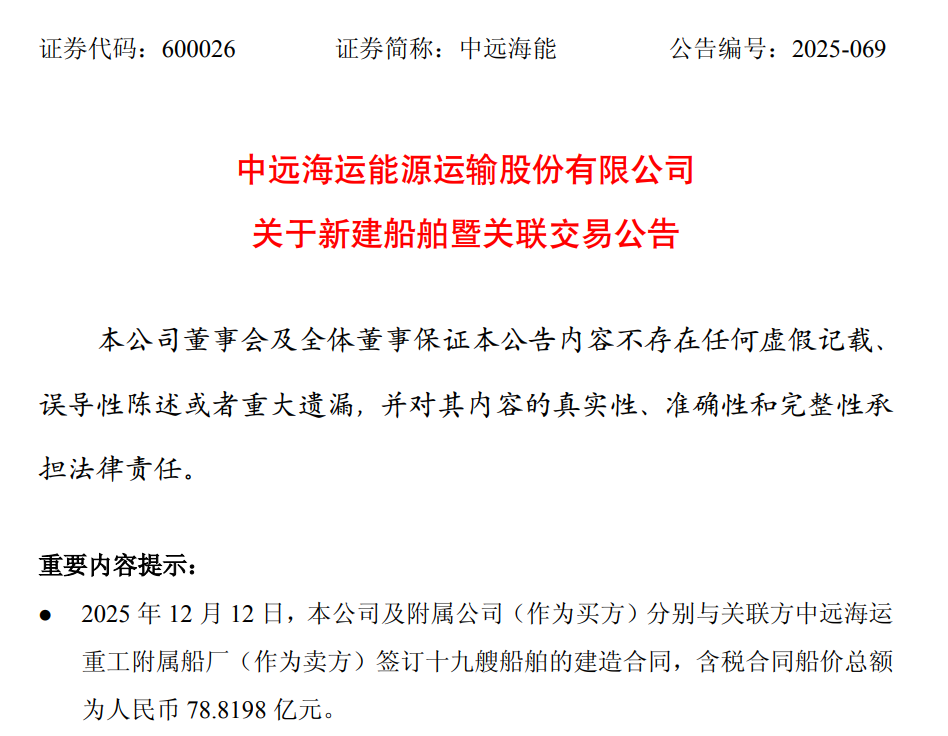
Core Insights - China COSCO Shipping Group's subsidiary, COSCO Shipping Energy Transportation Co., Ltd., announced the signing of contracts for the construction of 19 vessels with a total contract price of RMB 7.88198 billion, with total investment including capitalized costs around RMB 8.124 billion [1][8] - In a week, COSCO Shipping Group and its subsidiaries ordered a total of 106 new ships, all to be built by Chinese shipyards, with a significant order of 87 vessels worth over RMB 50 billion signed with China Shipbuilding Group [1][8] Summary by Category Contract Details - COSCO Shipping Heavy Industry's subsidiaries received orders for various types of vessels, including 10 new ships from Dalian COSCO Shipping Heavy Industry Co., Ltd., 4 new ships from Yangzhou COSCO Shipping Heavy Industry Co., Ltd., and 5 new ships from Guangdong COSCO Shipping Heavy Industry Co., Ltd. [3][11] - Specific contracts include one 9,000 cubic meter LNG dual-fuel ethylene carrier priced at RMB 327.98 million, two LR I product/oil tankers at RMB 912 million each, three MR product/oil tankers at RMB 1.047 billion each, and four MR crude oil tankers at RMB 1.37 billion each [3][11] Environmental and Operational Strategy - The new vessels will utilize clean energy systems such as LNG and methanol dual-fuel, aligning with global shipping decarbonization trends and enhancing the competitiveness of the vessels throughout their lifecycle [4][12] - The addition of new shipping capacity aims to improve the operational flexibility and efficiency of COSCO Shipping Group's fleet, thereby solidifying market share and sustainable profitability [4][12] Broader Industry Context - The 87 new ship projects signed with China Shipbuilding Group involve multiple subsidiaries and include various vessel types such as ultra-large container ships, bulk carriers, and oil tankers, indicating a robust demand in the shipbuilding sector [4][13]

中信证券:航运减碳大势所趋 海洋绿色甲醇迎产业化良机
Xin Lang Cai Jing· 2025-11-23 09:33
Core Viewpoint - The trend of decarbonization in the shipping industry is driving the continuous expansion of green methanol production capacity, while deep-sea economic policies are accelerating investments in offshore wind power [1] Group 1: Industry Trends - Breakthroughs in seawater hydrogen production technology have enabled the commercial model for producing green methanol from offshore wind power [1] - The new model for deep-sea scenarios is expected to demonstrate economic advantages by avoiding high investment costs associated with seabed cables [1] Group 2: Market Potential - The market space for marine green methanol engineering equipment during the 14th Five-Year Plan period is estimated to reach 24.2 billion yuan [1] - Companies involved in the industrialization process of marine engineering technology and core equipment suppliers for green hydrogen projects are recommended for investment [1] Group 3: Investment Opportunities - Conventional land project investors are also viewed positively, as they are likely to achieve high project returns in an environment of green methanol supply shortages [1]

申万宏源:航运减碳大势所趋 重视生柴、RNG及绿色甲醇
Zhi Tong Cai Jing· 2025-10-24 06:01
Core Viewpoint - The shipping decarbonization policies from IMO and the EU are becoming more frequent, marking the transition of shipping decarbonization into a practical phase, with low-carbon fuel materials entering a favorable market environment [1][2] Group 1: Policy Developments - The EU will include the shipping industry in its carbon market starting in 2024, imposing fines of 100 EURO/tCO2e for non-compliance, and requires a 2% reduction in carbon emissions by 2025 and an 80% reduction by 2050, with penalties of 642 EURO/tCO2e for violations [2] - The IMO has proposed a net-zero strategy by 2050 and approved a net-zero framework draft in April 2025, establishing a unified carbon price of $380 or $100/tCO2e to significantly promote shipping decarbonization [2] - China is initiating green fuel pilot projects and has set a target for zero net emissions (ZNZ) usage of 5-10% by 2030, with compliance costs expected to drive ZNZ demand [2] Group 2: Supply and Demand Analysis - According to DNV's statistics as of August 2025, the demand for biodiesel, LNG, and green methanol is projected to be approximately 200 million tons, 40 million tons, and 6 million tons respectively, while the supply of ship fuel is only 70,000 tons, 10,000 tons, and 10,000 tons, indicating a severe shortage of low-carbon fuel supply [2] - The compliance costs in the EU are higher than those under the IMO framework and are expected to increase annually, with projected costs for 2025, 2030, 2040, and 2050 being $741, $953, $1649, and $3014 per ton respectively, compared to $525, $583, and $1362 per ton under the IMO framework [2] Group 3: Sector-Specific Insights - Biodiesel is identified as a core decarbonization measure for existing vessels, with a significant increase in biodiesel refueling at Singapore ports since 2022, reflecting a growing demand [3] - The demand for renewable natural gas (RNG) is expected to surge, driven by the IMO's net-zero framework and the potential for green premiums, with historical RNG development being slow due to high costs [4] - The number of methanol ships is rapidly increasing, with current estimates of 406 ships corresponding to a demand of over 800,000 tons of methanol, while global green methanol production capacity is expected to be only 124,000 tons by the end of 2025 [5]
碳中和系列报告七:航运减碳大势所趋,重视生柴、RNG及绿色甲醇
Shenwan Hongyuan Securities· 2025-10-23 08:46
Investment Rating - The report indicates a positive investment outlook for the shipping decarbonization sector, emphasizing the importance of biofuels, RNG, and green methanol as key areas for investment opportunities [3]. Core Insights - The shipping industry is entering a critical phase of decarbonization, driven by frequent policies from the IMO and the EU. The global shipping fuel consumption is approximately 300 million tons, corresponding to carbon emissions exceeding 1 billion tons, with the EU accounting for about 18% of this [3][8]. - The demand for low-carbon fuels is expected to outstrip supply in the short term, with significant compliance costs driving the need for zero or near-zero emissions fuels (ZNZ) [3][36]. - Biofuels are identified as a core measure for existing vessels, with a notable increase in biofuel bunkering at ports like Singapore [3][36]. - The report highlights the potential for biogas, particularly RNG, to significantly reduce emissions and improve energy security, with ambitious production targets set for 2030 in both China and the EU [3][36]. - Green methanol is projected to see rapid growth in demand, with a current estimate of 406 methanol vessels corresponding to a demand exceeding 800,000 tons [3][36]. Summary by Sections 1. Decarbonization Policies - The report outlines the increasing frequency of decarbonization policies from the IMO and the EU, marking a significant acceleration in the implementation of these measures [3][11][18]. 2. Low-Carbon Fuel Demand - There is a broad demand space for low-carbon fuels, with a short-term supply shortage anticipated. The report notes that the compliance costs associated with EU regulations are higher than those of the IMO, which will further stimulate demand for low-carbon fuels [3][36]. 3. Biofuels - Biofuels are highlighted as a critical decarbonization measure for existing vessels, with a significant increase in biofuel bunkering observed at ports like Singapore. The global production of biodiesel is approximately 52 million tons, with expectations for increased usage in shipping as electric vehicles proliferate [3][36]. 4. Biogas - The report emphasizes the growing demand for LNG vessels and the potential for RNG to drive significant growth in the sector, supported by a green premium that could lead to an industry explosion [3][36]. 5. Green Methanol - The report notes a rapid increase in methanol vessels, with a projected demand of over 800,000 tons. However, the global production capacity for green methanol is expected to be only 1.24 million tons by the end of 2025, indicating a supply-demand imbalance [3][36]. 6. Investment Recommendations - The report suggests focusing on companies involved in biofuels, RNG, and green methanol production, including notable firms such as卓越新能, 山高环能, 维尔利, and 中国天楹, among others [3][36].