
融资保证金比例

Search documents
新规落地两周,杠杆盘理性回归
2 1 Shi Ji Jing Ji Bao Dao· 2026-02-06 03:17
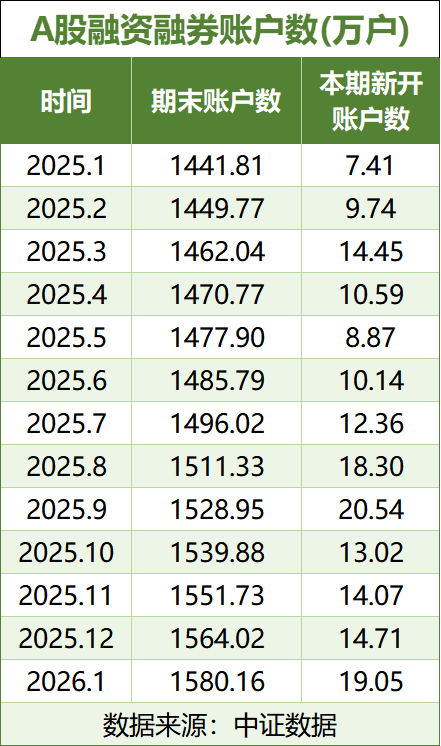
Group 1 - The A-share market experienced a "good start" in January 2026, with leveraged funds entering the market rapidly, leading to a record high in margin financing and securities lending balance [1][2] - In January, the number of new margin trading accounts reached 190,500, a month-on-month increase of 29.5% and a year-on-year increase of 157% [2][3] - As of the end of January, the total margin financing and securities lending balance reached 2.72 trillion yuan, marking a historical peak [2][6] Group 2 - The increase in new accounts and margin balance reflects a shift in market sentiment from cautious to proactive, driven by the profit effect of rising markets and long-term capital inflows [2][12] - The margin trading balance has been on an upward trend since the "9.24" market event, reaching 2.72 trillion yuan in January 2026 [8] - Despite the record high in margin balance, the overall leverage level in the market remains healthy, with key risk monitoring indicators significantly below historical high-risk periods [13][15] Group 3 - The market saw a significant increase in trading activity, with the total margin trading transaction amount reaching 640 billion yuan in January [6] - The adjustment of financing margin ratios, which increased from 80% to 100%, is viewed as a measure to cool down the market and prevent overheating of leveraged funds [13][15] - Following the implementation of the new financing regulations, the growth rate of margin balance has slowed, indicating a rational cooling of leveraged trading [12][13]

每日钉一下(A股牛市已经进入中后期了吗,出现了哪些信号?)
银行螺丝钉· 2026-01-23 14:04
Group 1 - The article discusses the current state of the A-share bull market, indicating that it may have entered the mid-to-late stage, supported by several signals observed in January 2026 [5][6]. - On January 12, a stock fund experienced over 10 billion yuan in subscriptions in a single day, a clear sign of a bull market's later stages, as similar occurrences were noted in previous bull markets in 2021, 2015, 2009, and 2007 [5]. - The announcement on January 14 to adjust the financing margin ratio from 80% to 100% is aimed at curbing leveraged investments in A-shares, a tactic previously used during the 2015 bull market [5][6]. Group 2 - On January 15, significant net outflows were observed in major ETFs, with the largest, the CSI 300 ETF, experiencing approximately 20 billion yuan in outflows, marking the highest single-day net outflow since 2012 [7]. - The primary investors in index funds are institutional investors, such as state-owned entities and pension funds, who typically buy during market dips and reduce their holdings as the market peaks [7][8]. - The current market conditions suggest that it may not be an opportune time for large investments in stock funds, as the market appears to be overvalued, and investors are advised to be cautious with their buying strategies [8][9].

当前A股场内杠杆处于什么水平?一文看懂
财联社· 2026-01-21 11:57
Core Viewpoint - The A-share market's financing balance has exceeded 2.7 trillion, coinciding with the regulatory policy of raising the minimum margin ratio from 80% to 100%, leading to renewed discussions about leverage levels in the market [1] Group 1: Current Leverage Levels - The current leverage level in the A-share market is not irrationally high when considering structural changes and core indicators [2] - Key indicators such as the financing balance to circulating market value ratio and the financing buy amount to A-share transaction amount ratio are significantly below historical peaks [2] - The financing balance to circulating market value ratio is currently at 2.62%, which is about 55.5% of the historical peak of 4.72% reached in 2015 [4] Group 2: Industry Analysis - Financing balance to circulating market value ratios across various sectors are significantly lower than their historical highs in 2015, with notable declines in sectors like Information Technology (38.9% drop), Real Estate (36.4% drop), and Healthcare (43.5% drop) [6][7] - The current ratios for various sectors as of January 19, 2026, are: - Information Technology: 3.50% - Real Estate: 3.09% - Healthcare: 2.74% - Communication Services: 2.50% [7] Group 3: Trading Activity and Investor Participation - The ratio of financing buy amount to A-share transaction amount is currently at 9.79%, significantly lower than the historical peak of 19.26% in 2015, indicating a controlled level of trading activity [8] - The proportion of investors participating in margin trading is at 6.84%, which is about half of the historical peak of 14.09% [10] - The average financing balance per investor has risen to 143.29 million, although it is still 16.1% lower than the historical peak of 170.79 million [13] Group 4: Safety Margins and Risk Management - The average maintenance margin ratio is at 288.03%, well above the 140% warning line, indicating a strong safety margin for leveraged investors [15]

宏观金融数据日报-20260119
Guo Mao Qi Huo· 2026-01-19 05:10
Report Summary 1. Report Industry Investment Rating - Not provided in the given content. 2. Core Viewpoints - The central bank's adjustment of structural monetary policy tools, including interest rate cuts and increased support for agriculture, small businesses, and private enterprises, aims to optimize the economic structure [5]. - The stock index market is currently experiencing short - term adjustments due to policy regulations, but the upward trend is expected to continue as the current strong capital - driven force and the domestic fundamentals in the bottom - building stage suggest that the upward pattern of the stock index has not ended. Long - term investors can consider long - term bullish positions [6]. 3. Summary by Relevant Catalogs 3.1. Money Market - DRO01 closed at 1.32 with a - 4.73bp change, DR007 at 1.44 with a - 5.94bp change, GC001 at 1.22 with a - 14.50bp change, and GC007 at 1.53 with a 0.50bp change. SHBOR 3M was 1.60 with no change, and LPR 5 - year was 3.50 with no change. 1 - year, 5 - year, and 10 - year treasury bonds had respective changes of - 1.66bp, - 0.98bp, and - 0.34bp, while 10 - year US bonds rose 7.00bp [4]. - Last week, the central bank conducted 9515 billion yuan of reverse repurchase operations, with 1387 billion yuan of reverse repurchase maturing, resulting in a net injection of 8128 billion yuan. Also, 6000 billion yuan of outright reverse repurchase matured, and the central bank carried out 9000 billion yuan of outright reverse repurchase operations [4]. 3.2. Structural Monetary Policy Adjustments - On January 15, 2026, the central bank announced a 0.25 - percentage - point cut in the interest rates of various structural monetary policy tools. The one - year interest rate of various re - loans dropped to 1.25%, and other term - based interest rates were adjusted accordingly. The central bank also increased the amount of re - loans for agriculture and small businesses by 5000 billion yuan, and set up a 1 - trillion - yuan special re - loan for private enterprises, mainly supporting small and medium - sized private enterprises [5]. 3.3. Stock Index Market - The closing prices of major indices on a certain day: the CSI 300 was 4732 with a - 0.41% change, the SSE 50 was 3080 with a - 0.83% change, the CSI 500 was 8233 with a 0.11% change, and the CSI 1000 was 8233 with a - 0.10% change. The corresponding index futures also had different changes [5]. - Last week, the CSI 300 fell 0.57% to 4731.9, the SSE 50 fell 1.74% to 3079.8, the CSI 500 rose 2.18% to 8232.7, and the CSI 1000 rose 1.27% to 8232.7. The market liquidity remained abundant, with the average daily trading volume increasing by 6131.1 billion yuan compared to the previous week, and the margin trading balance hitting a new high [5]. - Policy regulations led to short - term adjustments in the stock index market. The increase in the margin ratio for margin trading by exchanges and the large - scale selling of broad - based index ETFs by Central Huijin affected the market. However, considering the strong capital - driven force and the domestic fundamentals in the bottom - building stage, the upward trend of the stock index is expected to continue [6]. 3.4. Index Futures Basis - For the IF contract, the basis for the next - month contract was 1.42%, the current - quarter contract was 1.10%, and the next - quarter contract was 2.63%. For the IH contract, it was - 0.44%, - 0.90%, and 0.08% respectively. For the IC contract, it was 0.76%, 1.62%, and 4.79%, and for the IM contract, it was 1.04%, 3.89%, and 7.40% [7].
单边行情纠偏,股指行稳致远
Dong Zheng Qi Huo· 2026-01-18 09:14
Report Industry Investment Rating - The rating for stock index trends is "Volatility" [4] Core View of the Report - The domestic stock market showed dramatic changes this week. With multiple trading days hitting record high trading volumes, regulatory actions to cool down the market were evident, suppressing stock performance. The stock index opened high and closed low, showing signs of a phased peak. From a capital perspective, ETFs such as the CSI 300 experienced net redemptions, which directly affected index prices. The CSRC's 2026 system work conference emphasized preventing market fluctuations and controlling the market rhythm. Therefore, the long - term slow - bull market pattern remains unchanged, but in the short term, market volatility will increase, and it still needs to accumulate upward momentum [2][10] Summary by Relevant Catalogs 1. One - Week View and Macro Key Event Overview - **Next - week view**: The regulatory measures are cooling down the market, leading to increased stock market volatility. The long - term slow - bull pattern remains, but short - term market shocks will intensify, and it needs to accumulate upward momentum [2][10] - **This - week key event focus**: - On January 12th, four departments jointly issued regulations on the operation of government investment funds, and the NDRC introduced evaluation and management methods for fund investment directions, supporting the cultivation of emerging and future industries [11] - On January 14th, the Shanghai, Shenzhen, and Beijing stock exchanges raised the margin ratio for margin trading to 100%; three departments issued tax incentives for home - buying replacement; China's December exports and imports both exceeded expectations [12][13][14] - On January 15th, the central bank implemented a 25BP structural interest rate cut, increased various re - loan quotas, and adjusted the minimum down - payment ratio for commercial real estate loans; at the end of 2025, China's social financing increased by 8.3% year - on - year [15][16] - On January 16th, the CSRC emphasized counter - cyclical adjustment to prevent market fluctuations; China and Canada reached a series of economic and trade agreements; the State Council executive meeting studied measures to promote consumption [17][18][19] 2. One - Week Market Quotes Overview - **Global stock market weekly overview**: From January 12th to 16th, global stock markets denominated in US dollars rose. The MSCI Global Index increased by 0.33%, with emerging markets (+2.25%) > frontier markets (+0.89%) > developed markets (+0.09%). The South Korean stock market rose 4.29%, outperforming the world, while the French stock market fell 1.47%, the worst - performing globally [1][21] - **Chinese stock market weekly overview**: From January 12th to 16th, most Chinese equity assets rose, with Hong Kong stocks > A - shares > Chinese concept stocks. The average daily trading volume of the Shanghai, Shenzhen, and Beijing stock exchanges was 34653 billion yuan, an increase of 6131 billion yuan compared to last week. A - share broad - based indices were divided, with the STAR 50 Index rising 2.58% and the SSE 50 Index falling 1.74% [1][24] - **Weekly overview of GICS primary industries in Chinese and foreign stock markets**: Most global GICS primary industries rose this week, with real estate leading (+3.53%) and consumer discretionary falling the most (-1.39%). In the Chinese market, information technology had the largest increase (+3.37%), and real estate lagged (-3.66%) [27] - **Weekly overview of China's A - share CITIC primary industries**: Among China's A - share CITIC primary industries this week, 10 rose (28 last week) and 20 fell (2 last week). The computer industry had the largest increase (+4.31%), and the national defense and military industry fell the most (-5.66%) [1][29] - **Weekly overview of China's A - share styles**: Small - cap growth stocks outperformed this week [33] 3. Index Valuation and Earnings Forecast Overview - **Broad - based index valuation**: The report provides PE and PB data for various broad - based indices this week, at the beginning of the year, and their changes, as well as the eight - year percentile [43] - **Primary industry valuation**: The report provides PE and PB data for various primary industries this week, at the beginning of the year, and their changes, as well as the eight - year percentile [44] - **Broad - based index equity risk premium**: The ERP of the CSI 300, CSI 500, and CSI 1000 decreased slightly this week [45][49] - **Consensus expected earnings growth rate of broad - based indices**: The expected earnings growth rate of the CSI 300 in 2025 was adjusted down to 8.64% and in 2026 to 9.32%; for the CSI 500, it was adjusted down to 26.39% in 2025 and up to 22.70% in 2026; for the CSI 1000, it was adjusted down to 28.29% in 2025 and up to 23.27% in 2026 [51] 4. Liquidity and Capital Flow Tracking - **Interest rates and exchange rates**: This week, the 10Y and 1Y interest rates declined, and the spread widened. The US dollar index was 99, and the offshore RMB exchange rate was 6.96 [60] - **Trading - type capital tracking**: This week, the average daily trading volume of northbound funds increased by 740 billion yuan compared to last week, and the margin trading balance increased by 981 billion yuan [59] - **Tracking of funds flowing in through ETFs**: There are 30 on - exchange ETFs tracking the CSI 300, 29 tracking the CSI 500, 15 tracking the CSI 1000, and 40 tracking the CSI A500. This week, the shares of ETFs tracking the CSI 300 decreased by 21.4 billion, those tracking the CSI 500 decreased by 1.7 billion, those tracking the CSI 1000 decreased by 2.7 billion, and those tracking the CSI A500 decreased by 7.7 billion [62][63][65] 5. Tracking of China's Macro High - Frequency Data - **Supply side**: Tire production rates recovered after the Spring Festival [68] - **Consumption side**: Second - hand housing transactions increased seasonally [77] - **Inflation observation**: Producer prices rebounded, while agricultural product prices adjusted [88]
融资保证金最低比例上调至100% 引导市场理性投资
Jin Rong Shi Bao· 2026-01-16 02:04
Core Viewpoint - The adjustment of the financing margin ratio from 80% to 100% is aimed at stabilizing the market and preventing systemic risks, effective from January 19, 2026, for new financing contracts only [1][4]. Group 1: Market Context - The financing margin is the minimum self-funding ratio required from investors when borrowing money to buy stocks, which serves as a risk control lever [2]. - In August 2023, the financing margin ratio was reduced from 100% to 80%, leading to a steady increase in market financing scale and trading volume, with year-end financing balances projected to reach 1.58 trillion yuan, 1.85 trillion yuan, and 2.52 trillion yuan from 2023 to 2025 [2]. - As of January 14, 2024, the total market financing balance reached a historical high of 2.68 trillion yuan, with the margin balance accounting for 2.61% of the A-share circulating market value [2]. Group 2: Regulatory Actions - The adjustment is part of a broader regulatory strategy to manage market overheating and ensure stability, with recent measures including monitoring stocks with excessive short-term price increases [3][4]. - The increase in the financing margin ratio is seen as a moderate approach to cooling down the market and preventing high leverage risks, while existing contracts remain unaffected [4][6]. Group 3: Market Reactions - Following the announcement, the market showed mixed reactions, with the Shanghai Composite Index and Shenzhen Component Index experiencing slight fluctuations, indicating a rational market response rather than panic selling [7]. - Analysts believe that the increase in the financing margin ratio serves as a "preventive measure" during periods of market overheating, aiming to smooth volatility rather than reverse trends [7][8]. Group 4: Long-term Outlook - The long-term outlook for the equity market remains positive, with expectations of improved institutional foundations, liquidity, and attractiveness, suggesting a steady upward trajectory characterized by structural optimization and functional enhancement [8].

融资保证金比例回归100%,释放什么信号?
Guo Ji Jin Rong Bao· 2026-01-15 14:15
Core Viewpoint - The recent increase in the financing margin ratio from 80% to 100% aims to moderate market sentiment, curb excessive speculation, and reduce overall market volatility, while not affecting existing financing contracts [1][4][5] Group 1: Financing Margin Adjustment - The financing margin ratio has undergone three adjustments since 2015, with the latest change returning it to 100% [2] - The adjustment is expected to decrease the maximum financing amount from 125,000 to 100,000 for every 100,000 in margin, indicating a 25% reduction in leverage [3] - The adjustment is seen as a proactive measure to prevent credit risks associated with concentrated margin calls [3] Group 2: Market Impact and Fund Flow - The increase in the financing margin ratio is anticipated to lead to a shift in fund flows, with a contraction in new financing scale and a decrease in speculative demand due to higher costs [6] - Funds are likely to move from speculative stocks to those with stable performance and reasonable valuations, promoting a more sustainable market environment [6] - The adjustment may enhance international investors' confidence in the A-share market, signaling a commitment to stable market development [6] Group 3: Regulatory Perspective - The adjustment is part of a broader strategy to manage market risks and ensure the healthy operation of the capital market, especially in light of recent trading activity and liquidity [4][5] - Future regulatory measures may include enhanced risk monitoring, differentiated margin requirements based on risk levels, and incentives for long-term funds to participate in margin trading [9]
期指:政策降温,合理整固
Guo Tai Jun An Qi Huo· 2026-01-15 01:45
Report Summary 1. Report Industry Investment Rating - Not provided in the given content. 2. Core Viewpoints of the Report - On January 14, 2026, the four major stock index futures contracts of the current month showed mixed trends. IF fell by 0.63%, IH fell by 0.79%, IC rose by 0.64%, and IM rose by 0.08% [1]. - On the trading day, the total trading volume of stock index futures rebounded, indicating an increase in investors' trading enthusiasm. The total trading volume of IF, IH, IC, and IM increased by 35,576 lots, 13,666 lots, 81,143 lots, and 73,493 lots respectively. In terms of positions, the total positions of IF, IH, IC, and IM increased by 12,419 lots, 3,997 lots, 17,852 lots, and 13,386 lots respectively [2]. - The trend strength of IF and IH is 1, and that of IC and IM is also 1. The adjustment of the margin ratio for margin trading by the Shanghai, Shenzhen, and Beijing Stock Exchanges, the performance of the A - share market, and other policies and market conditions are important driving factors [6]. 3. Summary by Relevant Catalogs 3.1 Stock Index Futures Data Tracking - **Closing Price and Fluctuation**: The closing price of CSI 300 was 4741.9, down 0.40%; the closing price of SSE 50 was 3112.1, down 0.67%; the closing price of CSI 500 was 8227.7, up 1.04%; the closing price of CSI 1000 was 8257.2, up 0.66%. Among the corresponding futures contracts, the price trends were also mixed [1]. - **Basis**: The basis of different futures contracts varied, such as IF2601 with a basis of - 4.33, IH2601 with a basis of - 3.07, etc. [1]. - **Trading Volume and Turnover**: The trading volume and turnover of different contracts also showed different changes. For example, the turnover of IF2603 was 1717.2 billion yuan, and the trading volume increased by 22,545 lots [1]. - **Open Interest**: The open interest of each contract also had corresponding changes. For example, the open interest of IF2601 decreased by 8,395 lots [1]. 3.2 Top 20 Member Position Changes in Stock Index Futures - The position changes of long and short orders of the top 20 members in different contracts were different. For example, in IF2601, the long - order change was - 6541, and the short - order change was - 6248 [5]. 3.3 Important Driving Factors - **Policy Adjustment**: The Shanghai, Shenzhen, and Beijing Stock Exchanges adjusted the margin ratio for margin trading, raising the minimum margin ratio for investors' margin - buying securities from 80% to 100% [6]. - **Tax Policy**: The Ministry of Finance and other three departments announced the continuation of the personal income tax policy to support residents' housing exchange and purchase, providing tax - refund incentives for eligible taxpayers from January 1, 2026, to December 31, 2027 [7]. - **Foreign Trade Data**: In 2025, China's foreign trade imports and exports reached 45.47 trillion yuan, a year - on - year increase of 3.8%. Exports were 26.99 trillion yuan, up 6.1%, and imports were 18.48 trillion yuan, up 0.5% [8].
中泰期货晨会纪要-20260115
Zhong Tai Qi Huo· 2026-01-15 01:16
Report Industry Investment Rating No relevant content provided. Core Viewpoints - The report provides a comprehensive analysis of various sectors including macro - finance, black commodities, non - ferrous metals, agricultural products, and energy chemicals, offering trading strategies and outlooks for different futures products based on market conditions, policies, and supply - demand dynamics [16][19][25] Summary by Directory Macro News - The margin ratio for margin trading is raised from 80% to 100%, and the policy of tax refund for home - swapping is extended to the end of 2027. Several top - valued tech firms are preparing for IPOs. China's 2025 foreign trade grows 3.8% year - on - year. The central bank will conduct a 900 - billion - yuan 6 - month repurchase operation. Three departments regulate the new energy vehicle industry. The US imposes a 25% tariff on some semiconductor imports. Tesla changes its FSD business model. The Fed's economic situation improves, and there are different views on interest rate adjustments among Fed officials. US economic data shows mixed trends, and OPEC maintains its 2026 oil demand growth forecast and releases the 2027 forecast [9][10][11] Macro Finance Stock Index Futures - On January 14, A - shares fluctuated, with the Shanghai Composite Index down 0.31%. The increase in margin ratio signals a market cool - down. If the index fails to form a counter - enveloping bearish line with further volume, it may enter an adjustment phase. Short - term trading should focus on volume and price, and consider taking profits [16] Treasury Bond Futures - The money market has become looser. The adjustment of margin ratio and the 900 - billion - yuan 6 - month repurchase operation are announced. With the expected decline in interest - rate cut and the upward shift of the capital center, the strategy of flattening the yield curve is maintained [17] Black Commodities Steel and Ore - Policy - wise, there are no new demand - side policies, and supply - side policy interference is unlikely. Fundamentally, steel demand shows off - season pressure, but short - term contradictions are not significant. Long - term downstream demand for steel is weak, except for some consumption of coil products. Iron ore supply shows a port inventory increase, and demand is supported. Steel and ore are expected to fluctuate in the short term [19][20] Coking Coal and Coke - Coking coal futures prices rebound due to supply disturbances. In the short term, double - coking prices may fluctuate upwards, but the potential negative feedback from weak steel demand and the limited profit of the steel industry may restrict the upward space [22] Soda Ash and Glass - Soda ash prices fluctuate with the market atmosphere. Supply is at a high level, and new capacity progress is awaited. It is advisable to wait and see. Glass prices are recommended to be held by bulls, and attention should be paid to the implementation of cold - repair [23] Non - ferrous Metals and New Materials Zinc - As of January 12, domestic zinc inventories decrease. Zinc prices are supported by external markets and inventory trends. However, downstream procurement is weak. It is recommended to wait and see, and aggressive investors can short at high prices [25][26] Lead - As of January 12, lead inventories increase. Before delivery, inventories are expected to rise further. After delivery, supply pressure will increase, and price upward space may be limited. It is recommended to wait and see [27][28] Lithium Carbonate - Driven by the expectation of battery export rush, demand is better than expected. In the short term, it will operate in a high - level shock. Attention should be paid to the risk of sharp fluctuations [29] Industrial Silicon and Polysilicon - Industrial silicon is expected to fluctuate, lacking upward drivers. Polysilicon will fluctuate weakly, waiting for the rectification measures on January 20. For industrial silicon, downstream demand has short - term support, but long - term supply pressure remains. For polysilicon, the "anti - involution" policy is being corrected, and the market is in a vacuum period of policy and industry game [30][31] Agricultural Products Cotton - Cotton is in a short - term consolidation state due to the contradiction between short - term supply surplus and long - term supply contraction expectations, as well as pre - holiday restocking and declining production. Short - term trading is recommended [32][33] Sugar - Domestic sugar is in a season of both supply and demand growth, with prices fluctuating. It is recommended to conduct short - term trading in the low - price range [34][35] Eggs - The current inventory of laying hens is high. After the Spring Festival, egg prices may weaken. However, if the price increase is due to supply reduction, the situation needs to be re - evaluated [37] Apples - The apple market is in a game between supply support and demand restraint. Prices are likely to fluctuate within a range, and high - quality products will remain firm. The market may turn stronger during the Spring Festival [38][39] Corn - The corn market has large differences. Spot prices are stable to strong, and futures prices are weak. The price may fluctuate within a range, and attention should be paid to the release of grain sales in March [40] Red Dates - The red date market is in a consumption peak season, but the price lacks upward momentum. It is expected to fluctuate in the short term, and attention should be paid to the sales rhythm and buyer sentiment [41] Pigs - In the first half of January, pig consumption lacks a significant boost. From the middle of the month, the supply may increase, and the spot price is likely to decline. Futures contracts should be shorted at high prices [42] Energy Chemicals Crude Oil - Tensions in Iran continue to heat up, and the market is worried about supply disruptions. Although there is a supply surplus, geopolitical factors support oil prices in the short term [44] Fuel Oil - Fuel oil prices follow crude oil prices, with marginal improvement in supply and demand. The short - term focus is on the geopolitical situation in the US and Russia [46] Plastics - Polyolefins have large supply pressure and weak demand, but upstream losses may support a small - scale rebound. An oscillatory approach is recommended [47] Rubber - Rubber prices are expected to fluctuate. There is support from overseas raw material prices, and attention should be paid to short - term buying opportunities on dips [47] Synthetic Rubber - Synthetic rubber prices rise due to cost support. Caution is needed when chasing high prices, and it is advisable to wait and see if there is no position [48][49] Methanol - The supply - demand situation of methanol is improving. Although there is a risk of inventory accumulation, the long - term outlook is positive. Long - term contracts can be considered for a slightly long - biased allocation [50] Caustic Soda - The adjustment of export tax - refund policy has a negative impact on caustic soda futures. Spot prices are weak, and futures prices are under pressure [51] Asphalt - Asphalt prices are expected to fluctuate more due to raw material factors. The future focus is on the price bottom after the winter - storage game [52] Polyester Industry Chain - The polyester industry chain is cost - driven in the short term. Attention can be paid to the positive spread opportunities between May and September contracts of PX and PTA [53] Liquefied Petroleum Gas (LPG) - Affected by the geopolitical conflict in Iran, LPG prices rise. Supported by high costs and demand, it has some rebound momentum. It is recommended to wait and see [54] Urea - Urea futures drive the spot market. Spot prices are stable to rising, and futures prices are rising unilaterally. Attention is paid to the improvement of spot market liquidity [55]
沪深北交易所融资保证金比例提至100%
Xin Lang Cai Jing· 2026-01-14 20:45
Core Viewpoint - The China Securities Regulatory Commission has approved an increase in the minimum margin ratio for margin financing from 80% to 100%, aimed at reducing leverage and protecting investors' rights while promoting long-term market stability [1]. Group 1: Margin Financing Adjustment - The adjustment in margin financing ratio is applicable only to new financing contracts, while existing contracts will continue under previous regulations [1]. - The increase in margin ratio is a response to the recent active financing transactions and relatively ample market liquidity [1]. Group 2: Market Data - As of January 13, the total margin financing and securities lending balance in A-shares reached 26,829.77 billion yuan, accounting for 2.51% of the A-share market capitalization [2]. - The proportion of margin trading volume to total A-share trading volume is 10.95%, with individual investors numbering 7.9 million and institutional investors totaling 50,872 [2]. - The average maintenance guarantee ratio in the margin trading market is 288.2% [2]. Group 3: Historical Context - Since 2025, the balance of margin financing has increased from 1.86 trillion yuan to 2.68 trillion yuan, a cumulative growth of over 820 billion yuan [1]. - Current margin financing balance and trading volume ratios are significantly lower than the peak levels of 4.7% and 22.3% observed in 2015 [1].