融资结构调整

Search documents
1月社会融资规模增量7.22万亿元,其中政府债券融资占比为何创近年新高?
Sou Hu Cai Jing· 2026-02-14 01:08
Group 1 - The core viewpoint of the article highlights that the social financing scale in January 2026 reached 7.22 trillion yuan, with government bond financing at 976.4 billion yuan, marking the highest proportion in nearly five years at 13.5% [1][3] - Government bond financing saw a year-on-year increase of 283.1 billion yuan, contributing significantly to the total social financing, while the increase in RMB loans was 4.71 trillion yuan, which was a decrease of 420 billion yuan year-on-year [3][4] - The article emphasizes the collaborative efforts of fiscal and monetary policies, with the National Development and Reform Commission advancing 295 billion yuan for construction projects, and the central bank lowering the structural tool interest rate by 0.25 percentage points, releasing approximately 770 billion yuan in low-cost funds [4][5] Group 2 - The financing structure is undergoing adjustments during the economic transformation period, with traditional manufacturing credit demand slowing and emerging industries relying on long-term capital [5][6] - The article notes that some new bonds are used to replace high-interest hidden debts, with Liaoning reducing its weighted interest rate to 2.21%, saving over 300 million yuan in interest [5][6] - The government bond high proportion is expected to continue in the short term, with infrastructure investment growth likely to rebound, although there are potential challenges regarding rising debt rates in some provinces [6][7] Group 3 - There is a need to optimize the financing structure in the long term, with a focus on enhancing direct financing, as corporate bond financing in January was only 503.3 billion yuan, and equity financing was 29.1 billion yuan [7] - The article suggests deepening policy collaboration, emphasizing the need for financial support to align with fiscal subsidies and risk compensation [7] - The conclusion indicates that the high proportion of government bonds is not merely a result of excessive liquidity but rather a proactive approach underpinned by active fiscal policies in a supportive monetary environment [7]

2025年化债进行时系列专题报告:化债两年,城投付息下降,缩量格局延续(附下载)
Sou Hu Cai Jing· 2025-08-15 12:03
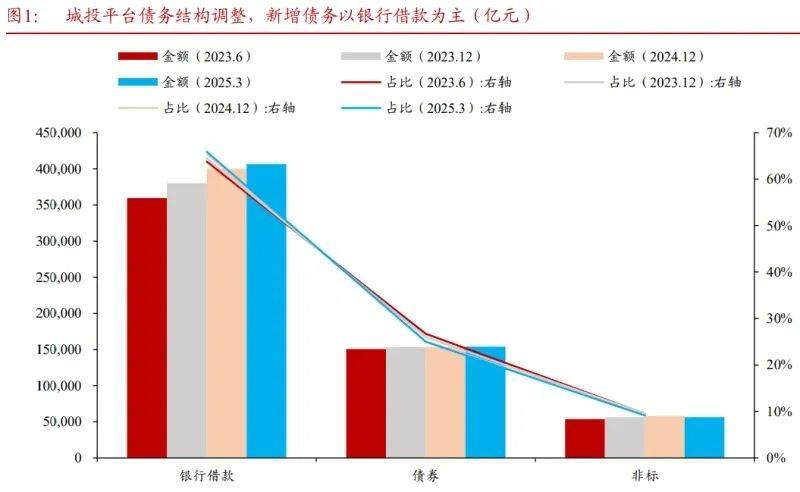
Core Viewpoint - The restructuring of urban investment (城投) debt is showing signs of improvement, with a shift towards lower-cost financing, although the overall debt scale remains high and the interest payment pressure is still significant in the short term [1][9]. Debt Structure Changes - As of March 2025, the total urban investment platform's interest-bearing debt reached 61.72 trillion yuan, a 9.4% increase from June 2023, with bank loans, bonds, and non-standard financing contributing 40.67 trillion, 15.41 trillion, and 5.63 trillion yuan respectively [2]. - The proportion of bank loans in the debt structure increased from 63.76% in June 2023 to 65.9% by March 2025, indicating a shift towards more stable financing sources [2][5]. - By the end of 2025, it is expected that the proportions of bank loans, bonds, and non-standard financing will be 68.11%, 23.71%, and 8.17% respectively [2]. Interest Payment Pressure - The overall interest payment pressure is expected to ease over time, despite the current high levels due to the lagging effect of past debt [1][9]. - The financing costs for banks, bonds, and non-standard financing have significantly decreased, with bank loan rates dropping to 3.26% and bond issuance rates to 2.61% by March 2025 [7]. - Interest expenses have decreased by over 190 billion yuan, with bank loan interest payments down by 284.38 million yuan and bond interest payments reduced by 1.355 billion yuan [8][9]. Provincial Variations in Debt Payments - All provinces except Beijing and Shanghai have seen a decrease in urban investment debt interest payments, with notable reductions in Jiangsu and Zhejiang, where interest payments decreased by 357.19 million yuan and 171.27 million yuan respectively [10]. - Some provinces, such as Henan, have not managed to control debt increments effectively, leading to smaller reductions in interest payments [10]. Market Outlook - The urban investment bond market is expected to see more certainty in the mid to short-term, with a lack of mainline logic in the market leading to fluctuations influenced by risk preferences [11]. - The supply-demand dynamics for urban investment bonds continue to be tight, with a net outflow of 21.784 billion yuan in July, indicating ongoing challenges in the market [11].