
非标产品

Search documents
东吴证券:保险业2025年显著增配核心权益 债券增配节奏放缓
Zhi Tong Cai Jing· 2026-02-13 07:24
Core Viewpoint - The market demand remains strong, with a reduction in the scheduled interest rates and a transformation in dividend insurance expected to continuously optimize liability costs, alleviating pressure from interest margin losses [1] Group 1: Insurance Fund Utilization - By the end of 2025, the insurance industry's fund utilization balance reached 38.5 trillion yuan, an increase of 15.7% from the beginning of the year and 2.7% from the end of Q3, marking the highest annual growth rate since 2021 [2] - The investment scale of life insurance companies was 34.7 trillion yuan, accounting for 90.1% of the industry, with a year-to-date increase of 15.7% and a Q3 increase of 2.8% [2] - The investment scale of property insurance companies was 2.4 trillion yuan, representing 6.3% of the industry, with a year-to-date increase of 8.8% and a Q3 increase of 1.2% [2] Group 2: Stock and Fund Growth - The total balance of "stocks + funds" for life and property insurance companies reached 5.7 trillion yuan by the end of 2025, with stocks at 3.73 trillion yuan and funds at 1.97 trillion yuan, reflecting a significant increase of 1.6 trillion yuan from the beginning of the year [3] - In Q4 alone, the "stocks + funds" scale increased by 110.1 billion yuan, with stocks increasing by 113.5 billion yuan and funds decreasing by 3.4 billion yuan [3] - By the end of 2025, "stocks + funds" accounted for 15.4% of the total investment scale, up 2.6 percentage points from the beginning of the year but down 0.1 percentage points from Q3 [3] Group 3: Asset Allocation Trends - By the end of 2025, the proportion of bank deposits decreased to 7.6%, down 0.8 percentage points from the beginning of the year and up 0.3 percentage points from Q3 [4] - The bond allocation continued to increase, reaching 51.1% by the end of 2025, up 0.9 percentage points from the beginning of the year and 0.1 percentage points from Q3, although the pace of bond allocation has noticeably slowed compared to previous years [4] - The allocation to "stocks + funds" significantly increased, reaching a recent high of 15.3% by the end of 2025, up 2.9 percentage points from the beginning of the year but down 0.1 percentage points from Q3 [4]

去年12月份标品信托发行数量再创新高
Zheng Quan Ri Bao· 2026-01-08 23:08
Core Insights - The asset management trust market maintained high activity levels in December 2025, with significant growth in both product issuance and establishment numbers, driven by both standard and non-standard products [1][2] Issuance Market - In December 2025, a total of 3,364 asset management trust products were issued, representing a month-on-month increase of 18.28%, with a disclosed issuance scale of 135.4 billion yuan, down 8.05% from the previous month [1] - Standard product issuance reached 1,873, marking a month-on-month growth of 14.14%, with notable increases in fixed income (8.56%), mixed (37.57%), and equity products (43.48%) [2] - The growth in standard products is attributed to year-end funding allocation needs and the benefits of the industry’s shift towards standardization [2] Establishment Market - In December 2025, 2,875 asset management trust products were established, reflecting a month-on-month increase of 30.45% and a year-on-year increase of 17.73%, with a disclosed establishment scale of 78.291 billion yuan, down 1.63% month-on-month and down 8.33% year-on-year [1] - The establishment of standard products increased by 376, with a growth rate of 30.30%, particularly in bond investment products [3] - The liquidity support from the central bank has maintained a stable funding environment, which has positively influenced the establishment of fixed income standard products [3] Industry Trends - The research team anticipates that the high growth trend of non-standard products may continue in the short term, but market activity could decline as new regulations come into effect and business quotas are gradually exhausted [2] - The development of standard products is expected to significantly impact the industry ecosystem, prompting trust companies to diversify their product lines and enhance their research and customer service capabilities [3]
2025年化债进行时系列专题报告:化债两年,城投付息下降,缩量格局延续(附下载)
Sou Hu Cai Jing· 2025-08-15 12:03
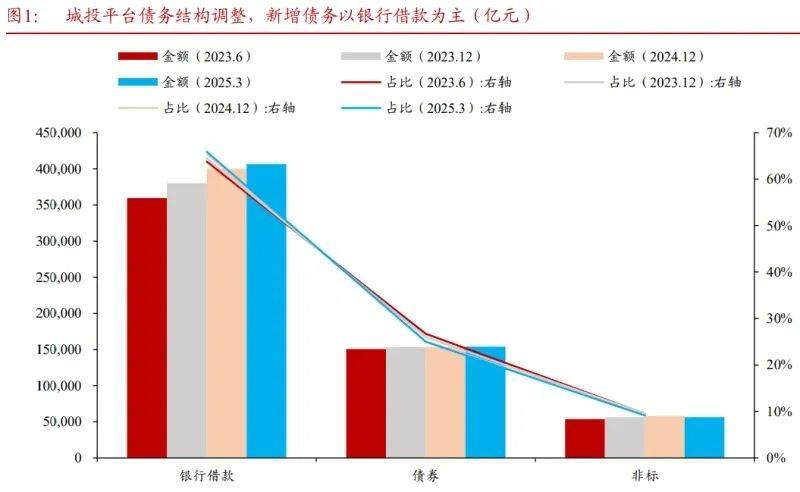
Core Viewpoint - The restructuring of urban investment (城投) debt is showing signs of improvement, with a shift towards lower-cost financing, although the overall debt scale remains high and the interest payment pressure is still significant in the short term [1][9]. Debt Structure Changes - As of March 2025, the total urban investment platform's interest-bearing debt reached 61.72 trillion yuan, a 9.4% increase from June 2023, with bank loans, bonds, and non-standard financing contributing 40.67 trillion, 15.41 trillion, and 5.63 trillion yuan respectively [2]. - The proportion of bank loans in the debt structure increased from 63.76% in June 2023 to 65.9% by March 2025, indicating a shift towards more stable financing sources [2][5]. - By the end of 2025, it is expected that the proportions of bank loans, bonds, and non-standard financing will be 68.11%, 23.71%, and 8.17% respectively [2]. Interest Payment Pressure - The overall interest payment pressure is expected to ease over time, despite the current high levels due to the lagging effect of past debt [1][9]. - The financing costs for banks, bonds, and non-standard financing have significantly decreased, with bank loan rates dropping to 3.26% and bond issuance rates to 2.61% by March 2025 [7]. - Interest expenses have decreased by over 190 billion yuan, with bank loan interest payments down by 284.38 million yuan and bond interest payments reduced by 1.355 billion yuan [8][9]. Provincial Variations in Debt Payments - All provinces except Beijing and Shanghai have seen a decrease in urban investment debt interest payments, with notable reductions in Jiangsu and Zhejiang, where interest payments decreased by 357.19 million yuan and 171.27 million yuan respectively [10]. - Some provinces, such as Henan, have not managed to control debt increments effectively, leading to smaller reductions in interest payments [10]. Market Outlook - The urban investment bond market is expected to see more certainty in the mid to short-term, with a lack of mainline logic in the market leading to fluctuations influenced by risk preferences [11]. - The supply-demand dynamics for urban investment bonds continue to be tight, with a net outflow of 21.784 billion yuan in July, indicating ongoing challenges in the market [11].

受益于权益市场行情向好 7月份标品信托发行数量显著增长
Zheng Quan Ri Bao· 2025-08-10 17:15
Core Insights - The asset management trust market in July showed a slight decline in issuance quantity and a significant decrease in issuance scale, while the establishment market experienced a notable increase in quantity but a clear decline in scale [1][2]. Issuance Market - In July, a total of 2,549 asset management trust products were issued, representing a month-on-month decrease of 1.13%, with a disclosed issuance scale of 130.318 billion yuan, down 16.35% [1]. - Non-standard products faced significant setbacks, with issuance quantity decreasing by 13.85% and issuance scale dropping by 23.97% [1]. - Conversely, standard products saw a notable increase, with 1,491 standard trust products issued, an increase of 141 products or 10.44%, while the disclosed issuance scale slightly decreased by 1.53% [1]. - The positive performance of the equity market contributed to the growth of standard trust product issuance [1]. Establishment Market - In July, 2,295 asset management trust products were established, marking a month-on-month increase of 10.50%, with a disclosed establishment scale of 77.682 billion yuan, down 6.88% [2]. - Non-standard products also saw a significant decline in establishment scale, with a month-on-month decrease of 9.30% [2]. - The establishment of standard trust products increased significantly, with a rise of 195 products or 17.55%, while the disclosed establishment scale remained relatively stable, decreasing by only 0.09% [2]. - TOF (Trust of Funds) products emerged as a key growth driver in the standard trust establishment market, with 481 products established, an increase of 121 products or 33.62%, and a disclosed establishment scale of 8.561 billion yuan, up 16.90% [2]. Importance of Standard Trusts - The development of standard trusts is crucial in the context of the trust industry's transformation, helping to reduce reliance on non-standard business and mitigate existing risks [3]. - Standard trusts offer high transparency, strong liquidity, and clear risk-return characteristics, catering to diverse investor preferences [3]. - By investing in standardized assets like bonds and stocks, standard trusts can channel social funds into the capital market and support the real economy, thereby enhancing resource allocation efficiency [3].