补短板

Search documents
“向上攀高”的潜力从何而来
Xin Lang Cai Jing· 2026-02-24 00:51
Core Insights - The articles emphasize the potential for growth in underdeveloped areas by identifying and addressing their weaknesses, suggesting that even "low-lying" regions can transform into "highlands" through focused efforts [2][4] - The importance of leveraging existing advantages and breaking down barriers to enhance collaboration and synergy among regions is highlighted, leading to greater overall economic benefits [3][4] Group 1: Regional Development Strategies - The "Modern Capital Metropolitan Area Spatial Coordination Plan (2023-2035)" aims to create a spatial structure of "one core, two wings, dual cities, multiple points, dual corridors, and multiple circles," transforming Beijing's core functional advantages into a driving force for surrounding areas [1] - Guangdong's Bo Luo County has become the first "trillion county" in the province, showcasing a successful model of regional development through focused county-level economic strategies [2] - The "Hundred Counties, Thousand Towns, and Ten Thousand Villages High-Quality Development Project" has led to 57 counties achieving an average annual GDP growth rate exceeding the provincial average over the past three years [2] Group 2: Industry and Innovation - The Long Triangle region has developed a robust supply chain for the new energy vehicle industry, demonstrating how regional collaboration can enhance competitive advantages in global markets [3] - Shandong's Cao County has transformed from a traditional agricultural base to a hub for the original Hanfu clothing industry, with projected sales exceeding 13 billion yuan by 2025, illustrating the potential of niche markets [3][4] - Anhui's Wuhu has developed a general aviation industry over the past decade, attracting over 200 upstream and downstream enterprises, while the Guangdong-Hong Kong-Macau Greater Bay Area has established "super clusters" in AI and biomedicine [4]
“向上攀高”的潜力从何而来(评论员观察)
Ren Min Ri Bao· 2026-02-23 23:42
Group 1 - The core idea emphasizes that areas with developmental weaknesses hold significant growth potential, and by identifying the "shortest board" and concentrating efforts, these "depressions" can transform into "highlands" [1][2] - The "Modern Capital Metropolitan Area Spatial Coordination Plan (2023-2035)" aims to create a spatial pattern of "one core, two wings, dual cities, multiple points, dual corridors, and multiple circles," leveraging Beijing's core functional advantages to radiate and drive surrounding regions [1] - Guangdong's Bo Luo County has become the first "trillion county" in the province, showcasing the success of the "Hundred Counties, Thousand Towns, and Ten Thousand Villages High-Quality Development Project" [2] Group 2 - The transformation of Bo Luo County is attributed to addressing its previous shortcomings, particularly in industrial development, by strategically focusing on industries like electronic information and new energy, leading to the establishment of a trillion-level intelligent equipment industrial park [2] - The "Hundred Counties, Thousand Towns, and Ten Thousand Villages High-Quality Development Project" has resulted in 57 counties (cities) achieving an average annual GDP growth rate exceeding the provincial average over the past three years [2] - The Long Triangle region benefits from a tightly integrated supply chain for new energy vehicles, enhancing its competitive advantage in the global market [3] Group 3 - The concept of "nurturing new boards" highlights the importance of new technologies, industries, business models, and new patterns as sources of incremental growth for regional development [3][4] - Shandong's Cao County has transformed from a traditional agricultural county to a new industrial city by developing a complete industrial chain for Hanfu, with projected sales exceeding 13 billion yuan by 2025 [3] - Anhui Wuhu has developed a general aviation industry over the past decade, attracting over 200 upstream and downstream enterprises, while the Guangdong-Hong Kong-Macao Greater Bay Area has seen the rise of super clusters in AI and biomedicine [4] Group 4 - The strategies of addressing weaknesses, enhancing strengths, and nurturing new opportunities must be tailored to local conditions, avoiding blind imitation and instead focusing on identifying and leveraging regional advantages [4] - The approach of solidifying the foundation through addressing weaknesses, amplifying advantages, and exploring new markets will lead to a more coordinated and vibrant regional economic layout [4]
广发证券郭磊:经济潜能如何充分释放?四大领域补短板成关键密码
2 1 Shi Ji Jing Ji Bao Dao· 2026-02-11 09:13
Core Viewpoint - The chief economist of GF Securities, Guo Lei, predicts that China's economic growth will transition from a "two-wheel drive" model, primarily based on exports and "two new" sectors in 2025, to a "four-wheel drive" model by 2026, driven by policy efforts to tap into economic potential [1] Group 1: Policy Focus Areas - Fixed Asset Investment: The growth rate for fixed asset investment is projected to be -3.8% in 2025, with significant improvement expected in 2026. The policy aims to "stop the decline and stabilize," focusing on investments in major economic provinces, supported by a 500 billion yuan policy financial tool for projects [2] - Service Consumption: The policy emphasizes the need to "release the potential of service consumption," shifting the focus from goods consumption to addressing the shortfall in service consumption [2] - Real Estate Sector: The policy aims to "stabilize the real estate market," with a renewed focus on "de-stocking," indicating a shift towards improving sales to alleviate the negative impact on overall economic performance [2] - Traditional Manufacturing: The policy will continue to promote "anti-involution," targeting improvements in the competitive landscape of manufacturing, aiming to balance supply and demand, which will enhance market structure and price recovery, ultimately benefiting profit margins [2] Group 2: Economic Growth Outlook - After addressing the shortfalls, the "broad-based" nature of economic growth is expected to improve, leading to better performance across more industries, increased employment, higher household income, and improved corporate profits, which will eventually contribute to a recovery in microeconomic sentiment [2]

2019年前11月 全社会固定资产投资比上年同期增长12.5% 内江产业项目重点推进见实效
Si Chuan Ri Bao· 2026-01-04 07:05
Group 1 - The core focus of the news is the significant progress in infrastructure and agricultural projects in Neijiang, with a strong emphasis on the "key year for industrial project promotion" in 2019 [1][6] - Neijiang has initiated three major industrial projects, including the International Agricultural Products Trading Center, Steel Structure Prefabricated Building Industrial Park, and Modern Service Industry Concentration Area [1] - The "5+4+5" industrial system aims to enhance industrial quality through targeted projects, focusing on new materials, new equipment, new medicine, new energy, big data, and four key agricultural industries [2][3] Group 2 - The blood orange industry in Zizhong County has rapidly developed, with a planting area of 246,000 acres, accounting for 60% of the national planting area and production [2] - Infrastructure projects such as the Huangjingba Bridge and the Victory Guangyao City project are underway, with significant progress reported in construction [5][6] - In 2019, Neijiang's total fixed asset investment grew by 12.5% year-on-year, with private investment increasing by 23.2%, and industrial investment rising by 19.7%, indicating strong economic performance [9]
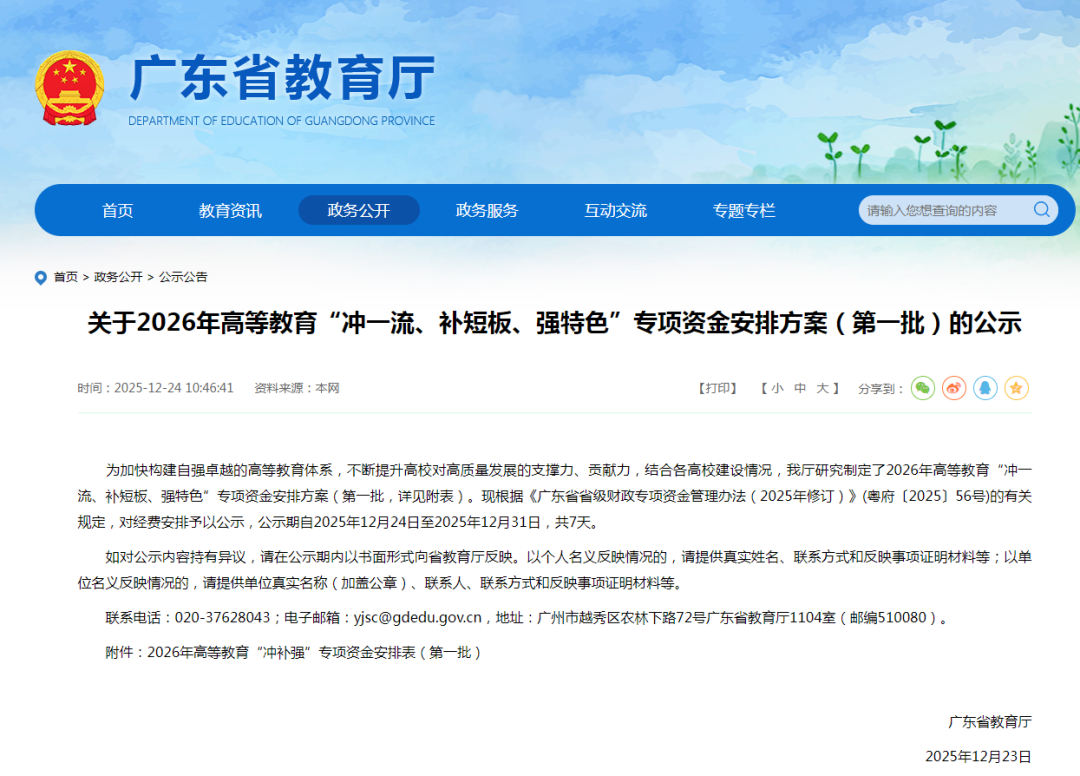
广东公示2026年高等教育“冲补强”专项资金安排方案
Nan Fang Ri Bao Wang Luo Ban· 2025-12-25 08:40
Core Insights - The Guangdong Provincial Education Department announced a funding plan of 3.77985 billion yuan to support 34 universities in enhancing their educational capabilities, categorized into three main plans: high-level university construction, revitalization of universities in the eastern and western regions of Guangdong, and enhancement of characteristic universities [1][2] Group 1: High-Level University Construction Plan - A total of approximately 2.562 billion yuan is allocated to 14 universities classified as "first-class" institutions, with significant funding going to Sun Yat-sen University (approximately 290 million yuan), Jinan University (approximately 250 million yuan), and South China University of Technology (approximately 240 million yuan) [1] - Other universities receiving over 100 million yuan include South China Normal University (approximately 275 million yuan), Southern Medical University (approximately 265 million yuan), and South China Agricultural University (approximately 263 million yuan) [1] - Additional funding recipients include Guangdong University of Technology (approximately 249 million yuan), Guangzhou University of Chinese Medicine (approximately 235 million yuan), Guangdong University of Foreign Studies (approximately 171 million yuan), Guangdong Medical University (approximately 106 million yuan), and Shantou University (approximately 100 million yuan) [1] Group 2: Revitalization of Universities in Eastern and Western Guangdong - The revitalization plan targets "shortcomings" with a total of 448 million yuan allocated to 8 universities, led by Lingnan Normal University receiving the highest amount of approximately 71.877 million yuan [2] - Other universities receiving significant funding include Zhaoqing University (approximately 58.874 million yuan), Guangdong Petroleum and Chemical College (approximately 58.450 million yuan), and Huizhou University (approximately 57.559 million yuan) [2] - Additional support is provided to Wuyi University (approximately 55.462 million yuan) and Shaoguan University (approximately 50.966 million yuan), with Jia Ying College and Han Mountain Normal University receiving approximately 49.985 million yuan and 44.877 million yuan, respectively [2] Group 3: Characteristic University Enhancement Plan - Guangzhou Academy of Fine Arts received the highest funding in this category, amounting to approximately 105 million yuan, making it the only university in this category to exceed 100 million yuan [2] - Other notable funding recipients include Guangdong Pharmaceutical University (approximately 76.078 million yuan) and Guangdong University of Finance (approximately 63.590 million yuan) [2] - Additional allocations include Guangzhou Sports University (approximately 58.174 million yuan), Guangdong Technical Normal University (approximately 54.707 million yuan), and Zhongkai University of Agriculture and Engineering (approximately 54.202 million yuan) [2]
名单公布!广东拟安排近38亿支持34所高校
Nan Fang Du Shi Bao· 2025-12-24 13:40
Core Viewpoint - Guangdong Province's Education Department announced a funding plan of 3.77985 billion yuan to support 34 universities in enhancing their educational capabilities, categorized into three main plans: high-level university construction, revitalization of universities in the eastern and western regions, and enhancement of characteristic universities [1][4]. Group 1: High-Level University Construction Plan - A total of approximately 2.562 billion yuan is allocated to 14 "first-class" universities, with significant funding for major institutions: Sun Yat-sen University (approximately 290 million yuan), South China University of Technology (approximately 240 million yuan), and Jinan University (approximately 250 million yuan) [6]. - Other universities receiving over 100 million yuan include South China Normal University (approximately 275 million yuan), Southern Medical University (approximately 265 million yuan), and South China Agricultural University (approximately 263 million yuan) [6][7]. Group 2: Revitalization of Universities in Eastern and Western Regions - The revitalization plan allocates 448 million yuan to 8 universities, with Lingnan Normal University receiving the highest amount of 71.877 million yuan [8]. - Other notable allocations include Zhaoqing University (58.874 million yuan), Guangdong University of Petrochemical Technology (58.450 million yuan), and Huizhou University (57.559 million yuan) [8]. Group 3: Characteristic University Enhancement Plan - Guangzhou Academy of Fine Arts received the largest funding in this category, amounting to approximately 105 million yuan, making it the only university in this plan to exceed 100 million yuan [9]. - Other universities receiving significant funding include Guangdong Pharmaceutical University (76.077 million yuan), Guangdong University of Finance (63.590 million yuan), and Guangzhou Sports University (58.174 million yuan) [9].



10万亿!超越京沪,中国“第一城”易主了
Qian Zhan Wang· 2025-12-12 04:33
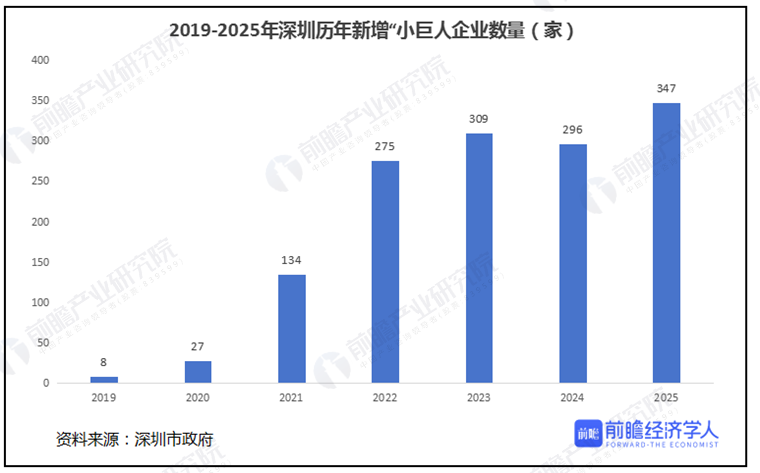
Core Viewpoint - Shenzhen has officially become China's "first city" for specialized and innovative "little giant" enterprises, surpassing Beijing and Shanghai in quantity and economic value [2][3][19]. Group 1: Overview of "Little Giants" - By the end of 2025, Shenzhen will have 1,333 "little giant" enterprises, leading the nation with 347 new additions, compared to Beijing's 1,210 and Shanghai's 1,032 [2][3]. - The total market value of these enterprises is estimated to be close to 10 trillion yuan, based on an average market value of 71 million yuan per listed "little giant" [3][8]. - These enterprises are concentrated in key areas of national focus, such as "manufacturing power" and "strengthening supply chains," with high entry barriers requiring domestic leadership in niche sectors and significant R&D investment [3][8]. Group 2: Growth and Innovation - Shenzhen's "little giants" exhibit remarkable growth, with an average time of 13 years from establishment to becoming a national-level "little giant," which is 1.71 years faster than the national average [8]. - The average R&D intensity of these enterprises is 7.63%, with annual R&D expenditure averaging 33.39 million yuan, significantly higher than the national average [8][19]. - These companies are also active in patent applications, averaging 152 patents per enterprise, with nearly 30% involved in setting international or national standards [8][19]. Group 3: Ecosystem and Support - Shenzhen's "20+8" industrial cluster strategy serves as a core engine for nurturing "little giant" enterprises, providing a structured ecosystem for growth and collaboration [9][10]. - The government facilitates connections between large and small enterprises through mechanisms like "chain leader" and "chain master" systems, resulting in over 500 technical cooperation agreements in 2024 alone [12][14]. - The city combines effective market strategies with government support, creating a comprehensive market support system that includes local validation and global expansion initiatives [14][15]. Group 4: Financial Support - Shenzhen has developed a "bold capital" approach to support innovative enterprises, allowing for long-term investments in high-tech sectors despite initial project risks [16][19]. - The city has established four major equity investment platforms to back innovative enterprises, with significant investments in numerous "little giants" [16][19]. Group 5: Future Implications - Achieving the title of "first city" for specialized and innovative enterprises marks a new starting point for Shenzhen, strengthening its industrial foundation and enhancing its resilience against global market fluctuations [19][20]. - The pathway from "little giants" to potential global leaders indicates a clear trajectory for future economic growth, with these enterprises expected to contribute significantly to Shenzhen's high-quality development [19][20].