
装配式建筑

Search documents
远大住工破产重整与复牌进展引关注
Jing Ji Guan Cha Wang· 2026-02-14 06:55
Group 1 - The company is currently undergoing bankruptcy restructuring and is in a suspended trading phase, with potential key impacts on its future development [1] - The company submitted a bankruptcy restructuring application to the Changsha Intermediate People's Court in October 2025, aiming to attract strategic investors to resolve its debt crisis. The court's acceptance of the application and the specifics of the restructuring plan remain market focal points [2] - The company is actively following the Hong Kong Stock Exchange's resumption guidelines, and it is crucial to monitor whether it can submit a compliant rectification plan on time and obtain approval for trading resumption [3] Group 2 - The annual report for 2024 has been delayed due to audit coordination issues, and attention should be paid to the release of the 2025 full-year financial data, including expected loss scale and cash flow status [4] - The prefabricated construction industry has received policy support, such as mentions in the "14th Five-Year Plan" regarding green buildings, but the company faces challenges like high costs and weak real estate demand. Successful bankruptcy restructuring could leverage its technological reserves and brand advantages for recovery [5] - The core events surrounding the company focus on the judicial outcome of the bankruptcy restructuring, progress on trading resumption, and financial disclosures, which will dictate the company's future direction [5]
中铁装配2025年业绩预亏扩大,股价波动资金流出
Jing Ji Guan Cha Wang· 2026-02-13 05:17
Group 1: Financial Performance - The company expects a net profit loss of between 79 million to 156 million yuan for 2025, indicating an expansion of losses compared to the previous year [2] - The losses are attributed to the adjustment period of the business structure, high costs of certain projects, and a year-on-year decline in gross profit margin [2] Group 2: Stock Price and Capital Flow - As of February 9, 2026, the stock price is reported at 16.50 yuan per share, with a daily increase of 2.04% and a trading volume of 46.56 million yuan, although there was a net outflow of 4.0043 million yuan in principal funds [3] - Year-to-date, the stock price has increased by 5.30%, while it has decreased by 4.07% over the past 60 days [3] Group 3: Business Development - The company has won several key projects in the first half of 2025, including an international industrial demonstration park and a logistics industry park, and is actively expanding into overseas markets through international exhibitions to promote a "domestic + overseas" dual circulation strategy [4] Group 4: Shareholder Structure - As of September 30, 2025, Bosera Innovation Economy Mixed A has become the sixth largest circulating shareholder, holding 918,500 shares, while the number of shareholders has decreased by 4.15%, with an increase in the average circulating shares per person [5] Group 5: Industry Policy and Environment - The prefabricated construction industry, to which the company belongs, is supported by policies promoting infrastructure investment and affordable housing construction; a decrease in external factors such as financing costs (e.g., expectations of interest rate cuts by the Federal Reserve) may impact business demand and financial costs [6]

远大住工破产重整申请待法院受理,生产基地暂停运营
Jing Ji Guan Cha Wang· 2026-02-11 07:45
Recent Events - The company, Yuanda China Holdings (stock code: 02163.HK), filed for bankruptcy restructuring with the Changsha Intermediate People's Court in October 2025 to address debt and operational crises, aiming to attract strategic investors to mitigate risks [1] - The court's acceptance of the restructuring application and the specific progress of the restructuring plan remain focal points for the market, as the outcome will directly impact the company's future viability and capital structure [1] Company Status - Due to the suspension of its stock, the company is actively taking steps to comply with the Hong Kong Stock Exchange's resumption guidelines and is seeking to restore trading of its shares [2] - An announcement on December 22, 2025, indicated that some production bases have suspended operations due to unfavorable market conditions, but the company has committed to assessing the impact of the suspension and will provide regular updates on its business status [2] Operational Status - Following the suspension of operations at some production bases, the board of directors stated that it will monitor the impact on financial performance and may take further actions [3] - The company's annual report for 2024 is still pending disclosure, as additional time is needed to cooperate with the auditing firm, Tianjian Certified Public Accountants [3] - Future disclosures of the 2025 full-year financial data and asset disposal plans will also require attention [3]
“招商之冬”签订协议13个总投资8.6亿元
Xin Lang Cai Jing· 2026-02-08 18:30
Core Insights - The "Winter Investment Promotion" event initiated by the 11th Division aims to optimize the business environment and enhance investment attraction, achieving significant results since its launch in November 2025 [1] Group 1: Investment Performance - As of February 1, 2026, the 11th Division has signed 13 investment agreements with a total investment of 860 million yuan, exceeding planned targets and marking a successful start to the year [1] - The event has led to a dual improvement in quality and efficiency of investment attraction [1] Group 2: Strategic Planning and Implementation - The 11th Division has developed a comprehensive work plan and implementation scheme for the "Winter Investment Promotion," focusing on key industries such as new building materials, equipment manufacturing, and prefabricated construction [1] - A professional investment promotion team has been established to collaborate with local enterprises and economic development zones, conducting targeted investment activities in cities like Shanghai, Zhejiang, and Anhui [1] Group 3: Engagement and Outreach - The 11th Division has visited 127 enterprises and invited 101 companies for on-site inspections, demonstrating proactive engagement in attracting investments [1] - Two centralized signing ceremonies for the "Winter Investment Promotion" have been held, further facilitating investment agreements [1]
工业机器人连续六年产量全国第一!广东晒“十四五”产业成绩
Nan Fang Du Shi Bao· 2026-02-06 14:32
Core Insights - Guangdong has made significant progress in building a modern industrial system with international competitiveness during the "14th Five-Year Plan" period, focusing on the development of the real economy and manufacturing industry [1] Group 1: Manufacturing Industry - Guangdong's manufacturing sector has implemented five major actions to strengthen its industrial foundation, resulting in a more optimized manufacturing landscape and increased enterprise strength [2] - The province's industrial enterprises maintained the highest revenue in the country, averaging an increase of approximately 1 trillion yuan annually, with strategic emerging industries achieving a target annual growth rate of 10% [2][3] - By 2025, industrial investment is expected to account for 38.4% of fixed asset investment, the highest in nearly 19 years [2] Group 2: Low-altitude Economy - Guangdong's low-altitude economy has developed a complete industrial ecosystem, with over 15,000 enterprises in the sector and a projected production of over 6.9 million civilian drones by 2025 [4][5] - The province has established 73 general airports and over 3,500 low-altitude takeoff and landing points, leading the nation in infrastructure development [4] Group 3: Prefabricated Construction - The area of new prefabricated buildings in Guangdong is expected to reach 47.8 million square meters by 2025, with the proportion of new prefabricated buildings increasing from 19% to 39% [6] - The province is focusing on top-level design, technology research and development, and typical demonstrations to promote prefabricated construction as a new driving force in the construction industry [6] Group 4: Consumer Market - The "old-for-new" policy in Guangdong has driven a sales volume of 264.2 billion yuan in consumer goods, accounting for 10% of the national total, effectively promoting industrial upgrades [7] - In the automotive sector, 55% of old vehicles replaced were new energy vehicles, while 92% of replaced home appliances were of the highest energy efficiency [7] Group 5: New Energy Industry - The new energy industry cluster in Guangdong has surpassed 1 trillion yuan in revenue, becoming the province's ninth trillion-level industry cluster, with an installed capacity of 164 million kilowatts by 2025 [8][9] - The province has established a national-level innovation platform for new energy storage, enhancing its energy technology innovation capabilities [8] Group 6: Robotics Industry - Guangdong is a leading province in robot production, with industrial and service robot outputs expected to reach 336,300 units and 15.18 million units respectively by 2025, accounting for 43.5% and 81.7% of the national total [10] - The province's robotics industry benefits from a large scale, a healthy ecosystem, rapid iteration, diverse application scenarios, and effective international market expansion [10] Group 7: R&D and Agriculture - Guangdong's total R&D investment is projected to increase from 347.99 billion yuan in 2020 to 535 billion yuan by 2025, indicating a strong focus on technological advancement [11] - The total output value of agriculture, forestry, animal husbandry, and fishery in Guangdong is expected to reach 979.87 billion yuan by 2025, with agricultural exports ranking first in the country [11]

2025济宁市装配式建筑协会融链固链跨链融合发展大会举行
Qi Lu Wan Bao· 2026-02-04 10:32
Group 1 - The conference titled "Integrating Chains for Development" was co-hosted by the Jining Prefabricated Building Association and Jining Vocational and Technical College, attracting nearly 400 participants including industry experts and representatives from various sectors [1] - The college's president, Li Zhongguo, emphasized the institution's commitment to aligning with regional development strategies and optimizing professional structures to cultivate high-quality technical talent for Jining's development [1] - Keynote speeches highlighted the importance of integrating supply chains and industry collaboration to enhance resilience and promote high-quality development in the prefabricated building sector [1][2] Group 2 - Several significant activities took place during the conference, including the establishment of the Jining Prefabricated Building Industry Dispute Mediation Committee and the launch of a vocational skills competition in the green building materials sector [2] - Member units signed collective procurement agreements with supply chain partners, and the Jining Prefabricated Building Association's information procurement platform was officially launched [2] - The conference marked a significant step towards the integration, clustering, and high-end development of Jining's prefabricated building industry, with plans for continued collaboration between the college, industry associations, and enterprises [2]
市场洞察:政策+市场双轮驱动下,装配式建筑如何抢占建筑业转型新赛道?
Tou Bao Yan Jiu Yuan· 2026-02-03 00:24
Investment Rating - The report does not explicitly state an investment rating for the prefabricated construction industry Core Insights - The prefabricated construction industry is driven by the need for transformation and sustainable development in the construction sector, aligning with national carbon neutrality goals [10] - The industry has shown significant growth, with new construction area increasing from 290 million square meters in 2018 to 740 million square meters in 2021, and a penetration rate rising from 11.5% to 24.5% during the same period [21][22] - By 2025, the new construction area is expected to reach 870 million square meters, with a penetration rate of 30% [21][22] Summary by Sections Industry Overview - Prefabricated buildings are categorized into three main structural types: concrete, steel, and wood [6] - Prefabricated concrete structures are the most common, suitable for various civil buildings and industrial plants, while steel structures are favored for public buildings and high-rise constructions [6][10] - Wood structures are recognized for their sustainability and comfort, primarily used in low-rise residential buildings and eco-friendly public structures [6] Advantages and Challenges - Prefabricated construction offers several advantages over traditional methods, including a 30%-50% reduction in construction time, 20% less energy consumption, and significant reductions in water usage and construction waste [10][11] - However, challenges include higher costs (over 10% more than traditional methods) and the need for improved technical standards and systems [10] Policy Support - The government has implemented various policies to promote prefabricated construction, including specific targets for the proportion of new buildings that must be prefabricated by 2025 [15][16] - These policies aim to facilitate the transition to industrialized, intelligent, and green construction practices, thereby reducing resource consumption and carbon emissions [16] Market Trends - The prefabricated construction market is expected to continue growing, driven by urbanization, rising labor costs, and increasing environmental regulations [21][22] - Despite the current penetration rate being below 30%, there is significant potential for growth as the industry matures and technology improves [22]
市场洞察:政策+市场双轮驱动下,装配式建筑如何抢占建筑业转型新赛道?
Tou Bao Yan Jiu Yuan· 2026-02-02 15:10
Investment Rating - The report does not explicitly state an investment rating for the prefabricated construction industry Core Insights - The prefabricated construction industry is driven by the need for transformation and sustainable development in the construction sector, aligning with national carbon neutrality goals. The advantages of prefabricated buildings include higher efficiency, reduced energy and resource consumption, and improved quality compared to traditional construction methods. However, challenges such as higher costs and the need for improved technical standards remain [10][21]. Summary by Sections Industry Overview - Prefabricated construction refers to the production of building components in factories, which are then assembled on-site. The main types include prefabricated concrete structures, steel structures, and wooden structures, each with distinct advantages and applications [6][10]. Advantages and Challenges - Prefabricated buildings can reduce construction time by 30%-50%, lower energy consumption by 20%, and decrease water usage by 63%. However, they face challenges such as a cost increase of over 10% compared to traditional methods and the need for better technical standards [10][11]. Policy Support - The Chinese government has implemented various policies to promote prefabricated construction, including specific targets for the proportion of new buildings that should be prefabricated by 2025. These policies aim to enhance industrialization, improve construction quality, and support sustainable development [15][16]. Market Trends - The new construction area for prefabricated buildings in China has grown from 290 million square meters in 2018 to 740 million square meters in 2021, with a penetration rate increasing from 11.5% to 24.5%. Projections indicate that by 2025, the new construction area will reach 870 million square meters, with a penetration rate of 30% [21][22]. Comparison with Global Standards - Despite rapid growth, China's prefabricated construction penetration rate remains below 30%, significantly lower than over 80% in developed countries like the US and Japan. This indicates substantial room for growth and improvement in technology and industry standards [22][24].
临高金牌港:生产车间满负荷运转 冲刺一季度“开门红”
Hai Nan Ri Bao· 2026-01-29 02:35
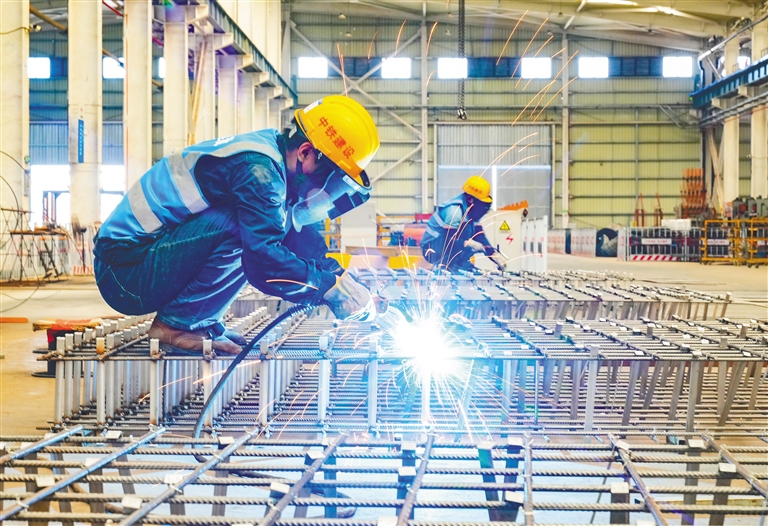
Core Viewpoint - The construction of the Hainan Green Building Industrial Park by China Railway Construction is actively contributing to the assembly-type building industry in the Lingao Jinpai Port Development Zone, aiming for significant production output and supporting urban renewal projects in Haikou [2] Group 1: Production and Operations - The production workshop at the Hainan Green Building Industrial Park is operating at full capacity with over 70 workers focused on the processes of casting and curing prefabricated components [2] - The park is expected to achieve an output value of 282 million yuan by 2025, setting a record for annual production [2] Group 2: Strategic Importance - The industrial park will leverage the integrated development advantages of the Lingao Jinpai Port to continuously inject momentum into the construction of the Hainan Free Trade Port [2] - The park is supplying high-quality components for multiple urban renewal projects in Haikou, indicating its strategic role in local infrastructure development [2]

海南绿色建筑占新建建筑比例达100%
Ren Min Ri Bao· 2026-01-27 22:30
Core Viewpoint - Hainan Province has achieved 100% of new buildings being green buildings and over 80% being prefabricated buildings, indicating a strong commitment to sustainable construction practices [1] Group 1: Green Building Initiatives - As of now, the proportion of green buildings in new constructions in Hainan Province has reached 100% [1] - The proportion of prefabricated buildings in new constructions exceeds 80% [1] Group 2: Development Goals - During the 14th Five-Year Plan period, the housing and urban-rural development system in Hainan focuses on high-quality development, transitioning from "adequate housing" to "better housing" [1] - The Boao Zero Carbon Demonstration Zone has achieved zero carbon operation, and the Hainan Green Low-Carbon Development Research Institute has been officially established [1] Group 3: Future Plans - By 2026, Hainan will promote intelligent construction and issue relevant implementation opinions [1] - The province will advance pilot projects for "cool cities" in Haikou, Sanya, and Danzhou, and will promote initiatives such as selecting the "most beautiful tree-lined roads," rooftop greening, vertical greening, and the continuous construction of "pocket parks" [1]