负责任AI

Search documents
因美军方要求“无限制使用”AI爆发冲突,特朗普下令联邦机构停用Anthropic产品
Zhi Tong Cai Jing· 2026-02-28 00:55
Core Viewpoint - The decision by President Trump to order federal agencies to stop using products from AI company Anthropic escalates the dispute over technology usage restrictions between the company and the Pentagon [1][2]. Group 1: Government Actions - Trump has instructed all federal agencies to immediately cease the use of Anthropic technology, warning of significant civil and criminal consequences if the company does not comply with transition arrangements [1]. - A six-month transition period has been announced for relevant agencies, including the Department of Defense, to gradually stop using Anthropic products [1]. Group 2: Company Position - Anthropic has maintained its stance against the use of its models for mass surveillance of U.S. citizens or fully autonomous weapon systems, emphasizing its commitment to "responsible AI" [1][2]. - The CEO of Anthropic, Amodei, has been in direct conflict with Pentagon officials over these usage restrictions [1]. Group 3: Market Impact - The potential termination of contracts with the military, which could be worth up to $200 million, may weaken Anthropic's presence in the federal market [2]. - Anthropic's current valuation is approximately $380 billion, with expectations of an initial public offering (IPO) potentially starting this year [2]. Group 4: Competitive Landscape - Competitors such as Musk's xAI, OpenAI, and Google's Gemini are accelerating their efforts to secure government contracts, with OpenAI actively communicating with the Department of Defense under certain restrictions [2]. - Anthropic's "Claude Gov" tool has been one of the few AI systems capable of operating in the Pentagon's secure cloud environment, and exclusion from government systems could pose national security and technological challenges [2]. Group 5: Industry Reactions - Trump's decision may provoke backlash in Silicon Valley, where employees from companies like Amazon and Microsoft have previously urged management to reject the Pentagon's demands for unrestricted usage [3]. - Anthropic has reiterated that threats will not alter its decision to uphold its ethical standards [3].
因美军方要求“无限制使用”AI爆发冲突 特朗普下令联邦机构停用Anthropic产品
Zhi Tong Cai Jing· 2026-02-27 23:41
Core Viewpoint - The U.S. government, under President Trump's directive, has ordered federal agencies to cease using products from AI company Anthropic, escalating a dispute over technology usage restrictions with the Pentagon [1][2]. Group 1: Government Actions and Directives - President Trump instructed all federal agencies to immediately stop using Anthropic technology, warning of significant civil and criminal consequences if the company does not comply with transition arrangements [1]. - A six-month transition period has been announced for relevant agencies, including the Department of Defense, to gradually discontinue the use of Anthropic products [1]. Group 2: Dispute Details - The core of the dispute lies in the Pentagon's demands for the use of AI models, with Defense Secretary Lloyd Austin requesting unrestricted use of Anthropic's Claude chatbot within legal frameworks [1]. - Anthropic maintains that its models should not be used for mass surveillance of U.S. citizens or fully autonomous weapon systems, emphasizing its commitment to responsible AI [1]. Group 3: Industry Impact - Trump's decision is expected to shake the AI industry, as Anthropic had contracts with the military worth up to $200 million and provided services to civilian agencies like the State Department [2]. - Anthropic's current valuation is approximately $380 billion, with expectations for an initial public offering (IPO) potentially this year [2]. - If completely excluded from government systems, Anthropic may face national security and technological replacement challenges in the short term [2]. Group 4: Competitive Landscape - Competitors are rapidly pursuing government contracts, with Musk's xAI gaining approval for classified projects, and OpenAI and Google's Gemini models actively expanding in the federal market [2]. - OpenAI's CEO has indicated that the company is in discussions with the Pentagon to provide model services under certain restrictions [2]. Group 5: Reactions from the Tech Industry - Trump's decision may provoke backlash in Silicon Valley, as employees from major tech companies like Amazon and Microsoft previously urged management to reject the Pentagon's demands for unrestricted use [3]. - Anthropic reiterated its stance, stating that threats will not alter its decision to uphold ethical standards [3].
中美CIO对话:负责任AI的价值重构与跨境破局之道在哪?
Xin Lang Cai Jing· 2026-01-12 12:28
Core Insights - Responsible AI is transitioning from a practice of a few companies to an industry standard, with deeper collaboration emerging in the US-China AI ecosystem driven by the strategic foresight and practical actions of CIOs [1][9]. Group 1: CIO Role Evolution - The role of Chief Information Officers (CIOs) has evolved from traditional technology managers to core drivers of enterprise strategy, guardians of risk control, and bridges for cross-border technology cooperation [3]. - CIOs are now expected to balance innovation with risk management, requiring a shift in mindset to become strategic business enablers rather than just technical supporters [8][9]. Group 2: Responsible AI Adoption - Only 28% of US respondents view "responsible AI" as a core business priority, and only 33% have implemented clear applications across their organizations, indicating a significant gap in AI governance maturity [3][4]. - The rapid pace of AI technology evolution has outstripped the development of governance frameworks, leading to a low maturity level in responsible AI practices [4][10]. Group 3: Data Governance Importance - Data is recognized as the fuel for AI, with high-quality data being essential for generating valuable AI outcomes. Effective data governance is crucial for the successful implementation of responsible AI [7]. - Companies with established data governance frameworks see a 2.8 times higher success rate in AI projects compared to those without such frameworks [7]. Group 4: Global AI Regulation Perspectives - There are significant regional differences in AI regulation, with the US and China adopting a more relaxed approach compared to Europe and the Middle East, which favor stricter regulations [5]. - The EU's AI Act introduces stringent compliance requirements for high-risk AI systems, which can inhibit innovation, particularly for small and medium-sized enterprises [5]. Group 5: Multi-AI Model Strategy - A multi-AI model strategy is essential for global enterprises to navigate varying regulatory requirements and business needs across different regions [9]. - Companies must adapt their AI model choices based on local compliance and operational demands, ensuring flexibility in their AI deployments [9]. Group 6: Future of AI in Business - The future of AI is seen as a dual opportunity and challenge for CIOs, who must navigate technological advancements, regulatory differences, and data governance to drive responsible AI development [9]. - As AI technology continues to evolve, responsible AI practices are expected to become standard across industries, fostering deeper collaboration in the US-China AI ecosystem [9].


中美CIO对话:负责任AI的价值重构与跨境破局之道在哪?丨2025 T-EDGE全球对话
Tai Mei Ti A P P· 2026-01-12 10:15
Group 1 - The role of Chief Information Officers (CIOs) has evolved from traditional technology managers to core drivers of enterprise strategy, guardians of risk control, and bridges for cross-border technology collaboration [2][3] - A recent PwC survey indicates that only 28% of U.S. respondents view "responsible AI" as a top business priority, and only 33% of companies have implemented clear applications across the organization [2][11] - McKinsey's 2024 global AI survey shows that while about 60% of companies have initiated AI projects, only 15% have established comprehensive AI governance frameworks, with average returns on AI investments falling short of the expected 30% [2][3] Group 2 - Responsible AI should not only focus on risk mitigation but also on helping businesses extract more commercial value from AI systems, transforming it from a compliance tool to a value extraction engine [3][4] - The low maturity of responsible AI practices is attributed to the imbalance between the rapid pace of technological iteration and the development of governance frameworks [3][4] - The emergence of AI agents has highlighted the inadequacy of traditional application management models, complicating the establishment of forward-looking governance frameworks [3][4] Group 3 - Global differences in AI regulation were discussed, with the U.S. and China seen as more relaxed compared to Europe and the Middle East, which adopt stricter regulatory approaches [4][5] - The EU AI Act categorizes AI systems by risk levels, imposing stringent compliance requirements on high-risk AI systems, which can inhibit innovation, particularly for small and medium enterprises [5][6] - A unified global AI standard is desired to reduce cross-border operational costs, similar to telecommunications standards [5][6] Group 4 - Data governance is crucial for responsible AI implementation, with high-quality data being essential for generating quality AI outcomes [6][7] - Companies must invest significant effort in data governance, ensuring proper data management and access control to prevent sensitive information leaks [6][7] - Organizations with established data governance frameworks see a 2.8 times higher success rate in AI projects compared to those without such frameworks [6][7] Group 5 - The evolution of the CIO role requires a balance of entrepreneurial spirit and a strong sense of responsibility, as they must drive innovation while safeguarding data security and compliance [7][8] - CIOs are now seen as strategic business enablers, leveraging core data assets to enhance productivity and differentiate business offerings [7][8] - The challenges posed by geopolitical uncertainties have led to a focus on "supply chain resilience" among global enterprises [7][8] Group 6 - The importance of a multi-AI model strategy was emphasized, as different AI models have varying service terms and usage restrictions, necessitating compliance with regional regulations [8][9] - CIOs must navigate the complexities of cross-border regulations while ensuring the selection of the most suitable AI models for their business needs [8][9] - The dual-supplier strategy is being adopted to mitigate risks associated with reliance on a single technology source [8][9] Group 7 - The rapid evolution of AI technology presents both opportunities and challenges for CIOs, who must adapt to changing landscapes and governance requirements [9][10] - The future of responsible AI is expected to shift from being a practice of a few companies to becoming an industry standard, driven by the strategic foresight and pragmatic actions of CIOs [9][10]

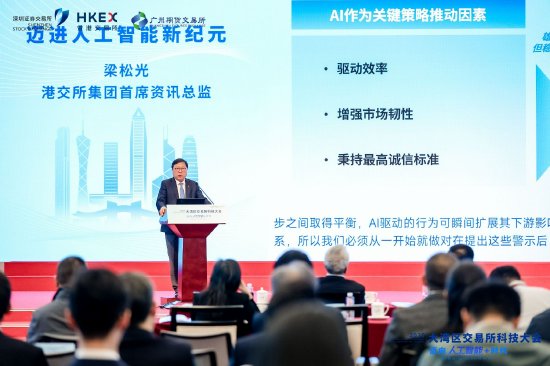
港交所首席资讯总监:建议交易所采用负责任AI的五项最佳实践 平衡创新与风险
Xin Lang Zheng Quan· 2025-11-28 12:50
Core Viewpoint - The Hong Kong Stock Exchange (HKEX) emphasizes the importance of balancing innovation and stability in the context of AI, advocating for responsible AI practices to mitigate governance, privacy, and security risks [1][3]. Group 1: Responsible AI Best Practices - The five best practices for responsible AI suggested by HKEX include: 1. Establishing a robust AI governance framework [3] 2. Promoting human oversight to maintain a "human-machine collaboration" model [3] 3. Ensuring data quality and diversity to reduce bias [3] 4. Enhancing AI literacy and risk awareness across the organization [3] 5. Deploying AI securely through local or trusted cloud infrastructure [3] Group 2: Opportunities in the Greater Bay Area - The Greater Bay Area is recognized as a leading global technology innovation cluster, providing unique advantages for the development of technology in exchanges [3] - HKEX looks forward to deepening collaboration with peers in Shenzhen and Guangzhou to fully leverage AI's potential in capital markets and broader economic contexts, while maintaining market integrity and stability [3]