货币新秩序

Search documents
黄金涨疯了!都在疯狂买黄金...
Sou Hu Cai Jing· 2025-10-02 13:47
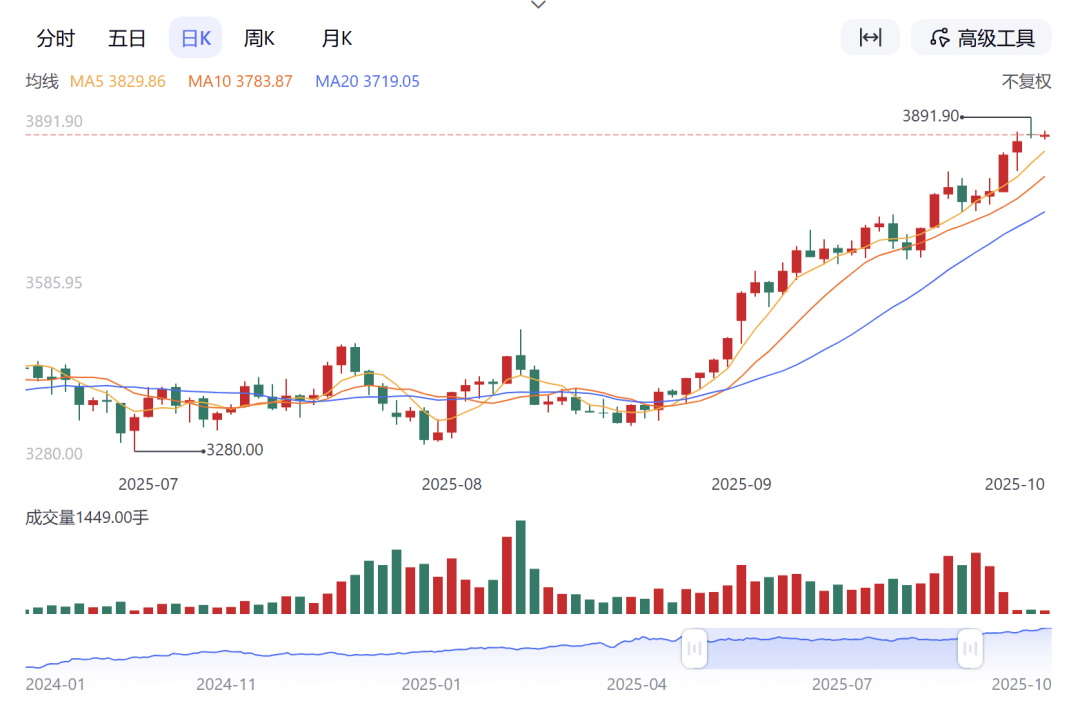
Market Overview - The Hang Seng Index in Hong Kong has seen a significant increase recently, indicating a positive trend in the stock market [1] - The gold market has experienced a dramatic surge, with prices rising from over 3300 to nearly 3900 in just one month, marking an 18% increase [3] Gold Investment Insights - The perception of gold is shifting from a traditional safe-haven asset to a more investment-oriented asset, as evidenced by the recent price movements [6][8] - Goldman Sachs has issued a report predicting that gold prices could reach 4300 USD per ounce, driven by increased buying from individual investors and central banks [9][10] Investor Behavior - There has been a notable influx of funds into gold ETFs, with 109 tons of gold purchased in September alone, surpassing Goldman Sachs' initial estimate of 17 tons [9] - The current economic climate is prompting individuals to reconsider their investment strategies, with a growing preference for gold over cash savings due to concerns about currency devaluation [12][14] Currency and Inflation Dynamics - The article highlights the impact of excessive money printing on currency value, suggesting that gold serves as a hedge against inflation and currency depreciation [16][18] - Historical data shows that while China's M2 money supply has increased significantly, gold prices have not kept pace, indicating a loss of confidence in fiat currencies [19] Future Outlook - The long-term outlook for gold is bullish, with expectations of continued price increases unless there is a significant reduction in money printing or an unexpected influx of gold supply [20][21]

东盟黄金存中国?3800美元金价背后,人民币正在悄悄换道超车
Sou Hu Cai Jing· 2025-09-30 23:14
Core Insights - The article discusses the ongoing transformation of the global financial order, highlighted by the significant rise in gold prices from $1,800 to over $3,800, signaling a shift away from the dollar-centric financial system [1][6]. Group 1: China's Role in Gold Custody - China is emerging as a custodian for foreign sovereign gold, with several Southeast Asian countries opting to store their gold in China, challenging the traditional dollar-centered financial system and establishing new trust relationships [2]. - This strategy of gold custody is seen as a response to the diminishing influence of the U.S. dollar and aims to create a new settlement system, reminiscent of the impact of Alipay on consumer payment habits [2]. Group 2: CIPS and the Shift from SWIFT - The rise of the Cross-Border Interbank Payment System (CIPS) is a strategic move to bypass U.S. dollar dominance, as evidenced by a decrease in the use of the SWIFT system for RMB transactions [3]. - Despite a drop in payment amounts, the RMB has become the third-largest financing and payment currency globally, indicating a shift towards more independent transaction systems [3]. Group 3: Dual Strategy for Financial Stability - China is implementing a dual strategy to promote the internationalization of the RMB, combining gold custody to build a credit system based on tangible assets and the CIPS system to facilitate RMB transactions [4]. - This approach is considered more robust than the Bretton Woods system, as it ensures control over gold reserves and a self-sufficient payment system [4]. Group 4: Future of the Global Currency System - The dominance of the U.S. dollar is expected to decline, leading to a more diversified international currency system where currencies like the RMB, Euro, Yen, and Indian Rupee will play significant roles [5]. - The evolving currency landscape is likened to the competitive smartphone market, where multiple brands coexist, providing consumers with more choices and fostering a healthier market [5]. Group 5: Implications for Ordinary Investors - Ordinary investors are advised to diversify their asset allocations beyond the dollar, considering RMB, gold, and other quality assets as viable options [8]. - The ongoing monetary transformation may present unexpected opportunities, similar to the wealth creation seen after the collapse of the Bretton Woods system in 1971 [8].
东盟黄金存中国?3800美元金价背后,人民币正在悄悄“换道超车”
Sou Hu Cai Jing· 2025-09-29 07:22
Core Insights - Gold, once considered an outdated asset, has surged from $1,800 during the Russia-Ukraine conflict to $3,800, indicating a significant shift in the global financial order [1] - China is emerging as a "custodian of foreign sovereign gold," with Southeast Asian countries storing their gold in China, which could reshape international settlement systems [1][3] Group 1: Historical Context - The Bretton Woods system established the dollar's dominance through a fixed gold exchange rate, but the U.S. later abandoned this, leading to the oil-dollar system [3] - The decline of U.S. influence in the Middle East is weakening the oil-dollar system, prompting alternative arrangements [3] Group 2: China's Strategy - China is withdrawing from the U.S.-dominated SWIFT system and promoting its own CIPS (Cross-Border Interbank Payment System), facilitating international transactions in yuan [5] - The IMF ranks the yuan as the third-largest financing and payment currency globally, indicating a shift away from U.S. control [5] Group 3: Future Implications - The dual strategy of gold custody and CIPS development positions China to create a new credit system based on tangible assets, enhancing its global financial influence [7] - The rise in gold prices reflects central banks' increasing purchases in preparation for a new monetary order, suggesting that gold will play a crucial role in future negotiations [7] Group 4: Investment Perspective - Investors should diversify their assets beyond the dollar, considering yuan, gold, and quality assets as viable options [9] - Historical shifts in monetary systems, such as the collapse of Bretton Woods, have led to significant wealth creation, indicating potential opportunities in the current transformation [9]
美联储降息 25 基点引恐慌,美元霸权松动,黄金暴涨能避险吗?
Sou Hu Cai Jing· 2025-09-20 04:47
Group 1 - The Federal Reserve's recent 25 basis point interest rate cut is perceived as insufficient by the market, leading to increased uncertainty rather than stability [1][3] - There is a growing trend among countries to move away from the US dollar in international transactions, indicating a potential decline in the dollar's dominance due to trust issues [3][7] - The US government's strategy of increasing military spending to maintain its global position is resulting in rising fiscal deficits and interest burdens, complicating the economic landscape [5][10] Group 2 - The recent interest rate cut has not provided the expected positive impact, causing capital to flow towards gold and other safe-haven assets instead of waiting for a recovery in the dollar [7][12] - The International Monetary Fund reports that the dollar's share in global reserves has fallen to its lowest level in nearly 30 years, with over a hundred countries exploring alternatives to the dollar for trade [7][10] - The evolving global financial landscape suggests that the dollar is no longer the sole dominant currency, with new players emerging and reshaping the monetary order [12]