货币锚

Search documents
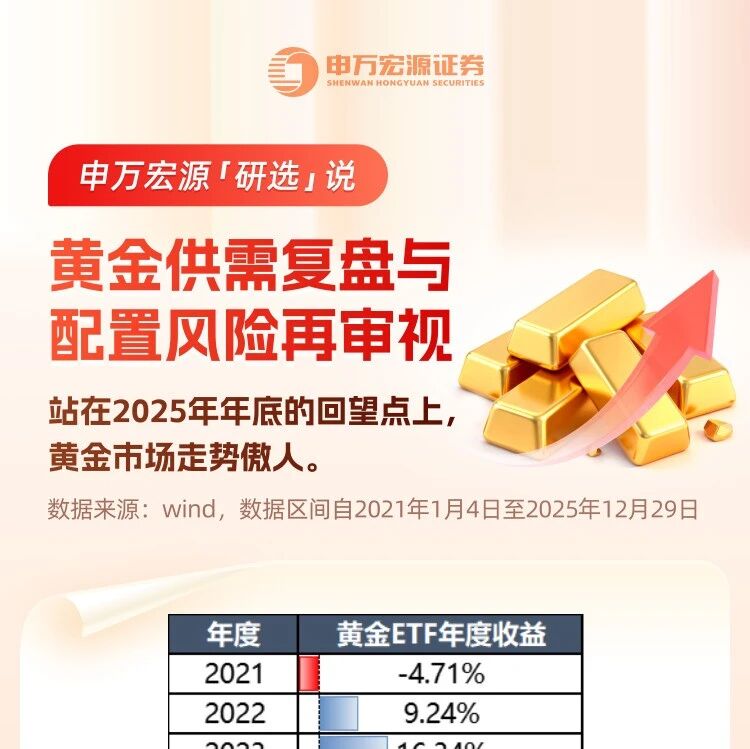
申万宏源“研选”说——黄金供需复盘与配置风险再审视
申万宏源证券上海北京西路营业部· 2026-01-13 03:33
Core Viewpoint - The article discusses the impressive performance of the gold market from the perspective of the end of 2025, highlighting the evolving role of gold as both a strategic asset for central banks and a key focus for investors [1]. Supply and Demand Analysis - Gold supply has remained stable, averaging between 1,200 tons and 1,300 tons per quarter in recent years, with total supply in 2025 projected to be around 1,313.10 tons [3][4]. - Demand for gold has been driven by high levels of jewelry manufacturing, increasing investment in gold bars and coins, and significant purchases by central banks, which have reached levels not seen since 2010 [3][4]. Investment Performance - The annual returns of gold ETFs have shown a significant upward trend, with returns projected to reach 62.75% in 2025, following 27.45% in 2024 and 16.34% in 2023 [2][3]. - The volatility of gold ETFs has been relatively lower compared to the market index, with annualized volatility for gold ETFs at 18.61% in 2025, compared to 17.21% for the market index [11]. Price Dynamics - Long-term gold price movements are influenced by factors such as inflation hedging and monetary policy, particularly in a low-interest-rate environment, which challenges the credibility of the dollar [9]. - Short-term fluctuations in gold prices are affected by geopolitical risks and speculative trading, with significant events such as U.S. policy changes and regional conflicts impacting market sentiment [10]. Investment Considerations - For individual investors, the gold market in 2025 presents both opportunities and risks, with gold serving as a hedge against inflation over a long-term horizon, while short-term volatility necessitates careful monitoring of central bank activities and geopolitical risks [12].

中金缪延亮:美元霸权的“双锚”——从国家信用的“法理之锚”到全球市场的“功能之锚”
中金点睛· 2025-07-14 23:39
Core Viewpoint - The article discusses the evolution of the international monetary system, emphasizing the dual anchors of the US dollar: the "legal anchor" based on national credit and the "functional anchor" provided by its robust financial markets, which have allowed the dollar to maintain and even strengthen its global position despite various crises [1][2]. Group 1: Sovereign Currency Anchor - The evolution of currency forms has transitioned from commodity-based (gold and silver) to credit-based systems, with modern fiat currencies relying on national credit as their "legal anchor" [4][7]. - The modern fiat currency's essence is a special debt backed by national sovereignty, which requires public trust in its value and stability [8]. Group 2: International Currency Anchor - The international monetary system relies on a dual anchoring mechanism, where the "legal anchor" is supported by national credit, while the "functional anchor" is established through a strong financial market that provides stability and liquidity [9][10]. - The US dollar's global dominance is attributed to its extensive and efficient financial market, which supports a vast array of transactions and serves as a safe haven for global capital [10][14]. Group 3: Historical Validation of the Dollar's Functional Anchor - The dollar's international status was solidified through historical events, including the establishment of the Bretton Woods system and the subsequent oil dollar mechanism, which reinforced its role as a global reserve currency [19][24]. - The 2008 financial crisis highlighted the dollar's position as the "ultimate safe asset," as global capital flowed into US markets despite the crisis originating in the US [28][30]. Group 4: Implications for the Renminbi - The current shift in the international monetary system presents a strategic opportunity for the internationalization of the Renminbi, as the weakening of the dollar's dominance creates a window for alternative currencies [37][41]. - The article suggests that building a strong financial market and strategically planning for international currency status are crucial for the Renminbi's future [39][40].