贸易限制性措施

Search documents
多边贸易体系面临更大重塑压力
Sou Hu Cai Jing· 2025-11-21 23:27
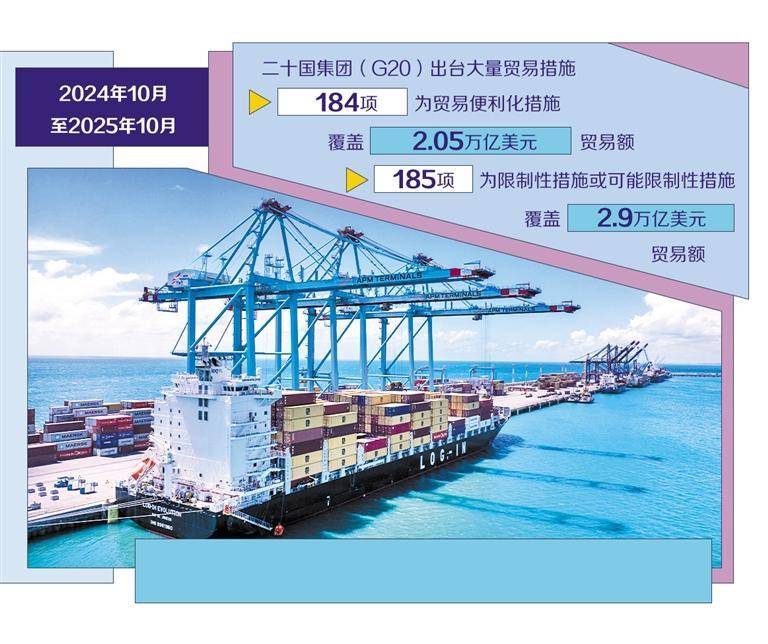
Core Insights - The World Trade Organization's report indicates a significant shift in G20 trade policies, with restrictive measures now covering more trade volume than facilitative measures for the first time since the monitoring mechanism was established in 2009, highlighting a rise in global protectionism [2][6] Group 1: Trade Facilitation Measures - The G20 implemented 184 trade facilitation measures, the second highest in the last decade, covering a trade volume of $2.05 trillion, nearly doubling from the previous period's $1.07 trillion [3] - Of these measures, 129 were related to import facilitation, accounting for 70% and covering $1.90 trillion, which is 10.5% of the G20's total imports [3] - These measures included lowering or eliminating import and export tariffs, simplifying customs procedures, and easing export quantity restrictions, which helped alleviate supply chain pressures and reduce production costs [3] Group 2: Trade Restrictive Measures - The report recorded 185 trade restrictive or potentially restrictive measures, the highest since monitoring began in 2009, covering a trade volume of $2.90 trillion, significantly up from $829 billion in the previous period [4] - Import-restricted trade volume reached $2.60 trillion, more than four times the previous period's $598 billion, with $2.35 trillion directly related to U.S. trade policies since early 2025 [4][5] - Types of restrictive measures included increased import tariffs, complex customs procedures, and setting limits on import and export quantities, with the U.S. being a key driver of these measures [5] Group 3: Long-term Structural Adjustments in Global Trade Policy - The increase in restrictive measures over facilitative ones reflects a systemic spillover effect rather than isolated actions by individual countries, indicating a gradual rise in protectionist policies [6] - The surge in restrictive trade policies and the spread of protectionism are contributing to greater uncertainty in global trade, with potential risks including supply chain reconfiguration and increased regionalism [6] - The growing number of restrictive measures is prompting countries to strengthen regional trade arrangements and bilateral agreements, which may further undermine the relative position of multilateralism in global trade [6]

中国钢铁工业协会:9月我国出口钢材1046.5万吨 环比增长10.0%
智通财经网· 2025-10-30 23:28
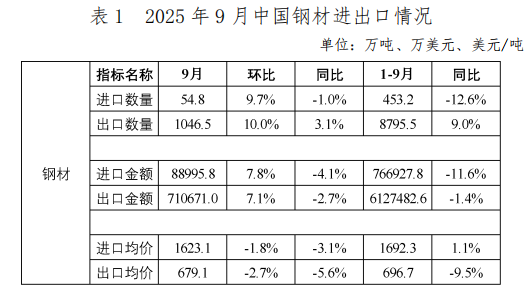
Overall Situation of Steel Products Import and Export - In September 2025, China exported 10.465 million tons of steel, a month-on-month increase of 10.0%, with an average export price of $679.1 per ton, down 2.7% from the previous month [2][3] - Cumulatively, from January to September, China exported 87.955 million tons of steel, a year-on-year increase of 9.0%, with an average export price of $696.7 per ton, down 9.5% year-on-year [2][3] - In September, China imported 548,000 tons of steel, a month-on-month increase of 9.7%, with an average import price of $1,623.1 per ton, down 1.8% from the previous month [2][3] - Cumulatively, from January to September, China imported 4.532 million tons of steel, a year-on-year decrease of 12.6%, with an average import price of $1,692.3 per ton, up 1.1% year-on-year [2][3] Export Situation of Steel Products - In September, the export volume of major steel varieties increased, with significant growth in hot-rolled sheets and coated sheets [5] - Exports to ASEAN, African Union, and Gulf Cooperation Council countries saw notable increases, while exports to the European Union decreased [5][10] - Among 22 major steel varieties, only three showed a month-on-month decline in export volume, while several key varieties saw increases of over 10% [7][8] Import Situation of Steel Products - In September, the import scale of steel continued to rise, with a stable overall import structure [12][17] - 15 out of 22 major steel varieties saw a month-on-month increase in import volume, with significant growth in cold-rolled wide steel strips [15] - The import volume from major countries, except Germany, generally increased month-on-month [17] Future Outlook - The export volume of steel and steel billets remains high, with September's monthly steel export volume exceeding 10 million tons [18] - Exports to Southeast Asia and the Middle East are increasing, but competition in these markets is intensifying [18] - Emerging economies are imposing trade restrictions on Chinese steel products, prompting recommendations for exporters to manage their export pace and protect their rights [18]