
资产全球化配置

Search documents
2026开年ETF资金流向图谱:宽基ETF合计流出3499亿元 行业主题与跨境ETF受追捧
Xin Lang Cai Jing· 2026-01-21 07:43
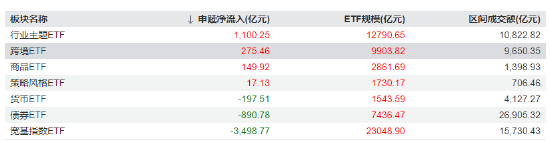
Core Viewpoint - The domestic ETF market has experienced significant capital outflows since the beginning of 2026, primarily driven by large withdrawals from broad-based indices and fixed-income products, while certain thematic and globally-oriented ETFs have attracted capital inflows [1][8]. Overall Market Trends - The total net outflow from the ETF market is approximately 304.6 billion yuan, with broad-based index ETFs accounting for a net outflow of 349.9 billion yuan, representing the majority of the total outflow [2][9]. - Bond ETFs have also seen a net outflow of 89.1 billion yuan, indicating a withdrawal of funds from fixed-income instruments amid market volatility [2][9]. Thematic and Global ETFs - Industry-themed ETFs have emerged as the most attractive category, with a net inflow of 110 billion yuan, particularly in sectors like materials, consumer goods, and pharmaceuticals, which are perceived as defensive and supported by policy [3][10]. - Cross-border ETFs recorded a net inflow of 27.5 billion yuan, reflecting strong demand for overseas assets amid the appreciation of the yuan and pressure on domestic assets [3][10]. - Commodity ETFs also gained 15 billion yuan in net inflows, especially in gold-related products, aligning with the rise in international gold prices and heightened global risk aversion [3][10]. Performance of Broad-based ETFs - Broad-based ETFs are under pressure, with the CSI 300 ETF leading the outflows at 162.5 billion yuan, indicating a phase of capital avoidance from core large-cap assets [5][12]. - The STAR 50 and SSE 50 ETFs also experienced significant outflows of over 30 billion yuan each, suggesting a withdrawal from technology leaders and large-cap blue chips [5][12]. - In contrast, the CSI 2000 index ETF saw a net inflow of 0.0956 billion yuan, indicating a shift towards more flexible small-cap styles during the adjustment period [5][12]. Sector-specific Insights - The semiconductor materials ETF has attracted a notable net inflow of 10.9 billion yuan, likely benefiting from global inflation expectations and specific industry policies [6][13]. - The consumer and pharmaceutical sectors also received slight increases in investment, with inflows of 2.123 billion yuan and 2.037 billion yuan, respectively, reflecting their defensive attributes [6][13].

洋派王爷爷的外币理财新体验:让资产“出海”更轻松!
Zhong Guo Zheng Quan Bao· 2025-12-31 01:17
Core Viewpoint - The article discusses the benefits of investing in USD-denominated financial products, highlighting their potential for higher returns and risk diversification for investors with overseas needs [2][3]. Group 1: Benefits of USD Financial Products - Benefit 1: Enhanced Yield Growth Potential USD financial products encompass a range of investments such as USD deposits, bonds, and cross-border structured tools, providing investors with opportunities for higher returns compared to single-currency investments [2]. - Benefit 2: Diversification of Market Risk Global allocation helps avoid concentration risk, as USD financial products are typically linked to overseas markets, offering options for risk diversification and hedging for investors holding USD assets [3]. Group 2: Accessibility and Risk Levels - Accessibility: Low Investment Threshold Most USD financial products have a minimum investment amount of just 1 USD, making them accessible for ordinary investors with needs related to overseas study or consumption [4]. - Risk Levels: Predominantly Low-Risk Products The current market features mainly fixed-income USD financial products, with risk ratings typically classified as R1 (low risk) or R2 (medium-low risk) [6][12]. Group 3: Product Features - Product Structure: Closed-End Operation The "Jinxin" series of closed-end USD financial products focuses on USD fixed-term deposits and aims to effectively diversify risks associated with single currency and asset types, enhancing portfolio resilience [11][12]. - Purchase and Redemption: USD Transactions Investors can purchase and redeem these products in USD, ensuring that both principal and returns remain in USD, which facilitates continued investment or use for other foreign currency needs [5]. Group 4: Risk Awareness - Currency Risk: Exchange Rate Fluctuations Investors should be aware of currency risks, as fluctuations in exchange rates can impact actual returns, particularly if the RMB appreciates against the USD [9].

️华尔街全员看涨2026年美股!跨境ETF成全球化投资布局好方案
Xin Lang Cai Jing· 2025-12-30 11:04
Group 1 - The core viewpoint is that there is a strong consensus among 21 top market forecasters that the US stock market will experience a bull market in 2026, with an average prediction of a 9% increase in the S&P 500 index, aiming for the longest consecutive rise in nearly two decades [2][8] - The stability of the US, which has not experienced war for over 200 years, is seen as a solid foundation for continued economic growth, with expectations that this security will persist for the next 20 years [2][8] - The current market uptrend, which began in 2022, is driven by a combination of policy, capital, and technology, leading to a significant expansion cycle [2][8] Group 2 - The Nasdaq ETF is highlighted as a key vehicle for capturing growth dividends from the technology revolution, particularly driven by AI, which is projected to contribute 0.9 percentage points to US GDP growth in 2025, with a contribution rate of 42% [3][9] - Major tech companies within the Nasdaq are expected to maintain a capital expenditure growth rate exceeding 28% annually, allowing investors to benefit from the ongoing technological advancements [3][9] - The "Artificial Intelligence 30 Index" identified by JPMorgan accounts for 44% of the market capitalization of the S&P 500, with many of these core assets concentrated in the Nasdaq, making the Nasdaq ETF an effective tool for global investment [3][9] Group 3 - The Dow Jones ETF is characterized as a stable choice for blue-chip investments, providing resilience across economic cycles, with its index comprising 30 leading companies across key sectors [4][10] - In a projected easing environment with the Federal Reserve expected to lower interest rates by 50 basis points, blue-chip companies are anticipated to offer robust earnings resilience and consistent dividends [4][10] - The Dow Jones ETF is positioned as a "ballast" in the investment landscape, particularly as traditional sectors like consumption and industry are expected to see valuation recovery [4][10] Group 4 - Investing in individual stocks is viewed as a more aggressive strategy, while allocating to ETFs is seen as a prudent approach for global diversification, significantly lowering the barriers and risks for ordinary investors [5][11] - The combination of Nasdaq and Dow Jones ETFs allows investors to capture high-growth potential while also providing stability against market fluctuations, aligning with the strategy of diversified risk management [5][11] - The emergence of ETFs is recognized as a key channel for accessing wealth opportunities in the global market, facilitating asset globalization [5][11]

2025湾区财富大会深圳举行 共探全球资产配置新机遇
2 1 Shi Ji Jing Ji Bao Dao· 2025-11-20 11:47
Core Viewpoint - The 2025 Bay Area Wealth Conference held in Shenzhen emphasizes the transformation of wealth management in the context of global economic changes, highlighting the Bay Area's unique advantages for cross-border wealth allocation [1][2]. Group 1: Conference Overview - The conference featured various segments including keynote speeches, roundtable forums, and thematic discussions, attracting nearly 30 senior guests from banking, securities, public funds, and insurance sectors [1]. - The event aimed to analyze trends in the wealth management industry and provide actionable insights for wealth appreciation and industry transformation for residents in the Bay Area [1]. Group 2: Keynote Insights - The Deputy Editor-in-Chief of Southern Finance Media Group, Deng Honghui, noted that global macroeconomic changes have made global asset allocation a necessity, positioning the Bay Area as a natural hub for cross-border wealth allocation [1][2]. - Yang Wenbiao, Chairman of Shenzhen Jinbohui Operation Development Co., emphasized the conference's role in connecting finance with the real economy and fostering international cooperation [3]. Group 3: Industry Trends and Strategies - Wu Xianhao, Vice President of CICC Wealth Securities, discussed high-quality development strategies in wealth management, focusing on client, asset, and advisory aspects [5]. - Huang Jiale, Managing Director of Ping An Asset Management (Hong Kong), highlighted trends in the Hong Kong stock market and recommended focusing on technology innovation, healthcare, consumer recovery, and high-yield stocks [7]. - Wang Ying, Head of Investment and Wealth Management at HSBC China, analyzed the growing interest in alternative investments among high-net-worth individuals, including private equity and hedge funds [8]. - Mao Li, Head of Market Investment and Strategy at East Asia, advocated for diversified asset allocation in response to market uncertainties, considering industry and regional layouts [10]. Group 4: Roundtable Discussions - A roundtable discussion featured industry leaders discussing global asset revaluation, low interest rates, and the "asset scarcity" phenomenon, emphasizing the need for new perspectives on multi-asset allocation [12]. - The conference also included discussions on the changing investment behaviors of high-net-worth clients, with insights on optimizing service models to meet evolving demands [12].