
赢家诅咒

Search documents
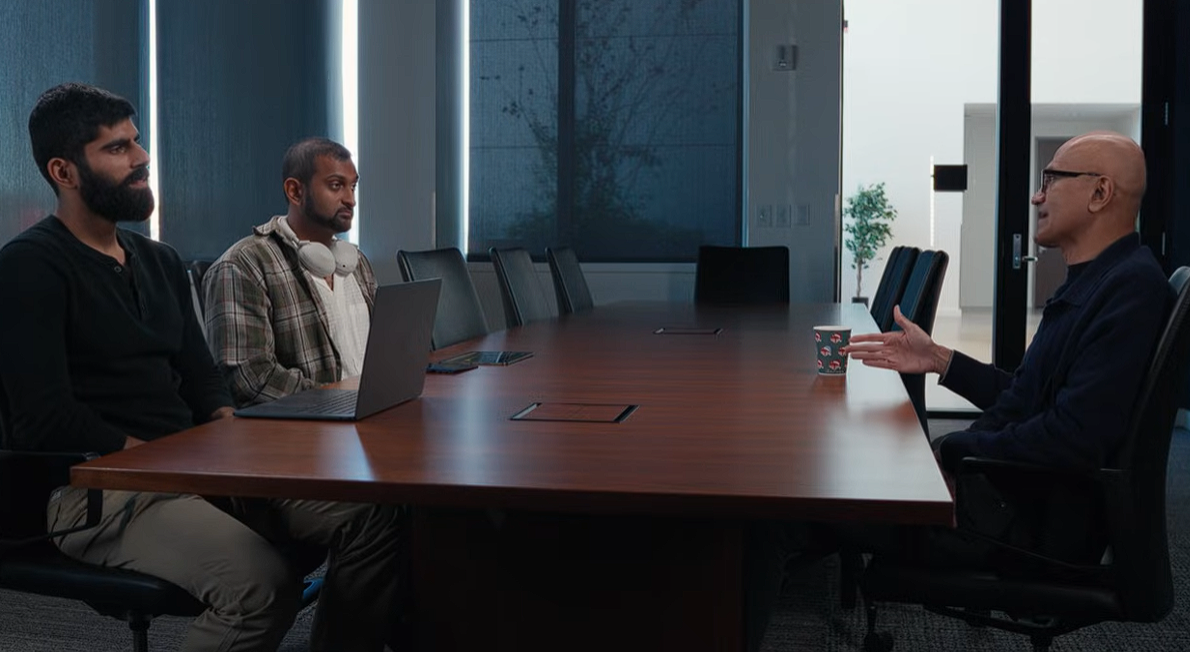
微软CEO深度访谈:Azure利润很大程度来自配套服务,模型开发商会陷入"赢家诅咒"、平台价值不会消失
Hua Er Jie Jian Wen· 2025-11-13 08:37
Core Insights - The interview with Microsoft CEO Satya Nadella discusses the company's AI strategy, self-developed chips, Azure/cloud business, and the commercialization of general artificial intelligence (AGI) [1][4][37]. Azure/Cloud Strategy - Nadella emphasizes that Azure/AI workloads require not only AI accelerators but also extensive supporting services, which significantly contribute to profit margins. The goal is to make Azure the ultimate platform for long-tail workloads, which is essential for large-scale cloud business [4][8]. - The company aims to maintain competitiveness from the foundational high-end training hardware level, ensuring that Azure supports a range of models, including self-developed ones [8][9]. Self-Developed Chip Strategy - Microsoft plans to reduce total cost of ownership (TCO) through a closed-loop optimization between its MAI models and custom chips, aiming for cost advantages in large-scale AI workloads [4][7]. - Nadella notes that any new accelerator will face competition from even previous generations of Nvidia products, highlighting the importance of overall TCO in decision-making [7]. Model Commercialization - Nadella warns that model developers may face the "winner's curse," where their innovations can be easily replicated and commoditized. Companies with strong data foundations and contextual engineering capabilities will have the advantage in retraining models [4][12]. - Microsoft has secured full IP rights for all system-level innovations from OpenAI, allowing it to leverage both its own MAI team and OpenAI's expertise [4][6]. Fairwater 2 Data Center - The new Fairwater 2 data center aims to increase training capacity tenfold every 18 to 24 months, significantly enhancing capabilities compared to GPT-5 [5][13]. - The data center's optical device count is nearly equivalent to the total of all Azure data centers two years ago, indicating a substantial investment in infrastructure [5][18]. Industry Profitability - Nadella believes that the future will see a shift towards tool-based businesses, where companies provide computational resources for AI agents that operate autonomously [12][176]. - The industry is expected to experience rapid growth, with significant capital expenditures projected for large-scale enterprises [37][38]. Agent HQ Strategy - Microsoft is developing the Agent HQ concept, which aims to integrate various AI agents into a cohesive system, allowing for task management and monitoring across different platforms [11][90]. - This strategy is seen as a way to innovate and maintain competitiveness in the rapidly evolving AI landscape [94][95]. Future Outlook - Nadella expresses optimism about the potential for AI to act as a cognitive amplifier and guardian, emphasizing the importance of understanding its utility for human productivity [39][40]. - The company is focused on building a world-class team to drive breakthroughs in AI, leveraging its existing capabilities and partnerships [226].


赛力斯为何突然暴跌?
3 6 Ke· 2025-11-07 02:14
Core Viewpoint - The initial public offering (IPO) of Seres Automotive faced significant challenges, including a sharp decline in stock price on its debut, reflecting a disconnect between market expectations and the company's valuation based on future risks [1][2][6]. Group 1: IPO Performance - Seres Automotive raised 14 billion HKD in its IPO, marking the largest IPO for a car company in Hong Kong this year [1]. - On its first trading day, the stock price dropped nearly 10%, leading to a market capitalization loss of over 20 billion HKD [1]. - Despite a significant oversubscription of 133 times from retail investors, institutional investors showed caution, purchasing only slightly more than half of the planned shares [1][5]. Group 2: Valuation Issues - The IPO pricing was based on a discount to the A-share market price, which was deemed inappropriate by institutional investors who focus on intrinsic value rather than relative pricing [3][4]. - The reliance on a potentially inflated A-share price as a benchmark led to a perception of the IPO price as excessively high [4][6]. - The valuation logic collapsed as the company transitioned from a "story-driven" to a "fundamentals-driven" assessment, revealing a disconnect between market expectations and actual performance [7][11]. Group 3: Financial Performance - For the first three quarters of 2025, Seres reported a mere 3.7% year-on-year revenue growth, signaling a potential peak in growth [12]. - The company's net profit declined by 1.7% in the third quarter, raising concerns about its profitability and operational efficiency [12]. - The projected price-to-earnings (P/E) ratio of 26.5 times at the IPO was significantly higher than the average of 13.6 times for traditional car companies in Hong Kong, leading to skepticism among investors [13][14]. Group 4: Strategic Dependence - Seres' heavy reliance on its partnership with Huawei has created strategic vulnerabilities, as the company has not developed its own core competencies [21][24]. - The shift in market perception from being a unique partner of Huawei to one among many competitors has diminished its valuation appeal [25][28]. - The uncertainty surrounding the future of the partnership with Huawei has led to increased risk premiums in the company's valuation [33]. Group 5: Market Dynamics - The activation of the "green shoe" mechanism by underwriters to stabilize the stock price indicated a lack of confidence in the stock's ability to maintain its initial price without intervention [34][36]. - The Hong Kong market's rationality and focus on performance metrics mean that any slowdown in growth or profitability will be harshly penalized [36][40]. - To regain market confidence, Seres must demonstrate a clear path to reducing its dependence on Huawei and improving its financial performance [38][40].
