超低延迟推理

Search documents
郭明錤:融入英伟达生态,LPU产量将暴增10倍,对PCB供应链有重大影响
Hua Er Jie Jian Wen· 2026-03-17 03:32
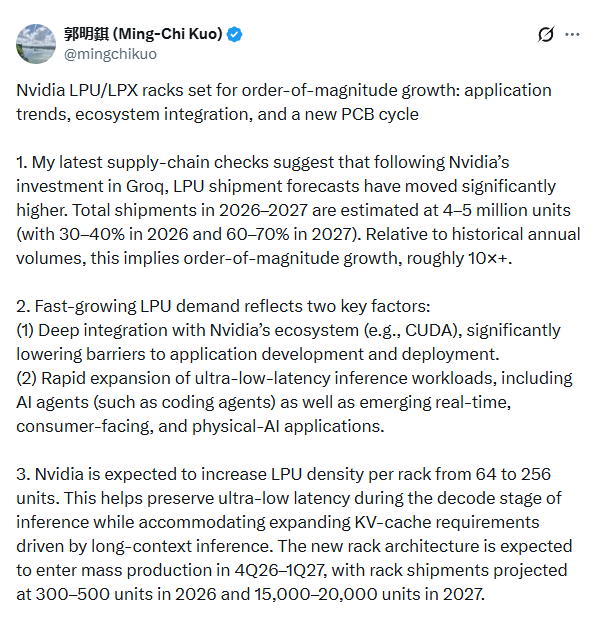
Core Insights - Nvidia has integrated Groq's LPU technology into the Rubin platform, marking a significant transformation in the supply chain [1] - The introduction of the Nvidia Groq 3 LPU chip is expected to drive substantial growth in LPU shipments, with projections of 4 to 5 million units from 2026 to 2027, representing over a tenfold increase compared to historical annual production [1][4] - The rapid growth in LPU demand is attributed to its deep integration with Nvidia's CUDA ecosystem, which lowers development barriers, and the expanding need for ultra-low latency inference scenarios [5] Product and Technology Integration - The Groq 3 LPU has been positioned as the seventh core component of the Rubin platform, following other key modules such as Rubin GPU and Vera CPU [2] - Unlike most AI accelerators that rely on HBM for working memory, each Groq 3 LPU features 500MB of SRAM, providing a bandwidth of 150TB/s, significantly higher than the 22TB/s of HBM [3] Supply Chain and Market Impact - The anticipated shipment of LPU units is expected to reach 30% to 40% in 2026 and 60% to 70% in 2027, with a ramp-up in rack architecture density from 64 to 256 units per rack [4] - The mass production of LPU/LPX racks is projected to begin between Q4 2026 and Q1 2027, with expected rack shipments increasing from 300 to 500 units in 2026 to 15,000 to 20,000 units in 2027 [4] Key Technology Nodes - Three critical technology integration nodes are identified: network architecture for seamless interconnectivity, developer interface for workload deployment without distinguishing between GPU and LPU, and compiler support for LPU's architecture [5] PCB Supply Chain Opportunities - The large-scale production of LPU/LPX racks is expected to significantly impact the PCB supply chain, with WUS Printed Circuit poised to benefit as it plays a crucial role in the deployment of M9-grade CCL materials [6] - The successful scaling of LPU/LPX racks could validate WUS's technological capabilities in high-end manufacturing, potentially catalyzing a new growth cycle in the PCB industry [6]


大芯片,再度崛起?
智通财经网· 2026-01-25 06:24
Core Insights - In early 2025, significant developments in the AI chip sector were reported, including Elon Musk's confirmation of Tesla's (TSLA.US) revival of the Dojo 3 supercomputer project, aiming to become the largest AI chip manufacturer globally, and Cerebras Systems' multi-year procurement agreement with OpenAI worth over $10 billion, promising 750 megawatts of computing power by 2028 [1][2]. Group 1: AI Chip Evolution - The evolution of AI chips is characterized by two distinct designs: Cerebras' wafer-scale integration and Tesla's Dojo, which represents a hybrid approach between single-chip and GPU clusters [3]. - The divergence stems from different solutions to the "memory wall" and "interconnect bottleneck" challenges, with traditional GPU architectures facing limitations in memory bandwidth compared to computational power [3][4]. Group 2: Cerebras' Innovations - Cerebras' WSE-3 chip features 40 trillion transistors, 900,000 AI cores, and 44GB of on-chip SRAM, achieving a bandwidth of 214 Pb/s, significantly outperforming NVIDIA's H100 [4]. - The design addresses yield issues associated with large wafers by minimizing the size of each AI core and employing redundancy to maintain performance despite defects [4]. Group 3: Tesla's Strategic Shift - Tesla's Dojo project faced setbacks but was revived with a new focus on "space AI computing," moving away from its original goal of competing with NVIDIA's GPU clusters [7][8]. - The AI5 chip, designed with a 3nm process, is expected to be produced by the end of 2026, aiming for performance comparable to NVIDIA's Hopper architecture [8]. Group 4: Market Dynamics and Competition - The AI chip market is becoming increasingly crowded, with competitors like AMD and NVIDIA rapidly advancing their offerings, which poses challenges for alternative architectures like wafer-scale systems [16][19]. - Cerebras aims to differentiate itself by focusing on low-latency inference systems, capitalizing on the growing demand for real-time AI applications [16][14]. Group 5: Strategic Partnerships - Cerebras' partnership with OpenAI, involving a $10 billion commitment for computing power, highlights the increasing importance of low-latency inference capabilities in the AI landscape [11][12]. - The collaboration reflects a broader trend of established tech companies integrating promising AI chip startups into their ecosystems, which may reshape the competitive landscape [20][21].

大芯片,再度崛起?
半导体行业观察· 2026-01-25 03:52
Core Insights - The article discusses significant developments in the AI chip sector, highlighting Tesla's revival of the Dojo 3 supercomputer project and Cerebras Systems' multi-billion dollar agreement with OpenAI for AI computing power [1][10]. Group 1: AI Chip Developments - Tesla's Dojo 3 project aims to position the company as a leading AI chip manufacturer, with a focus on "space artificial intelligence computing" rather than traditional training models [6][8]. - Cerebras Systems has secured a contract with OpenAI worth over $10 billion, promising to deliver 750 megawatts of computing power by 2028, emphasizing the growing demand for low-latency inference capabilities [10][11]. Group 2: Chip Architecture and Performance - The distinction between two types of large chips is made: Cerebras' wafer-scale integration and Tesla's wafer-scale system, each addressing the "memory wall" and "interconnect bottleneck" challenges differently [2][4]. - Cerebras' WSE-3 chip boasts 40 trillion transistors and 900,000 AI cores, achieving a memory bandwidth of 21 PB/s, significantly outperforming NVIDIA's H100 [3][11]. Group 3: Strategic Shifts - Tesla's shift in strategy reflects a recalibration of resources, moving away from competing directly with NVIDIA's GPU clusters to focusing on specialized applications in space computing [7][8]. - Cerebras' approach to positioning itself as a provider of dedicated inference machines allows it to capitalize on the emerging demand for low-latency processing, differentiating itself from traditional training platforms [15][19]. Group 4: Market Dynamics and Competition - The AI chip market is becoming increasingly crowded, with competitors like AMD and NVIDIA rapidly advancing their offerings, which poses challenges for alternative architectures like those from Cerebras and Tesla [15][19]. - The collaboration between OpenAI and Cerebras is seen as a strategic move to secure a foothold in the burgeoning inference market, which is expected to dominate AI computing needs in the future [10][19]. Group 5: Future Outlook - The advancements in packaging technology, such as TSMC's CoWoS, are expected to blur the lines between large and small chip architectures, potentially reshaping the competitive landscape [16][19]. - The article concludes that both Tesla and Cerebras are not merely trying to replicate NVIDIA's success but are instead seeking to find value in niches overlooked by general solutions, indicating a long-term battle for survival and innovation in the AI chip market [20].